The drop squat looks simple. Jump, land in a squat, rebound, jump again. And honestly, it is simple, but the details matter more than most people think. Every rep trains three things at once: reactive landing mechanics in your legs, core engagement to brace through the absorption, and cardiovascular output from the continuous rhythm.
The wide-stance landing is what separates the drop squat from every other bodyweight jump exercise. You start with feet together and land with feet shoulder-width or wider, which forces your hip abductors and adductors to stabilize the joint as your bodyweight crashes through. Done well, your quads and glutes brake the descent. Done poorly, your knees collapse inward and your joints take the load they were never designed to absorb at speed.
A 2015 review published in the International Journal of Sports Physical Therapy found that plyometric exercises improve neuromuscular control, joint position sense, and postural stability alongside the expected gains in power and explosiveness (Davies et al., 2015). Drop squats fit right in. Plus they double as effective cardio because the jump-land-rebound cycle keeps your heart rate elevated without any equipment at all.
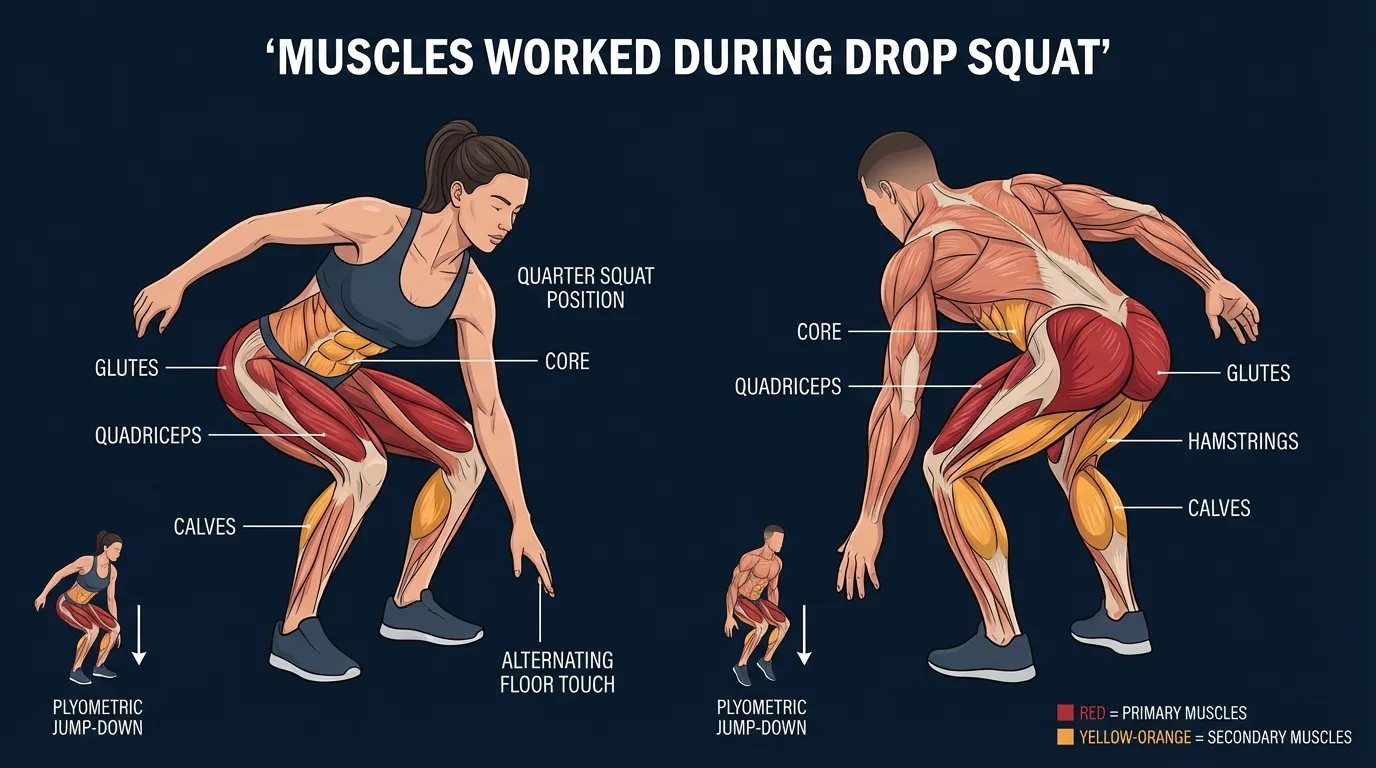
Muscles and Systems Worked
Primary movers. The quadriceps (rectus femoris, vastus lateralis, vastus medialis, vastus intermedius) are doing the heavy lifting eccentrically, absorbing your bodyweight as you drop into the squat. The gluteus maximus contributes to hip extension on the rebound and helps brake the descent. The gastrocnemius and soleus (calves) handle the initial soft landing on the balls of your feet before weight transfers through the foot.
Secondary movers. The hamstrings (biceps femoris, semitendinosus, semimembranosus) assist hip extension on the way up and contribute to knee stabilization at the bottom. Hip adductors stabilize the wide stance against the lateral spread of the landing. Hip abductors (gluteus medius and minimus) prevent the knees from collapsing inward, which is the single most important stabilizing job on this exercise.
Stabilizers. The core (rectus abdominis, transverse abdominis, obliques) braces the trunk through every landing to keep you upright. Ankle stabilizers (peroneals, tibialis anterior and posterior) control foot strike and prevent rollover. The spinal erectors keep your chest up and lower back neutral. The cardiovascular system and the phosphocreatine and glycolytic energy pathways are also "working" hard during continuous sets.
Evidence. A 2015 review in the International Journal of Sports Physical Therapy by Davies et al. (2015) synthesized research on plyometric training and found that beyond the well-known gains in power output and explosiveness, plyometric exercises produce measurable improvements in neuromuscular control, joint position sense, and postural stability. In practical terms, the reactive landing demand on a drop squat trains your nervous system to coordinate the muscles around your knees and ankles faster, which is why plyometrics are used both for sports performance and for ACL injury-prevention programs.
Quick Facts: Drop Squats
- Equipment needed: None (bodyweight only)
- Difficulty: Advanced to Expert
- Modality: Compound, bilateral, reactive plyometric
- Body region: Lower body (quads, glutes, calves) with full-body cardio demand
- FitCraft quest category: Cardio and conditioning
How to Do Drop Squats (Step-by-Step)
- Stand tall with feet together. Start with your feet together or very close together. Arms at your sides or hands clasped in front of your chest. Engage your core and keep your weight centered over the balls of your feet. Coach Ty's cue: "Tall and tight. Belly braced before you ever leave the ground."
- Jump and spread your feet. Make a small, quick jump and spread your feet out to shoulder-width or slightly wider. Your toes should angle out about 15 to 30 degrees as you land. You're not jumping for height. You're jumping for width. Coach Ty's cue: "Jump out, not up. Snap your feet apart."
- Drop into the squat. As your feet land wide, immediately sink your hips back and down into a squat. Land softly on the balls of your feet, then settle your weight through your heels and midfoot. Lower until your thighs are at or just below parallel. Chest up, knees tracking over your toes. Coach Ty's cue: "Brake with your muscles, not your joints."
- Absorb and stabilize. Hold the bottom of the squat for a brief moment. Knees bent, core braced, weight evenly distributed. This is the deceleration phase. Your quads and glutes are absorbing the downward force instead of letting it slam into your joints. Coach Ty's cue: "Quiet feet. If someone in the next room can hear you, lighten up."
- Return to start. Push through your feet to stand and jump your feet back together to the starting position. That's one rep. For continuous reps, jump right back out into the next drop squat without pausing at the top. Coach Ty's cue: "Knees track toes the whole way. If they cave, stop the set."
Get this exercise in a personalized workout
FitCraft, our mobile fitness app, uses its AI coach Ty to program conditioning work like this into your plan at the right volume and intensity, based on your level, goals, and equipment. Ty was designed and trained by Domenic Angelino, MPH (Brown University) and NSCA-CSCS, with research published in the Journal of Strength and Conditioning Research and Medicine & Science in Sports & Exercise.
Take the Free Assessment Free · 2 minutes · No credit card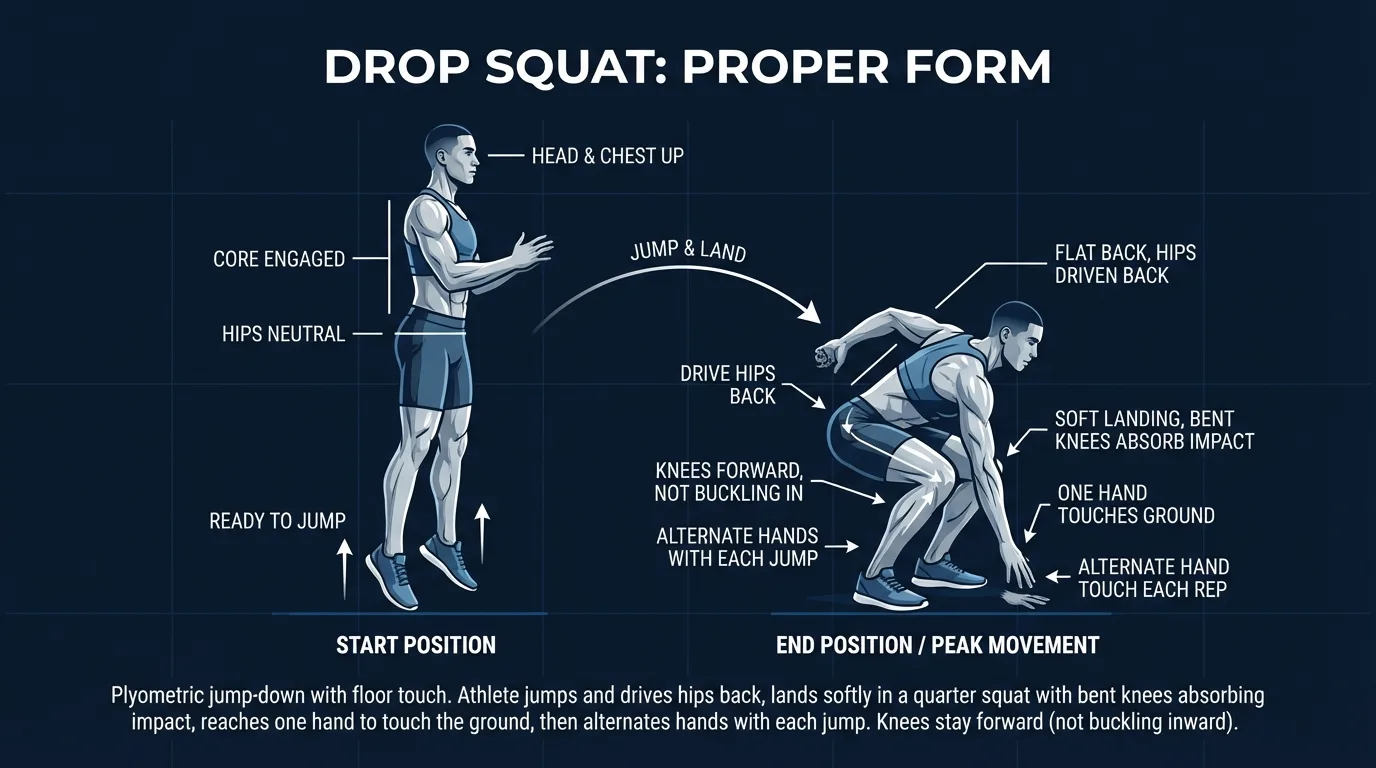
Common Mistakes to Avoid
Drop squats require fast, reactive movement under bodyweight load. These are the mistakes that either reduce effectiveness or get you hurt:
- Knees caving inward on landing. The most dangerous one. When your knees collapse inward as you land, the stress transfers to your ACL and meniscus instead of your muscles. This usually signals weak hip abductors. Fix the root cause with fire hydrants and side lunges before coming back to drop squats.
- Landing with straight legs. If you don't bend your knees as you land, the impact goes straight into your knee and ankle joints. You should be bending into the squat as your feet hit the ground. Not landing first and then squatting. There is a difference.
- Jumping too high. The jump is lateral, not vertical. Jumping high off the ground means a harder landing with more impact force and zero added training benefit. Keep the jump short and quick. Just enough to get your feet wide.
- Dropping the chest. Forward lean on the landing shifts stress to the lower back and reduces the quad and glute engagement that makes this exercise effective. If you can't land with an upright torso, slow down and work on hip mobility with bodyweight squats first.
- Going too fast too soon. The drop squat has a timing and coordination component that takes practice. Rushing into high-speed reps before the landing pattern is grooved degrades your form and loads your joints. Start with slow, deliberate reps and build speed gradually.
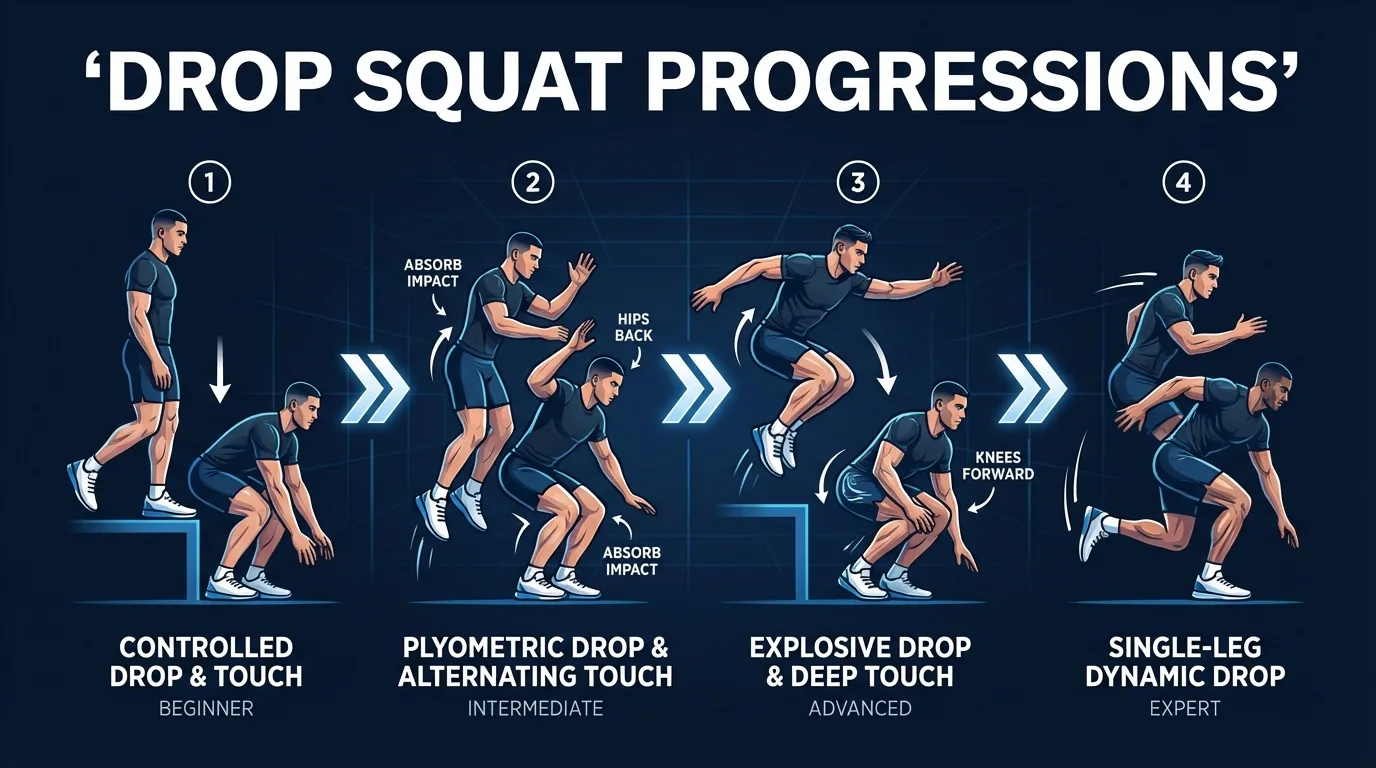
Variations and Progressions
Step-Out Squat (Beginner Regression)
Instead of jumping, step one foot out to the side, then the other, and lower into the squat. This removes the impact entirely while building the same wide-stance movement pattern. A good entry point if the reactive landing is too challenging or if you have joint concerns.
Drop Squat with Pause (Advanced)
Perform the standard drop squat but hold the bottom position for 2 to 3 seconds before returning to start. The pause forces your muscles to stabilize under load for longer, building isometric strength at the bottom of the squat. Way harder on the quads than it sounds.
Drop Squat to Jump (Expert)
Combine the drop squat with a vertical jump. Drop into the squat, then explode upward and land back with feet together. Now you're training both deceleration and acceleration in the same rep. Very demanding on the cardiovascular system.
Alternative Exercises
- Jump squats: Emphasize vertical power instead of deceleration. Same lower-body muscles, different training stimulus.
- Sumo squats: Wide-stance squat without the jump. Targets the same muscles with more inner thigh emphasis and zero impact.
- Squat walks: Lateral movement in a squat position. Builds hip abductor strength and endurance that directly supports drop squat performance.
When to Avoid or Modify Drop Squats
Drop squats are safe for most healthy adults who already own a clean bodyweight squat, but a few conditions warrant modification or substitution. Always consult a qualified healthcare provider or physical therapist before starting or returning to plyometric exercise, especially if any of the following apply.
- Known cardiovascular disease or uncontrolled hypertension. Drop squats spike heart rate and blood pressure rapidly. Get your cardiologist's approval and stay within their prescribed heart-rate zones. Substitute with low-impact alternatives like squat walks while you build a base.
- Acute lower-extremity injury (knee, ankle, hip, shin splints, plantar fasciitis). Plyometric loading aggravates all of these. Substitute with the step-out squat regression or skip the movement entirely until the injury resolves and your provider clears reactive loading.
- Pregnancy (any trimester) and the first 6 to 12 weeks postpartum. Increased joint laxity raises injury risk, and pelvic-floor recovery is a prerequisite for jumping movements. Substitute with low-impact sumo squats or bodyweight squats; get clearance from a pelvic-floor PT before returning to plyometrics.
- Stress incontinence or pelvic-floor weakness. Jumping movements often trigger leakage. Substitute with the step-out squat or strengthen the pelvic floor first.
- Vertigo, balance disorders, or vestibular conditions. The fast direction changes and rebound out of the squat risk falls.
- Insufficient prerequisite strength. If you cannot perform 20 controlled bodyweight squats with clean knee tracking and an upright chest, you are not ready for the reactive version. Build the base first.
- Recent ankle sprain or chronic ankle instability. The lateral landing component loads the ankle in a way that retests instability. Work through balance and proprioception drills first.
Related Exercises
- Lower-impact alternative within the same pattern: Squat walks train the same wide-stance position and hip abductor demand without the jumping component.
- Vertical power counterpart: Jump squats train concentric power and acceleration, the natural pairing to drop squats' deceleration focus.
- Unilateral plyometric progression: Jump lunges add single-leg landing demand once bilateral drop squats are easy.
- Hip abductor foundation: Fire hydrants and side lunges strengthen the muscles that keep your knees from caving on the landing.
- Strength foundation: Bodyweight squats and sumo squats build the prerequisite leg strength and squat pattern.
- Cardio circuit partners: Mountain climbers and high knees pair well with drop squats for full-body HIIT conditioning.
How to Program Drop Squats
Programming guidelines for resistance and conditioning work come from the ACSM Position Stand on progression in resistance training (Ratamess et al., 2009). Drop squats are a reactive plyometric, so the work-and-rest structure matters more than fixed sets and reps. Use these ranges based on your training goal and experience level:
| Level | Sets × Reps (or Work) | Rest between sets | Frequency |
|---|---|---|---|
| Beginner | Use step-out squat regression: 2 sets × 8 to 10 reps | 60 to 90 seconds | 2 sessions/week |
| Intermediate | 3 sets × 12 to 15 reps, or 30 sec work / 45 to 60 sec rest | 45 to 60 seconds | 2 to 3 sessions/week |
| Advanced | 3 to 4 sets × 15 to 20 reps, or 45 sec work / 30 sec rest | 30 to 45 seconds | 3 sessions/week |
Where in your workout. For power and deceleration training, do drop squats early in the session when your nervous system is fresh. As a metabolic finisher, use them in the last 5 to 10 minutes of a strength workout. As a standalone HIIT element, pair with mountain climbers, high knees, or jump lunges in a circuit. Never do plyometrics before heavy strength work; the depletion compromises the strength session.
Form floor over rep targets. The set ends when your landing mechanics break down, regardless of how many reps you planned. Knees caving, chest dropping forward, or loud foot strikes mean stop. Adding more sloppy reps trains the wrong pattern and loads your joints. Better to do 12 clean reps than 20 with collapsing knees.
FitCraft's AI coach Ty programs drop squats into your plan when your assessment shows you're ready for reactive lower-body work. Ty adjusts the variation and volume to match your level, demonstrates the full movement in 3D, and cues your landing mechanics so the reactive pattern grooves in cleanly instead of breaking down under fatigue.
Frequently Asked Questions
Can I do drop squats with knee pain?
Probably not until the pain resolves. Drop squats impose plyometric joint loading on the knees with every rep, which is exactly what an irritated knee does not need. Substitute with the step-out squat regression (no jump, no impact) and build back to plyometrics only once you can perform 20 controlled bodyweight squats without pain and your healthcare provider clears reactive loading. Always consult a qualified healthcare provider or physical therapist before resuming jumping exercises after a knee injury.
What muscles do drop squats work?
Drop squats primarily target the quadriceps, gluteus maximus, and calves. Assisting muscles include the hamstrings, hip adductors, hip abductors, erector spinae, and core stabilizers. The cardiovascular and energy systems also work hard, since the continuous jump-land-rebound cycle keeps heart rate elevated and recruits fast-twitch fibers.
What is the difference between a drop squat and a jump squat?
The key difference is direction and intent. A jump squat has you exploding upward from a squat into a vertical jump, training concentric power (the way out of the hole). A drop squat has you jumping outward from a narrow stance and dropping down into a squat, training eccentric deceleration (the way into the hole). Both are plyometric, but they train different qualities. Most well-rounded programs include both.
Are drop squats good for cardio?
Yes. Drop squats elevate heart rate quickly because they combine a jump with a full squat in rapid succession. Performed at a moderate to fast tempo for 30 to 60 seconds, they function as an effective bodyweight cardio exercise. Plyometric movements like drop squats create significant metabolic demand and increase excess post-exercise oxygen consumption.
How many drop squats should I do?
For power and deceleration training, 3 to 4 sets of 8 to 12 reps with full rest between sets. For cardio and conditioning, 3 sets of 15 to 20 reps or timed intervals of 30 to 45 seconds. Stop the set when your landing mechanics start getting sloppy, regardless of rep count.
Can beginners do drop squats?
Drop squats are an advanced-to-expert exercise because they require reactive landing mechanics and hip mobility under speed. Beginners should master regular bodyweight squats and squat-to-stand movements first. A good progression is stepping out into the squat position instead of jumping, which removes the impact while building the motor pattern.