Recomposition gets sold two ways, and both are wrong. One camp says it is impossible past the beginner stage, so pick bulking or cutting and stop kidding yourself. The other camp treats it as a free lunch that anybody can run forever, as long as they buy the right plan.
The literature sits between them. Recomposition happens, it is well documented, and how much of it you get depends almost entirely on two things: how much body fat you are carrying and how long you have been lifting. This calculator scores those two first, then sets the calorie, protein and training numbers to match.
How this calculator works
Every number the tool returns traces back to a primary source. Nothing is padded, and nothing is invented.
- Does recomposition fit you: scored from your body fat range and your training history. The framing comes from Barakat et al. 2020 in the Strength and Conditioning Journal, which notes that recomposition is often assumed to happen only in untrained and overweight populations but is in fact documented in resistance-trained individuals too, given progressive training and adequate nutrition. The tool returns one of four verdicts: strong fit, good fit, workable but slow, or pick a phase instead.
- Maintenance calories: the Mifflin-St Jeor equation (Mifflin et al. 1990) for resting metabolic rate, multiplied by a standard activity factor from 1.2 to 1.9.
- Recomp calorie target: maintenance minus a deficit of 4 to 16 percent, and never more than 450 calories a day. That ceiling comes from Murphy and Koehler 2022 in Scandinavian Journal of Medicine and Science in Sports, a meta-analysis and meta-regression that found lean mass gains during resistance training were impaired under an energy deficit, and stopped altogether at a deficit of roughly 500 calories per day. Where the verdict is "pick a phase instead", the target is plain maintenance.
- Protein: the 1.6 to 2.2 g per kg band from Morton et al. 2018, a meta-analysis of 49 randomized controlled trials and 1,863 participants in the British Journal of Sports Medicine, scaled by training status and bumped 0.2 g per kg whenever a deficit is applied, following Longland et al. 2016. Enter a body fat percentage and it switches to a fat-free-mass basis of 2.0 to 3.1 g per kg of lean mass, the range Helms et al. 2014 recommends for lifters holding muscle in a deficit.
- Training frequency: 3 to 5 sessions a week depending on training age, arranged so every muscle group gets trained at least twice, per Schoenfeld, Ogborn and Krieger 2016 in Sports Medicine.
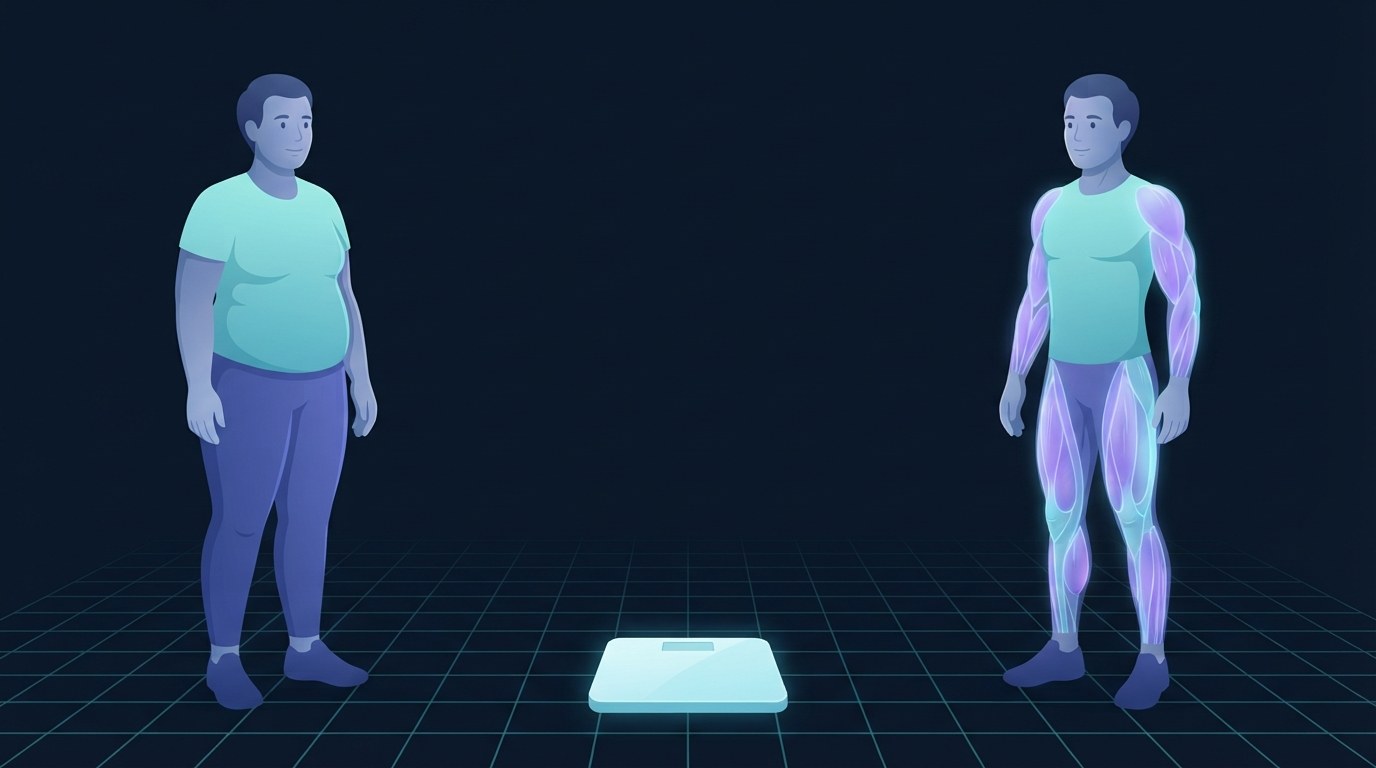
- Timeline: set by the verdict, and deliberately unflattering. Recomposition is the slowest visible route to a changed body, because the two changes cancel each other on the scale.
Who body recomposition actually works for
The variable that matters most is how much muscle you have left to gain easily. A person who has never trained has a large gap between where they are and where their body can get. A person who has trained hard for five years has almost none, which is why their progress is measured in grams a month rather than pounds.
The second variable is stored energy. Building muscle costs calories. When you are in a deficit, that energy has to come from somewhere, and body fat is the obvious source. Someone at 30 percent body fat has a large internal supply. Someone at 10 percent does not, which is why the leanest lifters get the least out of trying to do both at once.
Those two variables produce the four verdicts the calculator returns.
- Strong fit. New to lifting, returning after a break, or carrying roughly 20 percent body fat or more as a man, 28 percent or more as a woman. This is the case the literature documents most consistently, and the one where the calculator sets the largest deficit, because fat loss is a legitimate priority alongside the muscle.
- Good fit. Moderate body fat with one to three years of training, or lower body fat with under a year. Recomposition still works. It just needs a smaller deficit and more patience.
- Workable but slow. Trained for three or more years at moderate body fat, or very lean with little training history. The deficit shrinks to a few percent, which is close enough to maintenance that the main job becomes progressive overload rather than food.
- Pick a phase instead. Lean and well trained. At this point muscle gain wants a surplus and fat loss wants a deficit, and running both at once makes each of them crawl. The calculator returns your maintenance calories and says plainly that a lean-gain block followed by a short cut is the faster route. Our guide on bulking versus cutting works through how to sequence those.
The calorie target: a small deficit beats a big one
This is where most recomposition attempts fail, and they fail in the same direction. People treat recomposition as a cut with extra protein, drop 700 or 800 calories below maintenance, and then wonder why they lost weight but look the same.
Murphy and Koehler's 2022 meta-analysis and meta-regression put a number on it. Pooling resistance training trials run with and without an energy deficit, they found lean mass gains were meaningfully impaired in the deficit condition, while strength gains held up. The meta-regression pointed at a deficit of roughly 500 calories per day as the point where lean mass gains stopped entirely. That is the ceiling this calculator enforces, and it is why the largest deficit it will ever return is 450 calories.
Rate of weight loss tells the same story from another angle. Garthe et al. 2011 randomized elite athletes to lose weight at either 0.7 percent or 1.4 percent of body weight per week, with four resistance sessions a week in both arms. The slow group increased lean body mass over the period. The fast group did not. Same training, same athletes, different rate, opposite outcomes for muscle.
There is one well-known exception, and it is worth knowing because it gets quoted out of context. Longland et al. 2016 ran a six-week trial in which participants ate at roughly a 40 percent deficit while training six days a week. The arm eating 2.4 g of protein per kg still gained about 1.2 kg of lean mass while losing 4.8 kg of fat. The arm eating 1.2 g per kg only lost weight. That trial is a demonstration that very high protein plus very hard training can rescue an aggressive deficit for a short period in young men. It is not a template for a twelve-week plan, and this calculator does not treat it as one.
Worked examples
Eight scenarios with the calculator's output, so you can sanity-check the tool against your own numbers before trusting it. All four verdicts are represented.
| Person | Recomp fit | Calories / day | Protein | Lift days | Visible change |
|---|---|---|---|---|---|
| Man, 34, 5 ft 10 in, 190 lb178 cm, 86 kg, 24% body fat, under 1 year | Strong fit | 2,420 (380 below 2,800) | 157 g (1.8 g/kg) | 3 to 4 | 8 to 12 weeks |
| Woman, 29, 5 ft 5 in, 155 lb165 cm, 70 kg, 32% body fat, new to lifting | Strong fit | 1,650 (310 below 1,960) | 110 g (1.6 g/kg) | 3 | 8 to 12 weeks |
| Man, 41, 6 ft 0 in, 185 lb183 cm, 84 kg, 18% body fat, 1 to 3 years | Good fit | 2,540 (220 below 2,760) | 193 g (2.3 g/kg) | 4 | 12 to 16 weeks |
| Woman, 35, 5 ft 6 in, 140 lb168 cm, 64 kg, 25% body fat, 1 to 3 years | Good fit | 1,920 (170 below 2,090) | 133 g (2.1 g/kg) | 4 | 12 to 16 weeks |
| Man, 38, 5 ft 11 in, 170 lb180 cm, 77 kg, 16% body fat, 3+ years | Workable but slow | 2,560 (100 below 2,660) | 194 g (2.5 g/kg) | 4 to 5 | 16 to 24 weeks |
| Man, 27, 5 ft 9 in, 165 lb175 cm, 75 kg, 12% body fat, 3+ years, very active | Pick a phase instead | 2,960 (at maintenance) | 191 g (2.6 g/kg) | 4 to 5 | 24+ weeks |
| Woman, 46, 5 ft 4 in, 150 lb163 cm, 68 kg, 30% body fat, 3+ years | Strong fit | 1,820 (200 below 2,020) | 133 g (2.0 g/kg) | 4 to 5 | 8 to 12 weeks |
| Man, 68, 5 ft 8 in, 175 lb173 cm, 79 kg, 26% body fat, new to lifting | Strong fit | 1,790 (330 below 2,120) | 135 g (1.7 g/kg) | 3 | 8 to 12 weeks |
The numbers are the easy half. Four months of showing up is the hard half.
FitCraft, our mobile fitness app, pairs you with an AI coach who builds a personalized training plan around your goals, your schedule and how much time you actually have. Every FitCraft program is designed by Domenic Angelino, MPH (Brown University) and NSCA-CSCS.
Take the Free Assessment Free • 2 minutes • No credit cardProtein is the part people get wrong
Recomposition asks the body to do something slightly unreasonable: build new tissue while running short on energy. Protein is what makes that arithmetic survivable, which is why every recomposition study that worked used a high intake and every one that did not, did not.
The base range comes from Morton et al. 2018. Pooling 49 randomized controlled trials and 1,863 participants, the authors found gains in muscle mass and strength plateaued around 1.62 g per kg of body weight per day, with a confidence interval running to 2.2 g per kg. That plateau is the floor this calculator starts from, not the target. When a deficit is applied it adds 0.2 g per kg on top, following the Longland trial.
If you enter a body fat percentage, the basis changes. Instead of scaling protein against total body weight, which over-prescribes for people carrying more fat and under-prescribes for lean lifters, it scales against fat-free mass using the 2.0 to 3.1 g per kg band from Helms et al. 2014. That is why the protein number moves when you type in a body fat figure even though nothing else about you changed. If you want a number to enter there rather than a guess, the body fat calculator runs the Navy circumference method from a tape measure. For the full protein logic on its own, including the per-meal split, the protein calculator goes deeper.
How much to train, and how
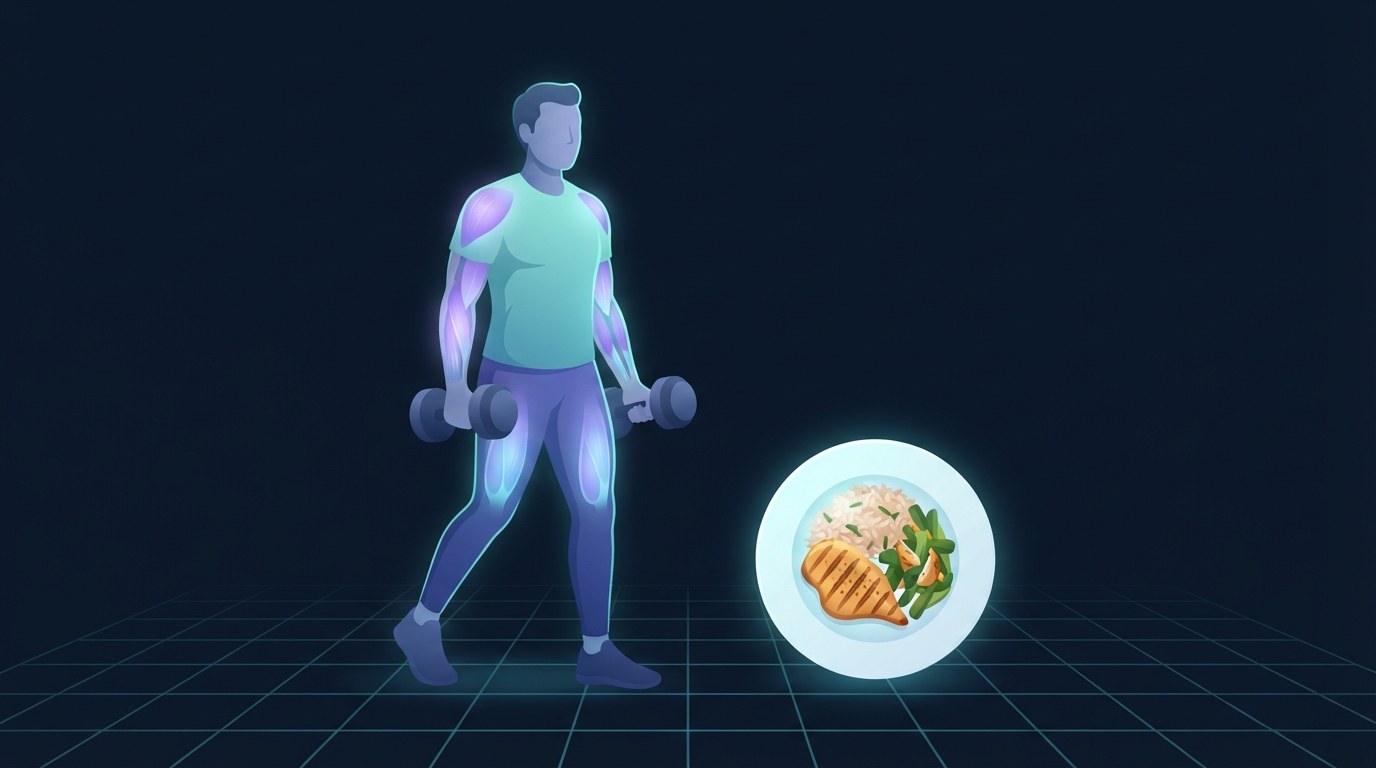
Protein and calories set the conditions. Training is the actual signal. Without progressive resistance training, a small deficit and a high protein intake produce weight loss with slightly better muscle retention, which is a worthwhile thing but is not recomposition.
Schoenfeld, Ogborn and Krieger's 2016 meta-analysis in Sports Medicine compared training frequencies at matched weekly volume and found that hitting each muscle group at least twice a week produced greater hypertrophy than once a week. That is the constraint behind the frequency this calculator returns: 3 full-body days for a beginner, 4 to 5 for an experienced lifter running an upper-lower or push-pull-legs structure, and in every case each muscle group trained at least twice.
Progression matters more than the split. During a deficit, adding reps or weight on your main lifts is the clearest evidence that the muscle side of the equation is still working. If the bar stops moving for three weeks straight while the tape keeps shrinking, the deficit is too large and the calculator's number should be nudged up rather than down. Our guide on how to lose fat without losing muscle covers what to do when the lifts stall first.
What the timeline actually looks like
Here is the part most calculators leave out, because it does not sell. Recomposition is the slowest visible route to a changed body, and the reason is arithmetic rather than effort.
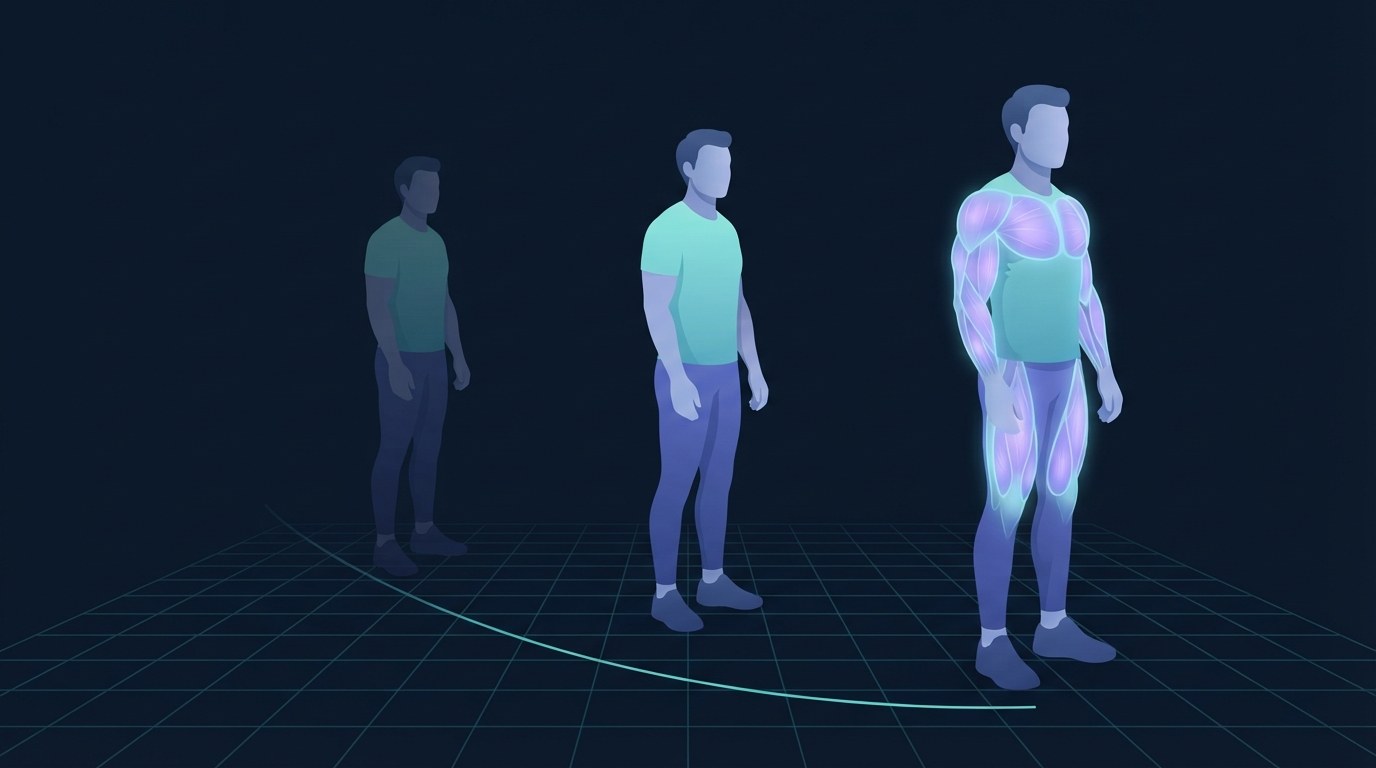
In twelve weeks, a well-run recomposition for someone in the strong-fit band might mean four to six pounds of fat gone and two to three pounds of muscle added. The scale shows a two-pound change. Anyone looking for a transformation photo at week four will conclude nothing is happening, quit, and tell their friends recomposition is a myth.
So do not track it on the scale. Track a waist measurement taken the same way each time, a monthly photo in the same light and the same clothing, and the weight on two or three main lifts. If the tape is going down while the bar is going up, the process is working, no matter what the scale reads. The calculator's visible-change estimate, 8 to 12 weeks in the best case and 16 to 24 in the hardest, is the point at which someone who has not seen you in a while would comment. It is not the point at which change starts.
Four months of consistent lifting is a harder problem than picking a calorie number, and it is the problem most people actually lose to. If you are choosing an app to carry the training side of a long recomposition, we compared the realistic options in our roundup of the best workout apps for weight loss.
Three things people get wrong about recomposition
Myth 1: the scale should be going down
It should be going nowhere in particular. That is the definition of the thing. A recomposition that moves the scale five pounds in either direction over twelve weeks is either a cut or a bulk wearing a different name. Judging a recomposition by body weight is like judging a renovation by the square footage.
Myth 2: recomposition only works for beginners
This is the claim the Barakat 2020 review exists to correct. The abstract puts it directly: although many suggest recomposition only occurs in untrained, novice and overweight or obese populations, there is a substantial body of literature demonstrating it in resistance-trained individuals. Training age slows recomposition down. It does not switch it off. What it does change is the honest expectation: a five-year lifter at 12 percent body fat will get more out of a lean-gain phase than out of holding at maintenance for six months.
Myth 3: more cardio speeds it up
Cardio is a way of enlarging the deficit, and the deficit is the variable the evidence says to keep small. Adding four cardio sessions on top of a 400 calorie food deficit produces an effective deficit well past the point where Murphy and Koehler found lean mass gains stop. Keep enough cardio for cardiovascular health and general activity. If you want the deficit larger, change the food and accept that you have moved from recomposition toward a cut.
When to ignore this calculator
The tool is built for healthy adults who can safely run a small calorie deficit and lift weights. Some situations need a clinician instead of a generic calculator.
- Pregnancy and lactation. Intentional calorie restriction is not appropriate during pregnancy or while establishing lactation. Defer entirely to your obstetric care team.
- Eating disorders, or recovery from one. Calorie targets, body fat percentages and progress photos are all common triggers. A registered dietitian who specializes in eating disorders is the right person, not a web tool.
- Chronic kidney disease. The protein intakes this calculator returns are well above the levels used in CKD nutrition management. Follow guidance from a nephrologist or renal dietitian.
- Diagnosed metabolic conditions. Type 1 and type 2 diabetes, thyroid disorders and conditions treated with corticosteroids all change how a deficit behaves. Get the target set with your clinician.
- Low energy availability or amenorrhea. If periods have stopped, or training performance and mood have fallen off alongside restricted intake, a deficit of any size is the wrong prescription. See a sports physician.
- Under 18, or over 65 with low appetite. Adolescents are still growing and should not be running intentional deficits without medical supervision. Older adults with poor appetite are usually better served by a maintenance intake plus a protein and resistance training focus, per the PROT-AGE consensus.
Related reading
References
- Barakat C, Pearson J, Escalante G, Campbell B, De Souza EO. "Body Recomposition: Can Trained Individuals Build Muscle and Lose Fat at the Same Time?" Strength Cond J. 2020;42(5):7-21. doi:10.1519/SSC.0000000000000584
- Murphy C, Koehler K. "Energy deficiency impairs resistance training gains in lean mass but not strength: a meta-analysis and meta-regression." Scand J Med Sci Sports. 2022;32(1):125-137. doi:10.1111/sms.14075
- Mifflin MD, St Jeor ST, Hill LA, Scott BJ, Daugherty SA, Koh YO. "A new predictive equation for resting energy expenditure in healthy individuals." Am J Clin Nutr. 1990;51(2):241-247. doi:10.1093/ajcn/51.2.241
- Morton RW, Murphy KT, McKellar SR, et al. "A systematic review, meta-analysis and meta-regression of the effect of protein supplementation on resistance training-induced gains in muscle mass and strength in healthy adults." Br J Sports Med. 2018;52(6):376-384. doi:10.1136/bjsports-2017-097608
- Longland TM, Oikawa SY, Mitchell CJ, Devries MC, Phillips SM. "Higher compared with lower dietary protein during an energy deficit combined with intense exercise promotes greater lean mass gain and fat mass loss: a randomized trial." Am J Clin Nutr. 2016;103(3):738-746. doi:10.3945/ajcn.115.119339
- Helms ER, Aragon AA, Fitschen PJ. "Evidence-based recommendations for natural bodybuilding contest preparation: nutrition and supplementation." J Int Soc Sports Nutr. 2014;11:20. doi:10.1186/1550-2783-11-20
- Schoenfeld BJ, Ogborn D, Krieger JW. "Effects of resistance training frequency on measures of muscle hypertrophy: a systematic review and meta-analysis." Sports Med. 2016;46(11):1689-1697. doi:10.1007/s40279-016-0543-8
- Garthe I, Raastad T, Refsnes PE, Koivisto A, Sundgot-Borgen J. "Effect of two different weight-loss rates on body composition and strength and power-related performance in elite athletes." Int J Sport Nutr Exerc Metab. 2011;21(2):97-104. doi:10.1123/ijsnem.21.2.97
- Jager R, Kerksick CM, Campbell BI, et al. "International Society of Sports Nutrition Position Stand: protein and exercise." J Int Soc Sports Nutr. 2017;14:20. doi:10.1186/s12970-017-0177-8
- Bauer J, Biolo G, Cederholm T, et al. "Evidence-based recommendations for optimal dietary protein intake in older people: a position paper from the PROT-AGE Study Group." J Am Med Dir Assoc. 2013;14(8):542-559. doi:10.1016/j.jamda.2013.05.021
How this calculator differs from typical body recomposition calculators
Most body recomposition calculators online do one of two things. They run a standard maintenance-calorie formula, subtract a fixed percentage, attach a round protein number, and call the result a recomposition plan without ever asking whether recomposition is the right goal for the person in front of them. Or they skip the calorie question entirely and return a macro split, which tells a lean five-year lifter and an untrained beginner at 32 percent body fat exactly the same thing. Neither approach engages with the variable the research says matters most, which is who you are before you start.
This tool leads with the feasibility question and is willing to answer it unfavourably. If you are lean and well trained, it says so, returns your maintenance calories rather than a deficit, and points you at a phased approach instead. It caps the deficit at 450 calories a day because a published meta-regression found lean mass gains stop at roughly 500, not because 450 sounds moderate. It switches the protein basis from body weight to fat-free mass the moment you supply a body fat percentage, so the number is not inflated for people carrying more fat. It validates every input against realistic adult bounds and checks the inches component of a feet-and-inches height separately, so a typo produces a specific warning rather than a confident wrong answer. And it states a timeline in months rather than weeks, which is the least marketable and most accurate thing on the page.
Frequently Asked Questions
What is body recomposition?
Body recomposition is losing fat and gaining muscle over the same stretch of time, rather than bulking to add muscle and then cutting to remove fat. Because the two changes partly cancel each other on the scale, body weight often barely moves while body composition shifts underneath. Barakat and colleagues reviewed the evidence in the 2020 Strength and Conditioning Journal and concluded that recomposition is well documented, driven mainly by progressive resistance training paired with adequate protein.
Who can actually build muscle and lose fat at the same time?
The clearest cases are people new to resistance training, people coming back after a long break, and people carrying enough body fat to fuel the new tissue. That is roughly 20 percent or more for men and 28 percent or more for women. The Barakat et al. 2020 review also documents recomposition in resistance-trained individuals, so training experience does not rule it out. It does slow it down. A lean lifter with three or more years of training usually gets more out of a dedicated lean-gain block followed by a short cut.
How many calories should I eat for body recomposition?
Start from maintenance and take a small deficit. This calculator uses the Mifflin-St Jeor equation for maintenance, then subtracts between 4 and 16 percent depending on your body fat and training history, never more than 450 calories a day. The cap comes from Murphy and Koehler 2022 in Scandinavian Journal of Medicine and Science in Sports, whose meta-regression found that lean mass gains during resistance training stopped at an energy deficit of roughly 500 calories per day. A 34-year-old man at 190 lb with a 2,800 calorie maintenance lands at about 2,420 calories a day.
How much protein do I need for body recomposition?
More than for either bulking or cutting alone, because you are asking the body to build tissue while running short on energy. The calculator starts from the 1.6 to 2.2 g per kg of body weight band in Morton et al. 2018, a meta-analysis of 49 randomized controlled trials and 1,863 participants in the British Journal of Sports Medicine, and adds 0.2 g per kg whenever a deficit is applied, following Longland et al. 2016. If you enter a body fat percentage it switches to a fat-free-mass basis of 2.0 to 3.1 g per kg of lean mass, per Helms et al. 2014.
How long does body recomposition take?
Longer than almost anyone wants. Because fat loss and muscle gain offset each other on the scale, the change shows up in the tape, in photos, and in the weight on the bar well before it shows up in body weight. This calculator returns 8 to 12 weeks to visible change for the clearest cases, 12 to 16 weeks in the middle, 16 to 24 weeks for trained and leaner lifters, and 24 weeks or more when recomposition is the wrong tool for the job.
Should I recomp, or bulk and cut instead?
Recomp if you are new to lifting, returning after a break, or carrying enough body fat that fat loss is a priority anyway. Bulk and cut if you are already lean and trained, because at that point muscle gain needs a surplus to move quickly and fat loss needs a deficit, and trying to do both at once makes each of them slow. Sitting at roughly 20 percent body fat for men or 28 percent for women, recomposition is usually the better first move because a surplus on top of existing fat mostly adds more fat.
Will the scale move during body recomposition?
Only slightly, and that is the point. A successful recomposition can mean the same body weight after twelve weeks with several pounds less fat and several pounds more muscle. Track a waist measurement, monthly photos in the same light, and the weight on your main lifts. If the tape is shrinking while the bar is going up, recomposition is working even when the scale reads the same number it did in week one.