
The beep test, also called the bleep test, the multistage fitness test or the 20 m shuttle run, is one of the most widely used field tests of aerobic fitness. Schools, sports teams and some police, fire and military services use it because a whole group can run it at once in a gym. Press Start above, put your phone where you can hear it, and run.
How does the beep test work?
You run back and forth between two lines 20 m apart. A beep marks the moment you should reach each line. The beeps start slowly and come a little closer together at every new level, so you run a little faster each minute until you cannot keep up. Here is how to run it with the player:
- Mark two lines 20 m apart. Measure 20 metres (65 feet 7 inches) on a flat surface with good grip and mark each end with a line or a row of cones. Leave a few metres of space past each line.
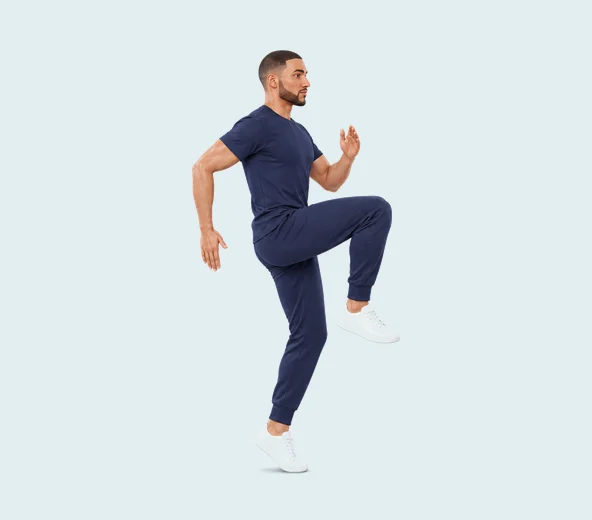
- Warm up. Use the 1-minute warm-up in the player (high knees and side lunges) or jog easily for a few minutes. The 1988 validation study allowed at least 5 minutes of warm-up before each test.
- Start on the line. After a 5-second countdown, the first beep sends you off. Run to the other line, get a foot on or over it by the next beep, then turn and run back.
- Keep pace as the levels get faster. Each level lasts about a minute. A triple beep starts the next level, which is 0.5 km/h faster, so the beeps come closer together.
- Stop when you miss the line twice in a row. If you miss the line at a beep, reach it, turn and try to catch up. Miss two beeps in a row and the test is over. Tap I'm out: your score is the last shuttle you reached on time.
Your score is written as level.shuttle: 9.5 means level 9, shuttle 5. If you tap I'm out a few seconds after your last good shuttle, the result screen lets you take off the shuttles you missed.
Beep test levels
The table shows the timing the player uses for all 21 levels. Each level has a whole number of shuttles and lasts about a minute. The last column is the estimated VO2 max for finishing that level, from the 1988 prediction table described further down.
| Level | Speed km/h (mph) | Shuttles | Seconds per shuttle | Level time | Distance at end | Time at end | Est. VO2 max at end |
|---|---|---|---|---|---|---|---|
| 1 | 8.0 (5.0) | 7 | 9.00 | 63.0 s | 140 m | 1:03 | Not in table |
| 2 | 9.0 (5.6) | 8 | 8.00 | 64.0 s | 300 m | 2:07 | Not in table |
| 3 | 9.5 (5.9) | 8 | 7.58 | 60.6 s | 460 m | 3:08 | Not in table |
| 4 | 10.0 (6.2) | 9 | 7.20 | 64.8 s | 640 m | 4:12 | 29.5 |
| 5 | 10.5 (6.5) | 9 | 6.86 | 61.7 s | 820 m | 5:14 | 32.9 |
| 6 | 11.0 (6.8) | 10 | 6.55 | 65.5 s | 1,020 m | 6:20 | 36.4 |
| 7 | 11.5 (7.1) | 10 | 6.26 | 62.6 s | 1,220 m | 7:22 | 39.9 |
| 8 | 12.0 (7.5) | 11 | 6.00 | 66.0 s | 1,440 m | 8:28 | 43.3 |
| 9 | 12.5 (7.8) | 11 | 5.76 | 63.4 s | 1,660 m | 9:32 | 46.8 |
| 10 | 13.0 (8.1) | 11 | 5.54 | 60.9 s | 1,880 m | 10:32 | 50.2 |
| 11 | 13.5 (8.4) | 12 | 5.33 | 64.0 s | 2,120 m | 11:36 | 53.7 |
| 12 | 14.0 (8.7) | 12 | 5.14 | 61.7 s | 2,360 m | 12:38 | 57.1 |
| 13 | 14.5 (9.0) | 13 | 4.97 | 64.6 s | 2,620 m | 13:43 | 60.6 |
| 14 | 15.0 (9.3) | 13 | 4.80 | 62.4 s | 2,880 m | 14:45 | 64.0 |
| 15 | 15.5 (9.6) | 13 | 4.65 | 60.4 s | 3,140 m | 15:46 | 67.5 |
| 16 | 16.0 (9.9) | 14 | 4.50 | 63.0 s | 3,420 m | 16:49 | 70.9 |
| 17 | 16.5 (10.3) | 14 | 4.36 | 61.1 s | 3,700 m | 17:50 | 74.4 |
| 18 | 17.0 (10.6) | 15 | 4.24 | 63.5 s | 4,000 m | 18:53 | 77.9 |
| 19 | 17.5 (10.9) | 15 | 4.11 | 61.7 s | 4,300 m | 19:55 | 81.3 |
| 20 | 18.0 (11.2) | 16 | 4.00 | 64.0 s | 4,620 m | 20:59 | 84.8 |
| 21 | 18.5 (11.5) | 16 | 3.89 | 62.3 s | 4,940 m | 22:01 | Not in table |
Distances are totals since the first beep. The prediction table covers levels 4 to 20, so levels 1 to 3 and 21 have no estimate.
Level 1 runs at 8.0 km/h and level 2 at 9.0 km/h. After that, each level adds 0.5 km/h, up to 18.5 km/h at level 21, when a beep comes every 3.9 seconds. All 21 levels add up to 247 shuttles, 4,940 m (3.1 miles), in 22 minutes 1 second.
The test comes from Montreal. Luc Léger and Jean Lambert described it in 1982 with 2-minute stages that started at 8 km/h and rose by 0.5 km/h each stage (Léger and Lambert 1982). Léger and colleagues' 1988 version shortened the stages to 1 minute, starting at 8.5 km/h (Léger et al. 1988), and gave the speed of each stage as 8 km/h plus 0.5 km/h for every stage number. The UK version that most beep test level tables follow, and that this player runs, also uses 1-minute levels and the same speeds from level 2 on, with level 1 at 8.0 km/h. Its shuttles per level match the prediction table in Ramsbottom et al. 1988.

Beep test scores and VO2 max
VO2 max is the most oxygen your body can use per minute, and it is the usual lab measure of aerobic fitness. The beep test estimates it from how far you get. The player uses the prediction table from Ramsbottom et al. 1988, a study at Loughborough University in which 74 active adults aged 19 to 36 (36 men and 38 women) ran the shuttle test and had their VO2 max measured on a treadmill. The final level they reached and their measured VO2 max were closely related (r = 0.92), and estimates were typically within about 3.5 ml/kg/min of the lab value. The men in that group reached level 12.6 on average and the women level 9.6.
The table lists predicted VO2 max for levels 4 to 20 at every second shuttle. The player reads your score straight from it and fills in the shuttles between listed values in a straight line. For example, level 10, shuttle 2 is 47.4 ml/kg/min and finishing level 10 is 50.2.
Other equations exist. Léger's 1988 paper predicts VO2 max from the speed of the last stage you reached and, for children and teens, your age; adults use an age of 18 in it. Because the two sources were built on different groups, they can differ by a few points for the same score. A meta-analysis of 57 studies found that shuttle run scores correlate with measured VO2 max at 0.66 to 0.84, and more strongly in adults on Léger's protocol (Mayorga-Vega et al. 2015). Treat the number as an estimate, not a lab result.
What is a good beep test score by age?
A good score depends on your age and sex. To rate a result, the player compares your estimated VO2 max with the FRIEND registry, which reports VO2 max percentiles from treadmill tests of US adults without heart disease, by sex and decade of age (Kaminsky et al. 2015). The table below turns those percentiles into beep test scores: each cell is the lowest score whose estimated VO2 max reaches that percentile.
| Age | Women: median | Women: top 25% | Women: top 10% | Men: median | Men: top 25% | Men: top 10% |
|---|---|---|---|---|---|---|
| 20 to 29 | 7.4 | 9.5 | 11.4 | 10.4 | 12.6 | 14.5 |
| 30 to 39 | 5.2 | 6.9 | 8.5 | 8.8 | 10.8 | 12.10 |
| 40 to 49 | Under 4.2 | 5.8 | 7.6 | 7.4 | 9.6 | 11.7 |
| 50 to 59 | Under 4.2 | 4.4 | 5.7 | 5.9 | 7.10 | 9.8 |
| 60 to 69 | Under 4.2 | Under 4.2 | 4.3 | 4.6 | 6.5 | 8.2 |
| 70 to 79 | Under 4.2 | Under 4.2 | Under 4.2 | Under 4.2 | 5.3 | 7.1 |
Median is the middle of the FRIEND group (50th percentile), top 25% is the 75th percentile and top 10% the 90th. "Under 4.2" means the percentile falls below the first row of the 1988 prediction table. These scores are an estimate built from two sources, not norms measured with the beep test.
On the result screen, pick your sex and age group to see where your own estimate sits, for example "higher than about 52% of women aged 20 to 29" for a score of 7.5. The rating covers ages 20 to 79, the range FRIEND reports.
Build the fitness for a better score, with workouts customized to you in detailed 3D
The FitCraft app builds workouts around your goals, shows every move with a 3D AI coach and adjusts as you progress. Earn XP, keep your streak and level up. Free version available.
Take the Free Assessment Free • Takes 2 minutes • Personalized to youBeep test tips
- Arrive with the beep. In the early levels, run at a pace that gets you to the line as the beep sounds. Sprinting and then waiting at the line spends energy you will want later.
- Turn tight and switch feet. Put one foot on or over the line, turn and push off. Turning on alternate feet shares the load between both legs.
- Learn the pace first. Run the Practice option to level 5 once or twice. The early levels then feel automatic on test day.
- Set up the space well. Measure the 20 m carefully, use a dry floor with good grip, wear running shoes and leave room to slow down past each line.
- Build the engine. Your score follows your aerobic fitness. Steady running builds the base, and harder intervals such as fartlek or HIIT raise the top end. Our guide on how to increase VO2 max covers what works.
What is a beep test in football?
Football and soccer teams use the beep test as a quick check of aerobic fitness for a whole squad, because the stop, turn and go running is close to how the game is played. Léger designed his 1988 version for schoolchildren, healthy adults in fitness classes and athletes in sports with frequent stops and starts, such as basketball (Léger et al. 1988). Some teams also use related shuttle tests that add a short rest after each pair of shuttles.

Is the beep test safe? Who should check with a doctor first
The beep test is a maximal test: it ends when you cannot go on, so your heart and lungs work as hard as they can at the end. For healthy, active adults that is fine. The American College of Sports Medicine's screening guidance recommends medical clearance before inactive people with known heart, metabolic or kidney disease start exercising, before active people with those conditions exercise vigorously, and for anyone with symptoms such as chest pain or unusual breathlessness (Riebe et al. 2015). The player asks a short set of questions adapted from the PAR-Q+ before your first test and again every 30 days.
- Check with a doctor first if you have a heart condition or high blood pressure, chest pain, dizziness or fainting, another long-term condition, or a joint or muscle problem that hard running could make worse, or if you are pregnant.
- Do not run it when you are ill, injured or very short of sleep, or in hot, humid conditions.
- Stop at once if you feel chest pain, dizziness, faintness or unusual shortness of breath. These are reasons to stop, not to push through.
- Cool down. Walk until your breathing settles, then do the two stretches in the player: half kneeling stretch and downward dog.
The optional warm-up uses two moves from the FitCraft app: high knees to get your knees and heart rate up and side lunges to loosen your hips for the turns. If you are new to running, our guide to building endurance is a better place to start than a maximal test.
Related reading
References
- Léger LA, Lambert J. "A maximal multistage 20-m shuttle run test to predict VO2 max." European Journal of Applied Physiology and Occupational Physiology. 1982;49(1):1-12. doi:10.1007/BF00428958
- Léger LA, Mercier D, Gadoury C, Lambert J. "The multistage 20 metre shuttle run test for aerobic fitness." Journal of Sports Sciences. 1988;6(2):93-101. doi:10.1080/02640418808729800
- Ramsbottom R, Brewer J, Williams C. "A progressive shuttle run test to estimate maximal oxygen uptake." British Journal of Sports Medicine. 1988;22(4):141-144. doi:10.1136/bjsm.22.4.141 (PMC1478728)
- Kaminsky LA, Arena R, Myers J. "Reference Standards for Cardiorespiratory Fitness Measured With Cardiopulmonary Exercise Testing: Data From the Fitness Registry and the Importance of Exercise National Database." Mayo Clinic Proceedings. 2015;90(11):1515-1523. doi:10.1016/j.mayocp.2015.07.026 (PMC4919021)
- Mayorga-Vega D, Aguilar-Soto P, Viciana J. "Criterion-Related Validity of the 20-M Shuttle Run Test for Estimating Cardiorespiratory Fitness: A Meta-Analysis." Journal of Sports Science and Medicine. 2015;14(3):536-547. PMC4541117
- Warburton DER, Jamnik VK, Bredin SSD, Gledhill N. "The Physical Activity Readiness Questionnaire for Everyone (PAR-Q+) and Electronic Physical Activity Readiness Medical Examination (ePARmed-X+)." Health & Fitness Journal of Canada. 2011;4(2):3-17. doi:10.14288/hfjc.v4i2.103
- Riebe D, Franklin BA, Thompson PD, et al. "Updating ACSM's Recommendations for Exercise Preparticipation Health Screening." Medicine & Science in Sports & Exercise. 2015;47(11):2473-2479. doi:10.1249/MSS.0000000000000664
How this beep test player differs from beep test videos
Most people run the beep test to a video or a recording. A recording cannot tell you your score, and it keeps playing whether you are still running or not. This player builds every beep from the published level timing and schedules it on your device's audio clock, so the beeps stay on time even when the page is busy, and a phone that wakes up never plays a burst of missed beeps. It shows your level and shuttle in numbers you can read from the far line and a dot that crosses the lane in time with the beeps, so you can see if you are ahead or behind.
When you tap I'm out, it saves your score with the distance and time, estimates your VO2 max from the 1988 prediction table and, if you choose, rates it against FRIEND registry percentiles for your sex and age. It keeps your personal best and recent tests on your device, tells you the moment you pass your best, and gives XP for every level you finish. It also offers a Practice option, a warm-up and a cool-down, and says plainly where its numbers come from and how far to trust them.
Frequently Asked Questions
How many levels does a beep test have?
The UK beep test has 21 levels and 247 shuttles of 20 m, 4,940 m in all, and takes 22 minutes 1 second from the first beep to the end of level 21. Each level lasts about a minute. Level 1 runs at 8.0 km/h and level 21 at 18.5 km/h, with a beep every 3.9 seconds.
What is a good beep test score by age?
Matched to the FRIEND registry's VO2 max medians, a middle score is about 10.4 for men and 7.4 for women aged 20 to 29, and about 8.8 for men and 5.2 for women aged 30 to 39. The table on this page gives the median, top 25% and top 10% scores for ages 20 to 79. These come from an estimate, so treat them as a rough guide.
How hard is 7.5 on a beep test?
Level 7, shuttle 5 means 56 shuttles, 1,120 m in 6 minutes 51 seconds, at a top speed of 11.5 km/h. The 1988 prediction table puts it at an estimated VO2 max of 38.2 ml/kg/min. That is higher than about 52% of women and about 21% of men aged 20 to 29 in the FRIEND registry.
What is a beep test in football?
Football and soccer teams use the beep test to check the aerobic fitness of a whole squad at once, because the stop, turn and go running is close to how the game is played. Léger designed his 1988 version for schoolchildren, adults in fitness classes and athletes in sports with frequent stops and starts.
What are some tips for the beep test?
Warm up, run on a dry floor with good grip, and get a foot to the line just as the beep sounds instead of sprinting and waiting. Turn on alternate feet so both legs share the work. Run the Practice option to level 5 once or twice so the early pace feels automatic.
Can you complete a beep test?
Yes. The test ends after level 21, shuttle 16, which is 4,940 m at 18.5 km/h. In the 1988 validation study of 74 active adults, the best man reached level 15 and the best woman level 14, so finishing all 21 levels is rare.
Is there a 15 m beep test?
Yes, shorter 15 m versions exist for small gyms. Their scores do not carry over one to one, and we did not find a conversion to 20 m scores that was validated in adults, so this player runs the 20 m test only.
How accurate is the beep test for VO2 max?
Fairly accurate for a field test. A meta-analysis of 57 studies found correlations of 0.66 to 0.84 between shuttle run scores and measured VO2 max, and higher in adults on the Léger protocol (Mayorga-Vega et al. 2015). In the 1988 UK study, estimates were typically within about 3.5 ml/kg/min of the lab value.