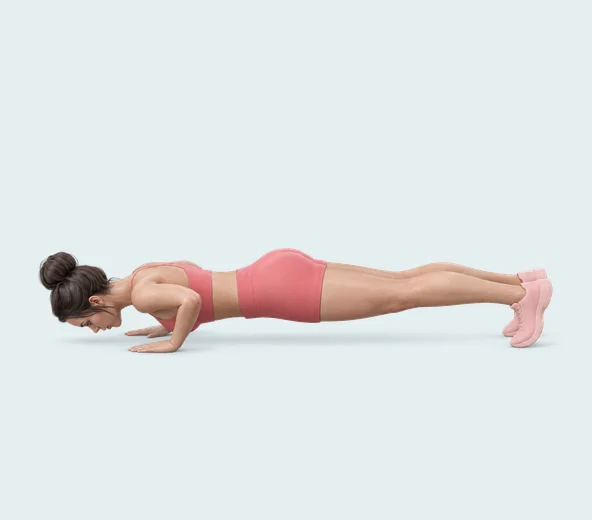
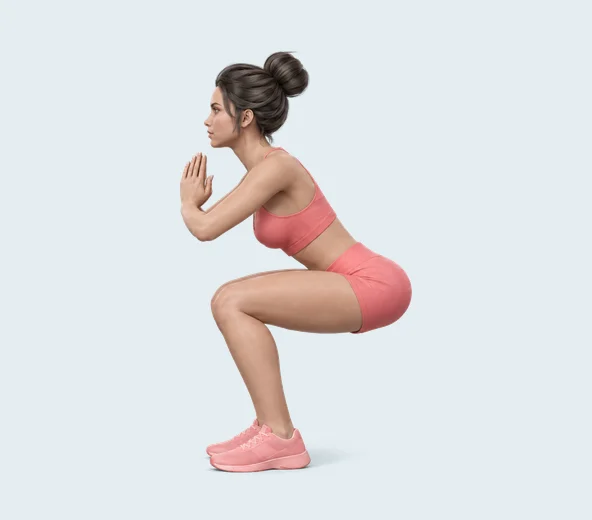
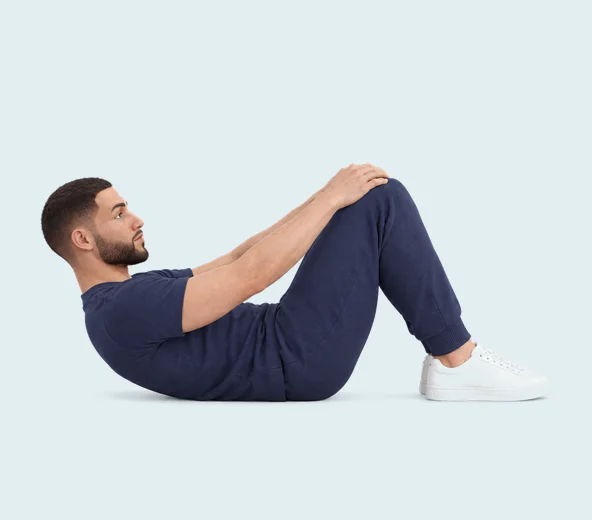
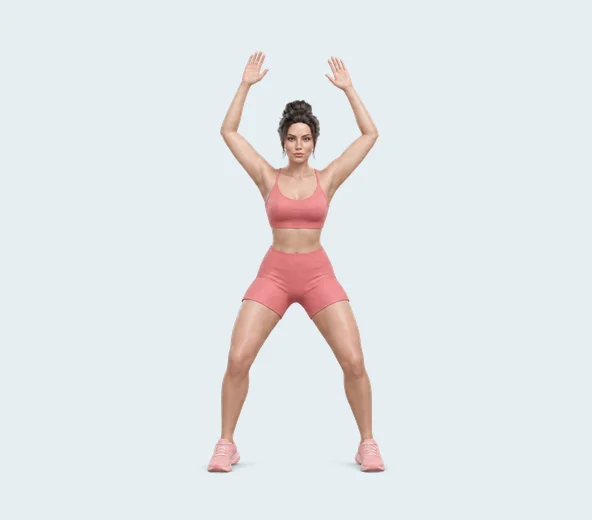
A deck of cards workout turns a list of exercises into a game of chance. You never know whether the next card is a 2 or a king, so every flip is a small surprise, and the decision about what to do next is already made for you. All it needs is a deck, a bit of floor and four exercises. This page does the shuffling, counting and timing for you, and shows a picture of each move with a form tip from its exercise guide.
How to do a deck of cards workout
- Pick one exercise for each suit. Hearts, spades, diamonds and clubs each get one move. Choose moves that work different parts of the body: a push, a leg move, a core move and something that raises your heart rate. The default in the generator is push-ups, squats, crunches and jumping jacks.
- Decide what the cards are worth. Number cards count as their number. In the standard rules, jacks, queens and kings count as 10 and aces as 11.
- Shuffle and flip one card at a time. The suit tells you the exercise and the value tells you the reps. The 7 of hearts means 7 reps of the hearts exercise.
- Do the reps, then flip the next card. Rest when you need to and keep your form clean. A short pause is better than a sloppy set.
- Keep going until the deck is gone. A full deck is 52 cards and 380 reps with the standard values. For a shorter workout, stop sooner. The generator on this page deals only as many cards as fit the time you pick.
Moves that alternate sides, such as lunges, bicycle crunches, mountain climbers and high knees, count each side as one rep. So a 6 of spades with rear lunges means three lunges on each leg.

Card values and how many reps a deck adds up to
Every rule set counts number cards at their face value. The difference is the face cards and the ace. The standard rules make jacks, queens and kings worth 10 and the ace worth 11, which gives each suit 95 reps. Counting the ace as 1 takes 10 reps off each suit. The climb rules count up the ranks, jack 11 to ace 14, and add 9 reps to each suit. The generator on this page uses the standard values.
The level then scales every card. Easy halves each card and rounds up, so a 7 becomes 4 and a 3 becomes 2. Hard multiplies each card by one and a half and rounds, so a 7 becomes 11. Here is what a full deck of four exercises adds up to under each combination:
| Card values | Easy | Normal | Hard |
|---|---|---|---|
| Standard: J, Q, K 10, ace 11 | 50 each, 200 total | 95 each, 380 total | 145 each, 580 total |
| Low ace: J, Q, K 10, ace 1 | 45 each, 180 total | 85 each, 340 total | 130 each, 520 total |
| Climb: J 11, Q 12, K 13, A 14 | 55 each, 220 total | 104 each, 416 total | 159 each, 636 total |
The generator works by time instead of by deck. It estimates about 3.5 seconds a rep and deals cards until the reps fill the time you pick. At the Normal level, 15 minutes comes to about 257 reps, or about 35 cards. A full standard deck is 380 reps, about 22 minutes, so 20 minutes deals most of a deck and 30 minutes goes into a second one.
Pick your exercises
Spread the four suits across different muscles so one tired muscle group does not end the workout early. These are the five workouts in the generator. Every exercise name links to its full form guide.
| Pick | Hearts | Spades | Diamonds | Clubs |
|---|---|---|---|---|
| Full body | Push-ups | Squats | Crunches | Jumping jacks |
| Legs | Squats | Rear lunges | Glute bridges | Side lunges |
| Upper body | Push-ups | Pike push-ups | Diamond push-ups | Mountain climbers |
| Cardio | Jumping jacks | High knees | Mountain climbers | Burpees |
| Dumbbells | Goblet squats | Bent-over rows | Shoulder presses | Romanian deadlifts |
Bodyweight upper-body work is mostly pushing. If you have dumbbells, the bent-over row from the Dumbbells workout adds the pulling that push-ups leave out. High reps of a loaded move add up fast, so pick a light weight and start on Easy or with a shorter time. For more ideas, see our list of the best bodyweight exercises.
Like turning your workout into a game?
FitCraft is built on it. Your AI coach guides every workout, and you earn XP, keep streaks and collect cards as you train. Free version available.
Take the Free Assessment Free • 2 minutes • No credit card
The two-exercise version: red and black
If four exercises feel like too much to keep track of, split the deck by color. Red cards (hearts and diamonds) are one exercise and black cards (spades and clubs) are the other. Each exercise then gets 26 cards, which is 190 reps each with the standard rules and 380 in all. Push-ups on red and squats on black is the classic pairing. To play it in the generator, choose your own exercises: give hearts and diamonds one move, and spades and clubs the other.
Make it easier or harder
- Level. Easy halves each card, rounded up, and Hard multiplies it by one and a half. The time stays the one you picked: Easy gives you smaller sets and more cards, and Hard gives you bigger sets and fewer cards.
- Time. Pick 5 or 10 minutes for a short workout, or 20 or 30 minutes for a long one.
- Exercise choice. Swap a hard move for an easier one, such as squats for jump squats or kneeling push-ups for push-ups.
- Rest. Take a short break whenever your form starts to slip. The timer keeps running, so you can try to beat your time next round.

Is the deck of cards workout good?
It is a good way to get a lot of work done without a plan to follow. No study has tested the deck of cards workout itself, so the case for it rests on two things that have been studied: game elements and variety.
In a systematic review and meta-analysis, Mazeas et al. 2022 in the Journal of Medical Internet Research pooled 16 randomized controlled trials with 2,407 participants. Gamified programs increased physical activity, with a small to medium effect (Hedges' g 0.42). The effect was smaller at follow-up, an average of 14 weeks after the programs ended (g 0.15), so the game helps most while you are playing it. Our research summary on gamification and fitness and our review of whether gamification works go deeper.
Variety matters too. Sylvester et al. 2016 in the Journal of Behavioral Medicine randomly assigned 121 inactive university students to a high-variety or a low-variety exercise program for six weeks. The high-variety group stuck to the program better, and the effect ran through how varied the program felt to them. A shuffled deck is variety by design: no two sessions come out the same.
As strength work, a deck of bodyweight or dumbbell exercises counts toward the muscle-strengthening part of the Physical Activity Guidelines for Americans (Piercy et al. 2018), which ask adults to do muscle-strengthening activity on 2 or more days a week. What a deck cannot do is make you stronger on a schedule. The cards change every session, so the load does not climb in a planned way. Use it for variety, conditioning and days when you do not want to think, and use the free AI workout plan generator when you want a structured week that adds load over time.
Who should go easy or skip it
The deck is built for healthy adults. Adjust it, or check with a professional first, in these situations.
- New to exercise or coming back after a long break. Dozens of reps of one move add up fast. Start on Easy with 5 or 10 minutes, and see our guide to starting from zero fitness.
- Joint pain or a current injury. Pick moves that do not hurt and skip jumping. If a move causes sharp pain, stop and see a physiotherapist. Our guide to training with joint pain covers common swaps.
- High blood pressure or heart disease. Talk to your doctor before hard conditioning sets such as burpees and jump squats.
- Pregnancy and the months after birth. Follow your care team on which moves to use and how hard to work. Our postpartum fitness guide has more context.
Stop the workout if you feel chest pain, dizziness or sharp joint pain.
Related reading
References
- Mazeas A, Duclos M, Pereira B, Chalabaev A. "Evaluating the Effectiveness of Gamification on Physical Activity: Systematic Review and Meta-analysis of Randomized Controlled Trials." Journal of Medical Internet Research. 2022;24(1):e26779. doi:10.2196/26779
- Sylvester BD, Standage M, McEwan D, et al. "Variety support and exercise adherence behavior: experimental and mediating effects." Journal of Behavioral Medicine. 2016;39(2):214-224. doi:10.1007/s10865-015-9688-4
- Piercy KL, Troiano RP, Ballard RM, et al. "The Physical Activity Guidelines for Americans." JAMA. 2018;320(19):2020-2028. doi:10.1001/jama.2018.14854
How this generator differs from typical deck of cards workout guides
Most deck of cards workout guides give you the rules and leave the rest to you: you shuffle, you count, you keep track of how many reps you have done, and you have to guess how long a deck will take. Many also pad the format with claims about calories burned or with an origin story nobody can source.
This generator deals the cards for you and shows each one with a picture of the move and a form tip from that exercise's guide, so a card is never just a number. You pick how long you have instead of a deck size, and it deals enough cards to fill that time. It keeps a timer while you play and adds up your reps for each exercise at the end. It states plainly that no study has tested this format, and it cites the research on game elements and variety that it does lean on, instead of inventing numbers.
Frequently Asked Questions
Is the deck of cards workout good?
Yes, for getting a lot of work done without following a plan. No study has tested the deck of cards workout itself. The format leans on two things that have been studied. A meta-analysis of 16 randomized trials found that game elements raised physical activity (Mazeas et al. 2022), and inactive adults stuck with a program better when it felt varied (Sylvester et al. 2016). What a shuffled deck cannot do is add load on a planned schedule, so pair it with a structured plan if you want steady strength gains.
What are the rules for a deck of cards workout?
Give each suit an exercise, shuffle, and flip one card at a time. The suit tells you the exercise and the card's value tells you the reps, so the 7 of hearts is 7 reps of the hearts exercise. In the standard rules, jacks, queens and kings count as 10 and aces as 11. Keep flipping until the deck is gone. Moves that alternate sides, such as lunges, count each side as one rep.
How many reps is a deck of cards workout?
With standard rules a full deck is 380 reps, 95 for each of the four exercises. Counting aces as 1 makes it 340, and counting jacks as 11, queens 12, kings 13 and aces 14 makes it 416. On the generator's Easy level, which halves each card and rounds up, a standard deck is 200 reps. On Hard, one and a half times each card, it is 580. The generator estimates about 3.5 seconds a rep, so a full standard deck takes about 22 minutes.
What exercises should I use for a deck of cards workout?
Pick four moves that work different parts of the body so no single muscle group gives out early. A good full body set is push-ups for hearts, squats for spades, crunches for diamonds and jumping jacks for clubs. For legs, try squats, rear lunges, glute bridges and side lunges. With dumbbells, try goblet squats, bent-over rows, shoulder presses and Romanian deadlifts.
Can beginners do a deck of cards workout?
Yes. In the generator, pick Easy, which halves every card, and a short time such as 5 or 10 minutes. Swap push-ups for kneeling or incline push-ups, skip jumping moves, and rest whenever your form slips.
What do jokers mean in a deck of cards workout?
There is no fixed rule. Many people use the two jokers for a bonus or a penalty, such as a plank hold or a free rest. The generator on this page leaves the jokers out, so every card is an exercise and a number of reps.
Can I do a deck of cards workout with dumbbells?
Yes. Use dumbbell moves such as goblet squats, bent-over rows, shoulder presses and Romanian deadlifts, which is the Dumbbells workout in the generator. High reps of a loaded move add up fast, so choose a light weight and start on Easy or with a shorter time.
Is there a deck of cards workout app?
This page works like one. Open it on your phone, pick a workout and how long you have, press Shuffle and start, and tap Next card after each card. It runs in your browser with no download or signup, keeps your screen awake where the browser allows it, and adds up your reps and time at the end.