- Variety matters on top of volume. A 2026 BMJ Medicine analysis of 111,467 adults (Nurses' Health Study + Health Professionals Follow-Up Study) found people in the highest exercise-variety quintile had a 19% lower all-cause mortality risk than those in the lowest.
- Cause-specific deaths dropped 13-41% across cardiovascular disease, cancer, respiratory disease, and other causes.
- The benefit held at every total-activity level. Variety added to volume; it did not replace it.
- Most listed activities helped individually. Walking, jogging, running, tennis, calisthenics, stairs, and weight training all showed lower mortality. Swimming was the only mode without a significant association.
- The dose-response was non-linear. Most of the benefit came from moving from 1-2 activity types to 4-5, with diminishing returns above that.

If you have ever read fitness advice, the usual prescription is some version of "do more." More minutes per week. More step counts. More sessions. A study just published in BMJ Medicine adds a different dimension to that picture, and it has practical consequences for how you train.
The analysis used data from two of the largest ongoing health cohorts in the world, the Nurses' Health Study and the Health Professionals Follow-Up Study, with a combined sample of 111,467 adults followed for more than 30 years. It asked a different question than the standard mortality-and-exercise paper: does the variety of physical activities a person does, on top of how much they do, independently predict how long they live?
The answer was yes. People with the highest variety of regular activities had a 19% lower risk of death from any cause than those with the lowest variety. And that effect held at every level of total physical activity. So a person doing 150 minutes a week split across walking, weight training, and tennis had a meaningfully lower mortality risk than a person doing 150 minutes a week of one of those alone.
The Research: What Studies Show
Han et al. (2026): The 111,000-Person Variety Study
The headline paper here is Han, Hu, Lee, Zhang, Giovannucci, Stampfer, Hu, Hu, and Sun, published January 20, 2026 in BMJ Medicine. The team pulled physical activity assessments from two prospective cohorts run out of Harvard T.H. Chan School of Public Health: 70,725 women from the Nurses' Health Study (1986 to 2018) and 40,742 men from the Health Professionals Follow-Up Study (1986 to 2020). Combined follow-up exceeded 3 million person-years.
Participants reported physical activity every two to four years, including detailed time spent on walking, jogging, running, bicycling, swimming, tennis or squash or racquetball, stair climbing, rowing or calisthenics, and weight training. The researchers built a "variety score" capturing how many different activity types each person did regularly, then tracked mortality outcomes against that score.
The headline finding: people in the highest variety quintile had a 19% lower all-cause mortality risk than those in the lowest, after adjustment for total physical activity volume, age, body mass index, smoking, alcohol, diet, and a long list of other covariates. The relationship was non-linear, with most of the benefit accumulating between the lowest and middle quintiles.
Cause-specific mortality dropped too: 13 to 41% lower across cardiovascular disease, cancer, respiratory disease, and other causes. The strongest effect was on respiratory disease deaths, where the highest-variety group had a 41% lower risk.
Citation: Han H, Hu J, Lee DH, et al. Physical activity types, variety, and mortality: results from two prospective cohort studies. BMJ Medicine. 2026;5:e001513.
The Individual Activities: Which Modes Showed Mortality Benefit
Before getting to variety, Han and colleagues quantified what each activity did on its own. Comparing the highest vs lowest activity levels for each mode (with total physical activity from other modes adjusted for), the multivariable-adjusted hazard ratios for all-cause mortality were:
| Activity | Hazard Ratio (95% CI) | Mortality risk reduction |
|---|---|---|
| Walking | 0.83 (0.80 to 0.85) | 17% |
| Tennis / squash / racquetball | 0.85 (0.80 to 0.89) | 15% |
| Rowing or calisthenics | 0.86 (0.84 to 0.89) | 14% |
| Running | 0.87 (0.80 to 0.93) | 13% |
| Weight training | 0.87 (0.82 to 0.91) | 13% |
| Jogging | 0.89 (0.85 to 0.94) | 11% |
| Stair climbing | 0.90 (0.87 to 0.93) | 10% |
| Bicycling | 0.96 (0.93 to 0.99) | 4% |
| Swimming | 1.01 (0.97 to 1.05) | not significant |
The swimming result surprised some commentators. The likely explanation is selection bias: in this cohort, swimming was often the chosen activity for people with joint pain, prior injuries, or other conditions that pushed them off land-based modes. That underlying health profile partially offset the benefit of the activity itself. Other cohorts with different swimming populations have shown protective associations. The single-cohort null result does not mean swimming is useless. It means the variable in this specific dataset captured a less-healthy subgroup.
Older Evidence: Volume and Domain
The variety dimension is new. The total-volume dimension is well established. A 2011 systematic review and dose-response meta-analysis by Samitz, Egger, and Zwahlen in the International Journal of Epidemiology pooled 80 cohort studies covering 1,338,143 participants. Comparing the most active to the least active across all activity domains gave a combined risk ratio of 0.65 for all-cause mortality. Leisure-time activity alone had a risk ratio of 0.74, occupational activity 0.83, activities of daily living 0.64.
A 2019 JAMA Network Open paper by Saint-Maurice and colleagues followed 315,059 adults and showed that maintaining moderate-to-vigorous activity across the adult life course was associated with 29 to 36% lower all-cause mortality versus people who were inactive throughout. Importantly, people who started exercising later in adulthood still captured most of the benefit. The pattern is consistent: do more, do it longer, do it across more years of your life.
The 2026 BMJ Medicine analysis layers a third dimension on this existing picture: do more types.
Why Variety, Specifically
There is a clean biological story for why mixing modes would add benefit on top of total dose. Different exercises adapt different systems. Aerobic exercise drives cardiorespiratory fitness, capillary density, mitochondrial biogenesis. Resistance training drives muscular strength, motor unit recruitment, bone mineral density. Plyometric or sport-style movement drives power, coordination, balance. Mobility work drives joint range, tissue tolerance.
A meta-analysis by Garcia-Hermoso et al. (2018) in Archives of Physical Medicine and Rehabilitation pooled 38 cohort studies and showed muscular strength predicted all-cause mortality independent of cardiorespiratory fitness. So an exercise program that develops only one of those systems leaves measurable mortality risk on the table. The 19% variety effect Han et al. measured is roughly consistent with what you would predict if multiple independent adaptation pathways each contribute to longevity.
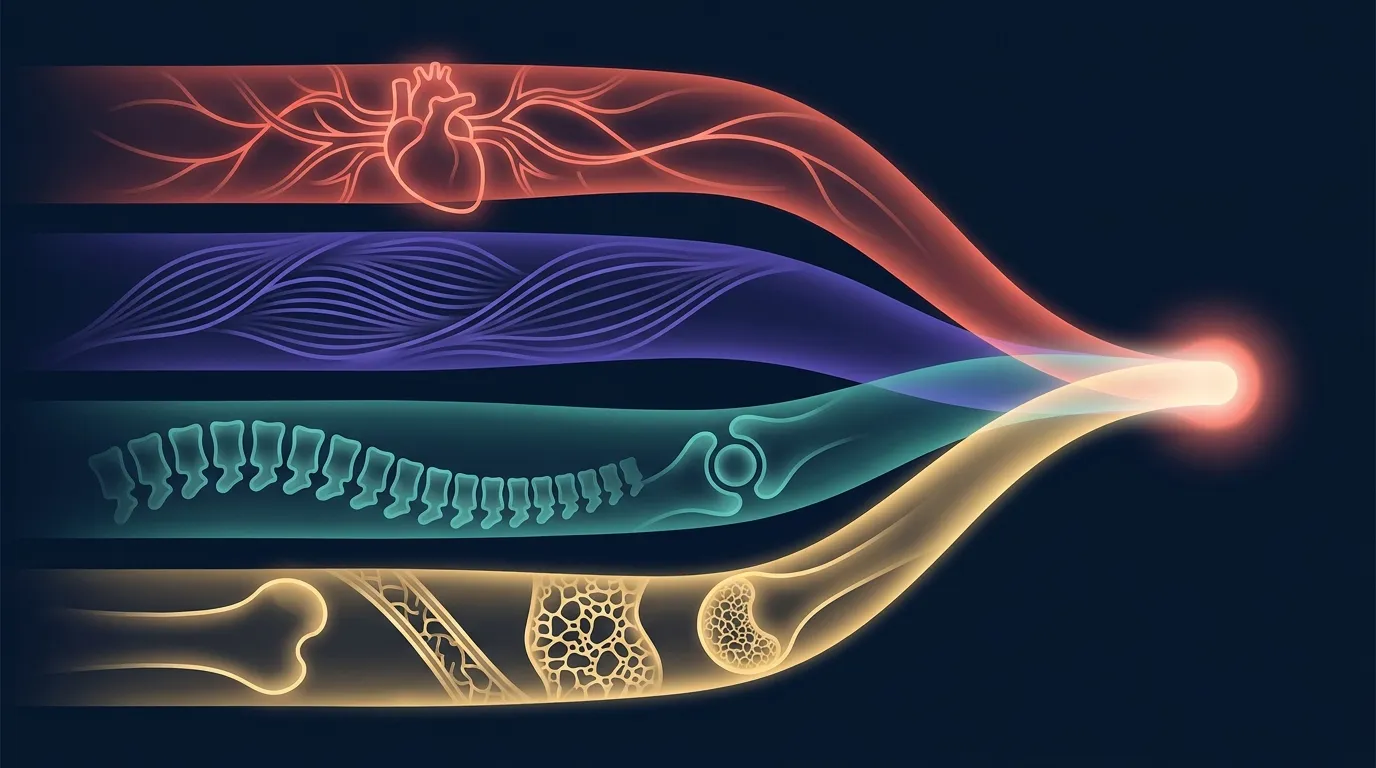
This also matches the World Health Organization's 2020 guidelines on physical activity and sedentary behaviour, which already recommend that adults combine 150 to 300 minutes per week of moderate-intensity aerobic activity (or 75 to 150 minutes of vigorous) with muscle-strengthening activity on at least two days per week. The variety prescription is not new in public health policy. What is new is a large dataset showing that adults who follow it, naturally or deliberately, live longer than adults who hit the same total minutes through a single mode.
How Variety Works in Practice
What does "more variety" actually look like? Roughly: 3 to 5 distinct activity modes hit regularly across a typical month. A workable baseline for most adults:
- One aerobic base. Walking, jogging, running, cycling, or a similar steady-state mode. This is the high-frequency anchor.
- One resistance mode. Bodyweight strength, dumbbell work, resistance bands, or barbell training. Two sessions per week is the WHO floor.
- One skill or play mode. Racquet sports, dance, climbing, martial arts, pickleball. The Han et al. data on tennis (15% mortality reduction) is interesting partly because skill sports drive coordination, balance, and motor learning, not just energy expenditure.
- One mobility or flexibility mode. Yoga, mobility flows, dedicated stretching. The Han et al. paper did not separately measure mobility work, but it is a low-cost addition that complements the other modes.
- Incidental movement. Stair climbing showed a 10% reduction on its own. Stairs are not a workout. They are a chance to add a mode at zero cost. See our companion piece on non-exercise activity thermogenesis for how this category compounds.
None of these modes are individually heroic. Walking, the most pedestrian (literally) entry on the list, posted the largest mortality benefit at 17%. The point is the combination. Stacking modes does not require stacking time. A person who walks 30 minutes a day, lifts twice a week, plays pickleball on Saturday, and takes the stairs at work already has 4 to 5 modes in regular rotation. For specific movements to fill those slots, see our roundup of the best exercises for longevity.
Enjoying the article?
Start a new fitness routine today, written by me and coached by the AI I designed.
Take the Free Assessment Free • 2 minutes • No credit cardCommon Misconceptions
Misconception: "Variety means doing a different workout every day"
It does not. The Han et al. analysis defined variety at the level of the month, not the day. A weekly schedule with 4 walks, 2 strength sessions, and a Saturday tennis match satisfies the variety dimension while still being repetitive enough to actually progress. Random "muscle confusion" programming, where you change the workout constantly to keep your muscles "guessing", is not what this research supports. Stable training within each mode, distributed across multiple modes, is.
For more on why progressive consistency beats randomness inside a single mode, see the muscle confusion myth article.
Misconception: "If I love running, I should just run more"
Running showed a 13% mortality benefit on its own. Real, but bounded. A runner who only runs is leaving the resistance-training benefit (13% on its own) and the racquet-sport / calisthenics benefit (14 to 15%) on the table. Layering 2 short strength sessions a week on top of running does not subtract from the running adaptation in any meaningful way for most non-elite athletes, and it adds an independent mortality pathway. The classic interference effect concern applies mostly to high-volume endurance combined with hypertrophy training in already-trained populations.
Misconception: "Switching activities is just an excuse to never get good at anything"
Variety in the Han et al. sense does not preclude specialization. The analysis showed benefit from having multiple regular modes. It did not require equal time across modes. Someone whose primary identity is "a runner" can still run 5 days a week, add 2 strength sessions, and have 2 to 3 modes in regular rotation. That counts. The point is to avoid being mono-modal, not to be a generalist with no anchor activity.
What the Research Suggests Going Forward
The Han et al. paper is one study, but it sits on top of decades of converging evidence: total physical activity matters, life-course consistency matters, muscular strength matters independent of cardio fitness, and now activity-type diversity matters independent of total volume. The directional signal is robust. The exact magnitudes will likely shift as more cohorts replicate the variety analysis, but the practical recommendation is unlikely to flip.
For an individual reader, the most useful read of this research is not "I need to track my variety score." It is "if I am only running, I should add lifting. If I am only lifting, I should add walking or a sport. If I am only walking, I should add some strength work." The biggest gains in the Han et al. variety curve came from moving off mono-modal training, not from optimizing a multi-mode routine.
The runner-up insight is that the modes are not all equivalent. Walking, racquet sports, calisthenics, running, and weight training each delivered 13 to 17% individual mortality reductions in this dataset. Bicycling was weaker (4%). Swimming was null. If you are choosing where to add a second or third mode, the data suggests walking and resistance training are the highest-yield first choices, with a racquet or play sport as a strong third.
And the connection to consistency is direct. None of this matters if you stop. The longevity literature consistently shows that cardiorespiratory fitness, muscular strength, and physical activity patterns are the things that actually predict outcomes. All of them depend on regular practice. Adding modes for variety only pays off if you actually train them. See our work on streak psychology and habit formation in fitness for the consistency side of the equation.

Honest Limitations
Two caveats matter before you take the 19% number at face value. First, the Han et al. study is observational. Like all observational mortality work, it cannot prove that variety causes lower mortality. People who do a wider mix of activities differ from people who do not in ways the researchers cannot fully measure. The team adjusted for the obvious confounders (age, sex, BMI, smoking, alcohol, diet, total activity volume). Residual confounding remains possible.
Second, the cohort is homogeneous in important ways. Nurses' Health Study and the Health Professionals Follow-Up Study participants are predominantly white, college-educated, and healthcare-adjacent. The dose-response curves may shift in populations with different baseline activity profiles, occupational physical demands, or environmental access. The 2011 Samitz et al. meta-analysis covered 1.3 million participants across many cohorts and showed a similar total-volume effect, which is reassuring. The variety-specific result has not yet been replicated at that scale.
Third, the activity list in this analysis did not include some modes that may matter, including yoga, Pilates, mobility-focused training, and high-intensity intervals as a distinct category. The "calisthenics" bucket partially captured bodyweight work but was not granular. The variety score may underestimate true activity diversity in people whose modes were not on the questionnaire.
So the practical advice (do more types of activity) holds. The specific 19% number is the best current estimate, not a fixed law.
References
- Han H, Hu J, Lee DH, Zhang Y, Giovannucci E, Stampfer MJ, Hu FB, Hu Y, Sun Q. "Physical activity types, variety, and mortality: results from two prospective cohort studies." BMJ Medicine 5 (2026): e001513. doi:10.1136/bmjmed-2025-001513
- Samitz G, Egger M, Zwahlen M. "Domains of physical activity and all-cause mortality: systematic review and dose-response meta-analysis of cohort studies." International Journal of Epidemiology 40.5 (2011): 1382-1400. doi:10.1093/ije/dyr112
- Saint-Maurice PF, Coughlan D, Kelly SP, et al. "Association of Leisure-Time Physical Activity Across the Adult Life Course With All-Cause and Cause-Specific Mortality." JAMA Network Open 2.3 (2019): e190355. doi:10.1001/jamanetworkopen.2019.0355
- Garcia-Hermoso A, Cavero-Redondo I, Ramirez-Velez R, et al. "Muscular Strength as a Predictor of All-Cause Mortality in an Apparently Healthy Population." Archives of Physical Medicine and Rehabilitation 99.10 (2018): 2100-2113. doi:10.1016/j.apmr.2018.01.008
- Bull FC, Al-Ansari SS, Biddle S, et al. "World Health Organization 2020 guidelines on physical activity and sedentary behaviour." British Journal of Sports Medicine 54.24 (2020): 1451-1462. doi:10.1136/bjsports-2020-102955
Frequently Asked Questions
Does exercise variety actually reduce mortality risk?
Yes. A January 2026 BMJ Medicine study by Han et al. analyzed 111,467 adults from the Nurses' Health Study and Health Professionals Follow-Up Study with more than 30 years of follow-up. Participants in the highest physical activity variety quintile had a 19% lower risk of all-cause mortality compared with the lowest, independent of total physical activity volume. Cause-specific mortality dropped 13-41% across cardiovascular disease, cancer, respiratory disease, and other causes.
Is variety more important than total exercise volume?
They are both important but work through different mechanisms. Total physical activity volume has its own well-documented dose-response with mortality, with combined risk ratios around 0.65 when comparing the most active to the least active across 1.3 million participants in the Samitz et al. (2011) meta-analysis. The 2026 BMJ Medicine variety analysis showed that on top of total volume, the diversity of activity types still independently predicted lower mortality. The benefit of variety held at every level of total activity, so volume and variety appear to add to each other rather than substitute.
Which activities had the strongest mortality benefit individually?
In the Han et al. 2026 analysis, the multivariable-adjusted hazard ratios for all-cause mortality, comparing highest vs lowest activity levels, were 0.83 for walking, 0.85 for tennis/squash/racquetball, 0.86 for rowing or calisthenics, 0.87 for running and for weight training, 0.89 for jogging, 0.90 for stair climbing, and 0.96 for bicycling. Swimming was the only listed activity that did not show a significant association with lower mortality (HR 1.01), likely due to selection bias (people with prior injuries or joint conditions in this cohort tended to choose swimming).
How many different types of activity should I aim for?
The Han et al. variety findings followed a non-linear dose-response. Most of the mortality benefit accumulated in the move from doing 1-2 types of activity to doing 4-5 types, with diminishing returns beyond that. A practical baseline most adults can hit is roughly 3-5 activity types over a typical month: one aerobic mode (walking, jogging, cycling), one resistance mode (weight training or calisthenics), one skill or play mode (racquet sports, dance, climbing), and incidental daily movement like stair climbing and household activity.
Does FitCraft support exercise variety?
Yes. FitCraft includes strength (bodyweight, dumbbells, barbells, resistance bands), cardio, mobility, yoga, and dynamic movement as workout types, plus multi-week programs that rotate modalities over time. Ty, the in-app 3D AI coach, demonstrates exercises through interactive 3D models you can pinch and zoom. The free FitCraft assessment matches you to a starting program based on your fitness level, equipment, and goals.