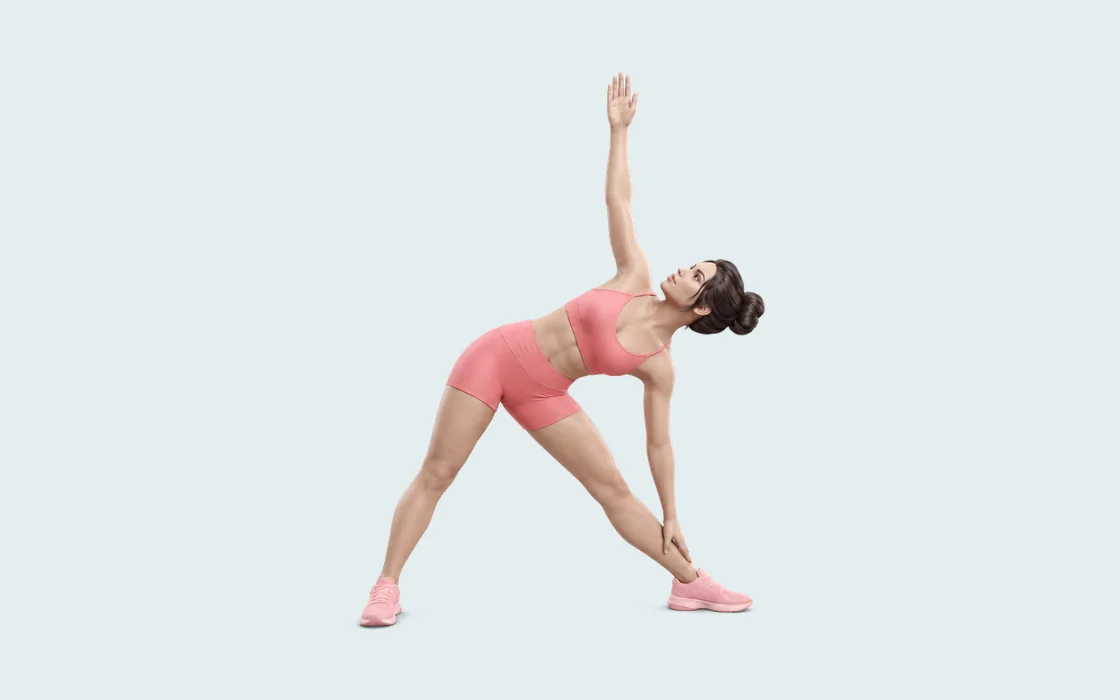

Choose a level and a length, start the timer and follow along. Each round lasts one minute: you work for the first part and rest for what is left, while the page shows the move for that round and an AI coach from the FitCraft app announces it. The 3-2-1 beeps let you keep your eyes on your form instead of the clock.
Already have a workout planned? Switch on Just the timer and the page becomes a plain HIIT timer, with the same rounds, beeps and countdown and no moves on screen.
How the interval timer runs a session
Every session follows the same plan:
- Warm-up, 1 minute. Easy mobility moves get you loose. It runs unless you turn it off with the warm-up switch.
- Rounds of work and rest, 1 minute each. Beginner works 30 seconds and rests 30, Intermediate 40 and 20, Advanced 45 and 15, and Expert 50 and 10. A 5-second get-ready comes before your first round.
- Your length. Choose 10, 15, 20 or 30 minutes of rounds, which is the same as 10, 15, 20 or 30 rounds. Ten is the default.
- Stretch, 1 minute. A short stretch closes every session, and it always runs.
Each level has four moves that take turns, one per round. Each move appears with a picture and a short form tip and links to the full exercise page, and tapping a move swaps it. An AI coach from the FitCraft app names the next move, 3-2-1 beeps count you through each change, and a single mute button turns the sound off. If your browser supports it, the page keeps your screen from going dark, and switching to another app won't throw off the timer. With the default settings, Intermediate for 10 minutes, the whole session takes 12 minutes.
Here are the moves and times at each level.
| Level | Each 1-minute round | Moves, in turn |
|---|---|---|
| Beginner | 30 s work, 30 s rest | Step-n-clap, butt kicks, running in place and sumo squats |
| Intermediate | 40 s work, 20 s rest | Ventral jacks, calf hops, step-n-punch and high knee-n-crunches |
| Advanced | 45 s work, 15 s rest | Squat kicks, jumping jacks, plank jacks and burpees |
| Expert | 50 s work, 10 s rest | Drop squats, burpees, jump lunges and step-n-lunge |
What interval training is, and where these splits fit
Interval training alternates hard work with recovery. In high-intensity interval training, or HIIT, the hard bouts reach roughly 80 to 95 percent of your max heart rate, and the rest is there so you can reach that level again in the next round. Without a heart rate monitor, go by effort: about 8 or 9 out of 10, where you can say two or three words but not a full sentence. Our heart rate zone calculator estimates your max heart rate if you want a number.
The split is your work time and your rest time, written as work/rest. The general rule is that the shorter and harder the work, the longer the rest needs to be. These are the best-known formats:
- Sprint intervals. About 20 seconds all-out, then 2 to 4 minutes of easy movement, repeated 3 to 6 times. The best-known version, three 20-second sprints inside a 10-minute session, comes from the Gibala lab at McMaster University (see our sprint interval training research).
- Short HIIT. 30 to 60 seconds of hard work at about 9 out of 10. Our guide to a HIIT workout at home uses this range for home routines and bodyweight moves, and all four splits on this timer fall inside it.
- Long intervals. 2 to 4 minutes hard with about the same time easy. The Norwegian 4x4, four 4-minute blocks at 90 to 95 percent of max heart rate, is the most-studied example, and intervals this long are linked to the biggest gains in VO2 max.
- Circuit training. 30 to 60 seconds at a moderate 6 or 7 out of 10. It builds muscular endurance, but it is not HIIT, because the effort never reaches your ceiling.
This timer's four splits are 30/30, 40/20, 45/15 and 50/10, so the work gets longer and the rest gets shorter as the level rises. They follow the pattern of the FitCraft app's fat-loss circuits: about 40 seconds of work, with less rest at higher levels, rounded so each round is one minute. The HIIT guide adds a caution: 20 seconds is not enough to recover from a truly all-out bout, so a long run of 40/20 rounds with no breaks tends to slide into a moderate effort that still feels very hard. The rests at 45/15 and 50/10 are shorter again. The timer keeps the clock, and the effort is up to you. At 6 or 7 out of 10, the same rounds count as circuit training, which trains muscular endurance rather than giving you HIIT.
Two other formats have their own timers on this site. Tabata runs a fixed clock of 20 seconds on and 10 off for 8 rounds, which takes 4 minutes, and our Tabata Timer is built for it. An EMOM, short for "every minute on the minute," gives you a set number of reps as each minute begins, and once they are done you rest until the next minute starts; the EMOM Timer handles that format.

What studies show about interval training
No trial has tested the rounds on this page. The studies below looked at interval training in general, on bikes, on foot and with bodyweight moves, so read them as evidence for the method rather than for this routine.
- Fat loss. A meta-analysis of 13 randomized trials in 786 adults with overweight or obesity found that interval training and moderate steady cardio cut about the same amount of fat, roughly 2.6 kg, while the interval groups trained for about 40% less time (Wewege et al. 2017).
- Fitness in healthy adults. Across 28 controlled trials with 723 healthy young and middle-aged adults, both interval training and steady endurance training produced large gains in VO2 max, your maximal oxygen uptake, compared with no exercise, and interval training produced larger ones (Milanović et al. 2015).
- How little it can take. In a 12-week trial, sedentary men who did three 20-second all-out cycling sprints per 10-minute session, with three sessions a week, raised their VO2 peak by about 19%, the same as men who cycled steadily for 45 minutes three times a week. That was 30 minutes of training a week against 150 (Gillen et al. 2016).
- Interval length. A meta-analysis of 53 randomized trials linked the largest VO2 max gains to work bouts of 2 minutes or more, more total work per session and programs lasting 4 to 12 weeks. Intervals of 30 seconds or less still gave clear gains compared with no training (Wen et al. 2019). The 30 to 50 seconds of work on this timer sit at the short end.
- Bodyweight moves. A 2019 review calls whole-body interval training built from bodyweight exercises an effective, safe method for improving fitness and body composition in many groups and ages (Machado et al. 2019).
- How it feels. A review of 42 studies with 1,258 people found that intervals tend to feel worse than steady exercise while you are doing them, but enjoyment afterward comes out the same or better (Stork et al. 2017).
Three limits apply. People who sign up for exercise studies tend to be more motivated than most, so everyday results are likely to be smaller. Most trials run for weeks or months, and there is little strong evidence past a year. And the results depend on effort: rounds that never get hard are still good exercise, but they are not the interval training these studies tested. For the full comparison with steady cardio, read HIIT vs steady-state cardio.
Every move in this timer has a 3D coach in the FitCraft app
The FitCraft app builds workouts customized to you and shows every move with a 3D AI coach. Earn XP, keep your streak and level up.
Take the Free Assessment Free • 2 minutes • No credit cardHow to pick a level and when to move up
Choose the level that matches your fitness today. You can move up whenever the rounds start to feel easy.
- Beginner: 30 seconds on, 30 off. For first-timers and anyone returning after time off. Equal work and rest gives you the most recovery of any level. The moves are step-n-clap, butt kicks, running in place and sumo squats.
- Intermediate: 40 on, 20 off. The default, for people who already exercise. Small hops mix with moves that keep one foot on the floor: ventral jacks, calf hops, step-n-punch and high knee-n-crunches.
- Advanced: 45 on, 15 off. For people with a solid fitness base. You get more jumping, plus two moves that use a plank position: squat kicks, jumping jacks, plank jacks and burpees.
- Expert: 50 on, 10 off. For people who already train hard. You have only 10 seconds to reset between drop squats, burpees, jump lunges and step-n-lunge. Jump lunges are not a beginner move, so get comfortable with ordinary lunges first.
For length, start with 10 minutes. Add time only when your last round looks like your first; the HIIT guide's test is a last round within about 10 percent of the first. Change one thing at a time, every two weeks or so: either the length or the level. The guide calls a longer work bout the most useful progression, and on this timer each step up a level lengthens the work. The 30-minute option is longer than the 15 to 25 minutes, warm-up and cool-down included, that the guide suggests for most people at home, so keep it for days when you want a long, steady effort.
The built-in warm-up lasts 1 minute. Before a hard session the guide suggests 3 to 5 minutes, so walk or march in place for a few minutes before you start, or turn off the built-in warm-up when you do your own. Tap any move to swap it. If you would rather use a bike, a rower, a jump rope or your own exercises, turn on Just the timer.
How many interval sessions to do each week
Two interval sessions a week is a sensible start if intervals are new to you, and three once you have a base, never on back-to-back days. A fourth session tends to turn your easy days into tired days rather than add fitness, so use the other days for walks, easy cardio and strength training.
The US guidelines ask adults for 150 to 300 minutes a week of moderate activity, or 75 to 150 minutes a week of vigorous activity, plus muscle-strengthening work on at least 2 days (Piercy et al. 2018). Three 20-minute sessions add up to 60 minutes, rests included, which is below the low end of both ranges, so add walks or longer workouts on other days. For the strength part, our AI workout plan generator builds a personalized plan with sets, reps and rest.
Give it time. A review of 65 studies in people with overweight or obesity found that programs under 12 weeks were already enough to improve VO2 max, fasting glucose and diastolic blood pressure, while programs of 12 weeks or longer also changed waist size, body fat percentage, resting heart rate and systolic blood pressure (Batacan et al. 2017).

Who should check with a doctor first
Hard intervals briefly drive your heart rate and blood pressure up toward their highest levels, and jumping moves add impact on top of that. Check with a doctor, or change how you use the timer, in these situations.
- Just starting out, or inactive for a long time. Build a base first with four to six weeks of easy cardio, like a brisk walk on most days, and then start at Beginner. Our guide on how to start working out with zero fitness walks you through the first week.
- Heart disease or high blood pressure. Ask your doctor whether hard intervals are right for you, and get cleared first if your blood pressure is not under control or if exertion brings on chest pain or unusual shortness of breath.
- Joint pain or an injury. Advanced and Expert lean on jumping moves such as jump lunges, burpees and drop squats, and Intermediate adds small hops. If landings hurt, drop to Beginner. Step-n-clap and sumo squats have no jumps, while butt kicks and running in place still land lightly on the balls of your feet, so tap either one to swap it if it bothers you. Our guides to low-impact exercise for joint pain and low impact cardio at home have more no-jump options.
- Pregnancy and after giving birth. Ask your care team which moves and effort levels suit you. The HIIT guide steers postpartum readers to no-impact intervals, and our guide to getting back to exercise after pregnancy covers more.
Stop right away if you get chest pain, feel dizzy or have a sharp pain in a joint.
Is 20 minutes of interval training enough?
For most people, yes, as long as the work is hard and the session is one part of a week that includes easier activity too. The HIIT guide puts the useful range at home at 15 to 25 minutes, warm-up and cool-down included, of which 8 to 20 minutes is the interval work itself, and 20 minutes of rounds on this timer fits it.
You may need even less. In the Gillen trial described above, 10-minute sessions with 1 minute of all-out cycling, three times a week, matched 45-minute steady rides on VO2 peak over 12 weeks. Those were all-out sprints on a bike with 2 minutes of easy pedaling between them, which is a different session from 20 rounds of bodyweight moves, so read the result as proof that short sessions can work, not as a promise for this one. Lower-volume programs also beat no training in the Wen meta-analysis, so if 20 minutes is too much for now, start at 10 and build up.
Related reading
References
- Wewege M, van den Berg R, Ward RE, Keech A. "The effects of high-intensity interval training vs. moderate-intensity continuous training on body composition in overweight and obese adults: a systematic review and meta-analysis." Obesity Reviews 18.6 (2017): 635-646. doi:10.1111/obr.12532
- Milanović Z, Sporiš G, Weston M. "Effectiveness of High-Intensity Interval Training (HIT) and Continuous Endurance Training for VO2max Improvements: A Systematic Review and Meta-Analysis of Controlled Trials." Sports Medicine 45.10 (2015): 1469-1481. doi:10.1007/s40279-015-0365-0
- Gillen JB, Martin BJ, MacInnis MJ, Skelly LE, Tarnopolsky MA, Gibala MJ. "Twelve Weeks of Sprint Interval Training Improves Indices of Cardiometabolic Health Similar to Traditional Endurance Training despite a Five-Fold Lower Exercise Volume and Time Commitment." PLoS One. 2016;11(4):e0154075. doi:10.1371/journal.pone.0154075
- Wen D, Utesch T, Wu J, Robertson S, Liu J, Hu G, Chen H. "Effects of different protocols of high intensity interval training for VO2max improvements in adults: A meta-analysis of randomised controlled trials." J Sci Med Sport. 2019;22(8):941-947. doi:10.1016/j.jsams.2019.01.013
- Machado AF, Baker JS, Figueira Junior AJ, Bocalini DS. "High-intensity interval training using whole-body exercises: training recommendations and methodological overview." Clin Physiol Funct Imaging. 2019;39(6):378-383. doi:10.1111/cpf.12433
- Stork MJ, Banfield LE, Gibala MJ, Martin Ginis KA. "A scoping review of the psychological responses to interval exercise: is interval exercise a viable alternative to traditional exercise?" Health Psychol Rev. 2017;11(4):324-344. doi:10.1080/17437199.2017.1326011
- Piercy KL, Troiano RP, Ballard RM, et al. "The Physical Activity Guidelines for Americans." JAMA. 2018;320(19):2020-2028. doi:10.1001/jama.2018.14854
- Batacan RB, Duncan MJ, Dalbo VJ, Tucker PS, Fenning AS. "Effects of high-intensity interval training on cardiometabolic health: a systematic review and meta-analysis of intervention studies." Br J Sports Med. 2017;51(6):494-503. doi:10.1136/bjsports-2015-095841
How this interval timer differs from other interval timers
A typical timer of this kind counts down your work and rest and leaves the moves to you. This one starts from four set splits that match the pattern of the FitCraft app's fat-loss circuits, and it fills every round with a move to follow, shown in a picture with a form tip and linked to that exercise's guide, while an AI coach from the FitCraft app names what comes next. A 1-minute warm-up that you can turn off comes before the rounds, and a 1-minute stretch always follows them. The session is also scored like a game. You collect 10 XP per work interval at Beginner, rising to 15, 20 and 25 at the higher levels, and a combo bonus rewards unbroken intervals. Reaching the end is worth 50 XP, with 25 more if you never skip. Badges, your player level, the daily streak and personal bests are stored on your device and nowhere else. When you want a free interval timer for your own routine, Just the timer turns the moves off.
Frequently Asked Questions
What is a good interval workout?
A good interval workout pairs hard work, the kind where you can only get out two or three words, with rests long enough that you can repeat that effort in the next round. For most people at home, 15 to 25 minutes including the warm-up and cool-down is enough, two or three times a week with at least a day between sessions. Your last round should look about as strong as your first, and if you are new, 30 seconds on and 30 off is a good place to start.
Is 20 minutes of interval training enough?
For most people, yes, if the work is hard and you do it two or three times a week. In a 12-week trial by Gillen and colleagues, 10-minute sessions with just 1 minute of all-out cycling, three times a week, matched 45-minute steady rides for VO2 peak. For the week as a whole, the US physical activity guidelines ask for 75 to 150 minutes of vigorous or 150 to 300 minutes of moderate activity, so add walks or other workouts too.
What is a 30 minute interval?
A 30-minute interval session is half an hour of alternating work and rest. On this timer, the 30-minute length is 30 one-minute rounds, for example 40 seconds of work and 20 of rest at Intermediate, with the warm-up and stretch added on. That is longer than the 15 to 25 minutes that suit most home interval sessions, so choose a level you can hold for all 30 rounds.
What is a repeating timer?
A repeating timer runs the same pattern of work and rest over and over for a set number of rounds, so you never have to reset it between sets. An interval timer is one kind. The one on this page repeats a 1-minute round 10, 15, 20 or 30 times, with 3-2-1 beeps and an AI coach announcing each move.
What is a good gym timer?
A good gym timer is simple to set up, gives you sound cues so you don't have to stare at it, and keeps accurate time while your phone does other things. The free online interval timer on this page runs in your browser with 3-2-1 beeps, keeps your phone's screen on where the browser lets it, and stays accurate if you jump to another app. With Just the timer switched on, it works as a plain workout timer for any exercises you choose.
Can I use this interval timer with my own exercises?
Yes. With Just the timer switched on, the page hides the moves and keeps the beeps and the countdown, so you can do any exercise you like. The level you pick still sets the work and rest split, from 30/30 at Beginner to 50/10 at Expert.
Is this interval timer free?
Yes. You can use it as often as you like without paying or signing up. Your XP and streak, along with your badges and personal bests, never leave your device.