Step-N-Lunge takes the side lunge and gives it a rhythm. You step laterally, load one hip, reach forward, and drive back to center before repeating on the other side.
The movement is low impact because there is no jump, but it still asks a lot from the hips, knees, ankles, core, and shoulders. That makes it useful for conditioning circuits when you want lateral movement without the landing stress of jump lunges or shuffles.
Quick Facts: Step-N-Lunge
- Equipment needed: None
- Difficulty: Intermediate to advanced
- Modality: Cardio / conditioning
- Body region: Full body with lower-body emphasis
- FitCraft quest category: Cardio
Muscles & Systems Worked
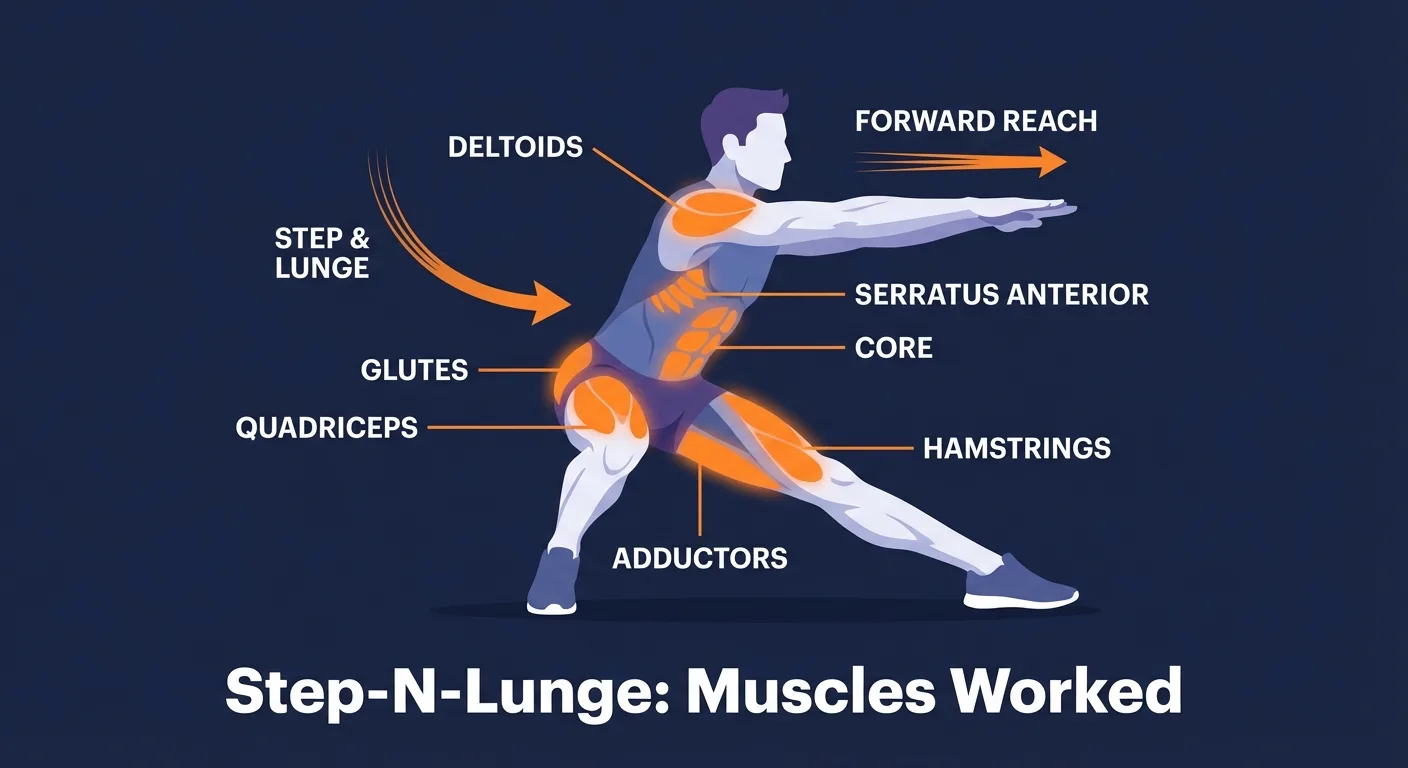
Primary movers: the quadriceps, gluteus maximus, adductors, and hamstrings of the lunging leg. They control the descent eccentrically as you step wide and bend the knee, then contract concentrically as you drive back to center.
Secondary movers: the gluteus medius and other hip abductors help keep the pelvis level, while the calves help manage foot pressure and the return step. The anterior deltoids raise the arms forward, and the serratus anterior helps the shoulder blades glide around the rib cage.
Stabilizers: the rectus abdominis, transverse abdominis, obliques, spinal erectors, ankle stabilizers, and deep hip rotators work isometrically so the torso stays tall as the legs move side to side. The cardiovascular system, lungs, phosphocreatine system, glycolytic system, and oxidative system all contribute as the interval gets longer.
Mechanism: Step-N-Lunge creates a conditioning effect by repeating a large lower-body movement on alternating sides while the arms move away from the torso. The side lunge loads hip abduction and adduction more than forward-only lunges, and the reach adds a trunk-control demand because the body has to stay stacked while the arms shift forward.
Step-by-Step: How to Do Step-N-Lunge
- Set your stance. Stand tall with your feet hip-width apart, chest lifted, and hands together in front of your chest. Coach Ty's cue: "Start tall before you move. Ribs over hips."
- Step wide into a side lunge. Take a wide step to the right. Bend the right knee, push your hips back, keep the left leg long, and keep both feet flat. Coach Ty's cue: "Big step, knee over toes."
- Reach forward at chest level. As you sink into the lunge, extend both arms straight forward from your chest. Keep the hands at chest height. Coach Ty's cue: "Reach long without dropping your chest."
- Drive back to center. Push through the heel and midfoot of the right leg to stand back up. Pull your hands to your chest as your feet meet. Coach Ty's cue: "Push the floor away and reset tall."
- Repeat on the opposite side. Step left, lunge, reach, return, and keep alternating. Exhale on the reach and inhale as you return. Coach Ty's cue: "Same depth, same reach, every rep."
Get this exercise in a personalized workout
FitCraft, our mobile fitness app, uses its AI coach Ty to program conditioning work like this into your plan at the right volume and intensity, based on your level, goals, and equipment. Ty was designed and trained by Domenic Angelino, MPH (Brown University) and NSCA-CSCS, with research published in the Journal of Strength and Conditioning Research and Medicine & Science in Sports & Exercise.
Take the Free Assessment Free • 2 minutes • No credit card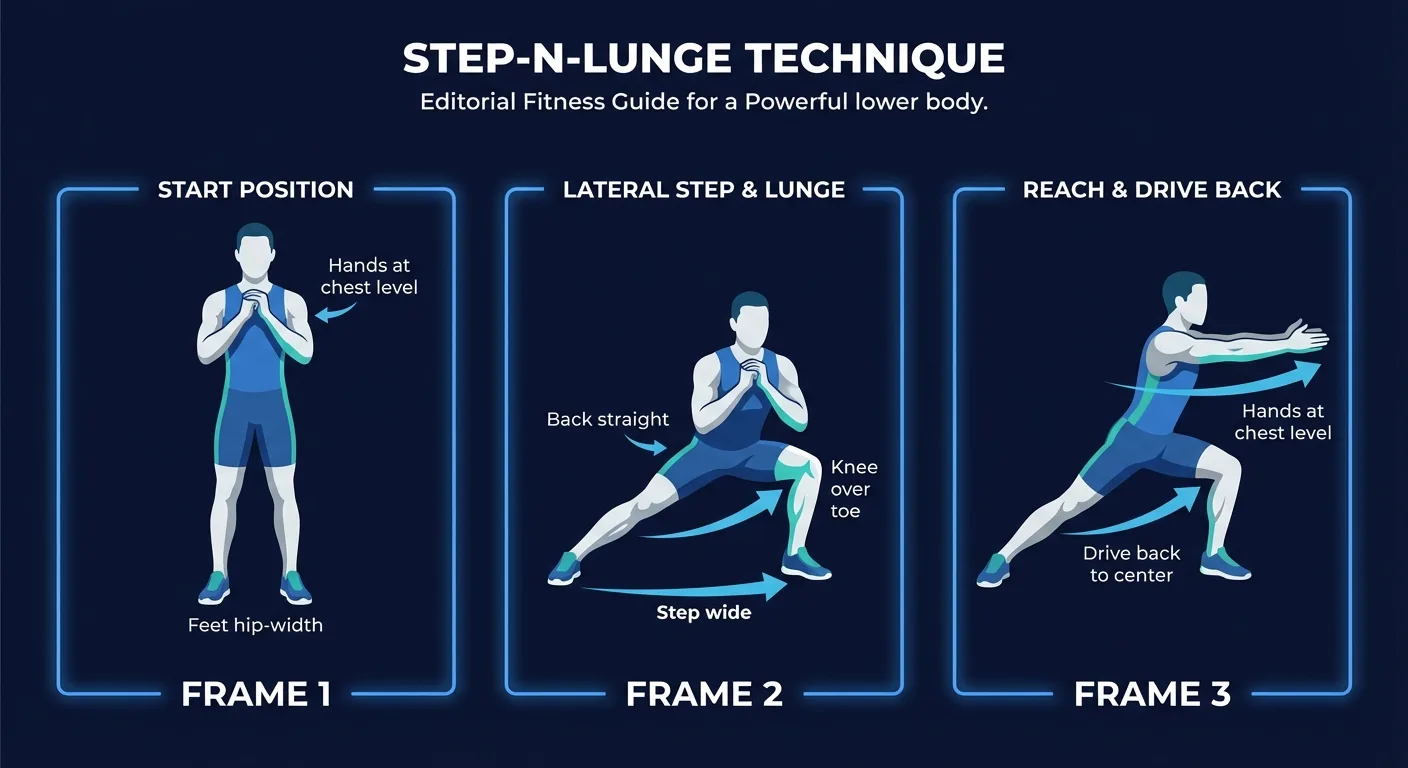
Common Mistakes and How to Fix Them
Taking Too Small a Step
What it looks like: the foot barely moves to the side, the knee bends only a little, and the body stays almost vertical.
Why it matters: a narrow step turns the movement into a side step with an arm reach. You miss the hip and adductor training that makes the drill useful.
The fix: step wide enough that your hips have room to travel back. If depth feels blocked, slow down and use a smaller range until your hip mobility improves.
Letting the Knee Collapse Inward
What it looks like: the lunging knee falls toward the midline instead of tracking over the toes.
Why it matters: knee collapse under speed can irritate the knee and turns a clean lateral pattern into a sloppy one.
The fix: keep the lunging foot planted and gently drive the knee in the same direction as the toes. Use a slower tempo if you can't control the line.
Dropping the Arm Reach
What it looks like: the hands start at chest height but drift toward the waist as fatigue builds.
Why it matters: the chest-height reach is what adds shoulder and core work. Dropping the hands removes that demand.
The fix: choose a visual target at chest height and reach toward it every rep. End the set when you can't hold that height.
Rounding the Back at the Bottom
What it looks like: the chest folds toward the floor and the spine rounds as you reach forward.
Why it matters: rounding shifts the movement away from the hips and makes the reach harder to control.
The fix: keep the ribs stacked over the pelvis. Think "hips back, chest proud" as you lunge.
Rushing the Return
What it looks like: you bounce out of the bottom and let momentum carry you to center.
Why it matters: bouncing reduces the muscular work and makes each rep less predictable.
The fix: pause for a half count at the bottom for one or two sets. Once control improves, return to a smoother cardio rhythm.
Step-N-Lunge Variations and Progressions
Shallow Step-N-Lunge
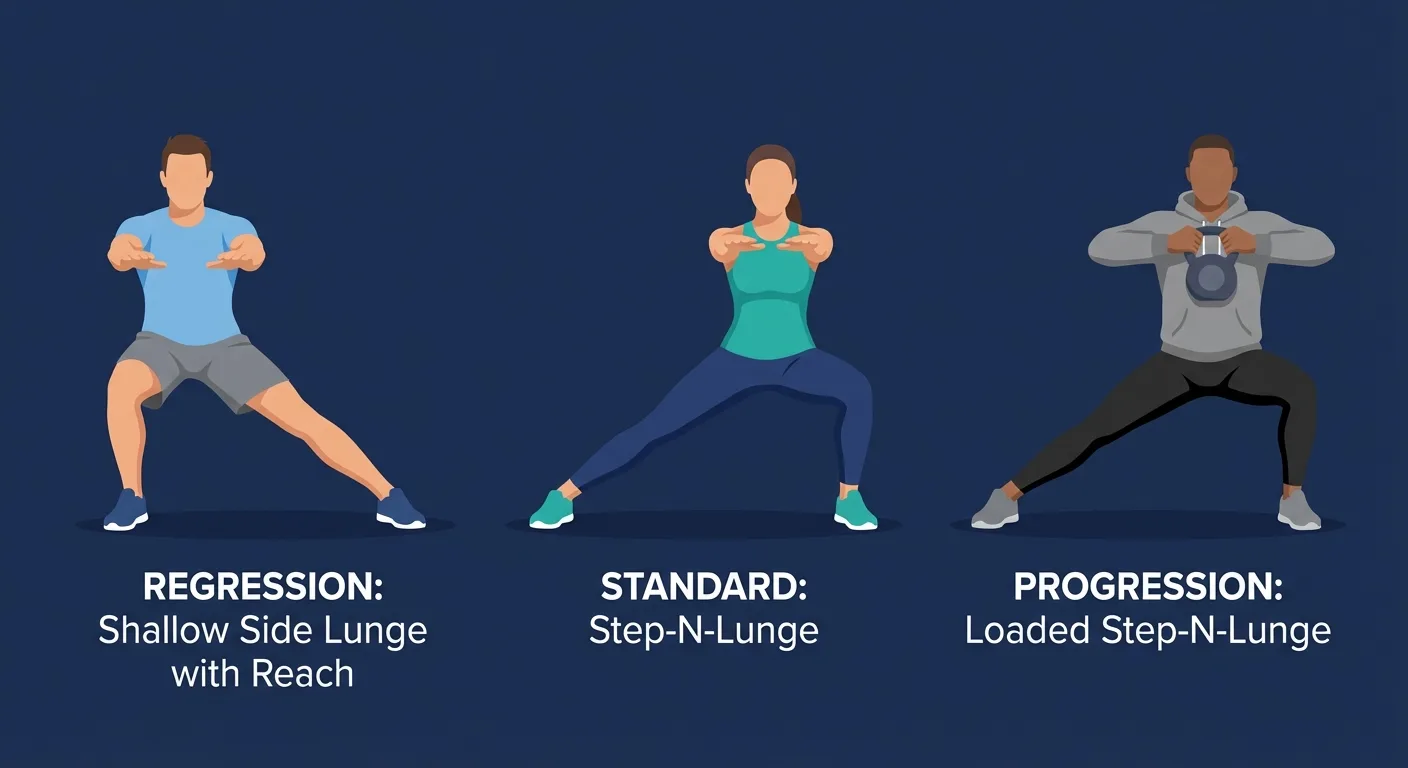
Use the same step and reach pattern, but cut the depth in half. This is the best starting point if your knees, hips, or adductors need more time to adapt.
Step-N-Lunge With Pause
Pause at the bottom of each side lunge before driving back to center. The pause makes it easier to feel knee tracking, foot pressure, and chest position.
Step-N-Lunge With Overhead Reach
Reach both arms up and slightly forward instead of straight ahead. This increases shoulder demand and makes the core work harder to keep the ribs down.
Light Loaded Step-N-Lunge
Hold a light dumbbell or medicine ball at chest level and reach it forward. Keep the load light because the rhythm and lateral control matter more than resistance.
When to Avoid or Modify Step-N-Lunge
Step-N-Lunge is safe for many healthy adults, but lateral lunging and repeated conditioning intervals still require judgment. Modify the range, slow the tempo, or choose a lower-intensity option when the movement changes your joint position or breathing beyond what you can control. Always consult your physician before starting or returning to exercise if you have a medical condition, recent injury, or pregnancy-related concern.
- Knee pain during lateral lunges. Use a shallow range, slow tempo, or supported squats. Stop if pain changes your knee tracking.
- Acute hip, groin, ankle, shin, or foot injury. Step-N-Lunge loads the side-to-side pattern. Use marching in place or walking in place until the injury is cleared.
- Known cardiovascular disease or uncontrolled hypertension. Conditioning intervals can raise heart rate and blood pressure quickly. Get clinical clearance and stay within prescribed intensity zones.
- Pregnancy or early postpartum recovery. Joint laxity, pelvic-floor pressure, and balance changes can make lateral conditioning less predictable. Use slower, supported work and follow your clinician's guidance.
- Stress incontinence, pelvic-floor symptoms, vertigo, or balance disorders. Use low-impact, slower drills and hold a stable support as needed. Fast side-to-side changes are optional.
- Asthma or exercise-induced bronchoconstriction. Extend your warm-up, keep prescribed medication accessible, and reduce interval intensity if breathing control breaks down.
Related Exercises
- Lower-impact same-pattern option: Step-N-Clap keeps the lateral rhythm simpler.
- Upper-body rhythm variation: Step-N-Punch pairs side steps with chest-level punches.
- Lateral conditioning progression: Side-Lunge Toe Touch adds more range and trunk control.
- Hip-control variation: Side-Lunge Lean keeps the side-lunge emphasis without the forward reach.
- Strength foundation: Side Lunges and Squats build the lower-body base for cleaner reps.
- Core foundation: Deadbugs help train the trunk position needed when the arms reach away from the body.
How to Program Step-N-Lunge
Ratamess et al., 2009 outlines progressive training principles that apply well here: increase volume, density, or difficulty only when form stays repeatable. For Step-N-Lunge, that means depth and knee tracking come before longer intervals.
| Level | Work interval | Rest between sets | Frequency |
|---|---|---|---|
| Beginner | 20-30 seconds | 60-90 seconds | 2-3 sessions/week |
| Intermediate | 30-45 seconds | 45-60 seconds | 3-4 sessions/week |
| Advanced | 45-60 seconds | 30-45 seconds | 3-5 sessions/week |
Where in your workout: use Step-N-Lunge in a conditioning circuit, as a low-impact HIIT station, or as a short finisher after strength work. Keep it after heavy squat or lunge work so fatigue from the interval doesn't reduce the quality of your strength sets.
Form floor: stop the set when the lunging knee caves, the trailing heel lifts, the chest folds, or the arm reach drops below chest height. A shorter clean interval beats a longer sloppy one.
Frequently Asked Questions
What is the Step-N-Lunge exercise?
Step-N-Lunge is a low-impact conditioning drill that pairs an alternating lateral lunge with a forward arm reach at chest height. It trains the legs, hips, core, shoulders, and cardiovascular system without jumping.
What muscles does Step-N-Lunge work?
Step-N-Lunge primarily works the quadriceps, glutes, adductors, and hamstrings on the lunging side. The hip abductors, calves, core, spinal erectors, anterior deltoids, and serratus anterior help stabilize the reach and return.
Can I do Step-N-Lunge with knee pain?
Modify or skip Step-N-Lunge if lateral lunging causes knee pain. Start with a shallow side lunge, slow the tempo, keep the knee tracking over the toes, or use lower-impact options like walking in place, marching in place, or supported squats. Persistent pain should be assessed by a qualified clinician.
How deep should I go in Step-N-Lunge?
Go only as deep as you can keep the lunging foot flat, knee tracking over the toes, trailing leg long, and chest lifted. A parallel thigh is a strong target, but a clean shallow range beats a deep rep with knee collapse.
How should I program Step-N-Lunge?
Use Step-N-Lunge as a low-impact conditioning interval. Beginners can start with 20 to 30 seconds of work and 60 to 90 seconds of rest. Intermediate and advanced users can progress toward 45 to 60 seconds of work while keeping depth and arm height consistent.