The high knee-n-crunch takes two exercises you already know, high knees and crunches, and smashes them together into a standing cardio-core hybrid. You drive one knee up as high as you can while pulling your arms down from overhead to meet it. Think of it as a standing vertical crunch where the raised knee replaces the floor. Every rep hits your abs and hip flexors while keeping your heart rate elevated. It is one of the most time-efficient bodyweight exercises you can do because you are training core strength and cardiovascular fitness simultaneously.
But here is the problem most people run into. They turn it into a sloppy arm-waving drill where the knee barely leaves the ground and the arms flop around without a real crunch. When that happens, you are basically doing a shuffling march with bent elbows, which looks like something but trains almost nothing. A 2020 systematic review published in the International Journal of Environmental Research and Public Health confirmed that multi-joint dynamic exercises produce greater overall core muscle activation than isolated movements (Martuscello et al., 2020). The high knee-n-crunch fits that description perfectly, but only when the knee drives high and the crunch is real.
This guide covers the exact technique, the mistakes that turn the exercise into theater, and the progression path from slow-tempo marching all the way to rapid-fire HIIT sets.
Quick Facts: High Knee-N-Crunches
- Equipment needed: None (bodyweight only)
- Difficulty: Intermediate (beginner-accessible via the marching variation)
- Modality: Cardio-core hybrid · Dynamic standing pattern · Low to moderate impact
- Body region: Anterior core, hip flexors, lower body, cardiovascular system
- FitCraft quest category: Conditioning / Core
Muscles & Systems Worked
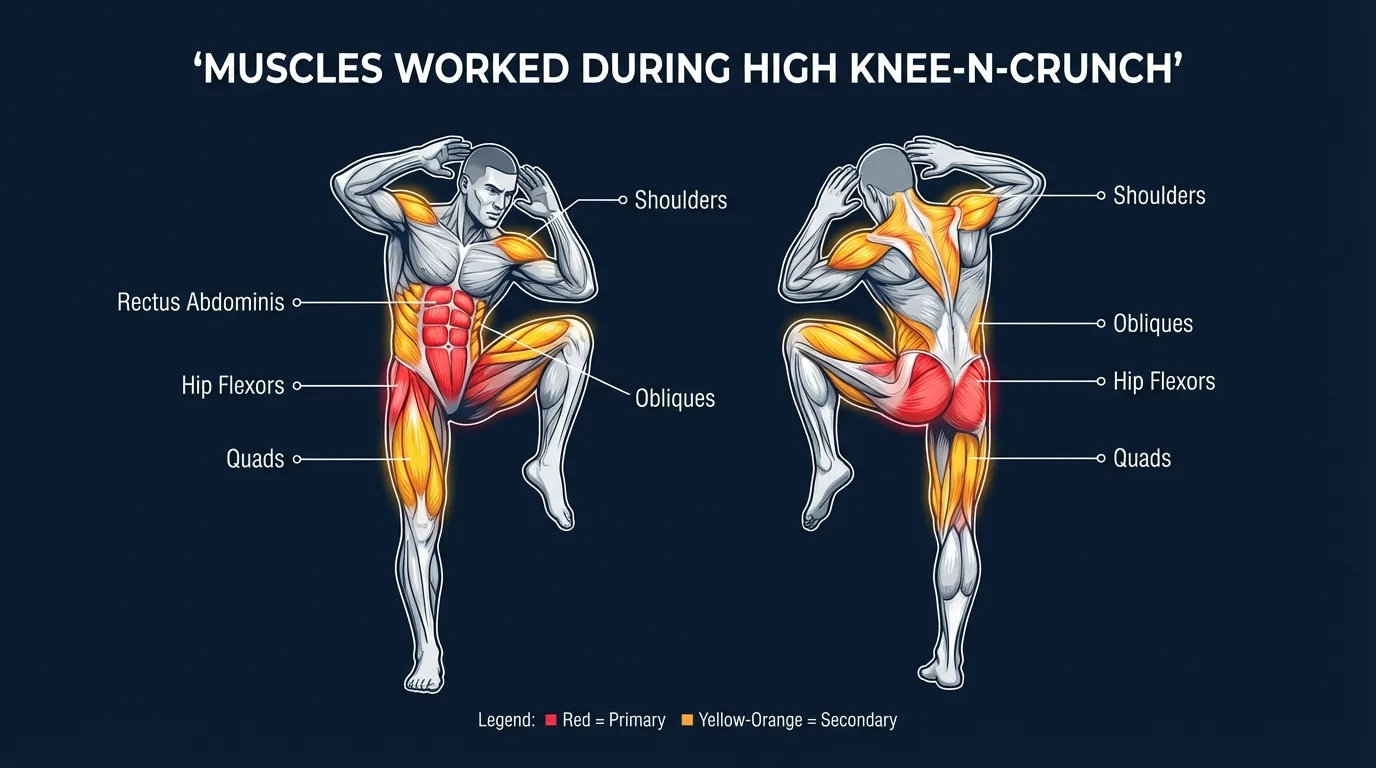
Primary movers: the rectus abdominis (front abs) and the hip flexors (iliopsoas and rectus femoris). The rectus abdominis shortens concentrically every time you pull your arms and ribcage down toward the rising knee. The hip flexors drive the knee upward in an explosive concentric contraction. Both work hard on every single rep, which is what makes this exercise a real core movement rather than just a cardio drill with extra arm motion.
Secondary movers: the obliques (internal and external) assist trunk flexion and resist any unwanted rotation; the quadriceps stabilize the standing leg and assist the knee drive; the calves (gastrocnemius and soleus) handle the toe-off and landing on each side; the glutes fire to control hip extension on the planted leg; the shoulders (anterior and posterior deltoids) and lats decelerate the arm swing into the crunch position.
Stabilizers and systems: the deep core (transverse abdominis) and spinal erectors hold the trunk stable during the dynamic alternation; the ankle stabilizers (peroneals, tibialis anterior and posterior) manage foot-strike control. On the systems side, the cardiovascular system works hard because the alternating full-body motion keeps heart rate elevated, and the phosphocreatine and glycolytic energy systems supply the rapid power for the explosive knee drives, especially during short, intense intervals.
Why multi-joint dynamic movement out-activates floor crunches: Martuscello et al. (2020) systematically reviewed core muscle activation across exercise types and found that integrated, multi-joint dynamic exercises (the category the high knee-n-crunch belongs to) produce greater overall core activation than isolated core exercises like floor crunches. The mechanism is simple: when the trunk has to stabilize against rapid limb movement while also producing trunk flexion against gravity, the rectus abdominis, obliques, and deep core all fire together. A floor crunch isolates the rectus abdominis; the high knee-n-crunch makes the whole core system work as one unit.
How to Do the High Knee-N-Crunch (Step-by-Step)
- Stand tall with your arms reaching overhead. Feet hip-width apart. Reach both arms straight up over your head, biceps close to your ears, palms facing in or forward. Brace your core, pull your shoulders down and back, and stand straight. This is your starting position for every rep.
Coach Ty's cue: "Stand as tall as you can. Long spine, ribs stacked over hips. The taller you start, the more range of motion you get on the crunch." - Drive one knee up as high as it will go. Drive your right knee upward hard, like you are stepping over a tall hurdle. Get the thigh as close to parallel with the floor as possible, or higher if you can. Your left foot stays planted with a slight bend at the knee for stability. Do not let the standing leg lock out.
Ty's cue: "Drive the knee, do not just lift it. Explosive up, controlled down. The drive is what makes this a cardio exercise." - Crunch your arms straight down to meet the rising knee. At the same instant the knee drives up, pull your arms and torso straight down toward the top of your raised knee. Both arms come down together. This is a vertical crunch, not a twist. Squeeze your abs hard at the bottom, as if you are trying to crush a walnut between your arms and your knee. A short, sharp contraction is the goal.
Ty's key cue: "Pull with your abs, not your arms. The arms are just along for the ride. If your abs aren't burning by rep 10, you are arm-waving." - Return to start and alternate knees. Lower your right foot back to the ground and reach your arms back overhead to the tall starting position. Immediately drive your left knee up and crunch your arms down again to meet it. Alternate knees with every rep, right, left, right, left, in a continuous, rhythmic motion.
Ty's cue: "Reset to tall between every rep. If you start staying hunched, you lose the range of motion on the crunch." - Breathe and find your rhythm. Exhale hard on every crunch. Inhale as your arms reach back overhead. Keep a brisk, rhythmic pace, but remember, it is not a race. Quality over quantity, always. Beginners: 3 sets of 20 total reps (10 per side) at a moderate tempo.
Ty's reminder: "Speed without contraction is just cardio. Slow down until you feel every crunch. Then build the tempo from there."
Get this exercise in a personalized workout
FitCraft, our mobile fitness app, uses its AI coach Ty to program conditioning work like this into your plan at the right volume and intensity, based on your level, goals, and equipment. Ty was designed and trained by Domenic Angelino, MPH (Brown University) and NSCA-CSCS, with research published in the Journal of Strength and Conditioning Research and Medicine & Science in Sports & Exercise.
Take the Free Assessment Free · 2 minutes · No credit card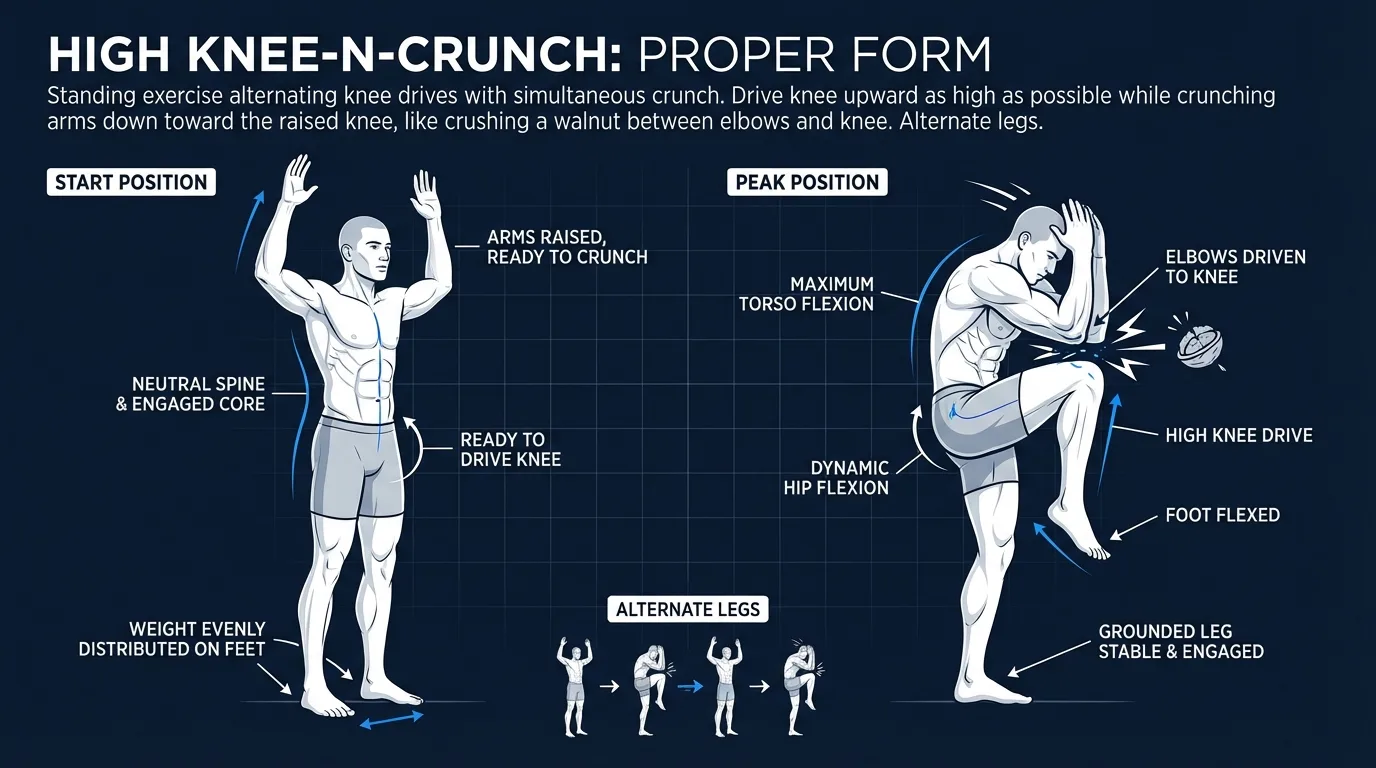
Common Mistakes (and How to Fix Them)
The high knee-n-crunch looks simple in a demo. In practice, these are the form breakdowns that turn it from effective to pointless.
- No actual crunch happening. Many people drive the knee up just fine but barely move their upper body. The arms stay behind the head, the torso stays upright, and the core does almost nothing. You are just doing high knees with a different arm position. Fix: focus on bringing your ribcage toward the rising knee. You should feel your abs contract on every single rep. If you do not, the crunch is fake.
- Knee drive that barely leaves the floor. The other common version of the same problem. The arms crunch, but the knee only comes up to mid-thigh height. The hip flexors and quads barely fire. Fix: imagine stepping over a tall hurdle. Thigh approaches parallel to the floor or higher. If you can't get there, regress to the marching variation and build hip-flexor strength first.
- Leaning too far forward. Some people overcompensate by bending at the waist and staying hunched between reps. This takes your spine out of neutral and loads the lower back. The crunch should be a short, sharp contraction, not a full forward fold. Think of it as a 20-degree trunk flexion, not a 45-degree bow. Fix: reset to a tall standing position between every rep.
- Going too fast without control. Speed is part of the exercise, but speed without deliberate contraction is just cardio with extra arm movement. Research consistently shows that the quality of muscle activation matters more than rep speed for core development (McGill, 2010). Start at a pace where you feel your abs engage on every rep. Build speed from there.
- Standing leg locking out. When fatigue hits, the planted knee can snap into full extension on every rep. That hard rebound goes straight into the joint. Fix: keep a soft bend in the standing knee throughout the set. The standing leg is a shock absorber, not a stick.
High Knee-N-Crunch Variations: Beginner to Advanced
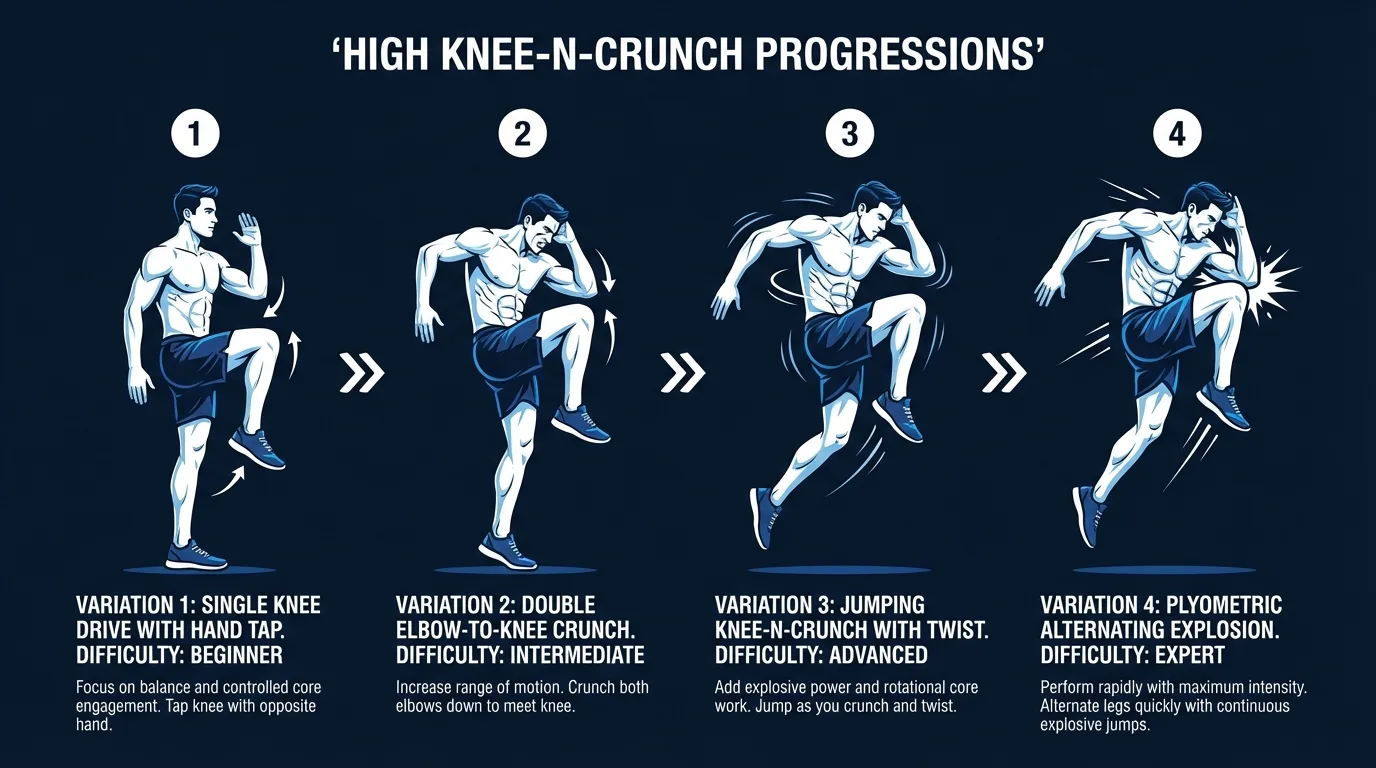
Marching Knee-N-Crunch (Beginner)
Same movement, but at a walking pace. Instead of driving the knee explosively, march in place and crunch slowly with each step. This removes the impact, reduces the balance challenge, and lets you focus on the crunch contraction. When you can do 3 sets of 20 reps (10 per side) with a strong contraction on every rep, move to the standard version.
Standard High Knee-N-Crunch (Intermediate)
The full version described above. Explosive knee drive, deliberate crunch, continuous alternation at moderate to fast pace. This is the version Ty programs for most users. Master the contraction quality before chasing speed.
Rapid-Fire High Knee-N-Crunch (Advanced)
Same exercise at maximum speed for timed intervals. Think 30-45 seconds of all-out effort. This turns the exercise into a serious cardio challenge on top of the core work. Only go full speed if your crunch stays real. If the upper-body component disappears at high speed, slow back down. A fast exercise done poorly trains nothing.
Hop-and-Crunch (Plyometric Advanced)
Add a small hop on the standing leg as the opposite knee drives up. The hop turns the exercise into a low-grade plyometric, raising the cardiovascular demand and adding a ballistic load to the calves and glutes. Skip this variation if you have any knee, ankle, or pelvic-floor concerns. Land softly through the midfoot with a soft knee bend.
Alternative Exercises
If the high knee-n-crunch is not accessible right now, these alternatives train similar patterns:
- High knees: Same lower-body cardio pattern without the crunch component. If coordination is the issue, master high knees first and add the crunch later. High knees alone are still an effective cardio drill for building the explosive knee drive.
- Crunches: The floor-based version of the crunch component. If your core is too weak for the standing version, build baseline strength with standard crunches. Once you can do 3 sets of 20 with control, you are ready to try the standing combination.
- Mountain climbers: Another dynamic cardio-core exercise that combines knee drives with core stabilization. Different body position (plank vs. standing) but a similar training effect, core work plus cardiovascular conditioning in one movement.
- Marching in place: The lowest-impact regression. Useful for warm-up, active recovery, or as the entry point if balance or joint sensitivity rules out the marching knee-n-crunch.
When to Avoid or Modify High Knee-N-Crunches
The high knee-n-crunch is safe for most healthy adults, but a few conditions call for modification or swapping in a lower-impact alternative. None of these are permanent restrictions. They are starting points. Always consult your physician or physical therapist for personalized guidance, especially before starting or returning to high-intensity exercise.
- Known cardiovascular disease or uncontrolled hypertension. HIIT-style work spikes heart rate and blood pressure rapidly. Get your cardiologist's approval before adding intervals and stay within their prescribed heart-rate zones. Use the marching variation at a moderate pace, not the rapid-fire HIIT version, until cleared.
- Acute knee, ankle, hip, or foot injury (including patellofemoral pain, plantar fasciitis, shin splints). The explosive knee drive and the standing-leg load can aggravate any of these. Drop to the marching knee-n-crunch at walking pace, reduce knee height, and keep both feet in contact with the floor. If pain persists, substitute with deadbugs or bird-dogs for the core stimulus without the impact.
- Lower-back pain that worsens with trunk flexion. The crunch component is a repeated trunk flexion. If your back hurts when you fold forward, this exercise will likely make it worse. Build core stability with neutral-spine alternatives like forearm planks, deadbugs, and bird-dogs first, then revisit when flexion is pain-free.
- First 6-12 weeks postpartum, active diastasis recti, or pelvic-floor weakness. The impact of the knee drive combined with repeated trunk flexion can stress an unrecovered pelvic floor and worsen abdominal separation. Get clearance from a pelvic-floor PT. Until then, prioritize diaphragmatic breathing, transverse abdominis activation with deadbugs, and the marching variation only.
- Stress incontinence. Even the marching variation may trigger leakage; the rapid-fire HIIT version almost certainly will. Strengthen the pelvic floor first and substitute non-impact core work (deadbugs, forearm planks) until you can manage the load.
- Vertigo or balance disorders. The single-leg balance phase and rapid alternation increase fall risk. Use a stable surface for hand support, slow the tempo, and reduce knee height. If balance remains a concern, substitute with seated or supine core work.
Related Exercises
If the high knee-n-crunch is part of your routine, these movements complement or extend the same training pattern:
- Lower-impact alternative within the same pattern: Marching in place and high knees give you the same standing cardio pattern without the crunch component. Useful for warm-up, active recovery, or rebuilding the movement after time off.
- Core foundation: Crunches, deadbugs, and forearm planks isolate the trunk-stability and trunk-flexion patterns that the high knee-n-crunch combines.
- Cardio-core hybrid alternatives: Mountain climbers, bicycle crunches, and burpees train the same dynamic core-plus-conditioning effect from different positions.
- Same conditioning family (HIIT-friendly): Jumping jacks and march-n-chop drop into the same circuit slots and balance the high knee-n-crunch with different movement planes.
- Ankle and lower-leg conditioning: Calf raises build the calves and ankle stabilizers that absorb impact and produce the explosive toe-off on every knee drive.
How to Program High Knee-N-Crunches
Cardio-core hybrid exercises like the high knee-n-crunch are programmed by work-and-rest intervals or by timed sets, not by sets and reps in the strength-training sense. The American College of Sports Medicine (ACSM) Position Stand on resistance training applies for the core-strength portion (roughly 12-20 reps per set for muscular endurance, with progressive overload through tempo and volume), while HIIT programming uses work-to-rest ratios tuned to fitness level (Ratamess et al., 2009).
| Level | Work × Rest | Sets or total session | Frequency |
|---|---|---|---|
| Beginner (marching pace) | 20-30 sec work / 60-90 sec rest | 3 sets, or 10-15 min total session | 2-3 sessions/week |
| Intermediate (standard tempo) | 30-45 sec work / 45-60 sec rest | 3-4 sets, or 15-25 min total session | 3-4 sessions/week |
| Advanced (rapid-fire, Tabata) | 20-60 sec work / 10-30 sec rest | 4-8 rounds in a circuit, or 20-30 min total | 3-5 sessions/week |
Where in your workout: high knee-n-crunches fit best as a metabolic finisher at the end of a strength session (5-10 minutes max), as one station in a 4-6 movement HIIT circuit, or as a standalone cardio-core session. Do not place HIIT work before heavy resistance training. The glycolytic depletion will compromise your lifts. Before a low-intensity zone-2 cardio session is acceptable.
Form floor over rep targets: if your last few reps lose the real crunch (arms flopping, knee dropping, torso staying upright), stop the set there. A 25-second set with a real crunch on every rep trains more than a 45-second set that turns into shuffling.
How FitCraft Programs This Exercise
Knowing how to do a high knee-n-crunch is step one. Knowing when to do it, how long to work, and when to scale up is where most people get stuck.
FitCraft's AI coach Ty handles that. During your personalized diagnostic assessment, Ty maps your fitness level, goals, and any joint or cardiovascular considerations. Then Ty builds a personalized plan that slots the high knee-n-crunch into cardio-core circuits at the right intensity for your level, swapping in the marching variation when impact needs to come down or the rapid-fire interval when you are ready for the conditioning challenge.
As your conditioning improves, Ty adjusts the variation and the work-to-rest ratio to match your current capacity. Marching becomes standard tempo. Standard tempo becomes Tabata intervals. Every program is built by an Ivy League-trained exercise scientist and NSCA-certified strength coach using evidence-based periodization, then adapted to you by the AI.
Frequently Asked Questions
Can I do high knee-n-crunches if I have knee pain?
Not at full impact. The explosive knee drive and the standing-leg load can aggravate patellofemoral pain, meniscus issues, or arthritic knees. Drop to the marching knee-n-crunch (walking pace, no impact) and reduce the knee height so the standing leg never has to absorb a hard rebound. If pain persists beyond a few sessions of the marching variation, see a physical therapist before progressing. Build foundational lower-body and core strength with low-impact alternatives like deadbugs and bird-dogs first.
What muscles does the high knee-n-crunch work?
The high knee-n-crunch primarily targets the rectus abdominis and hip flexors (iliopsoas, rectus femoris). Secondary movers include the obliques, quadriceps, calves, glutes, shoulders, and lats. The cardiovascular and metabolic systems also work hard because the continuous alternating motion keeps your heart rate elevated. The standing crunch component trains the upper abs as you pull your arms down, while the explosive knee drive engages the hip flexors, quads, and core stabilizers.
Is the high knee crunch good for burning calories?
Yes. The high knee-n-crunch is one of the most efficient calorie-burning bodyweight exercises because it combines core work with cardiovascular conditioning. The continuous alternating movement keeps your heart rate elevated, and the large muscle groups involved increase total energy expenditure compared to floor-based crunches.
How many high knee crunches should I do?
For most people, 3 sets of 20-30 total reps (10-15 per side) or 3 sets of 30-45 seconds is a solid starting point. Beginners should focus on controlled movements at a moderate pace. Intermediate and advanced athletes can increase speed and duration.
Can beginners do the high knee-n-crunch?
The high knee-n-crunch is an intermediate exercise, but beginners can start with the marching variation, which uses the same movement at walking pace. This removes the impact, reduces the balance challenge, and lets you focus on the crunch contraction. Practice high knees and crunches separately first if coordination is an issue.
What is the difference between high knees and high knee crunches?
Standard high knees are purely a cardio drill. You drive your knees up rapidly while pumping your arms. The high knee-n-crunch adds an upper-body crunch, pulling both arms down to meet the rising knee. This engages the rectus abdominis and obliques far more than regular high knees, turning a cardio-only exercise into a cardio-core hybrid.