Quick Facts: March-N-Chop
- Equipment needed: None (optional: light medicine ball or dumbbell for the weighted variation)
- Difficulty: Intermediate (beginners scale with slow-tempo or paused variations)
- Modality: Cardio-core hybrid; low-impact at standard tempo, plyometric at advanced
- Body region: Full body, oblique and hip-flexor dominant
- FitCraft quest category: Conditioning circuits and rotational core blocks
The march-n-chop is a standing bodyweight exercise that pairs a high-knee march with a diagonal chopping arm motion. You drive one knee up while your clasped hands chop down toward the rising knee, then return overhead and repeat on the opposite side. It looks simple. It is not. Done at a brisk pace, the march-n-chop hammers your obliques, spikes your heart rate, and demands coordination that most single-plane cardio moves never touch.
Muscles and Systems Worked
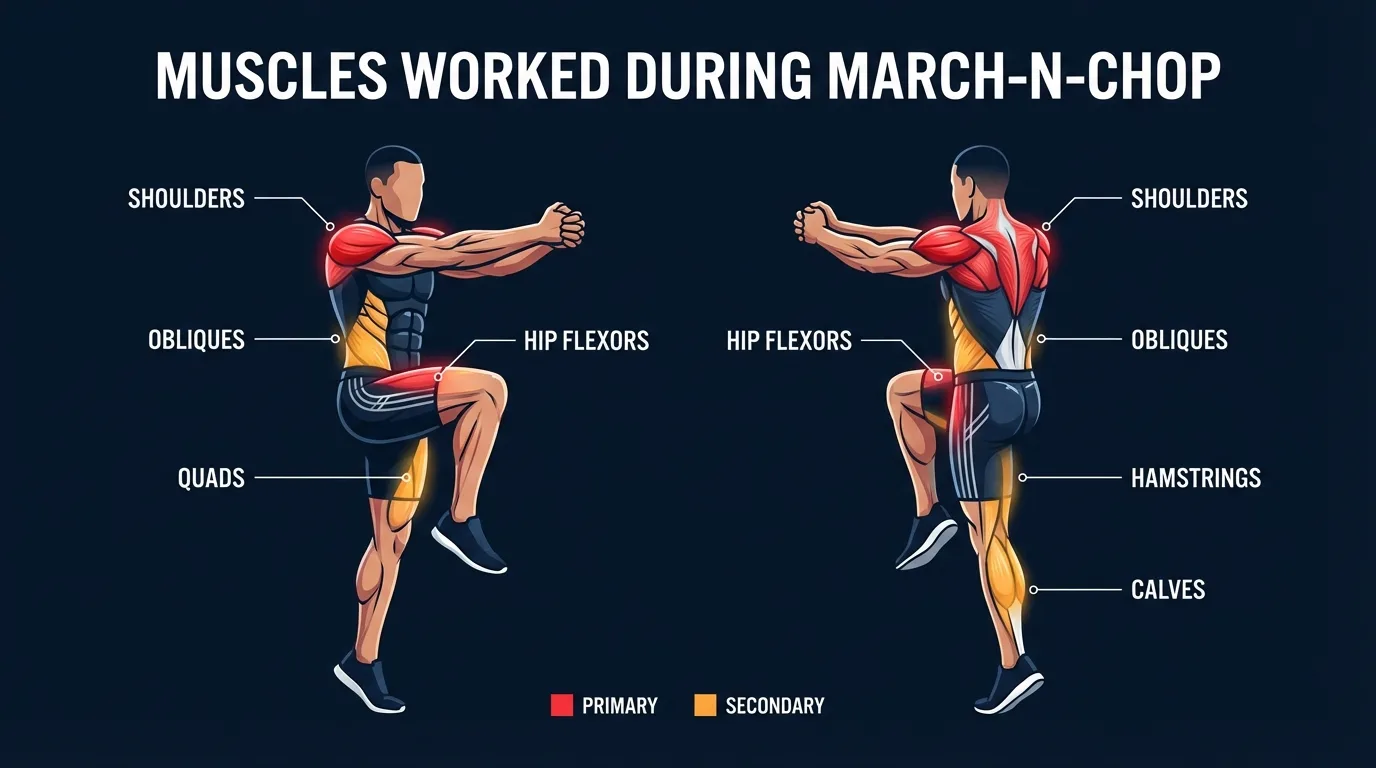
Primary movers. The obliques (internal and external) drive the trunk rotation during the chop. They contract concentrically as you rotate toward the lifting knee and eccentrically as you sweep your arms back overhead. The hip flexors (iliopsoas and rectus femoris on the lifting leg) produce the knee drive, working concentrically on the way up and supporting eccentric control on the way down.
Secondary movers. The rectus abdominis assists trunk flexion as the hands chop down. The glutes and quadriceps of the standing leg stabilize the hip and knee against the off-axis load created by the moving limb. The lats, posterior deltoids, and triceps decelerate the chop and re-extend the arms overhead. The anterior deltoids and biceps assist the return path.
Stabilizers and systems. The transverse abdominis braces the spine isometrically through every rep. Spinal erectors and quadratus lumborum prevent lateral collapse during the single-leg phase. The peroneals, tibialis anterior, and intrinsic foot muscles of the standing leg manage balance. The cardiovascular system (heart, lungs) and the glycolytic and oxidative energy systems carry the metabolic load at brisk tempos; at 30-45 second work intervals, this is firmly aerobic-to-glycolytic conditioning territory.
Mechanism. What makes the march-n-chop especially effective is the rotational component. Most bodyweight cardio stays in the sagittal plane (forward and back, up and down). The diagonal chop adds transverse-plane rotation, which loads the obliques and transverse abdominis in the way they actually function during daily life: stabilizing the spine while producing controlled rotation. Pairing that demand with a knee drive turns each rep into a coordinated full-kinetic-chain movement, which is why heart rate climbs faster than during a same-tempo straight march.
Step-by-Step Instructions
- Stand tall with feet hip-width apart, hands overhead. Clasp your hands together or press your palms against each other. Extend your arms fully overhead. Pull your shoulders down away from your ears, brace your core, and keep your chest lifted. This is your start position for every rep.
- Drive your right knee up to waist height. Think about pulling your knee straight up, not swinging it forward. Your thigh should reach roughly parallel to the floor. Keep your standing leg slightly bent to maintain balance.
Coach Ty's cue: "Knee up to waist height, every single rep. Half-height knee drives cut the hip flexor engagement in half and reduce the core demand."
- Chop your hands down toward the outside of your right hip. As the knee comes up, bring both hands down in a diagonal line across your body. Your torso rotates slightly toward the lifting knee. The power comes from your obliques contracting. Your arms are just along for the ride.
Coach Ty's cue: "The chop comes from your core, not your arms. Torso rotates first, hands follow."
- Return to the start. Lower your right foot back to the floor and sweep your arms back overhead in one smooth motion. Control the movement on the way up. Don't let gravity and momentum do the work for you.
Coach Ty's cue: "Control the arms on the way back up. That eccentric phase is free core work; don't waste it."
- Immediately drive your left knee up and chop to the left. Mirror the movement on the opposite side. Left knee up, hands chop down toward the outside of your left hip, torso rotates slightly left. Then return overhead.
- Alternate sides at a steady, brisk pace. Each knee-drive-plus-chop counts as one rep. Maintain a rhythm that keeps your heart rate elevated but lets you keep clean form. Exhale on every chop, inhale on every return.
Coach Ty's cue: "Breathe out on the chop. Every time. Exhaling increases intra-abdominal pressure and helps your obliques fire harder."
Get this exercise in a personalized workout
FitCraft, our mobile fitness app, uses its AI coach Ty to program conditioning work like this into your plan at the right volume and intensity, based on your level, goals, and equipment. Ty was designed and trained by Domenic Angelino, MPH (Brown University) and NSCA-CSCS, with research published in the Journal of Strength and Conditioning Research and Medicine & Science in Sports & Exercise.
Take the Free Assessment Free · 2 minutes · No credit card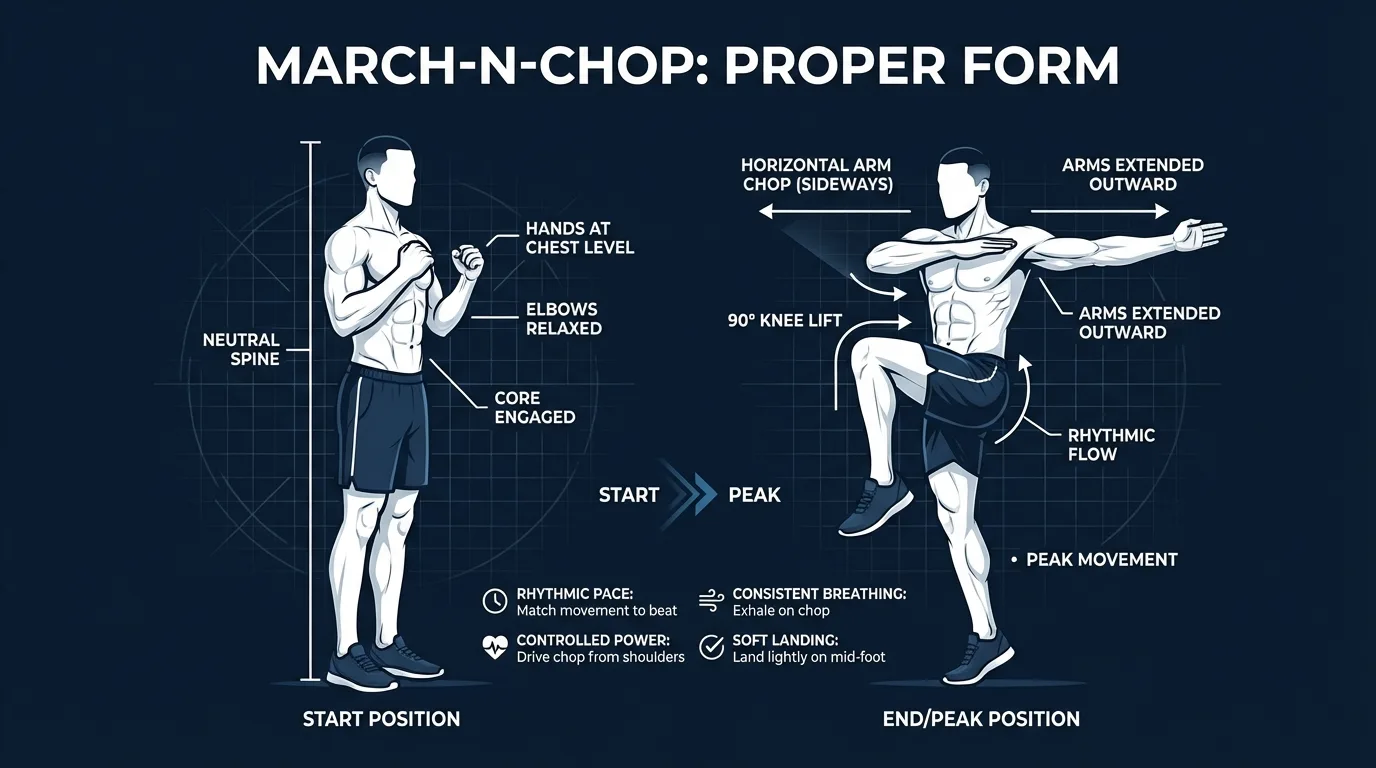
Common Mistakes
- Chopping with just the arms. The most common error. People swing their hands down without rotating through the trunk. The arms should follow the torso's rotation. If your obliques aren't burning after 20 seconds, you're doing the arm-swing version.
- Low knee drives. When the pace picks up, knee height drops. Your thigh needs to reach at least parallel to the floor on every rep. If it doesn't, reduce your speed until it does. Partial reps produce partial results.
- Rounding the upper back on the chop. Crunching forward to bring your hands closer to your knee compromises your spine position and takes tension off your obliques. Keep your chest open and your spine neutral. The rotation comes from your midsection rotating, not your shoulders collapsing.
- Holding your breath. At a brisk pace, the march-n-chop will drive your heart rate up fast. If you hold your breath, you'll gas out in under 20 seconds. Establish a steady exhale-on-chop, inhale-on-return pattern from your first rep.
- Losing balance on the standing leg. If you're wobbling on every rep, your standing foot isn't grounded properly. Press your entire foot into the floor: big toe, little toe, and heel. A slightly bent standing knee also helps.
Variations
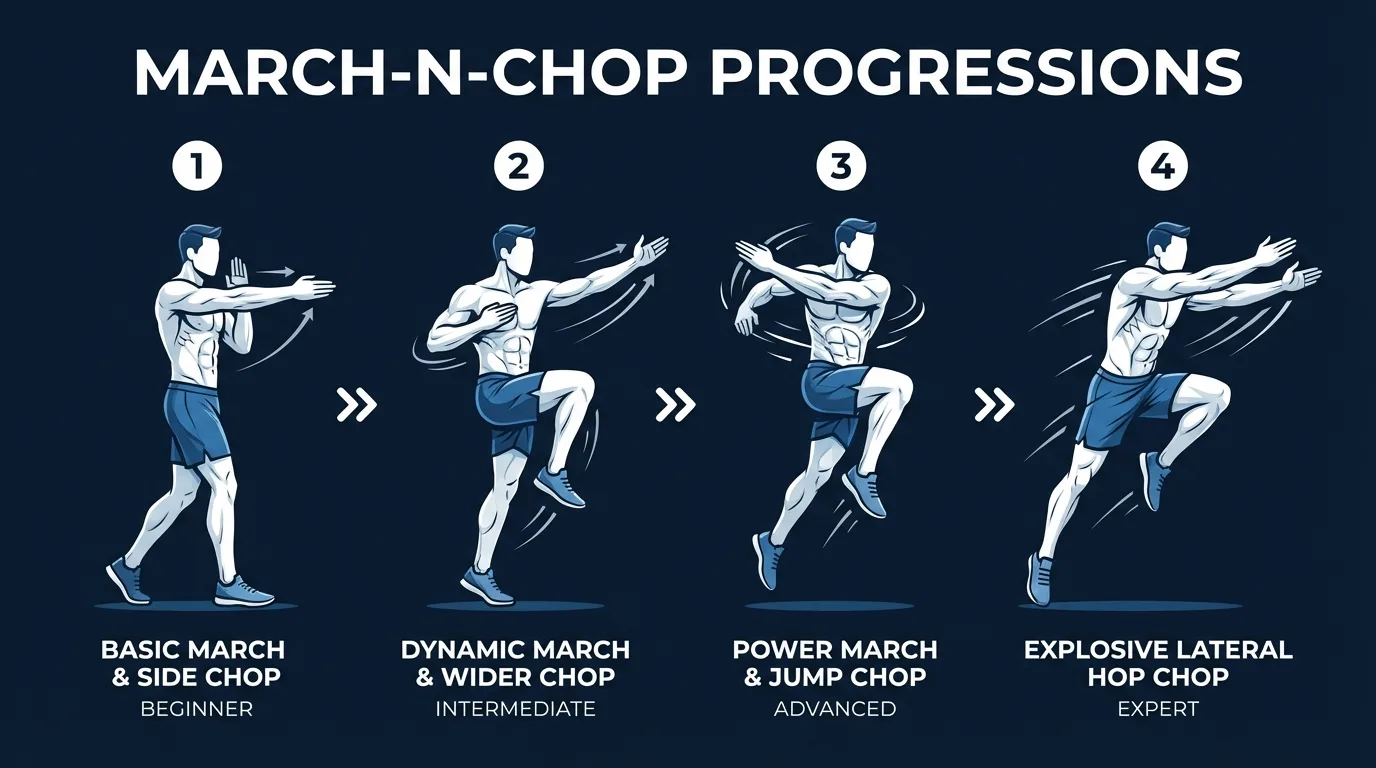
- Slow-tempo march-n-chop (beginner). Perform one rep every 2-3 seconds. Take your time on each side, focusing on driving the knee high and rotating your torso fully on the chop. This removes the cardio intensity and lets you build the coordination pattern before adding speed.
- March-n-chop with a pause (beginner). Add a 1-second hold at the bottom of each chop with your knee at its highest point. The pause removes momentum and forces your core and hip flexors to stabilize under load. It also makes balance demands more obvious, which is useful feedback for beginners.
- Weighted march-n-chop (intermediate to advanced). Hold a light dumbbell, medicine ball, or weight plate with both hands. The added load increases the core demand on both the chop and the return. Start light: 5 to 10 pounds is plenty. The point is rotational control, not how much weight you can swing.
- Jump-switch march-n-chop (advanced). Instead of stepping, add a small hop as you switch sides. Your feet leave the ground briefly during the transition. This plyometric version significantly increases the cardiovascular demand and challenges your coordination at higher speeds.
- Cross-body march-n-chop. Chop toward the opposite hip instead of the same-side hip. Right knee up, hands chop toward the left hip. This variation increases the rotational range of motion and shifts more emphasis to the obliques on the side opposite the lifting knee.
When to Avoid or Modify March-N-Chop
The march-n-chop is safe for most healthy adults at standard tempo because it is a low-impact movement (no jumping). The jump-switch variation is plyometric and should be approached more carefully. Always consult a qualified healthcare provider or physical therapist before starting or returning to any exercise program, especially if you have any of the conditions below.
- Known cardiovascular disease or uncontrolled hypertension. The march-n-chop spikes heart rate quickly at brisk tempos. Get your cardiologist's approval and stay within their prescribed heart-rate zones. Start with slow-tempo work and progress under supervision.
- Acute hip-flexor or low-back injury. The repeated knee-drive loads the hip flexors and lumbar spine. Reduce knee height (thigh below parallel), skip the rotation, or substitute with marching in place until symptoms resolve.
- Stress incontinence or recent pelvic-floor weakness. The standard version (no jump) is usually tolerated, but the jump-switch variation often triggers leakage. Skip jumping variations and work on pelvic-floor coordination first. A pelvic-floor PT can guide return-to-impact progressions.
- First trimester (some intensity) and second to third trimester (most intensity) of pregnancy. Joint laxity and balance changes increase fall risk. Drop the jump-switch entirely, lower knee height, and shorten work intervals. Get medical clearance for higher-intensity work.
- Vertigo, balance disorders, or vestibular conditions. The single-leg phase combined with torso rotation can trigger dizziness. Substitute with seated rotations or skip the rotational component until evaluated.
- Acute shoulder injury or impingement. The full overhead arm position aggravates these. Lower the chop's starting position to chest level (chest-to-hip chop) instead of overhead-to-hip until the shoulder tolerates full flexion pain-free.
- Limited core stability foundation. If you can't hold a 30-second forearm plank with neutral spine, build that base first. Add deadbugs and bird-dogs 2-3 times per week before layering on rotational cardio.
Related Exercises
- Lower-impact alternative within the same pattern: marching in place removes the rotational and arm component for a true beginner cardio entry point; walking in place is even gentler.
- Other rotational and core-cardio hybrids: squat twist for a squat-based rotational pattern; tap-n-twist for low-impact rotational footwork; standing twists for isolated rotational practice without the knee drive.
- Core stability foundation: deadbugs, bird-dogs, and forearm planks build the anti-extension and anti-rotation base that makes the march-n-chop's rotational pattern safe.
- Higher-intensity cardio progressions: high knees and jumping jacks for sagittal-plane cardio at higher heart rate; burpees for full-body conditioning when you want maximum stimulus.
- Hip and ankle prep: butterfly pose for hip mobility; calf raises for ankle stability during the single-leg phase.
How to Program March-N-Chop
The march-n-chop is a HIIT-style conditioning movement, so it programs to time-and-rest intervals rather than sets-and-reps. The ranges below follow the general resistance and conditioning programming framework laid out in Ratamess et al., 2009 (the ACSM Position Stand on progression models), adapted for bodyweight cardio:
| Level | Work interval | Rest interval | Total session | Frequency |
|---|---|---|---|---|
| Beginner | 20-30 sec | 60-90 sec | 10-15 min | 2-3 sessions/week |
| Intermediate | 30-45 sec | 45-60 sec | 15-25 min | 3-4 sessions/week |
| Advanced | 45-60 sec | 30-45 sec | 20-30 min | 3-5 sessions/week |
Where in your workout: place the march-n-chop after your resistance training, never before. HIIT before strength work depletes the glycogen needed to generate force, which compromises the lifting portion of the session. It also works well as a 5-10 minute metabolic finisher at the end of a session or as a standalone HIIT block on a non-lifting day. A short low-intensity warm-up (1-2 minutes of slow marching) primes the hips and shoulders before the first work interval.
Form floor over time targets: if your knee height drops below parallel or your chop loses its rotational quality (becomes pure arm swing), stop the interval. A 25-second interval with full knee height and clean rotation beats a 45-second interval of degraded reps. Build duration only when you can maintain form across the full work block.
How FitCraft Programs This Exercise
The march-n-chop sits at the intersection of core work and cardio, which makes it one of the more versatile movements in FitCraft's exercise library. Coach Ty places it based on what your personalized diagnostic assessment reveals about your goals, fitness level, and available time.
For intermediate users focused on fat loss, Ty typically slots the march-n-chop into cardio circuits. Think 30 seconds of march-n-chops followed by 30 seconds of squats, then 30 seconds of push-ups, repeated for 3-4 rounds. The rotational component hits your core without needing a dedicated ab segment, and the continuous marching keeps your heart rate in the conditioning zone.
For users working on core strength, Ty programs the march-n-chop at a slower tempo with intentional pauses, treating it more like a stability drill than a cardio exercise. Either way, every placement decision is backed by exercise science. Programs are designed by Domenic Angelino, an Ivy League-trained exercise scientist and NSCA-certified strength coach, then adapted by Ty to match your fitness level, goals, and available time.
Ty also demonstrates proper form with 3D models, counts your reps, and adjusts the variation and volume to your level as you improve. FitCraft's gamification system (streaks, quests, collectible cards) makes the daily habit stick.
Frequently Asked Questions
Can I do march-n-chops if I have stress incontinence or recent pelvic-floor weakness?
The standard march-n-chop is a low-impact movement (no jumping), which makes it generally safer than plyometric cardio for stress incontinence. Avoid the jump-switch variation, which adds an explosive ground-reaction force that often triggers leakage. Stick with the slow-tempo or standard tempo version, exhale on every chop to coordinate your pelvic floor with the rotation, and consult a pelvic-floor physical therapist before adding intensity if you are postpartum or experiencing leakage.
What muscles does the march-n-chop exercise work?
The march-n-chop primarily targets the obliques and hip flexors. The obliques drive the trunk rotation during the chop. The hip flexors (iliopsoas, rectus femoris) lift the knee. Secondary movers include the rectus abdominis and transverse abdominis for trunk stabilization, the glutes and quadriceps for hip and knee control, and the lats, deltoids, and triceps for the overhead arm sweep. The cardiovascular system is the dominant working system at brisk tempos.
Is the march-n-chop good for beginners?
The march-n-chop is rated intermediate because it requires coordinating a knee drive and a diagonal arm chop while keeping the spine tall. Beginners should start with the slow-tempo variation, performing one rep every 2-3 seconds with full knee height and full torso rotation, then build pace once the pattern feels natural. The paused variation (holding the bottom position for one second) is another beginner entry point because it removes momentum from the equation.
How many march-n-chops should I do?
For cardiovascular conditioning, perform 3-4 sets of 30-45 seconds with 45-60 seconds of rest between sets. For rotational core work at a slower tempo, aim for 3 sets of 12-16 reps per side with 60 seconds rest. Beginners should start with 2-3 sets of 20-30 seconds, rest 60-90 seconds, and limit total sessions to 10-15 minutes 2-3 times per week, then build up as coordination and aerobic capacity improve.
Can march-n-chops replace traditional ab exercises?
March-n-chops train rotational core endurance under cardiovascular load, which is a different demand than the static or controlled-dynamic patterns trained by crunches, planks, or deadbugs. They complement those exercises rather than replace them. A balanced core program should include anti-extension work (planks, deadbugs), anti-rotation work (bird-dogs, Pallof presses), and rotational work like the march-n-chop. Programming all three patterns produces a more resilient trunk than any single category in isolation.
Should I do march-n-chops before or after my workout?
Place march-n-chops after your resistance training, not before. Doing HIIT before strength work depletes the glycogen your muscles need to generate force, which compromises the strength portion of your session. The march-n-chop also works well as a 5-10 minute metabolic finisher at the end of a session or as a standalone HIIT block on a non-lifting day. A short dynamic warm-up (1-2 minutes of low-intensity marching) before the first work set prepares the hips and shoulders.