Squat twists sit between a jump squat and a rotational conditioning drill. You squat, leave the floor, turn in the air, and land facing a new direction. That makes the exercise useful for short cardio intervals, athletic warm-ups, and lower-body power work when you already have a clean squat and a quiet landing.
The movement is demanding because it stacks three skills into one rep: squat mechanics, plyometric landing control, and torso rotation. Start small. A quarter turn done well is more useful than a full spin that ends with the knees caving or the feet slapping the floor.
Quick Facts: Squat Twists
- Equipment needed: None
- Difficulty: Intermediate to Advanced
- Modality: High-intensity conditioning and plyometrics
- Body region: Lower body, core, and cardiovascular system
- FitCraft quest category: Cardio
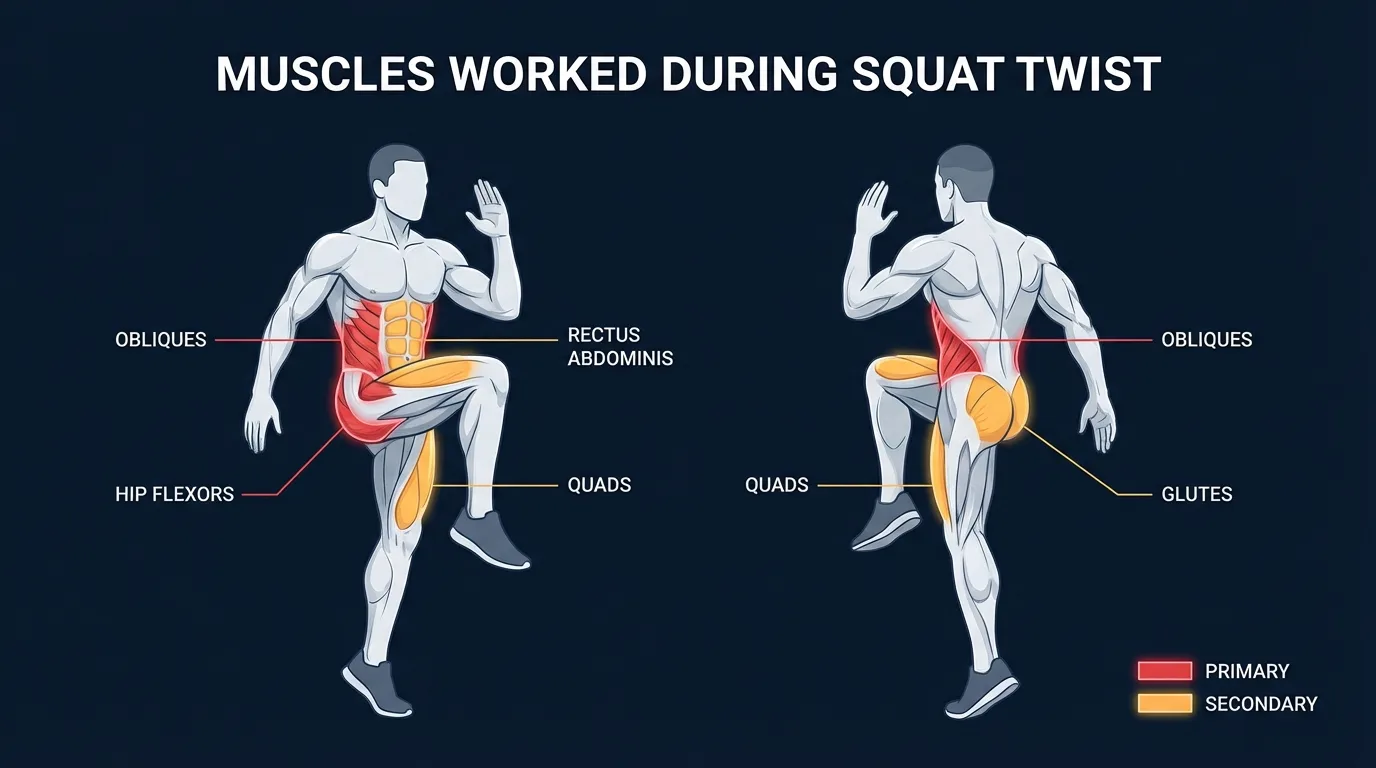
Muscles & Systems Worked
Primary movers: the quadriceps, gluteus maximus, hamstrings, and calves create the squat jump and absorb the landing. They work concentrically as you drive up from the squat, then eccentrically as you bend the knees and hips to catch the floor.
Secondary movers: the obliques, rectus abdominis, hip flexors, adductors, and gluteus medius assist the turn and help keep the pelvis under control as the feet leave and return to the floor.
Stabilizers: the transverse abdominis, spinal erectors, ankle stabilizers, and small hip stabilizers work isometrically to keep the trunk braced, the knees tracking, and the foot strike quiet through each landing.
Conditioning mechanism: repeated squat jumps with rotation create a fast work rate. The phosphocreatine and glycolytic systems cover the explosive reps, while the heart and lungs support recovery between intervals. No exercise-specific PubMed, PMC, or DOI citation is included in the verified FitCraft citation library for squat twists, so this section uses mechanism-based biomechanics instead of a proxy citation.
Step-by-Step: How to Do a Squat Twist
Use a clear floor, supportive shoes, and a rotation range you can land cleanly. Quarter turns are the right starting point for most people.
Step 1: Set Your Stance
Stand with your feet slightly wider than shoulder-width and your hands close to your chest. Brace your core and keep your ribs stacked over your hips.
Coach Ty's cue: "Start tall and organized before you add speed."
Step 2: Lower Into the Squat
Push your hips back and bend your knees. Keep the heels down, chest tall, and knees tracking in line with the toes.
Coach Ty's cue: "Sit into the squat first. The twist comes after the floor drive."
Step 3: Drive Up and Rotate
Press hard through the floor and jump. As your feet leave the ground, rotate your feet, hips, torso, and shoulders together toward the new direction.
Coach Ty's cue: "Turn the whole body as one piece."
Step 4: Land Softly
Land on the balls of your feet, then let the heels settle as the knees bend. Sink into the next squat to absorb force instead of sticking a stiff landing.
Coach Ty's cue: "Quiet feet mean better control."
Step 5: Alternate Direction
Rotate back the other way on the next rep. Keep the tempo steady and end the set when the landing gets loud, the knees cave, or your balance starts to drift.
Coach Ty's cue: "Stop on the first messy landing."
Get this exercise in a personalized workout
FitCraft, our mobile fitness app, uses its AI coach Ty to program conditioning work like this into your plan at the right volume and intensity, based on your level, goals, and equipment. Ty was designed and trained by Domenic Angelino, MPH (Brown University) and NSCA-CSCS, with research published in the Journal of Strength and Conditioning Research and Medicine & Science in Sports & Exercise.
Take the Free Assessment Free • 2 minutes • No credit card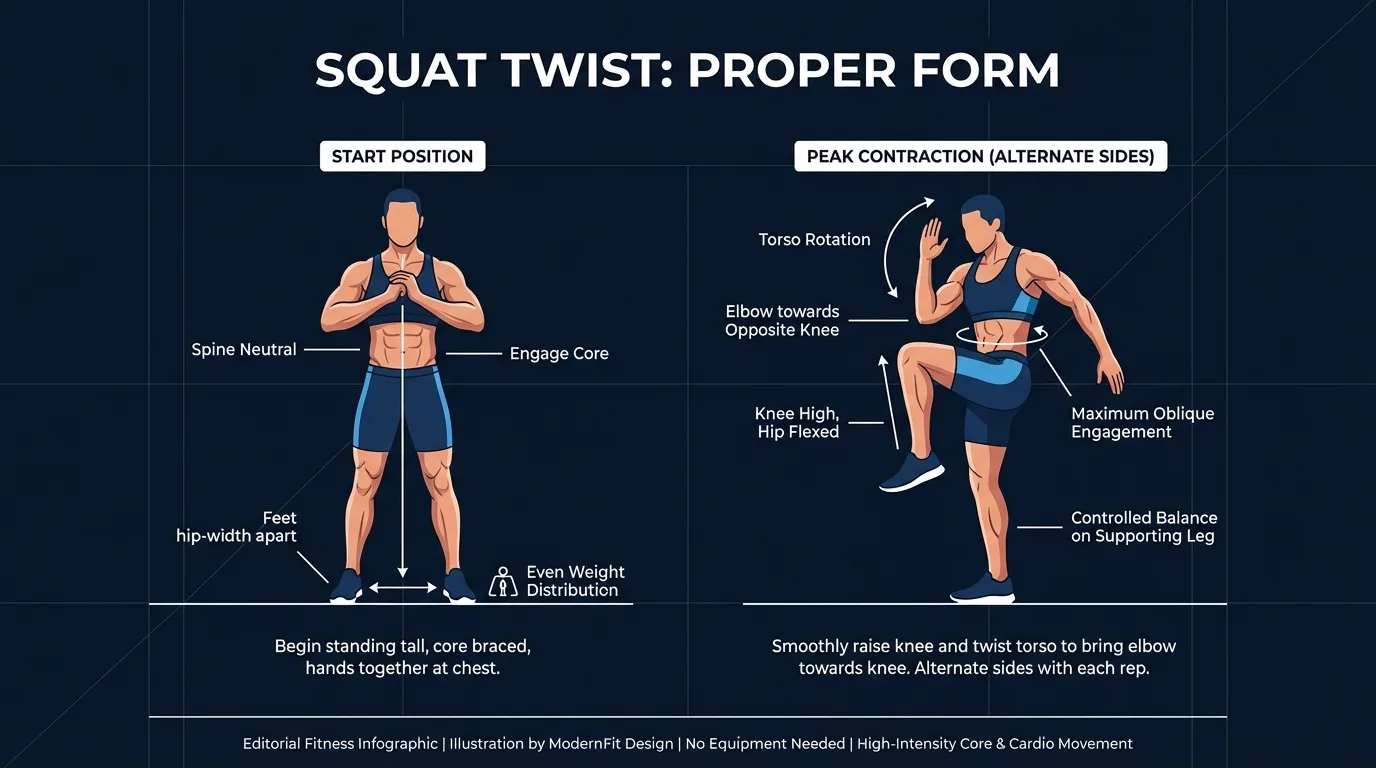
Common Mistakes (and How to Fix Them)
- Twisting through the knees. If the feet turn while the knees lag behind, the joint takes shear it does not need. Turn the feet, knees, hips, torso, and shoulders together.
- Landing stiff. Locked knees make the landing loud and harsh. Bend the knees and hips right away so the legs absorb the force.
- Rotating too far too soon. A sloppy 180-degree turn teaches poor control. Start with quarter turns and progress only when the landing stays quiet.
- Letting the knees cave inward. Fatigue often pulls the knees toward each other. Slow down, reduce the turn, and cue the knees to track with the toes.
- Using arm swing to fake rotation. Wild arms can pull you off balance. Keep the hands close to the chest so the turn comes from the body.
- Grinding through messy reps. Plyometric quality drops fast. End the set when your feet slap, your balance wobbles, or your squat depth disappears.
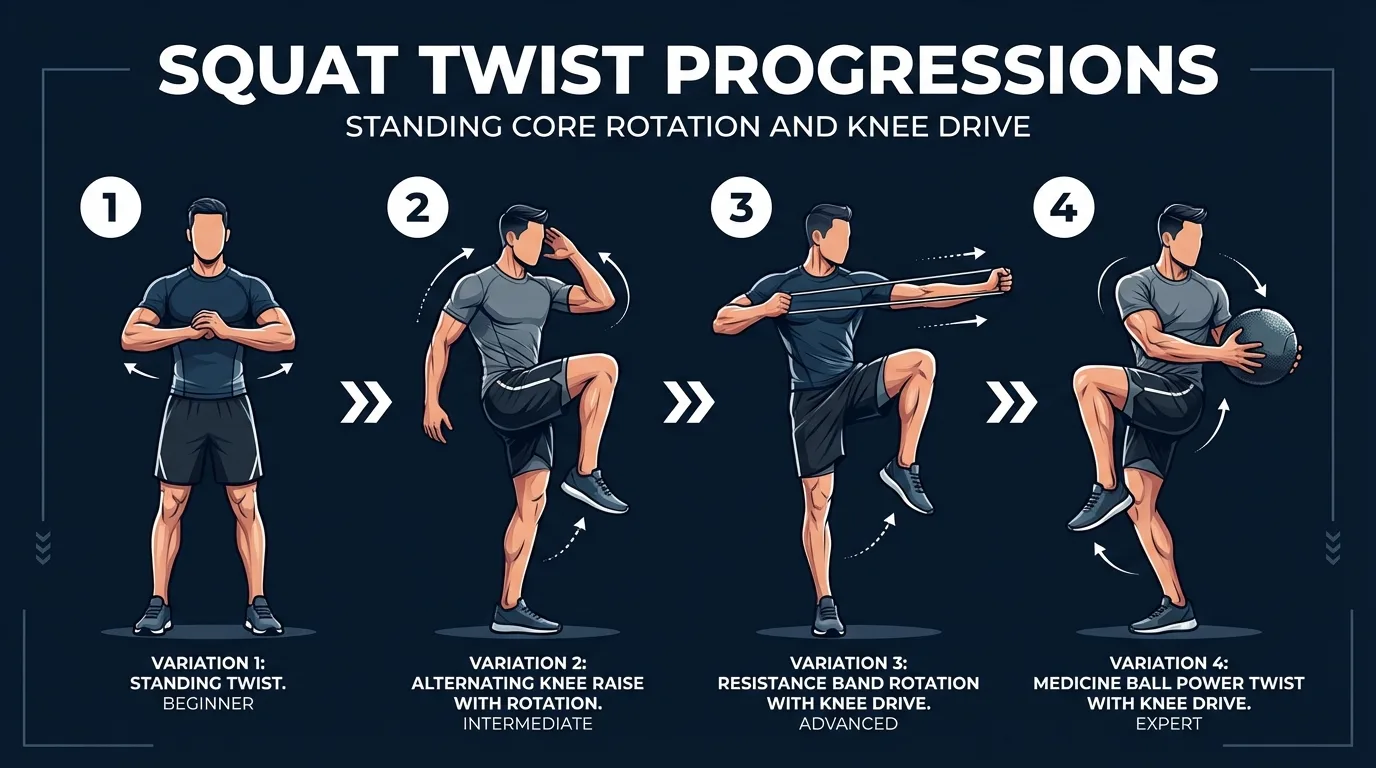
Squat Twist Variations: Regressions and Progressions
Choose the version that lets you control the squat, turn, and landing without knee pain or balance loss.
Standing Twists (Beginner Regression)
Stay grounded and rotate the torso side to side. This builds rotational awareness without the landing stress of a jump.
Jump Squats (Power Foundation)
Remove the turn and focus on vertical jump mechanics. Use this until you can land quietly with knees tracking cleanly.
Quarter-Turn Squat Twist (Standard Builder)
Rotate 90 degrees each rep. The smaller turn gives you enough rotation to train control without asking for a full spin.
Half-Turn Squat Twist (Advanced Progression)
Rotate 180 degrees so each rep ends facing the opposite direction. Use this only after quarter turns feel automatic.
Light Loaded Squat Twist (Advanced Variation)
Hold a light medicine ball or dumbbell close to your chest. Keep the load modest because extra weight increases the force you must control on landing.
When to Avoid or Modify Squat Twists
Squat twists can be useful for healthy, well-prepared adults, but the jump, rotation, and landing make them a poor fit when joints or balance are not ready. Always consult your physician or physical therapist for personalized guidance.
- Knee pain, prior ACL or meniscus injury, or painful landings. Use standing twists, marching in place, or pain-free jump squats before adding rotation.
- Ankle instability, shin splints, plantar fasciitis, or calf pain. Reduce impact and build lower-leg capacity with calf raises before returning to faster plyometrics.
- Known cardiovascular disease or uncontrolled hypertension. Squat twists spike heart rate and blood pressure quickly. Get medical clearance and stay within your prescribed intensity range.
- Pregnancy, early postpartum recovery, or pelvic-floor symptoms. Jumping and direction changes can increase pelvic-floor pressure and joint stress. Use low-impact options such as step-n-clap.
- Vertigo, balance disorders, or vestibular conditions. Rotation plus jumping raises fall risk. Choose grounded conditioning until balance is reliable.
- Asthma or exercise-induced bronchoconstriction. Use a longer warm-up, keep medication accessible if prescribed, and avoid hard intervals when symptoms are active.
Related Exercises
These movements build the same power, conditioning, and control qualities:
- Lower-impact rotation: Standing Twists train the rotational pattern without jumping.
- Plyometric foundation: Jump Squats build the vertical power and soft landing that squat twists require.
- Core rotation accessory: Russian Twists target trunk rotation in a seated position.
- Core stability foundation: Forearm Planks help you brace during fast changes of direction.
- Lower-leg impact prep: Calf Hops and Calf Raises build foot and ankle capacity.
- Higher-intensity conditioning: Burpees and High Knees give you other short-interval cardio options.
How to Program Squat Twists
Squat twists work best as short, time-based conditioning intervals. Use the broader progression model from the ACSM resistance-training position stand by matching work, rest, frequency, and progression to your current training status (Ratamess et al., 2009).
| Level | Work | Rest between sets | Frequency |
|---|---|---|---|
| Beginner | 20-30 seconds, quarter-turn reps or standing-twist regression | 60-90 seconds | 2-3 sessions/week |
| Intermediate | 30-45 seconds, controlled quarter-turn or half-turn reps | 45-60 seconds | 3-4 sessions/week |
| Advanced | 45-60 seconds, faster half-turn reps or light loaded reps | 30-45 seconds | 3-5 sessions/week |
Where in your workout: place squat twists in a standalone HIIT session, after resistance training as a short finisher, or after a full warm-up before sport-style movement work. Avoid using them before heavy squats, hinges, or loaded lunges because the intervals can fatigue the legs.
Form floor over time targets: stop the interval when the landing gets loud, the knees cave, the torso turns separately from the hips, or your breathing becomes too ragged to control the next rep.
How FitCraft Programs This Exercise
FitCraft uses conditioning drills like squat twists when they match your current level and movement control. Ty adjusts the variation and volume to fit your capacity, so grounded rotation and jump-squat foundations can build toward harder rotational intervals over time.
The goal is progression without forcing impact too early. The app can place rotational conditioning beside core stability, lower-leg prep, and other cardio work so the drill supports the plan instead of becoming a random finisher.
Frequently Asked Questions
What muscles does the squat twist work?
Squat twists work the quads, glutes, hamstrings, and calves during the squat and jump. The obliques, rectus abdominis, transverse abdominis, spinal erectors, hip stabilizers, and ankle stabilizers keep the torso and landing organized during the rotation.
Is the squat twist a cardio exercise?
Yes. Squat twists are a high-intensity bodyweight conditioning drill. The repeated squat, jump, rotation, and landing cycle raises heart rate quickly, so the exercise works best in short interval blocks.
Should beginners do squat twists?
Most beginners should build up first with bodyweight squats, jump squats, standing twists, and quarter-turn squat twists. The standard version asks for lower-body power, rotation control, and clean landings at the same time.
How many squat twists should I do?
Start with 2 to 3 rounds of 20 to 30 seconds, resting 60 to 90 seconds between rounds. Intermediate users can build toward 30 to 45 second rounds. Stop the set as soon as landing mechanics get loud, stiff, or unstable.
Can I do squat twists with knee pain?
Modify or avoid them if knee pain shows up. Use standing twists, marching in place, or jump squats only if those stay pain-free. Squat twists combine impact and rotation, so knee history deserves a conservative progression and professional guidance when symptoms are active.