Tap-N-Twist gives you a low-impact way to build rhythm, heart-rate work, and rotational control in a small space. You step one foot out, tap lightly, rotate your torso in the same direction, then come back to center and repeat on the other side.
The movement should feel closer to dancing in place than grinding through a drill. The tap is quiet, the knees stay soft, and the twist comes from the hips and ribs moving together instead of the low back yanking itself around.
Quick Facts: Tap-N-Twist
- Equipment needed: None
- Difficulty: Beginner to intermediate
- Modality: Low-impact cardio and conditioning
- Body region: Full body with lateral lower-body work and rotational core demand
- FitCraft quest category: Cardio
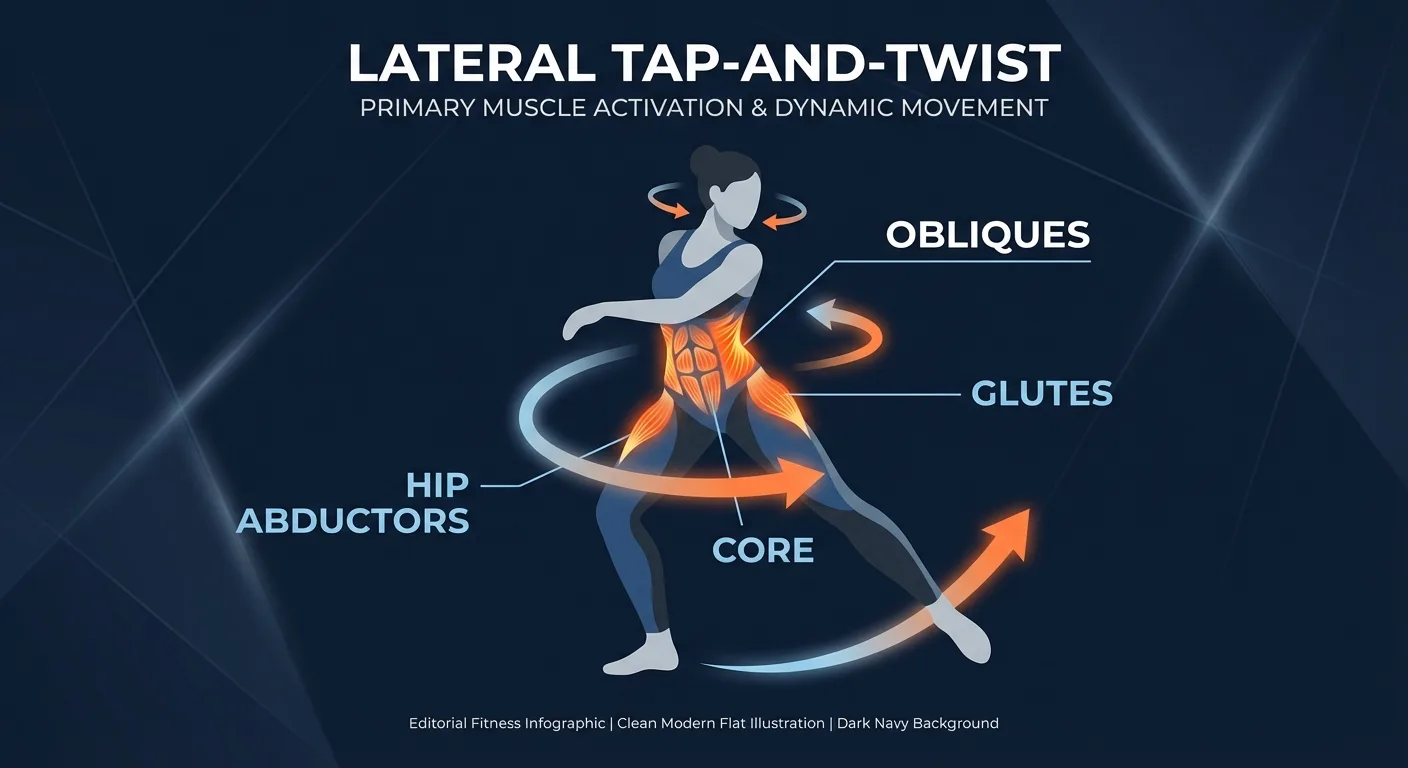
Muscles & Systems Worked
The primary movers are the obliques, transverse abdominis, gluteus medius, gluteus maximus, hip abductors, and adductors. The tapping leg moves out and back through the lateral step, while the trunk rotates and returns to center on every rep.
Secondary movers include the quadriceps, calves, hamstrings, thoracic rotators, and shoulder girdle muscles. These muscles help keep the knees soft, control the foot tap, guide the arm swing, and keep the rotation smooth instead of jerky.
The stabilizers are the spinal erectors, deep hip rotators, ankle stabilizers, and muscles around the pelvis. They work every rep to keep the ribs stacked over the hips, the feet quiet, and the knees from snapping straight as fatigue builds.
No exercise-specific PubMed, PMC, or DOI citation is included for Tap-N-Twist in the verified FitCraft citation library. The mechanism is straightforward: repeated low-impact side taps raise cardiovascular demand while gentle torso rotation adds core coordination and thoracic mobility without jumping.
Step-by-Step: How to Do Tap-N-Twist
-
Set your stance. Stand tall with your feet hip-width apart, knees soft, and weight balanced over the middle of each foot. Keep your chest up, shoulders relaxed, arms bent to about 90 degrees, and core lightly braced.
Coach Ty's cue: "Soft knees before you move."
-
Tap out to one side. Step your right foot out to the right and tap the ball of the foot lightly on the floor. Keep the right knee slightly bent and let the left leg support your weight without locking.
Coach Ty's cue: "Tap, don't stomp."
-
Rotate with the tap. As the right foot taps, rotate your hips, ribs, shoulders, and head to the right. Keep the twist smooth and comfortable.
Coach Ty's cue: "Eyes travel with the twist."
-
Return and switch sides. Pull the right foot back to center as your torso returns to neutral. Step the left foot out, tap lightly, and rotate left without rushing the transition.
Coach Ty's cue: "Center first, then switch."
-
Keep the rhythm. Alternate sides continuously with a tempo you can hold for the full round. Breathe steadily, keep the steps quiet, and stop when the twist gets jerky.
Coach Ty's cue: "Light feet, easy twist."
Get this exercise in a personalized workout
FitCraft, our mobile fitness app, uses its AI coach Ty to program conditioning work like this into your plan at the right volume and intensity, based on your level, goals, and equipment. Ty was designed and trained by Domenic Angelino, MPH (Brown University) and NSCA-CSCS, with research published in the Journal of Strength and Conditioning Research and Medicine & Science in Sports & Exercise.
Take the Free Assessment Free • 2 minutes • No credit card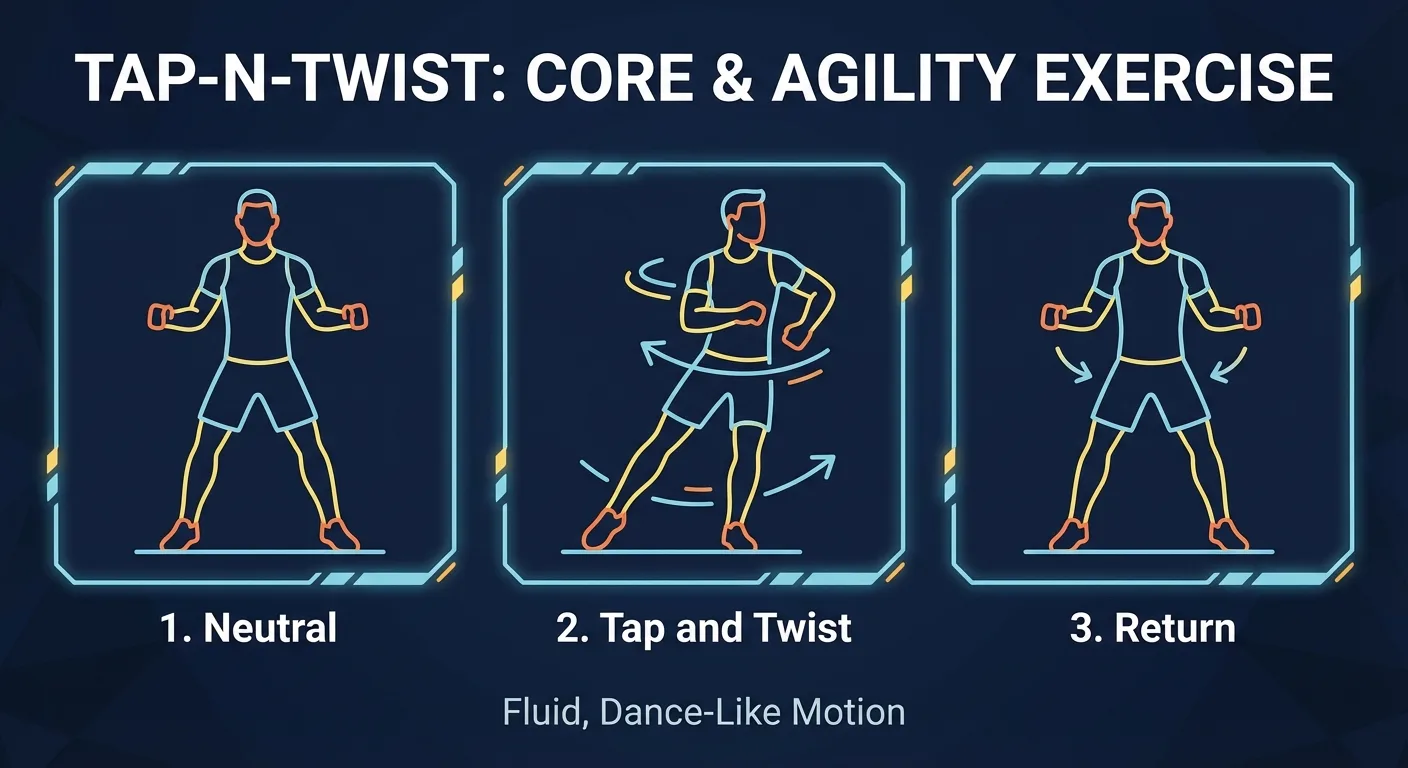
Common Mistakes
Stomping the tap
What it looks like: Each foot hits the floor with a loud thud when you step out.
Why it matters: Heavy foot strikes add unnecessary stress to the ankle, knee, and hip, which defeats the low-impact purpose of the drill.
The fix: Tap the ball of the foot lightly and use a smaller step until the landing gets quiet.
Locking the knees
What it looks like: The support leg snaps straight and the tapping leg gets stiff at the edge of the step.
Why it matters: Locked knees make the movement feel jarring and reduce the muscular control that should absorb the step.
The fix: Keep both knees softly bent through the whole round. If the knees lock, slow down.
Forcing the twist through the low back
What it looks like: The pelvis stays rigid while the low back yanks the torso around.
Why it matters: The exercise should be a smooth whole-torso rotation. Forcing the lumbar spine can irritate sensitive backs.
The fix: Let your hips, ribs, shoulders, and eyes turn together. Reduce the range until it feels easy.
Rushing the rhythm
What it looks like: The feet flail, the twist gets choppy, and balance starts to drift.
Why it matters: Speed without control turns the drill into sloppy motion and removes the core-control benefit.
The fix: Choose a tempo you can hold for the whole interval. Longer clean rounds beat faster messy ones.
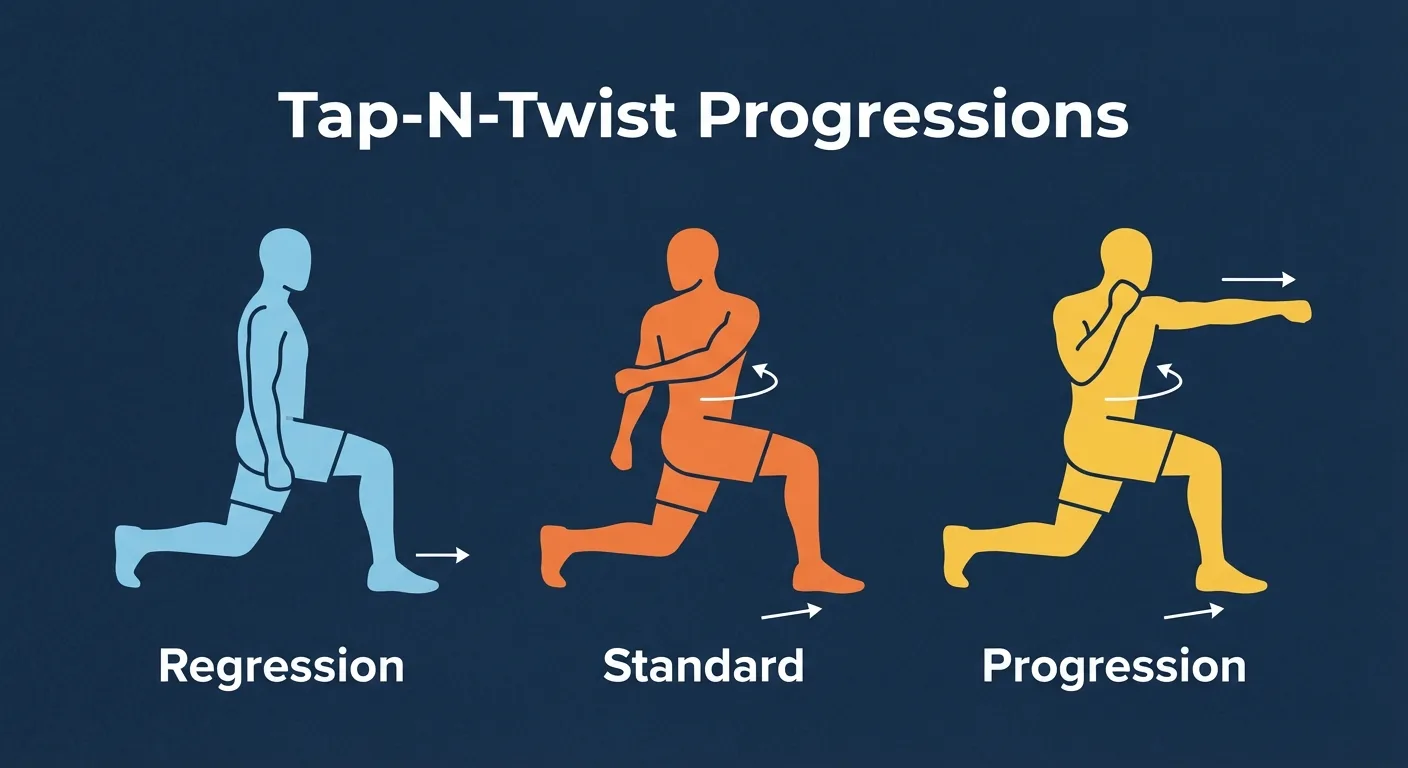
Tap-N-Twist Variations: Regressions and Progressions
Side tap only
Skip the rotation and practice stepping one foot out, tapping lightly, and returning to center. This regression builds the foot rhythm before you add the torso twist.
Standing Twists
Keep the feet planted and rotate the torso side to side at a controlled pace. This is useful when the twist feels awkward or balance is the main limiter.
Fast-tempo Tap-N-Twist
Use the same movement at a quicker cadence. Keep the tap quiet and shorten the round if the twist gets rough.
Tap-N-Twist with arm reach
Reach the opposite arm across the body in the direction of the twist. This adds shoulder rhythm and makes the core work harder to control the rotation.
When to Avoid or Modify Tap-N-Twist
Tap-N-Twist is safe for most healthy adults, but fast intervals and repeated rotation can still raise heart rate and challenge balance. Always consult your physician before starting or returning to intense exercise, especially if a medical condition affects your heart, joints, balance, breathing, low back, pelvic floor, or pregnancy status.
- Known cardiovascular disease or uncontrolled hypertension. Keep the tempo easy unless your clinician has cleared interval training. Use walking in place if you need a steadier heart-rate response.
- Knee, ankle, hip, shin, or foot pain. Reduce the step width, slow the tempo, or switch to marching in place until every tap is quiet and pain-free.
- Low-back pain triggered by rotation. Shrink the twist, keep the ribs and hips moving together, or use standing twists at a slower pace.
- Pregnancy or early postpartum recovery. Use clinician-cleared low-impact options and avoid breath holding. Fixed-stance or marching drills are usually easier to control than fast rotational steps.
- Vertigo, balance disorders, or vestibular symptoms. Hold a slower pace, keep the head turn small, or choose walking in place until balance feels steady.
- Asthma or exercise-induced bronchoconstriction. Warm up longer, keep medication accessible if prescribed, and stay below the pace that triggers symptoms.
Related Exercises
- Lower-impact same-pattern option: Walking in Place keeps cardio simple when the twist or side step feels like too much.
- Cadence progression: Marching in Place adds more hip flexor work and a clearer arm swing.
- Rotational cardio cousin: Squat Twist adds more knee bend and a bigger lower-body demand.
- Higher-intensity cardio swap: High Knees raises the pace when you don't need the low-impact benefit.
- Core foundation: Forearm Planks and Deadbugs build the trunk control that keeps the twist from dumping into the low back.
- Ankle and lower-leg support: Calf Raises help prepare the lower leg for cleaner, quieter taps.
How to Program Tap-N-Twist
Use Tap-N-Twist as time-based conditioning. The broader progression principle from the ACSM position stand by Ratamess et al., 2009 still applies: increase volume and intensity gradually, and let clean mechanics set the ceiling for progression.
| Level | Work interval | Rest between sets | Frequency |
|---|---|---|---|
| Beginner | 20-30 seconds | 60-90 seconds | 2-3 sessions/week |
| Intermediate | 30-45 seconds | 45-60 seconds | 3-4 sessions/week |
| Advanced | 45-60 seconds | 30-45 seconds | 3-5 sessions/week |
Place Tap-N-Twist after strength work, inside a low-impact cardio circuit, or as a short finisher. If you use it before lifting, keep the round easy so your hips, ankles, and core are warm without being tired.
Use form as the floor. The set ends when your tap gets loud, your knees lock, your balance drifts, or your twist starts snapping through the low back. More time only counts when the reps still look clean.
Frequently Asked Questions
What is the Tap-N-Twist exercise?
Tap-N-Twist is a low-impact cardio drill that pairs a lateral foot tap with a gentle torso rotation. One foot stays grounded while the other taps out, so it raises heart rate without jumping or heavy landing impact.
What muscles does Tap-N-Twist work?
Tap-N-Twist trains the obliques, transverse abdominis, glutes, hip abductors, adductors, quadriceps, calves, and ankle stabilizers. The side tap drives the lower-body work while the rotation asks the trunk to move and control the ribs over the pelvis.
Can I do Tap-N-Twist with knee, ankle, or low-back pain?
Modify it if pain changes your step, balance, or rotation. Use a smaller tap, slow the tempo, reduce the twist, or switch to walking in place until the joint or back feels normal.
Is Tap-N-Twist good for beginners?
Yes. Tap-N-Twist is beginner-friendly because it uses no equipment, no jumping, and no deep knee bend. Start with a small step and a gentle rotation, then increase tempo or round length only when the rhythm stays smooth.
How long should I do Tap-N-Twist?
Start with 20 to 30 seconds of clean work, rest 60 to 90 seconds, and repeat for 10 to 15 minutes total. Build toward 45- to 60-second rounds when the tap stays quiet and the twist stays controlled.