You can hold a steady jog for forty minutes and still be shaking after ninety seconds of a wall sit. Or you can deadlift respectable numbers and be the person quietly gripping the handrail at the top of three flights of stairs. Both people say the same thing afterward: "I need to build my endurance."
What makes that frustrating is that they're both right, and they need almost opposite work. The word "endurance" got stretched to cover two physiological systems that adapt on different timelines, respond to different stimuli, and barely transfer to each other. So people train the one they already like, notice no change in the thing that was actually failing, and decide they're just not built for it.
You're not built wrong. You've been handed one word for two jobs. Here's how to tell which one is limiting you, what physically changes when you train each, and what a week looks like when you train both.
What Endurance Actually Means (You Have Two Kinds)
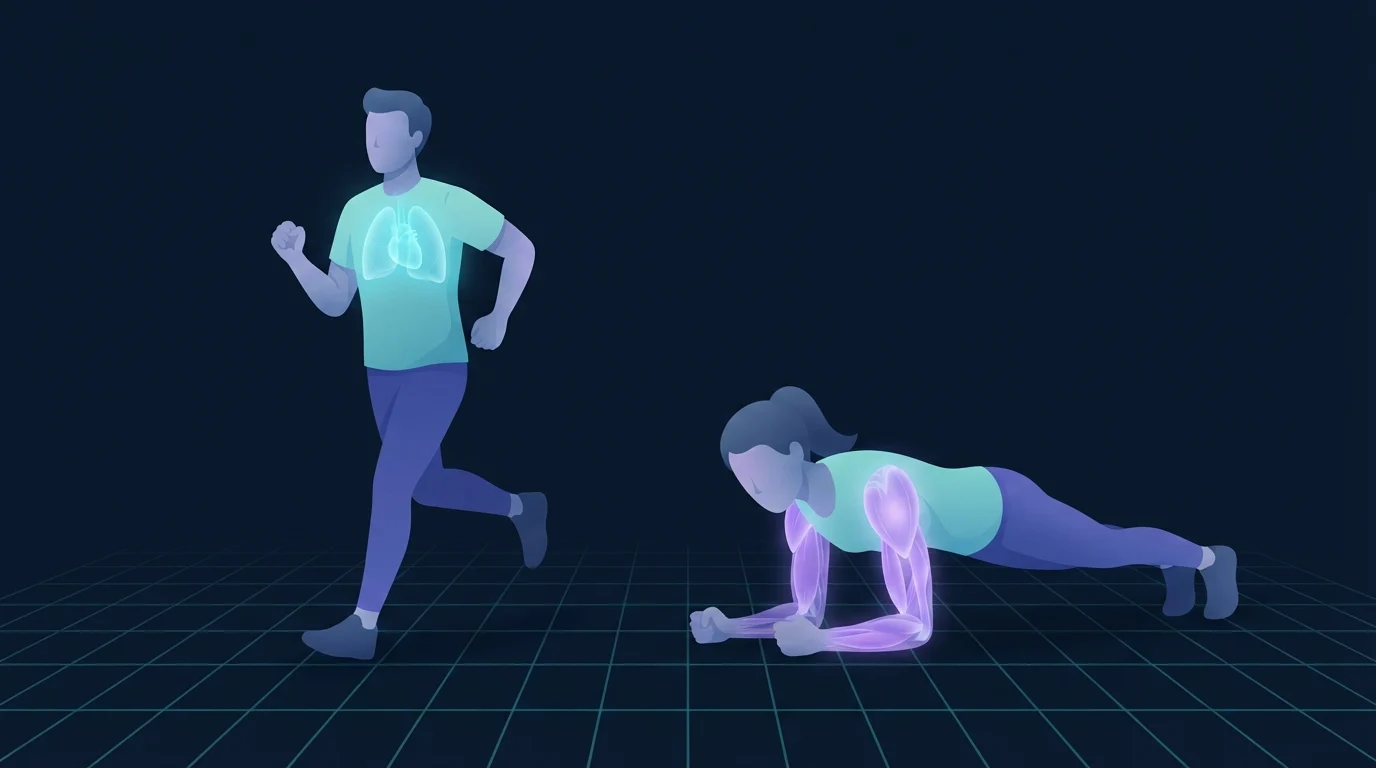
Cardiovascular endurance is a delivery problem. Your heart fills and ejects a certain volume per beat, your blood carries a certain amount of oxygen, and the ceiling on that delivery is what a VO2 max test measures. It's systemic. Improve it by cycling and your running gets easier too.
Muscular endurance is a local problem. It's how many contractions a given muscle can produce before force falls off, and it depends on the capillary supply, mitochondrial density and fatigue resistance of that specific muscle. It's stubbornly specific.
The cleanest demonstration is still Campos and colleagues (2002) in the European Journal of Applied Physiology. Thirty-two untrained men did eight weeks of resistance training in one of three rep zones: 3 to 5 reps, 9 to 11 reps, or 20 to 28 reps. The low-rep group gained the most maximal strength. The high-rep group gained by far the most muscular endurance, measured as time to exhaustion at a fixed percentage of their max. The adaptation followed the rep zone that was trained, not general fitness. Researchers call that the strength-endurance continuum, and the practical version is blunt: your muscles get good at what you actually asked them to keep doing.
Which one is limiting you
Run this test on yourself. Pick the activity you keep failing at and notice what gives out first.
- Breathing gives out first. You're heaving, your heart rate is near the top, your legs feel fine. That's a delivery ceiling. Train the cardiovascular side.
- A specific muscle gives out first. Your calves burn on the hill while your breathing is under control, or your shoulders quit during the plank while you can still hold a conversation. That's local. Train muscular endurance in that muscle.
- Both, at about minute forty. You started fine and everything degraded together. That's a durability problem, which is its own section below.
What Physically Changes When You Build Endurance
Endurance training is one of the few areas where the biology maps cleanly onto the programming decisions, so it's worth knowing what you're actually buying with each session.
Blood gets bigger before anything else does. Convertino (1991), reviewing blood volume adaptation in Medicine & Science in Sports & Exercise, describes plasma volume expansion accounting for nearly all of the exercise-induced increase in blood volume through the first two to four weeks, after which red cell volume starts catching up. More plasma means more blood returning to the heart, more volume ejected per beat, and a lower heart rate at the same pace. This is the adaptation responsible for the week-three moment where the route you've been dreading suddenly isn't that bad.
The muscle builds more engines, then better engines. Granata, Jamnick and Bishop (2018), reviewing human training studies in Sports Medicine, separated two things that get lumped together: mitochondrial content, meaning how much mitochondria you have, and mitochondrial respiratory function, meaning how well each unit works. Their read is that training volume is the critical factor for content, while relative exercise intensity is the important determinant of respiratory function. That single distinction explains why a plan made entirely of hard intervals stalls, and why a plan made entirely of easy minutes plateaus. You need volume for the quantity and intensity for the quality.
MacInnis and Gibala (2017) arrive at the same place from the interval side in the Journal of Physiology, reviewing how exercise intensity mediates adaptation in aerobic energy metabolism. Intensity buys you a lot per minute. It does not buy you the total minutes.
Delivery improves at the last inch. New capillaries around the trained fibers shorten the diffusion distance from blood to mitochondria, and lactate transport capacity rises so that the byproducts of hard work get shuttled and reused instead of accumulating. Both are local. Both are why your trained leg muscles clear a hard effort better than your untrained upper back does.
How to Build Stamina Fast (And What Fast Actually Means)
"Fast" in endurance training is about three weeks, not three days. Here's the honest timeline, stacked the way the adaptations actually arrive.
| Timeframe | What changes | What you notice |
|---|---|---|
| Days 1-14 | Plasma volume expands, stroke volume rises | Lower heart rate at the same effort |
| Weeks 3-6 | Mitochondrial content climbs with accumulated volume | The same session stops wrecking your afternoon |
| Weeks 6-12 | Capillary density and lactate handling improve | Hills and back halves stop falling apart |
| Months 3-6 | Tendon, bone and connective tissue catch up | You can safely carry more weekly volume |
The single most useful finding for anyone convinced they're a hopeless case comes from Montero and Lundby (2017) in the Journal of Physiology. They put 78 healthy adults into groups training one, two, three, four or five 60-minute sessions per week for six weeks. The proportion of people classified as non-responders for cardiorespiratory fitness fell steadily as weekly training time rose. Then they took the non-responders and gave them six more weeks with two extra sessions added. Non-response was abolished. Everyone responded.
That reframes the whole question. If six weeks of training did nothing for you, the most likely explanation isn't your genetics. It's the dose.
Find out what's really holding you back
FitCraft, our mobile fitness app, pairs you with an AI coach who builds you a personalized plan around your goals, schedule, and fitness level. Every FitCraft program is designed by Domenic Angelino, MPH (Brown University) and NSCA-CSCS, with research published in the Journal of Strength and Conditioning Research and Medicine & Science in Sports & Exercise.
Take the Free Assessment Free • 2 minutes • No credit card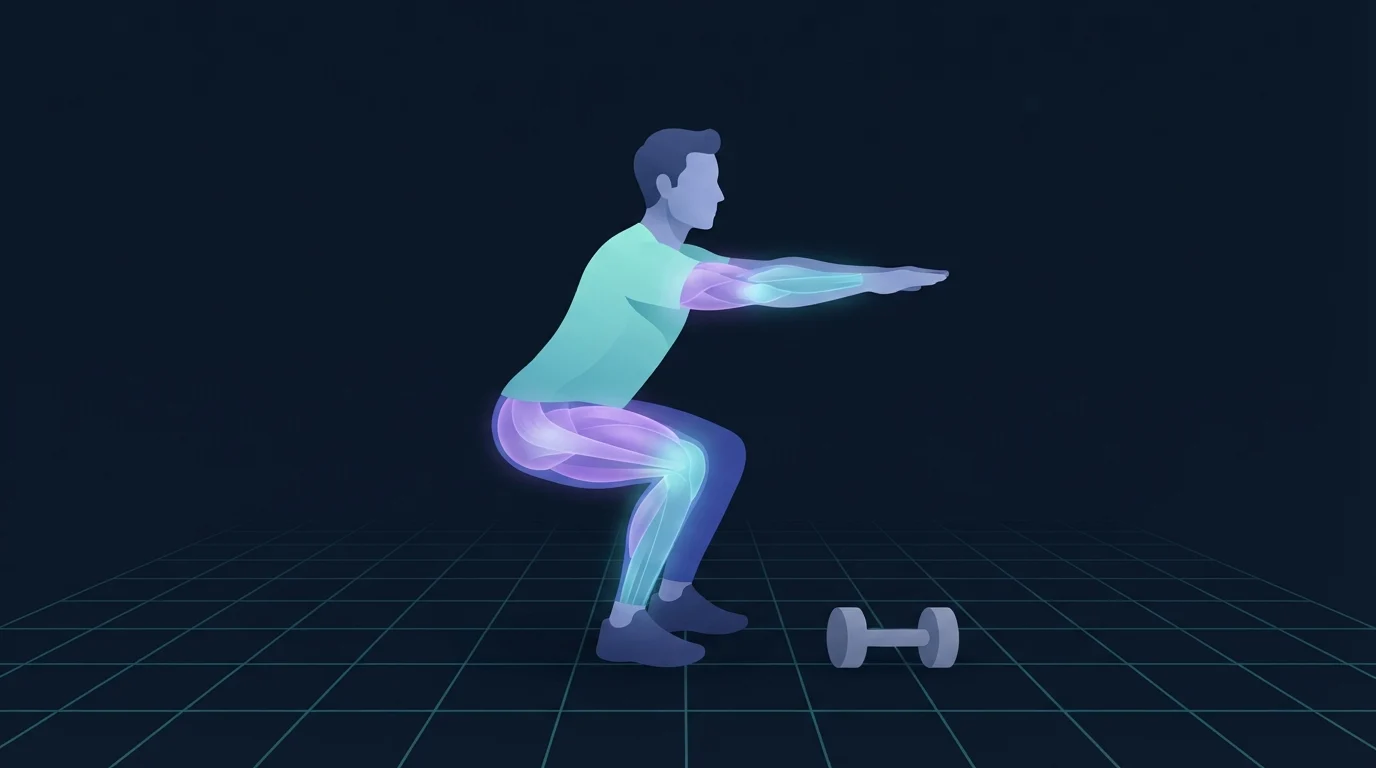
Building Muscular Endurance Without Running
If what quits first is a muscle rather than your breathing, more jogging won't fix it. Local endurance responds to sets that stay under tension long enough to stress the fatigue-resistance machinery in those specific fibers, which in the Campos data meant the 20 to 28 rep zone.
Three ways to train it, in order of how easy they are to start today:
- High-rep sets to a hard finish. 15 to 25 reps, two to three sets, stopping a couple of reps short of failure. Push-ups, split squats, rows with a band, glute bridges, calf raises. The rep count is the point.
- Density circuits. Four or five exercises, 40 seconds of work and 20 seconds of transition, three or four rounds. Short rest is the stimulus, not a shortcut.
- Frequent, easy volume. Small sets spread across the day, never near failure. We cover this pattern in detail in our review of greasing the groove, and it's the gentlest way to raise rep capacity in one movement.
The cardiovascular side also survives without a treadmill. Schaun and colleagues (2018), publishing in the Journal of Strength and Conditioning Research, ran 16 weeks comparing whole-body bodyweight interval training against treadmill-based intervals and moderate-intensity continuous running in healthy men. Maximal oxygen uptake and ventilatory threshold improved similarly across all three. Bodyweight work is not the compromise version of cardio. It's a different route to the same adaptation, and our guide to low-impact cardio at home lays out options for anyone who also needs to protect their joints.
Why Lifting Makes You Harder to Tire
This is the section most endurance plans leave out, and it costs people months.
Blagrove, Howatson and Hayes (2018) systematically reviewed strength training in middle- and long-distance runners for Sports Medicine and found that heavy resistance work and explosive or plyometric work both improved running economy, with the size of the effect depending on the method used and the speed at which economy was tested. Economy is the oxygen cost of holding a given pace. Improve it and every pace below your ceiling gets cheaper, without your ceiling moving at all. The reviewed programs did not produce meaningful increases in body mass, which is the objection people usually raise.
Two short sessions a week is the dose. Squats or split squats, a hinge, a press, a row, a loaded carry, kept heavy enough to be genuinely hard for 5 to 8 reps. If you're worried this cancels out your cardio, the honest picture is in our summary of the concurrent training interference effect: the problem shows up at high combined volumes and disappears at two sessions.
Durability: The Endurance Quality Almost Nobody Trains
Here's the piece that explains why some people fall apart at minute 50 of something they could hold comfortably at minute 10.
Maunder and colleagues (2021), writing in Sports Medicine, made the case that the physiological attributes measured in a standard fitness profile are not static. Thresholds, efficiency and heart rate at a given output all drift during prolonged exercise, and how much they drift differs between people. They called that resistance to drift durability, and argued that a profile taken fresh tells you very little about how someone will behave two hours in.
You train durability by putting quality at the back of a long session instead of the front. One long easy session a week, and in the last 15 minutes, lift the effort slightly rather than fading. Or do your strength circuit after the easy session rather than before it. It feels worse than it looks on paper, and it's the difference between an hour you survive and an hour you finish strong. Our guide to running without getting tired applies the same idea to pacing.
How the Week Fits Together
The weekly structure question has a well-settled answer and it isn't this page's job to relitigate it: keep most of your training easy enough to hold a conversation, put one genuinely hard session in the week, and protect the gap between them so that easy days stay easy. That distribution outperforms a week of medium-hard sessions, which is the trap almost everyone falls into. Our guide to increasing stamina is the full treatment of that structure, including the 12-week progression, and our review of polarized training research covers the evidence behind it. Everything below assumes you've got that split right.

A Six-Week Endurance Block You Can Run at Home
Three endurance sessions and two short strength sessions. The strength work can share a day with an easy session. Nothing here needs a gym, and the only equipment that helps is one pair of dumbbells or a loaded backpack.
| Week | Easy session x2 | Hard session x1 | Muscular endurance |
|---|---|---|---|
| 1-2 | 25 min walking, easy cycling or shadow work, conversational | 8 x 1 min brisk / 1 min easy | 2 circuits, 40 sec on / 20 sec off, 4 moves |
| 3-4 | 35 min, one session extended to 45 | 6 x 2 min hard / 90 sec easy | 3 circuits, same format, add one move |
| 5-6 | 40 min, long session to 55-60 | 4 x 4 min hard / 3 min easy | 3 circuits, 45 sec on / 15 sec off |
Three rules that matter more than the table. Keep the easy sessions honestly easy, which usually means slower than feels dignified, around a 3 or 4 out of 10 on RPE. Grow weekly volume by roughly 10 percent, not by whatever you felt like on a good Saturday. And in weeks five and six, put the last five minutes of the long session at a slightly lifted effort, which is the durability work.
If you'd rather not assemble and sequence this yourself, a personalized training program handles the progression so the only decision left is whether you show up.
Five Ways Endurance Training Goes Wrong
Training the system that wasn't failing. The most expensive error on this page. If your calves quit and your breathing didn't, more easy jogging is the wrong prescription.
Every session at the same medium effort. Medium is comfortable enough to repeat and hard enough to accumulate fatigue, which is the worst combination available. Nothing is truly easy, nothing is truly hard, and progress flattens.
Adding intensity before adding minutes. Volume drives mitochondrial content (Granata et al., 2018). Intervals stacked on a thin base give you a good six weeks and then a wall.
Skipping strength because it feels like the wrong sport. Two sessions a week improve the oxygen cost of your pace and don't add meaningful weight. The runners who skip this are leaving free economy on the table.
Quitting at week two. Plasma volume is the only adaptation that has fully landed by then, and it doesn't feel like much. The change people are waiting for shows up in weeks three to six. Our piece on running longer mentally covers the part of this that isn't physiological.
The Bottom Line
Endurance is two systems. Find out which one quits first, feed it the stimulus it actually responds to, keep the easy sessions easy and give it six weeks. The biology is unusually cooperative: more minutes build more mitochondria, harder minutes make them work better, and two strength sessions make every pace cheaper.
Mike, 23, put it simply after four months: "The streak system got me hooked. I didn't want to break my chain." That's not a training insight. It's the one that decides whether any of the above ever happens, because the endurance plan that works is the one still running in week six.
Frequently Asked Questions
How long does it take to build endurance?
The first changes are quick. Plasma volume expands over the first one to two weeks of consistent training and accounts for nearly all of the early increase in blood volume (Convertino, 1991), which is why sessions start feeling easier around week three before anything visible has changed. Mitochondrial content climbs measurably over roughly four to six weeks of steady volume. Tendon, bone and the deeper structural changes take three to six months, which is why progressing volume slowly matters more than any single workout.
What is the fastest way to build stamina?
Add total easy minutes first, then add one genuinely hard session a week. Training volume is the main driver of mitochondrial content while relative intensity drives how well those mitochondria respire (Granata et al., 2018), so you need both, in that order. If you think you're a non-responder, you're more likely under-dosed: Montero and Lundby (2017) found that everyone classified as a non-responder after six weeks responded once two extra sessions per week were added.
Can you build endurance without running?
Yes. Schaun and colleagues (2018) ran 16 weeks of whole-body bodyweight interval training against treadmill intervals and moderate continuous running, and the cardiorespiratory adaptations were similar across all three. Cycling, rowing, rucking, stair work and bodyweight circuits all raise cardiorespiratory fitness. Running is the most specific choice only if your goal involves running.
What is the difference between endurance and stamina?
In everyday use they mean the same thing, and search engines treat them as the same query. In training terms, endurance splits into two measurable qualities: cardiovascular endurance, which is how much oxygen your heart and blood can deliver, and muscular endurance, which is how long a specific muscle can keep producing force once the oxygen arrives. Muscular endurance is largely local to the muscles you actually trained (Campos et al., 2002), which is why a strong cyclist can still fail at 20 push-ups.
Does lifting weights help or hurt endurance?
It helps. A systematic review of strength training in middle- and long-distance runners by Blagrove, Howatson and Hayes (2018) found that heavy and explosive strength work improved running economy, the oxygen cost of holding a given pace, without meaningful gains in body mass. Two short strength sessions a week is enough. The interference people worry about shows up mainly at very high combined volumes, not at two sessions.
How many days a week should you train endurance?
Three sessions a week is the useful floor for building endurance, and four to five is where most of the dose-response sits for recreational trainees. Keep two of those sessions easy enough to hold a conversation, make one genuinely hard, and add two short strength sessions that can sit on the same days as the easy work.