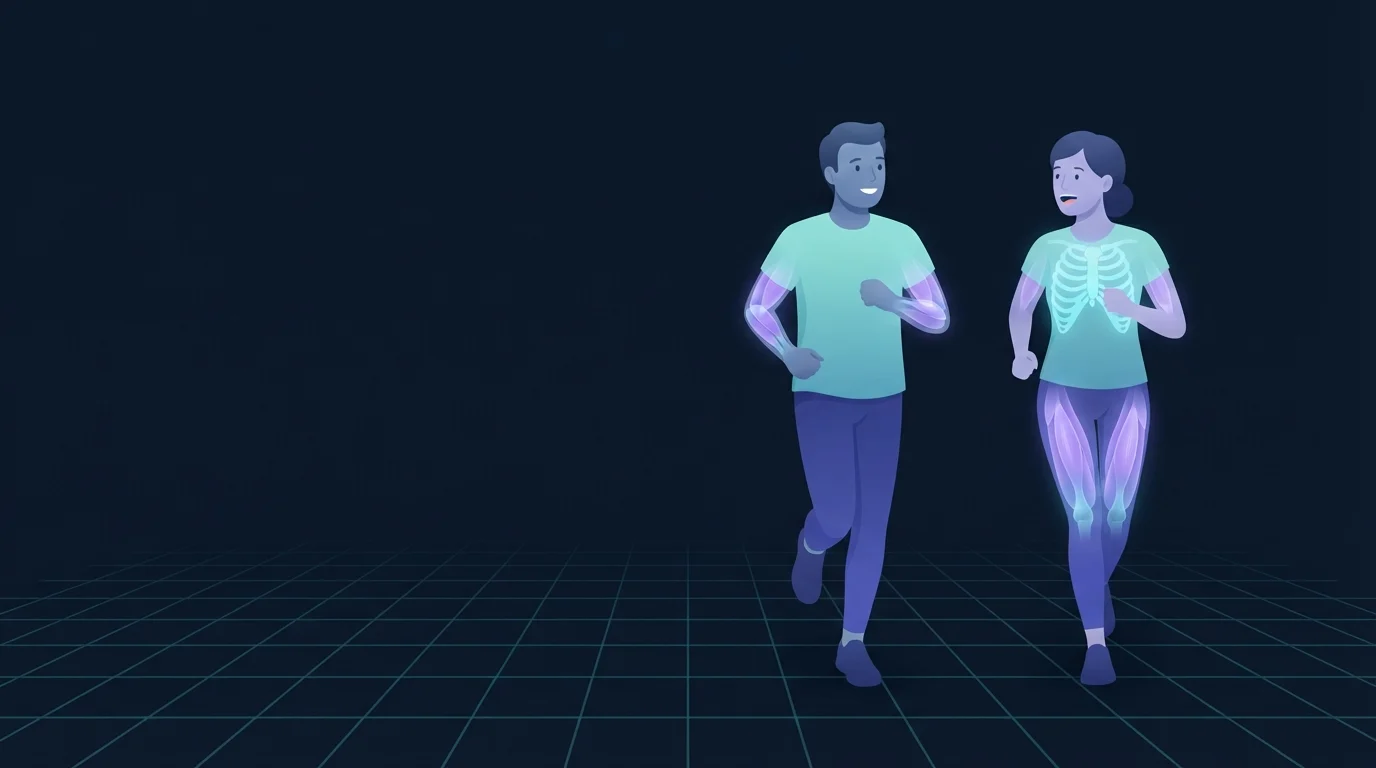
You lace up, you set off, and for about ninety seconds it's fine. Then your breathing gets loud, your legs feel heavy, and somewhere around minute four you're doing the maths on how far it is back to the car. You stop, you walk, and you feel like the only person on the path who can't do this.
Almost everyone has had that run. What makes it demoralising isn't the fatigue, it's the story you tell yourself afterwards: that you must be unusually unfit, or that running is just not for your body.
The far more likely explanation is boring and fixable. You're running too fast. Not fast in any absolute sense, just faster than the pace your aerobic system can currently support, and that's a dial you can turn down on your very next run.
Why You Get Tired So Fast
There are five common causes and they stack. Most beginners have two or three of them at once, which is why a single fix can feel like it only half worked.
1. Your easy pace isn't easy
This is the big one, and it accounts for more early-run exhaustion than the other four combined. Below a certain intensity your body supplies almost all the energy aerobically, and you can keep going for a long time. Above it, you start leaning on systems that run out fast. Cross that line in the first two minutes and the rest of the run is damage control.
Almost nobody crosses it on purpose. It happens because the pace that feels like "running" rather than "jogging" is usually already above the line, and because slowing to a genuinely easy pace feels embarrassing in a way that has nothing to do with physiology.
2. You don't have an aerobic base yet
An aerobic base is capillary density, mitochondria, stroke volume and the tendon resilience to absorb repeated impact. It's built with weeks of easy running, not with one heroic session. If you started three weeks ago, the base is genuinely small. That isn't a character flaw, it's a timeline.
The distribution elite athletes use is instructive here. Seiler's 2010 review in the International Journal of Sports Physiology and Performance describes roughly 80 percent of elite endurance sessions sitting at genuinely low intensity, with the hard work concentrated into a small remainder. Stoggl and Sperlich (2014), in Frontiers in Physiology, tested that directly: across nine weeks and four intensity distributions in 48 well-trained athletes, the polarized group (big easy base plus a little very hard work) improved VO2peak by 11.7 percent, while the group that trained mostly at threshold showed no significant improvement at all. If people who race for a living spend most of their time going easy, a beginner running every session at moderate-hard is not being tough, just inefficient.
3. Your breathing has gone shallow
When pace climbs, breathing tends to migrate up into the chest and get fast and small. Small breaths move less air per breath, so the rate rises to compensate, which feels like panic and makes the whole thing worse. Belly breathing with a steady rhythm moves more air with less effort. Our guide to breathing while running covers the rhythms and the side-stitch fix in detail.
4. You're running underfuelled
You don't need a gel for a 25-minute jog. You do need to have eaten that day. Running in the evening on a skipped lunch, or first thing on nothing after a light dinner, produces exactly the heavy-legged flatness people mistake for poor fitness. The joint position stand from the Academy of Nutrition and Dietetics, Dietitians of Canada and the American College of Sports Medicine (Thomas, Erdman and Burke, 2016) puts in-exercise carbohydrate in the picture from roughly an hour of continuous work onward. Below that, the meal you had four hours ago is the fuelling strategy.
5. You're short on sleep
Sleep is the most underrated performance variable in recreational running. Mah and colleagues (2011), publishing in Sleep, asked eleven collegiate basketball players to extend time in bed to a minimum of ten hours a night for five to seven weeks. Sprint times dropped from 16.2 to 15.5 seconds and shooting accuracy rose by nine percent on both free throws and three-point attempts, with no change to their training. If a run that was fine last week feels brutal today, check the last three nights before you blame your fitness.
The Talk Test: The One Tool That Fixes Most of It
Heart rate zones need a strap and a max heart rate estimate that's probably wrong. Pace targets don't adjust for heat, hills or a bad night. The talk test needs nothing, self-corrects on a hard day, and it holds up under measurement.
Jeans and colleagues (2011), in the Journal of Strength and Conditioning Research, examined how the talk test translates from a graded exercise test into an exercise prescription and found it works as a practical surrogate for the ventilatory threshold. In other words, the point where speaking gets awkward is very close to the physiological line you're trying to stay under.
| What you can say | Where you are | What to do |
|---|---|---|
| A full sentence, comfortably | Easy aerobic pace | Stay here. This is 80% of your running. |
| Four or five words, then a breath | Around threshold | Too hard for a beginner's normal run. Ease off. |
| One or two words | Above threshold | This is interval territory. You won't last. |
Use it properly: say an actual sentence out loud, at around minute six, not minute one. Everything feels easy in the first two minutes. If the sentence breaks into two breaths, slow down until it doesn't. That might mean running slower than you walk quickly. Do it anyway for two weeks and watch what happens to the same route.
Find out what's really holding you back
FitCraft, our mobile fitness app, pairs you with an AI coach who builds you a personalized plan around your goals, schedule, and fitness level. Every FitCraft program is designed by Domenic Angelino, MPH (Brown University) and NSCA-CSCS, with research published in the Journal of Strength and Conditioning Research and Medicine & Science in Sports & Exercise.
Take the Free Assessment Free • 2 minutes • No credit cardWalk Breaks Are Not Cheating
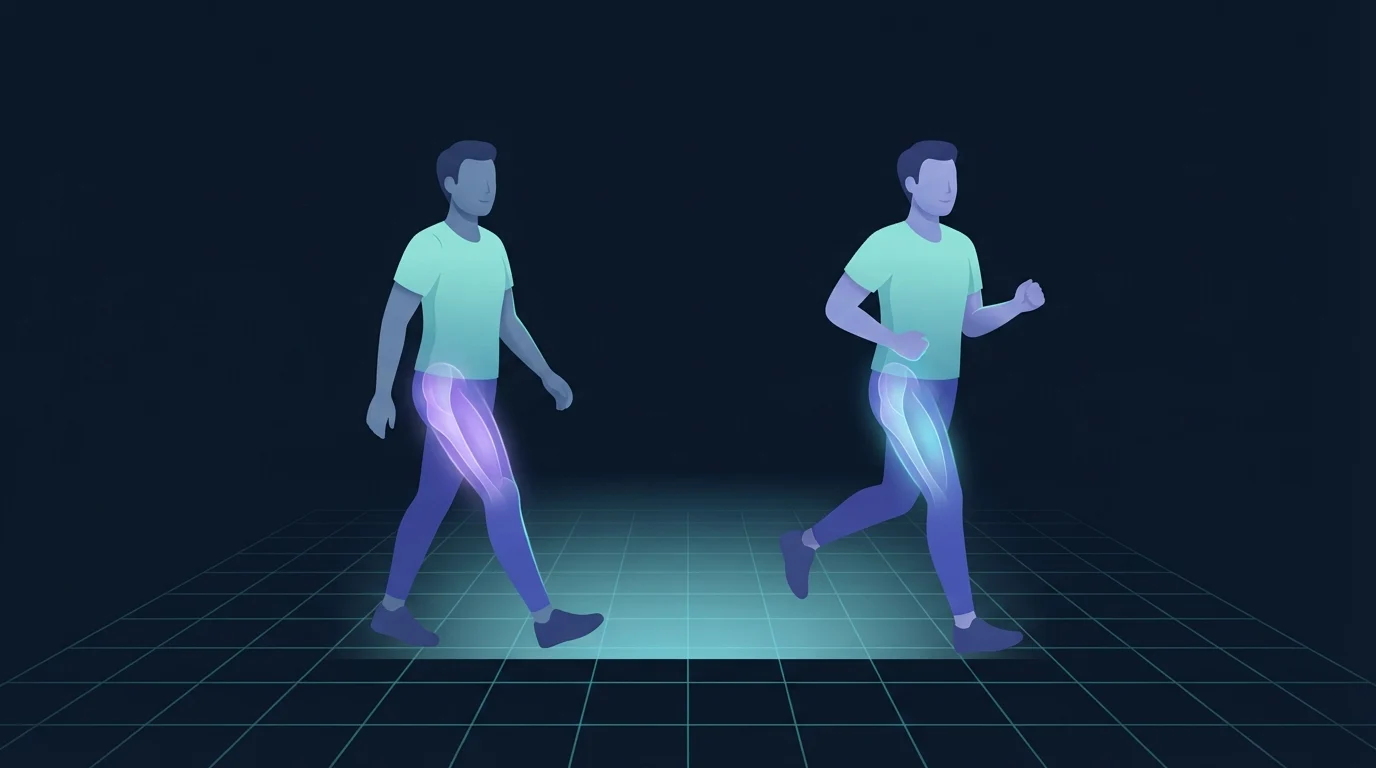
The single biggest mental block for new runners is the belief that stopping to walk means you failed. The research is unsentimental about this. Hottenrott and colleagues (2016), publishing in the Journal of Science and Medicine in Sport, randomised 42 recreational marathon runners to either a run/walk strategy or continuous running. Finish times were statistically indistinguishable, 4:14 against 4:08, and the run/walk group reported less muscle pain and fatigue after the race. Cardiac stress markers did not differ between the groups, so the walk breaks did not remove the strain of racing a marathon. What they changed was how much it hurt for the same finish time.
If planned walk breaks are roughly time-neutral for marathoners, they're a clear win for someone in month one. Our deeper look at the run-walk method covers the ratios and the maths behind why the time cost is so small.
The rule that matters: take the break before you need it. A 60-second walk inserted at minute three, while you still feel fine, keeps the whole session under control. A walk break taken at minute seven because you're falling apart is just the crash arriving on schedule.
Cadence and Form, Briefly
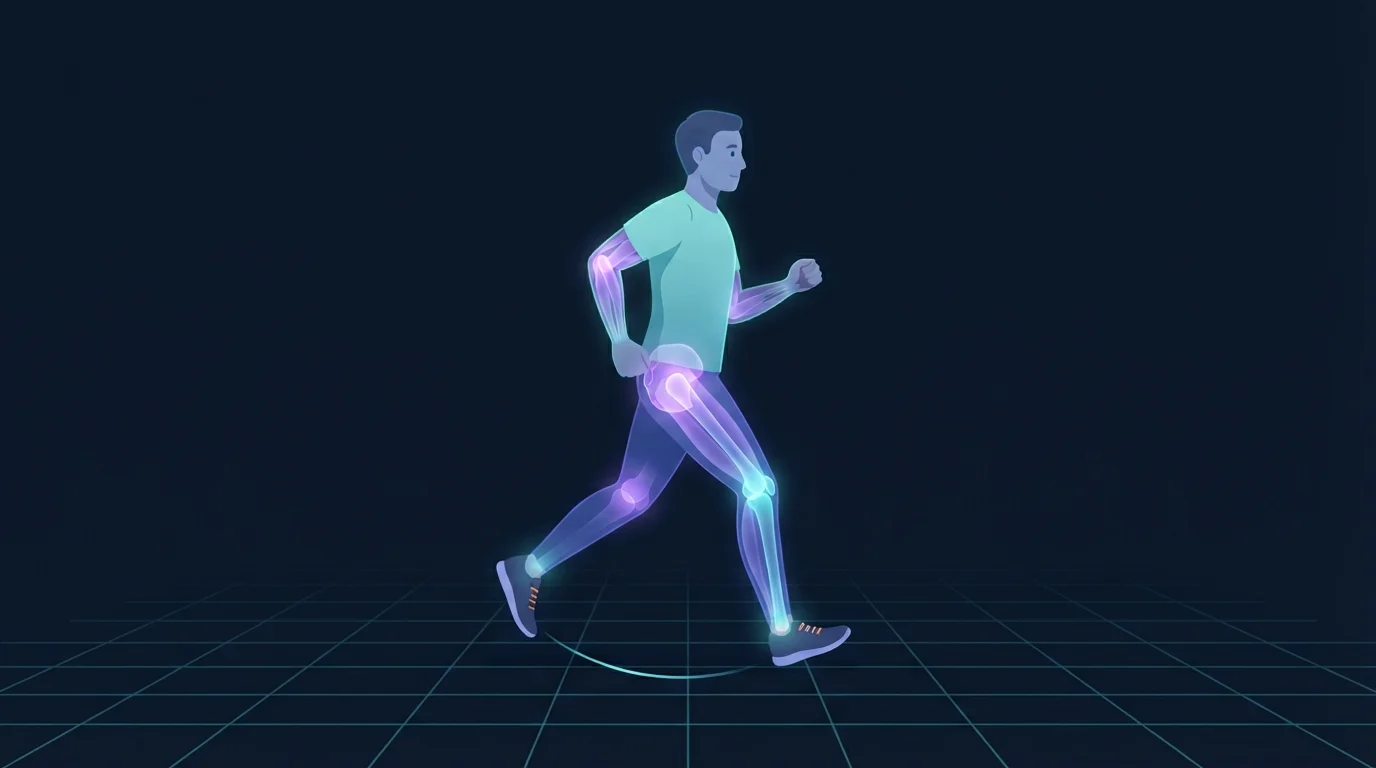
Form advice is where beginners get buried, so here is the short version. Reaching out in front with a long stride means landing on a straight leg with the foot ahead of your body, which brakes you slightly with every step and loads the knee.
Heiderscheit and colleagues (2011), in Medicine & Science in Sports & Exercise, recorded 45 recreational runners at a constant speed while manipulating step rate by 5 and 10 percent in each direction. Increasing step rate substantially reduced energy absorption at the knee and hip, and they concluded that subtle increases in step rate can meaningfully reduce loading on those joints.
The practical version: if you keep picking up niggles, try running with steps about five percent quicker and shorter at the same speed. Don't chase a magic number. Our review of running cadence research explains where the famous 180 figure came from and why it was never a prescription. Beyond that, keep your shoulders down, your hands unclenched, and stop thinking about it.
Mental Strategies With Actual Evidence
Fatigue is not purely mechanical. Perceived effort is a big part of when you stop, and a couple of interventions move it reliably.
Motivational self-talk. Blanchfield and colleagues (2014), in Medicine & Science in Sports & Exercise, trained one group in motivational self-talk over two weeks and left a control group untouched. The self-talk group increased time to exhaustion by roughly 18 percent and reported lower perceived effort at the same workload. No extra physical training was involved. Pick two or three short cues that sound like you, not like a poster, and rehearse them on easy runs so they're available on hard ones. Our piece on running longer mentally goes through how to build the cues.
Music. Terry and colleagues (2020), in a Psychological Bulletin meta-analytic review covering 139 studies and 3,599 participants, found music produced beneficial effects on how exercise feels, on perceived exertion, on physical performance and on oxygen consumption. It's a genuinely effective intervention, not a placebo you tolerate.
Shrink the run. Thinking "I have 25 minutes left" is a much heavier thought than "I'm running to that lamppost". Chunking the route into small targets is the oldest trick in distance running and it works because it keeps your attention off the effort.
The 4-Week Beginner Plan
Three sessions a week, a rest day between each, every running minute at talk-test pace. Walk briskly for five minutes before and after.
| Week | Session (3x per week) | Running time |
|---|---|---|
| 1 | 8 rounds of 1 min easy run, 2 min walk | 8 min |
| 2 | 7 rounds of 2 min easy run, 2 min walk | 14 min |
| 3 | 6 rounds of 3 min easy run, 90 sec walk | 18 min |
| 4 | 5 rounds of 5 min easy run, 90 sec walk | 25 min |
Two rules make this work. First, if you can't say a full sentence during the running minutes, the running minutes are too fast, not too long. Second, repeat a week rather than skipping ahead if it felt hard. Nothing in the plan gets better by arriving at week 4 out of breath.
After week 4, hold at 25 to 30 minutes of easy continuous running three times a week for another month before adding anything. That patience is what protects you: Nielsen and colleagues (2014), following 874 novice runners in the Journal of Orthopaedic & Sports Physical Therapy, found that raising weekly distance by more than 30 percent across a two-week window increased distance-related injuries including patellofemoral pain, iliotibial band syndrome and medial tibial stress syndrome. Your heart adapts in weeks. Your tendons take months.
If you're starting from a long gap or from zero, our guides to starting running out of shape and first-time running cover the week-one details this plan assumes. If you'd rather be handed the whole week instead of assembling it, one of the beginner fitness apps can do the sequencing for you.
What to Expect
The first change is immediate. Slow to talk-test pace and your very next run will feel different, because you stopped crossing the line in minute two. Most people describe it as anticlimactic. That's the point.
Weeks two to four are where the perception shifts. The same route at the same effort takes less out of you, and you start finishing runs thinking you could have gone further. That's the first real signal the base is forming.
Weeks four to eight are where the pace moves without you asking. You'll notice you're running faster at the same conversational effort. That's the whole mechanism: run easy long enough and easy gets quicker. The stamina guide covers what to add once that happens.
The Bottom Line
To run without getting tired, run slower than feels respectable, take walk breaks before you need them, breathe into your belly, eat like a person who exercises, and sleep. That's the whole answer, and four of the five cost nothing.
You're not bad at running. You've been running at the one pace nobody can sustain, and then concluding something about yourself from the result.
Frequently Asked Questions
Why do I get tired so quickly when I run?
For most new runners the cause is pace, not fitness. Running above the intensity your aerobic system can supply forces your body onto fuel it can only use briefly, which is why you feel fine for two minutes and wrecked by four. Slowing down until you can speak a full sentence usually fixes it on the first run. The other four common causes are no aerobic base yet, breathing that has gone shallow and fast, running underfuelled, and short sleep.
How do I stop getting out of breath while running?
Slow down first, because breathlessness is a symptom of pace more often than a breathing problem. Then breathe low into the belly rather than high into the chest, and settle into a rhythm such as inhaling for three footstrikes and exhaling for two. Breathing through the nose and mouth together moves more air than the nose alone and is fine at any pace.
Is it okay to walk during a run?
Yes, and for new runners it is often the faster route. When Hottenrott and colleagues randomised 42 recreational marathoners to run/walk or continuous running, finish times were statistically indistinguishable (4:14 versus 4:08) while the run/walk group reported less muscle pain and fatigue afterwards. Planned walk breaks taken before you need them work far better than emergency ones.
How long does it take to stop getting tired when running?
Pace changes help on day one. The aerobic adaptations that make running feel genuinely easier, more capillaries, more mitochondria, a bigger stroke volume, take roughly four to eight weeks of consistent easy running. Tendons and bone take longer, which is why volume should climb slowly rather than in jumps.
Should I eat before a short run?
For runs under about an hour you don't need to eat beforehand or carry anything with you, as long as you've eaten normally that day. The joint position stand from the Academy of Nutrition and Dietetics, Dietitians of Canada and the American College of Sports Medicine puts fuelling during exercise in the picture from roughly an hour of continuous work onward. Chronic underfuelling across the whole day is a different problem and it shows up as fatigue on every run.
Does running slower actually make you faster?
Over a training block, yes. Elite endurance athletes spend roughly 80 percent of their sessions at genuinely low intensity (Seiler, 2010), and when Stoggl and Sperlich compared four intensity distributions across nine weeks, the polarized group built on a large easy base improved VO2peak by 11.7 percent while the threshold group showed no significant change. Easy running is what lets the hard sessions be hard.