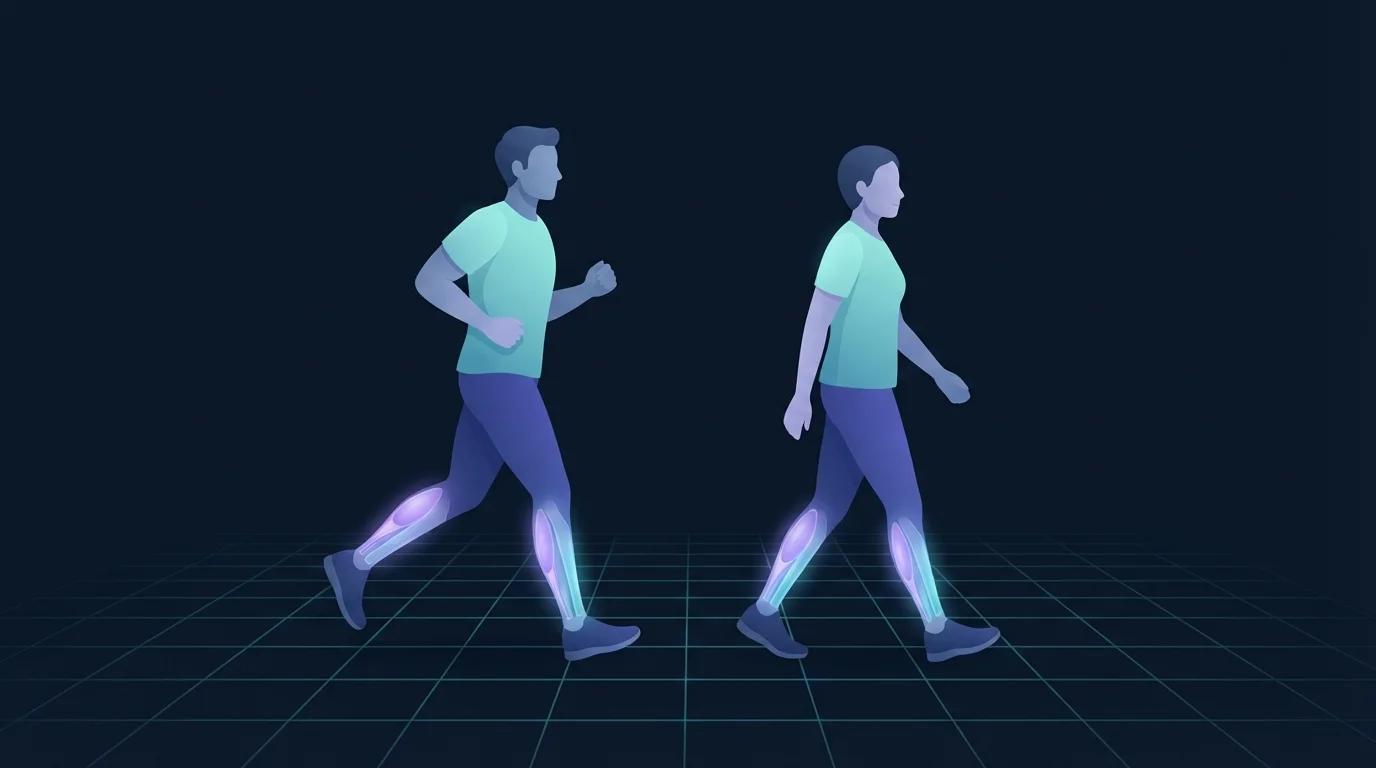
Five kilometres is 3.1 miles. Most beginners finish their first one somewhere between 30 and 45 minutes, and almost all of them spend the eight weeks beforehand convinced they're the one person this won't work for.
If your last attempt at running ended ninety seconds in, with your lungs on fire and a quiet decision never to do that again, nothing was wrong with you. You ran too fast. Everybody does, because jogging slowly feels ridiculous and your body has no calibration for an effort it's never held.
So this plan does two things. It starts with jogging intervals short enough that you can't wreck yourself, and it insists you run them slowly enough to talk. That's it. The rest is a calendar.
What "Starting From Zero" Actually Means
Zero means you can walk for 30 minutes without much trouble. That's the entire entry requirement. If a 30-minute walk is currently hard, spend two or three weeks walking before week 1 and you'll have a much better eight weeks afterwards.
The reason the plan starts this gently is that beginners are the most fragile runners there are. A 2015 systematic review and meta-analysis by Videbaek and colleagues in Sports Medicine found novice runners sustained 17.8 running-related injuries per 1000 hours of running (95% CI 16.7 to 19.1), compared with 7.7 per 1000 hours (95% CI 6.9 to 8.7) in experienced recreational runners. More than double the rate, per hour of exposure.
That's not an argument against running. It's an argument for starting at one minute at a time rather than trying to jog a mile on day one because a mile sounds like a respectable unit. Your heart and lungs will be ready long before your Achilles and shins are, and the gap between those two timelines is where beginners get hurt.
The 8-Week 5K Training Plan
Three sessions a week, on non-consecutive days. Every session opens with a 5-minute brisk walk and closes with a 5-minute easy walk. Nothing in the middle column is a workout you should finish exhausted.
| Week | Session A | Session B | Session C (longest) | Jogging total |
|---|---|---|---|---|
| 1 | 8 x (1 min jog / 90s walk) | 8 x (1 min jog / 90s walk) | 9 x (1 min jog / 90s walk) | 25 min |
| 2 | 7 x (90s jog / 90s walk) | 7 x (90s jog / 90s walk) | 8 x (90s jog / 90s walk) | 33 min |
| 3 | 6 x (2 min jog / 90s walk) | 6 x (2 min jog / 90s walk) | 5 x (3 min jog / 2 min walk) | 39 min |
| 4 | 5 x (3 min jog / 90s walk) | 5 x (3 min jog / 90s walk) | 4 x (4 min jog / 2 min walk) | 46 min |
| 5 | 4 x (5 min jog / 2 min walk) | 4 x (5 min jog / 2 min walk) | 3 x (7 min jog / 2 min walk) | 61 min |
| 6 | 3 x (8 min jog / 2 min walk) | 3 x (8 min jog / 2 min walk) | 2 x (12 min jog / 3 min walk) | 72 min |
| 7 | 2 x (12 min jog / 2 min walk) | 20 min continuous easy jog | 2 x (14 min jog / 2 min walk) | 72 min |
| 8 (race week) | 20 min easy with two walk breaks | 15 min easy jog | Race: 5K | Race |
A few notes that matter more than the table does.
- Distance is not in this plan on purpose. Everything is measured in minutes, because minutes are the same for everyone and miles are not. A 14-minute-mile jogger and an 11-minute-mile jogger doing 20 minutes are doing the same training. Doing "two miles" they are not.
- Repeat any week you want. Nothing bad happens if week 4 takes you two weeks. The calendar is a suggestion; your legs are the authority.
- Add a fourth day of walking or cycling if you want more. More aerobic time is good. More impact, this early, is not.
- The percentage jumps in weeks 1 to 3 look big and aren't. Going from 25 to 33 minutes of jogging is a 32 percent rise, but from a base this small the absolute load is tiny. From week 4 onward, when the volume is real, the plan settles into roughly 15 percent per week. How you feel 24 hours later is a better gauge than the percentage.
The Talk Test: How Slow Is Slow Enough
Here's the only intensity rule in the plan. During a jogging interval you should be able to say a full sentence out loud without breaking it up to breathe. Not a word. Not a phrase. A sentence.
This isn't folk wisdom. Foster and colleagues (2008) in the Journal of Cardiopulmonary Rehabilitation and Prevention examined the talk test against laboratory markers and found it functions as a usable surrogate for the ventilatory threshold, good enough to prescribe training intensity from. You have a free lab test in your own mouth.
In practice, almost every beginner's first instinct is 60 to 90 seconds per mile too fast. The fix is uncomfortable in a different way: pick a jog that feels embarrassingly slow, then slow down a bit more. If someone walking briskly beside you could keep up, that's fine. Speed is not what's being trained here. Your ability to keep going is.
Our guide on how to run without getting tired goes deeper on pace calibration and the other four reasons beginners fade early, and how to start running when you're out of shape covers the version of this where extra weight and a long layoff are both in play.
Find out what's really holding you back
FitCraft, our mobile fitness app, pairs you with an AI coach who builds you a personalized plan around your goals, schedule, and fitness level. Every FitCraft program is designed by Domenic Angelino, MPH (Brown University) and NSCA-CSCS, with research published in the Journal of Strength and Conditioning Research and Medicine & Science in Sports & Exercise.
Take the Free Assessment Free • 2 minutes • No credit cardDoes Run-Walk Actually Work?
Beginners treat walk breaks as an admission of failure, which is a shame, because the evidence says they're closer to a technique.
The cleanest test comes from the marathon rather than the 5K. Hottenrott and colleagues (2016) in the Journal of Science and Medicine in Sport randomised 42 non-elite marathon runners, 22 men and 20 women, to either a run/walk strategy or continuous running for an actual marathon. Finish times came out statistically indistinguishable, 4:14:25 against 4:07:40, and the run/walk group reported less muscle pain afterwards. If walk breaks cost almost nothing across 26.2 miles at a recreational pace, they cost nothing at all across 3.1.
The mechanism is unglamorous. A walking interval drops heart rate, lets the calf and Achilles unload for a moment, and interrupts the accumulating impact before it turns into a limp. You end up with more total minutes of movement at a lower cost. Our deeper look at the run-walk method covers the history and the ratios in detail.
What run-walk doesn't do is make you injury-proof. Relph and colleagues (2023) followed 110 participants through a modified 9-week UK Couch to 5K programme, mean age 47.1 and mean BMI 28.1, and found 19 percent sustained a musculoskeletal injury during the nine weeks, with previous injury raising the risk more than sevenfold. Only 27.3 percent completed the whole programme. Those numbers are worth knowing up front, because they reframe what a setback means. Most people hit one.
Cadence: The One Form Cue Worth Bothering With
Ignore almost everything you've read about running form. Foot strike, arm carriage, forward lean: none of it is worth a beginner's attention, and trying to change all of it at once usually makes things worse.
Cadence is the exception. Heiderscheit and colleagues (2011) in Medicine and Science in Sports and Exercise had runners alter their step rate above and below their preferred cadence and measured joint mechanics. Increasing step rate by 5 to 10 percent reduced the energy absorbed at the hip and knee, mostly by shortening stride length and reducing how far the centre of mass dropped with each step.
The practical version: count your right foot strikes for 30 seconds and double it, then double again for steps per minute. Whatever that number is, aim for about 5 percent higher. Don't chase 180 steps per minute as a universal target, which is a misreading of a single observation of elite runners at race pace. Slightly quicker, slightly shorter steps. That's the whole adjustment, and a metronome app or a playlist at the right tempo does the coaching for you.
Shoes and Surfaces: What Matters and What Doesn't
The running shoe industry would prefer this section were longer. Here's the honest version.
Shoe drop doesn't appear to matter. Malisoux and colleagues (2016) in the American Journal of Sports Medicine randomised 553 leisure-time runners to standard cushioned shoes with 10 mm, 6 mm or 0 mm heel-to-toe drop and followed them for six months. There was no overall difference in injury risk between the groups. Drop is a preference, not a prescription.
Comfort is the best available selection criterion. Buy a neutral cushioned trainer that feels good when you jog a few steps in the shop, typically half a size up from your everyday shoe because feet swell. Skip the gait analysis upsell for now. If a shoe feels wrong at minute two it will feel worse at minute twenty.
Surfaces matter less than variety. The evidence that softer surfaces reduce injury is thin, partly because runners unconsciously adjust leg stiffness to the surface. What does help is mixing it up: pavement, packed trail, track and treadmill load your tissues slightly differently, and a treadmill is a completely legitimate place to run this entire plan if weather, darkness or self-consciousness is the barrier. Avoid running the same direction on the same cambered road every session, since a steeply sloped road puts your two legs at different effective lengths.
Replace shoes when they feel dead, not on a schedule. The 300 to 500 mile guideline is a manufacturer heuristic rather than a research finding. For an eight-week 5K plan, one decent pair is all you need.
What to Do When a Week Goes Badly
It will. Work travel, a cold, a stretch of rain, a Tuesday that just doesn't happen. Here's the decision tree.
- Missed one session: do it on the next available day and carry on. Don't double up two sessions back to back to catch up.
- Missed a week: repeat the last week you actually completed, in full, before moving forward. This costs you seven days and saves you far more.
- Missed two weeks or more: drop back two weeks in the plan and rebuild. Fitness fades slower than you think, but tendon tolerance fades faster than fitness does.
- Sick above the neck (runny nose, sore throat, no fever): a shortened easy session is usually fine. Below the neck (fever, chest, body aches, stomach): rest, and return at the previous week's volume.
- Something hurts: pain that gets worse as the run goes on, hurts the next morning, or changes how you move means stop and repeat the previous week at lower volume. Sharp pain in a specific bony spot, particularly the shin or the top of the foot, is a reason to see someone rather than to push on.
Before you decide that dropping back means the plan isn't working, look at what happens when researchers try to engineer the setbacks away. Buist and colleagues (2008) in the American Journal of Sports Medicine randomised 532 novice runners preparing for a 4-mile event to either a graded 13-week programme applying the 10 percent rule or a standard 8-week programme, and found no difference in running-related injury rates between them. A gentler calendar on its own didn't help. What determines how this goes is how honestly you respond to the signals inside the plan.

Race Day: Your First 5K
Enter something six to eight weeks out so the date exists before your motivation wobbles. A local timed 5K, a parkrun, a charity event: the smaller and flatter the better for a first one.
- Nothing new. Same shoes, same socks, same breakfast, same shirt you've already run in. A 5K is too short for a fueling plan, so don't invent one.
- Warm up properly. Ten minutes of walking, five minutes of easy jogging, then two or three 20-second accelerations. A cold start is the fastest way to a calf strain.
- Start at the back. Everyone around the front goes out too fast, and standing among them makes you do it too.
- Run the first kilometre slower than feels right. You'll pass people from kilometre 3 onwards, which is a better day than the reverse.
- Keep your walk breaks if you've trained with them. Race day is not the day to test whether you can hold it continuously for the first time.
- Finish and then decide what's next. Not at kilometre 4, when your brain is unreliable.
The Bottom Line
A 5K training plan for beginners has exactly two jobs: keep the jogging intervals short enough that you finish every session able to do the next one, and keep the pace slow enough that you can talk. Do those two things three times a week for eight weeks and 3.1 miles stops being an ambition and becomes a Saturday.
You're not starting too late, too heavy or too unfit. You're starting at one minute, which is where everyone who now runs 5K comfortably also started. If you want a plan that keeps adjusting as your fitness changes instead of a static table, our roundup of workout apps for beginners compares how the main options handle progression from zero. And when 5K feels routine, our 12-week half marathon training plan is the next block, built on exactly this base.
Frequently Asked Questions
How long does it take a beginner to train for a 5K?
Eight to nine weeks of three run-walk sessions a week gets most people from no running at all to covering 5K continuously. Older beginners, heavier beginners and anyone returning from a long break often need ten to twelve weeks, and taking longer costs nothing. The finish line doesn't care how many weeks it took you to arrive.
Is it okay to walk during a 5K?
Yes, and for a first 5K it's often the smarter race. A randomised study of 42 non-elite marathon runners found a run/walk strategy produced finish times statistically indistinguishable from continuous running, with less muscle pain afterwards. Walk breaks lower heart rate, spread the impact load and keep your pace more even than trying to hold a jog you can't sustain.
How slow should a beginner run?
Slow enough to speak a full sentence out loud without gasping between words. That's the talk test, and research has found it tracks the ventilatory threshold closely enough to prescribe training intensity from. Nearly every beginner runs their easy pace too fast, which is the single biggest reason the first four weeks feel unbearable.
What should I do if I miss a week of 5K training?
Repeat the last week you actually completed rather than jumping back to where the calendar says you should be. Missing one session means repeating that session; missing a week or more means repeating the week. In a prospective study of 110 UK Couch to 5K participants, only 27.3 percent completed the full programme and 19 percent picked up a musculoskeletal injury, so falling behind is the normal experience rather than a personal failure.
What running shoes do beginners need for a 5K?
A neutral cushioned shoe that feels comfortable when you jog in it, bought half a size up from your usual, is enough. A randomised controlled trial of 553 leisure-time runners compared 10 mm, 6 mm and 0 mm heel-to-toe drops over six months and found no overall difference in injury risk, so comfort is a better selection criterion than drop, stability category or price.
How many days a week should a beginner run?
Three, on non-consecutive days. Novice runners sustain about 17.8 running-related injuries per 1000 hours of running, more than double the rate in experienced recreational runners, and the rest day between sessions is when tendons and bones actually adapt. A fourth day of walking or cycling adds aerobic time without adding impact.