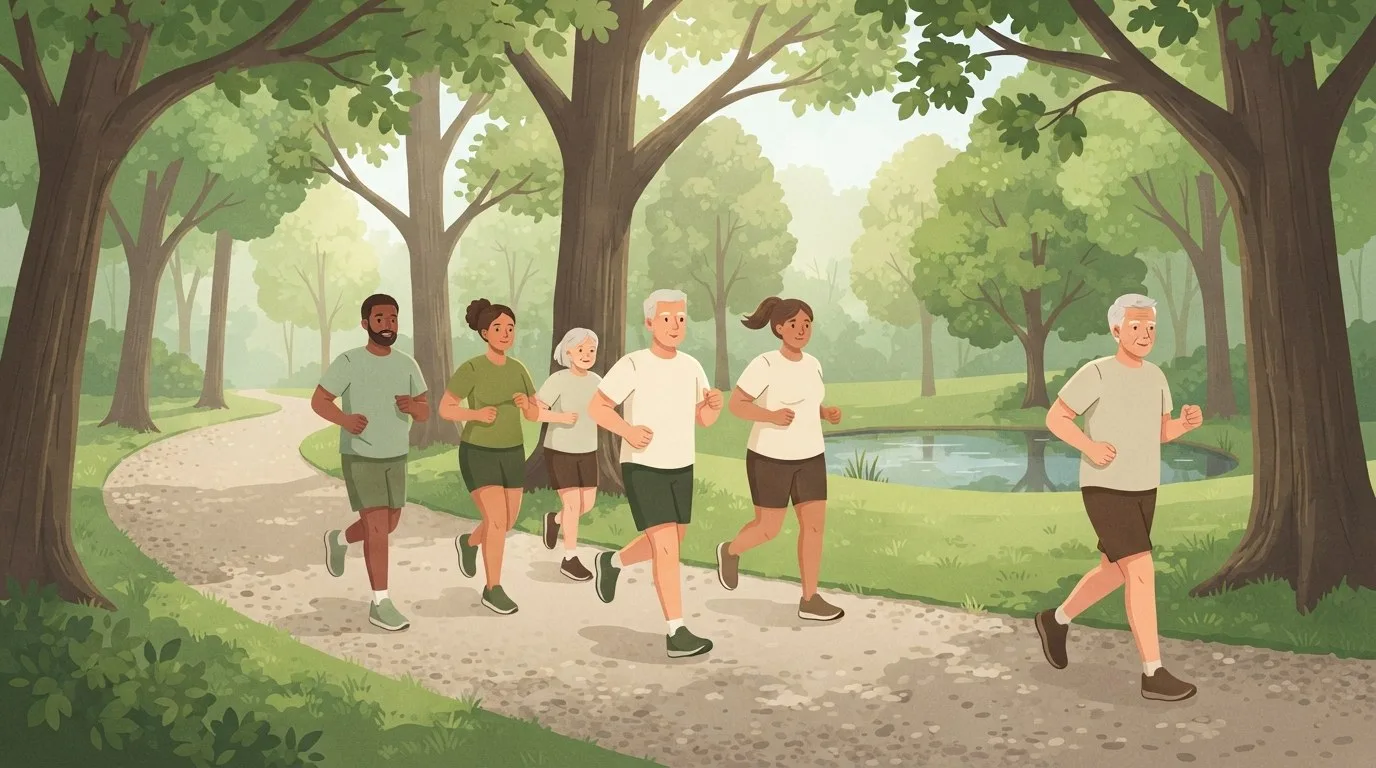
You signed up for a charity 5K, or a friend talked you into a Saturday morning parkrun, and now you want to know two things: how far is it, and how long will it take you? The distance has one answer. A 5K is 5 kilometers, which is 3.1 miles (3.107 if you want it exact), 5,000 meters or about 16,400 feet. The time has a range, and where you land in it depends mostly on whether you run, walk or mix the two.
So this page answers "5K is how many miles" in one line and spends the rest on the question underneath it: how long a 5K takes to run or walk at your age, sex and pace. The running times come from 2.2 million U.S. race finishes, and the walking times come from a meta-analysis of walking speed in 23,111 adults. You'll also find how many laps of a track a 5K is, how many steps it takes, and what counts as a good time.
5K Is How Many Miles?
A 5K is 3.1 miles. The K stands for kilometers, so a 5K is 5 kilometers, and one kilometer is 0.621 miles. Here's how a 5K compares with the other common race distances:
| Race | Kilometers | Miles |
|---|---|---|
| 1K | 1 | 0.62 |
| 5K | 5 | 3.11 (usually written 3.1) |
| 8K | 8 | 4.97 |
| 10K | 10 | 6.21 |
| 15K | 15 | 9.32 |
| Half marathon | 21.1 | 13.1 |
| Marathon | 42.2 | 26.2 |
Half of a 5K is 2.5 kilometers, or about 1.55 miles. A 10K is twice as far at 6.2 miles. And a 5K isn't a marathon, even though plenty of people search for a "5K marathon." A marathon is 26.2 miles, so a 5K is a little under one-eighth of one. A 5K run, a 5K race and a 5K walk all cover the same 3.1 miles. Only the pace changes.
How Long Does It Take to Run a 5K?
About 36 minutes puts you in the middle of an American race. An analysis of 2.2 million U.S. 5K road-race finishes from 2024 published by Outside put the overall median at about 36 minutes. Men came in at about 32 minutes and women at about 39. That's a pace of roughly 10:20 per mile for men and 12:30 per mile for women. The analysis kept every finish between 12 minutes and an hour, so those fields include plenty of run-walkers and brisk walkers alongside people who ran the whole way.
For scale, the world's best men run 5,000 meters in under 13 minutes and the best women in under 14. Between those two ends, these rough bands match what most people experience:
- First 5K, run-walk: 35 to 45 minutes.
- First 5K, running the whole way: 30 to 40 minutes.
- Regular recreational runner, a year or more in: 24 to 30 minutes.
- Competitive club runner: under 20 minutes.
- Brisk walker: 45 to 55 minutes. Easy walker: about an hour.
5K pace chart: from pace per mile to finish time
If you already know your usual pace, multiply your minutes per mile by 3.1 and you have your 5K time within a few seconds. The chart does it for you:
| Pace per mile | Pace per kilometer | 5K finish time |
|---|---|---|
| 7:00 | 4:21 | 21:45 |
| 8:00 | 4:58 | 24:51 |
| 9:00 | 5:36 | 27:58 |
| 10:00 | 6:13 | 31:04 |
| 11:00 | 6:50 | 34:11 |
| 12:00 | 7:27 | 37:17 |
| 13:00 | 8:05 | 40:23 |
| 15:00 (fast walk, 4 mph) | 9:19 | 46:36 |
| 17:09 (brisk walk, 3.5 mph) | 10:39 | 53:16 |
| 20:00 (easy walk, 3 mph) | 12:26 | 1:02:08 |
Finish times for 3.107 miles at an even pace, rounded to the nearest second.
Average 5K Time by Age and Sex
Here's the same 2024 dataset broken down by age group. These are medians, the time that half the finishers in each group beat, with the pace per mile that goes with each one:
| Age | Men, median | Men, pace per mile | Women, median | Women, pace per mile |
|---|---|---|---|---|
| 10 to 14 | 30:38 | 9:52 | 36:19 | 11:41 |
| 15 to 18 | 26:16 | 8:27 | 33:44 | 10:51 |
| 19 to 22 | 28:01 | 9:01 | 34:29 | 11:06 |
| 23 to 29 | 29:41 | 9:33 | 35:26 | 11:24 |
| 30 to 39 | 30:32 | 9:50 | 36:34 | 11:46 |
| 40 to 49 | 31:49 | 10:14 | 38:11 | 12:17 |
| 50 to 59 | 33:04 | 10:39 | 41:05 | 13:13 |
| 60 to 69 | 35:23 | 11:23 | 44:28 | 14:19 |
| 70 to 79 | 39:38 | 12:45 | 47:56 | 15:26 |
Median 5K finish times in U.S. road races in 2024, from the Outside analysis of 2.2 million finishes between 12 minutes and an hour, ages 10 to 79. The pace per mile is our arithmetic.
Two patterns stand out. The first is how gently the times slow with age until the 50s. From the 23 to 29 group to the 50 to 59 group, the men's median slows by about three and a half minutes. From 50 to 59 to 70 to 79 it slows by another six and a half. That's the same shape physiologists see in masters athletes. In a review in The Journal of Physiology, Tanaka and Seals (2008) describe peak endurance performance holding until about age 35, dropping modestly until 50 to 60 and then declining more steeply, mainly because maximal oxygen uptake falls.
The second is the size of the gap between men and women. Across the adult age groups the women's median is about 20 to 26 percent slower than the men's. Among the world's best, the gap in most events has held steady at about 8 to 12 percent, according to a review by Sandbakk and colleagues (2018), driven largely by men's higher hemoglobin levels and aerobic capacity. The extra spread in everyday races probably reflects who enters and how they train as much as physiology.
Who shows up moves a race median more than most people realize. Gilburn (2023) analyzed 1.57 million parkrun results from 56 Scottish courses between 2008 and 2019. The average performance at events fell year after year even though individual runners kept getting faster, because the people joining were newer and slower. A median describes the crowd that turned up that day, so read it as context for your own time.
How long should it take a 50 year old to run a 5K?
About 33 minutes for men and 41 minutes for women, going by the 2024 medians for ages 50 to 59. A 50-year-old who has run regularly for a few years will often beat those numbers. Someone starting from scratch can expect 40 to 50 minutes with walk breaks for a first race, and that's a perfectly good place to start.
How Long Does It Take to Walk a 5K?
About an hour at an ordinary walking pace. Bohannon and Andrews pooled 41 studies of 23,111 healthy adults and found comfortable walking speeds of 1.31 to 1.43 meters per second, or about 2.9 to 3.2 mph, for men and women under 60. Here's what those speeds mean for a 5K walk:
| Age | Men | Women |
|---|---|---|
| 20 to 29 | 61 min | 62 min |
| 30 to 39 | 58 min | 62 min |
| 40 to 49 | 58 min | 60 min |
| 50 to 59 | 58 min | 64 min |
| 60 to 69 | 62 min | 67 min |
| 70 to 79 | 66 min | 74 min |
| 80 to 99 | 86 min | 89 min |
Time to walk 5 kilometers at the average comfortable walking speed for each age group (Bohannon and Andrews, 2011), rounded to the nearest minute.
Those speeds were measured over short walkways in a lab, not across 3.1 miles, so read them as a natural, unhurried pace. A walk with some purpose is faster. At a brisk 3.5 mph a 5K takes about 53 minutes, and at 4 mph, which is a fast walk for most adults, it takes about 47. If you're walking a 5K race and want a target, finishing in 45 to 55 minutes is a strong walking time.
Can an Unfit Person Run a 5K?
Yes. If you can walk for 30 minutes without much trouble, you can almost certainly build up to running or run-walking a 5K in about eight to ten weeks of three short sessions a week. Plenty of people finish their first race with walk breaks built in, and a run-walk 5K usually lands between 35 and 45 minutes. That sits right around the race median for most age groups in the table above.
The mistake that sinks most beginners is speed. They run the first few sessions too fast, everything hurts, and they decide running isn't for them. Jog slowly enough that you could say a full sentence out loud, and take a walk break before you need one. Our 8-week 5K training plan for beginners lays out every session from the first one-minute jog to race week, so you don't have to guess how much to add.

Knowing what to do is the easy part.
FitCraft, our mobile fitness app, pairs you with an AI coach who builds you a personalized plan around your goals, schedule, and fitness level. Every FitCraft program is designed by Domenic Angelino, MPH (Brown University) and NSCA-CSCS, with research published in the Journal of Strength and Conditioning Research and Medicine & Science in Sports & Exercise.
Take the Free Assessment Free • 2 minutes • No credit cardHow Many Laps Is a 5K?
A 5K is 12.5 laps of a standard 400-meter outdoor track, run in the inside lane. That's why track 5,000-meter races start on the far side of the track, half a lap from the finish line. Older American tracks built to a quarter mile (440 yards, about 402 meters) need about 12.4 laps, and a 200-meter indoor track needs 25.
Lanes matter more than people expect. Each lane further out is a longer loop, and lane 2 adds about 7 meters to every lap. Run all 12.5 laps in lane 2 and you'll cover about 90 meters more than a 5K. On a treadmill there's no such problem: a 5K is 3.1 on the miles display or 5.0 in kilometers.
How Many Steps Is a 5K?
About 6,000 to 7,900 steps if you walk it and about 4,600 to 5,400 if you're a newer runner. The count depends on stride length, and stride length grows with speed, so the faster you go the fewer steps a 5K takes.
The walking figures use step rates from the CADENCE-Adults study, in which Tudor-Locke and colleagues (2019) hand-counted the steps of 76 adults aged 21 to 40 at each treadmill speed:
| Walking speed | Steps per minute | Time for a 5K | Steps for a 5K |
|---|---|---|---|
| 2.5 mph | 106 | 75 min | about 7,900 |
| 3.0 mph | 114 | 62 min | about 7,100 |
| 3.5 mph | 122 | 53 min | about 6,500 |
| 4.0 mph | 129 | 47 min | about 6,000 |
Step rates measured in the CADENCE-Adults study. Steps per 5K are our arithmetic, rounded to the nearest 100.
For running, van Oeveren and colleagues (2017) measured 12 inexperienced runners at speeds of their own choosing, about 2.4 to 2.9 meters per second, or roughly 9:15 to 11:15 per mile. They took 77 to 80 strides a minute, which is 154 to 160 steps. At those speeds a 5K takes 29 to 35 minutes and about 4,600 to 5,400 steps. Faster runners cover more ground with each step, so a sub-25-minute 5K usually takes fewer steps still. The same study found these new runners stepped a little slower than their most economical rate, and our review of running cadence research covers whether it's worth changing yours.

Is Running for 30 Minutes a Day Enough?
For health, yes, with room to spare. The World Health Organization's 2020 guidelines, summarized by Bull and colleagues (2020), ask adults for 150 to 300 minutes of moderate activity or 75 to 150 minutes of vigorous activity a week. They also ask for muscle-strengthening work on at least two days. Running counts as vigorous, so 30 minutes a day adds up to 210 minutes a week, past the top of the vigorous range.
You don't need nearly that much to benefit. In 55,137 adults followed for an average of 15 years, Lee and colleagues (2014) found that runners had a 30 percent lower risk of death from any cause and a 45 percent lower risk of cardiovascular death than non-runners. Even fewer than 51 minutes of running a week was linked to a lower risk.
A 30-minute run is also a 5K for a lot of people: at 9:40 per mile, 30 minutes covers 3.1 miles. If you're nowhere near that pace yet, 30 minutes of run-walk is still a complete session. And because the guidelines ask for strength work too, two short dumbbell or bodyweight sessions a week are a better use of your time than a seventh run.
How to Improve Your 5K Running Speed
Most of your 5K time comes from aerobic fitness, so the order you build things in matters more than any single workout:
- Add easy minutes before hard ones. Three or four runs a week at a pace where you can still talk build the base that faster running rests on.
- Then add one faster session a week. Once 30 minutes of easy running feels routine, try five or six rounds of 3 minutes at the effort you could hold for a whole 5K, with 2 minutes of easy jogging between them.
- Lift twice a week. Goblet squats, reverse lunges, single-leg deadlifts and calf raises with dumbbells or body weight make your legs sturdier for the extra running.
- Start race day slower than you feel like starting. An even pace beats a fast first kilometer followed by a crawl through the third.
Our guide on how to run a faster mile turns the same principles into an 8-week plan. And if you want to see how your 5K lines up with your mile, our breakdown of how long it takes to run a mile covers the mile times that go with each level.
What This Means for You
If you've never raced a 5K, the numbers that matter are short: 3.1 miles, about 36 minutes for the typical finisher, about an hour for a walker, and 12.5 laps if you're on a track. Find your row in the age table and treat its median as a reference point. Half the people in that row were slower, and every one of them still got a finish time.
Your first race tells you more than any table. Run it or walk it, write the time down, and you have a baseline you can beat eight weeks later. What stops most people is the third week of training, when the plan stops feeling new and the sessions start to feel optional. That's a consistency problem, and it gets solved by a routine with some pull to it rather than more willpower. As Katie put it: "I've tried everything. This is the first time I've stuck with something past two weeks."
If you're picking an app to build that habit around your runs, our comparison of the best fitness apps for beginners looks at which ones people actually keep using. In FitCraft, 3D AI coaches demonstrate each dumbbell and bodyweight exercise for your two strength days, your coach calls you by name during workouts, and a streak keeps the week on track.
Frequently Asked Questions
How many km is 5K run?
A 5K run is 5 kilometers, which is 5,000 meters or 3.1 miles. The K stands for kilometers, so a 10K is 10 kilometers (6.2 miles) and a 15K is 15 kilometers (9.3 miles).
How long does it take to walk a 5K?
About an hour at an ordinary pace of around 3 mph. A brisk walk at 3.5 mph takes about 53 minutes and a fast walk at 4 mph about 47 minutes. Adults in their 70s walking at their usual pace typically need 66 to 74 minutes.
What is a good 5K time?
Any time faster than the median for your age and sex is a good 5K time. In 2024 U.S. races that meant about 30 to 32 minutes for men and 36 to 38 minutes for women in their 30s and 40s. Under 25 minutes beat the median of every age and sex group in the data.
How long should it take a 50 year old to run a 5K?
About 33 minutes for men and 41 minutes for women, based on the 2024 median finish times for ages 50 to 59 in U.S. races. A beginner of that age who uses walk breaks can expect 40 to 50 minutes for a first 5K.
Can an unfit person run 5K?
Yes. Most people who can walk for 30 minutes can build up to a 5K in eight to ten weeks of three run-walk sessions a week. Keep every jog slow enough to talk, and expect a first finish of about 35 to 45 minutes with walk breaks.
Is a 5K the same as a marathon?
No. A 5K is 3.1 miles and a marathon is 26.2 miles, so a 5K is a little under one-eighth of a marathon. A half marathon is 13.1 miles and a 10K is 6.2 miles.
How many miles is half of a 5K?
Half of a 5K is 2.5 kilometers, or about 1.55 miles. On a 400-meter track that's six and a quarter laps.
Is running for 30 minutes a day enough?
Yes for health. Thirty minutes of running a day adds up to 210 minutes of vigorous activity a week, more than the 75 to 150 minutes the World Health Organization recommends. Add two strength sessions a week, which the same guidelines ask for.