
You can run three or four times a week for a year and finish the year with the same mile time you started with. That happens to a lot of people, and it isn't a discipline problem. It's what steady running does. Your body gets very good at the one pace you keep asking it for, and then it stops having any reason to change.
The frustrating part is that you're doing the work. You show up. You put in the miles. Then you line up at a fun run or get curious on a track, and the watch reads almost exactly what it read last spring, and you quietly decide that you're just not a fast person.
You're probably not slow. You're probably untrained in three specific ways, and eight weeks of the right sessions fixes a surprising amount of it.
What Actually Limits Your Mile Time
A mile takes most recreational runners between five and eleven minutes. That's long enough that aerobic fitness dominates, and short enough that you spend a big chunk of it above the pace you could sustain all day. The mile sits awkwardly between two worlds, so it needs training from both.
The classic synthesis by Joyner and Coyle (2008) in the Journal of Physiology lays out the three determinants of distance-running performance. They're worth understanding separately, because most runners are limited by one of them far more than the other two.
VO2 max: the ceiling
VO2 max is the most oxygen your body can take in and use per minute. It sets the top of the range. You can't run faster than your engine allows, and in the mile you spend a large fraction of the effort close to that ceiling, which is exactly why the mile is such a good test of it.
It also responds well to a specific kind of work. Helgerud and colleagues (2007), writing in Medicine & Science in Sports & Exercise, put 40 moderately trained men through eight weeks of one of four protocols, all matched for total oxygen cost: long slow distance at 70 percent of maximum heart rate, continuous work at threshold, 15-second intervals at 90 to 95 percent, and four-by-four-minute intervals at 90 to 95 percent. The two interval groups raised VO2 max by 5.5 and 7.2 percent. The long slow distance and threshold groups showed no significant change at all.
That's the single most useful result in this article. Equal work, very different outcomes. If you've never run intervals, this is the biggest lever available to you.
Running economy: the cost
Running economy is how much oxygen you burn to hold a given pace. Two runners with the same VO2 max can finish a long way apart over a mile because one of them wastes less energy getting down the road. Barnes and Kilding (2015), reviewing the topic in Sports Medicine Open, describe economy as a product of training history, tendon and muscle stiffness, biomechanics, body composition and neuromuscular coordination, and note that differences of 20 to 30 percent show up even between runners of similar aerobic capacity.
Economy is the one determinant that responds to work you do off your feet. Heavy strength training and plyometrics both improve it, which is covered further down.
Speed endurance: holding it together
The last quarter of a mile is where most personal bests are lost. You're above lactate threshold, your stride is shortening, and the pace decays whether you agree to it or not. Speed endurance is the capacity to keep producing force in that state. The only way to train it is to spend time there deliberately, in short repeats with incomplete recovery, rather than accidentally on the last 200 metres of a badly paced test.
Most recreational runners are limited by the first and third of these, because steady running at one comfortable pace trains neither. Our guide to increasing stamina covers the aerobic base that sits underneath all of it.
Step One: Time Trial Your Mile
You need a starting number. Without one you can't tell whether the plan worked, and you'll end up guessing your interval paces, which is how interval sessions quietly turn into races.

The protocol
- Pick a flat course. A track is ideal: four laps in lane one is 1,609 metres. A flat out-and-back road segment works too, as long as you use the identical segment every time.
- Warm up properly. Ten to fifteen minutes of easy jogging, then four or five 20-second strides at roughly mile effort with a full walk back between them. Cold legs run a slow first lap and a demoralising time.
- Run it in quarters. Take a split every 400 metres, or every 90 seconds if you're on the road. The splits matter more than the total, because they tell you whether you paced it or blew it.
- Go on a normal day. Not after a hard session, not in 90-degree heat, not on four hours of sleep. Everything that moves your threshold moves your mile.
- Cool down. Ten minutes of easy jogging. This is a maximal effort and your legs will thank you tomorrow.
Then leave it alone. Retest at week 8, not week 2. Testing weekly turns your one hard session into a race, and racing a mile every Saturday is a reliable way to stall.
What Counts as a Good Mile Time
Here's the framing most articles skip. Every published table of "average" mile times comes from databases of people who log their runs, so they describe the running population, not the general population. If you're 42 and three months into running, comparing yourself to that table is comparing yourself to people who have been at this for years.
With that caveat, the numbers below come from Running Level's public database of one-mile times, grouped by the share of logged runners you'd be ahead of. They line up closely with other public running datasets.
| Age | Men: faster than half | Men: faster than 80% | Women: faster than half | Women: faster than 80% |
|---|---|---|---|---|
| 20-29 | 6:38 | 5:46 | 7:44 | 6:48 |
| 30-39 | 6:38 | 5:46 | 7:44 | 6:48 |
| 40-49 | 6:58 | 6:04 | 7:57 | 6:59 |
| 50-59 | 7:31 | 6:33 | 8:40 | 7:36 |
| 60-69 | 8:09 | 7:06 | 9:43 | 8:32 |
| 70+ | 8:57 | 7:47 | 11:04 | 9:43 |
Two things stand out. Times barely move between the twenties and the thirties, then slow steadily. And the slope is gentler than most people fear. Fair and Kaplan (2018), modelling world running records by age in the Review of Economics and Statistics, found the decline is close to linear in percentage terms into the late seventies, after which it steepens. Roughly one percent a year is not the cliff the word "aging" suggests, and it's small enough that a first structured training block can outrun it comfortably.
If you want a cleaner comparison, masters runners use age grading, which scores your time against the age-and-sex standard for your event and returns a percentage. USATF Masters explains the system: 60 percent is a solid club-level performance, 70 percent is regionally competitive, 80 percent is national class. It's a far better yardstick than an average, because it compares you to the right population.
Find out what's really holding you back
FitCraft, our mobile fitness app, pairs you with an AI coach who builds you a personalized plan around your goals, schedule, and fitness level. Every FitCraft program is designed by Domenic Angelino, MPH (Brown University) and NSCA-CSCS, with research published in the Journal of Strength and Conditioning Research and Medicine & Science in Sports & Exercise.
Take the Free Assessment Free • 2 minutes • No credit cardThe 8-Week Plan
Four to five running days, one interval session, one tempo, everything else easy, and two short strength sessions that fit at home. Here's the week.
| Day | Session | Effort |
|---|---|---|
| Monday | Easy run 25-40 min, plus 4 x 20 sec strides | Conversational |
| Tuesday | Intervals (progression below) | Hard, 9 out of 10 |
| Wednesday | Strength 20 min, plus optional easy 20 min | Easy |
| Thursday | Easy run 30-45 min, plus 4 x 20 sec strides | Conversational |
| Friday | Rest, or easy 20-30 min | Easy |
| Saturday | Tempo: 2 x 10 min, or 20 min continuous | Comfortably hard |
| Sunday | Longer easy run 40-60 min, plus strength 20 min | Conversational |
The interval progression
This is the session that moves the number. Every one gets 12 to 15 minutes of easy jogging first and 10 minutes after.
| Weeks | Session | Recovery between reps |
|---|---|---|
| 1-2 | 6 x 400 m at current mile pace | 90 sec walk or slow jog |
| 3-4 | 5 x 600 m at current mile pace | 2 min jog |
| 5-6 | 4 x 800 m, 5 sec per 400 m slower than mile pace | 2 min 30 jog |
| 7 | 3 x 800 m at goal mile pace | 3 min jog |
| 8 | 4 x 200 m at goal pace, then test 2-3 days later | Full recovery |
If the last repeat of a session comes in more than three seconds slower than the first, you started too fast. Correct it next week rather than gutting it out. The point of intervals is accumulated time near your ceiling, and a session that falls apart in the second half delivers less of that, not more.
Strides, which almost nobody does
Strides are 20-second accelerations up to roughly mile effort, run relaxed, with a full walk back between them. Four of them twice a week, tacked onto an easy run, cost you six minutes and teach your legs to turn over quickly without the fatigue price of a real speed session. They're the cheapest thing on this list.
The one tempo
A weekly session at threshold raises the pace you can hold before the wheels come off, which directly protects the third and fourth quarter of your mile. Our guide to the tempo run covers how to find that effort without a lab test. Keep it to one per week: Seiler's 2010 review of elite endurance practice describes roughly 80 percent of sessions as genuinely easy, with the middle of the intensity range used sparingly on purpose.
Keep the easy days easy
This is where the plan usually breaks. If Monday and Thursday creep up to moderate, Tuesday's intervals get slower, Saturday's tempo gets slower, and you end up with a week of medium running and no hard days at all. Easy means you could hold a conversation. For most people that's slower than feels dignified.
How to Pace the Mile
Pacing is free time. It costs nothing to train and it's the difference between a personal best and a bad day for a lot of runners.
Abbiss and Laursen (2008), reviewing pacing strategies in Sports Medicine, concluded that very short events benefit from an all-out start, while events lasting longer than about two minutes produce better times when pace is distributed evenly. A mile sits comfortably in the second category for every recreational runner.
Even the fastest humans mostly obey this. Tucker, Lambert and Noakes (2006) analysed lap and kilometre splits from men's world records in the International Journal of Sports Physiology and Performance. Across 26 world-record 800-metre runs, only two had a second lap faster than the first. In the 5,000 and 10,000 metres, the first and last kilometres were faster than the middle ones, with the rest held even. Nobody sets records by sprinting the opening quarter and hanging on.
The practical version for test day:
- Quarter 1: goal pace, or one to two seconds slower. It will feel too easy. That feeling is the plan working.
- Quarter 2: goal pace. This is the quarter runners drift on, because the adrenaline has gone and the pain hasn't arrived.
- Quarter 3: goal pace, and expect to concentrate to hold it. Shorten your focus to the next 100 metres.
- Quarter 4: whatever is left, with the last 200 metres emptied out.
A ten-second-fast opening quarter typically costs fifteen to twenty-five seconds in the back half. The trade is never worth it.
Strength Work That Transfers
Runners skip lifting because they're worried about getting heavy and sore. The research points the other way when it's dosed sensibly. Blagrove, Howatson and Hayes (2018), in a Sports Medicine systematic review of strength training in middle- and long-distance runners, found that heavy resistance work and plyometric training improved running economy and time-trial performance, with no meaningful increase in body mass.
Plyometrics specifically move economy at fast paces, which is exactly where a mile lives. Saunders and colleagues (2006), in the Journal of Strength and Conditioning Research, added nine weeks of plyometric sessions to the training of highly trained distance runners and found economy improved by 4.1 percent at 18 km/h, though not at the two slower speeds tested. Our review of plyometric training research covers the mechanism and the progressions.
Two 20-minute sessions a week
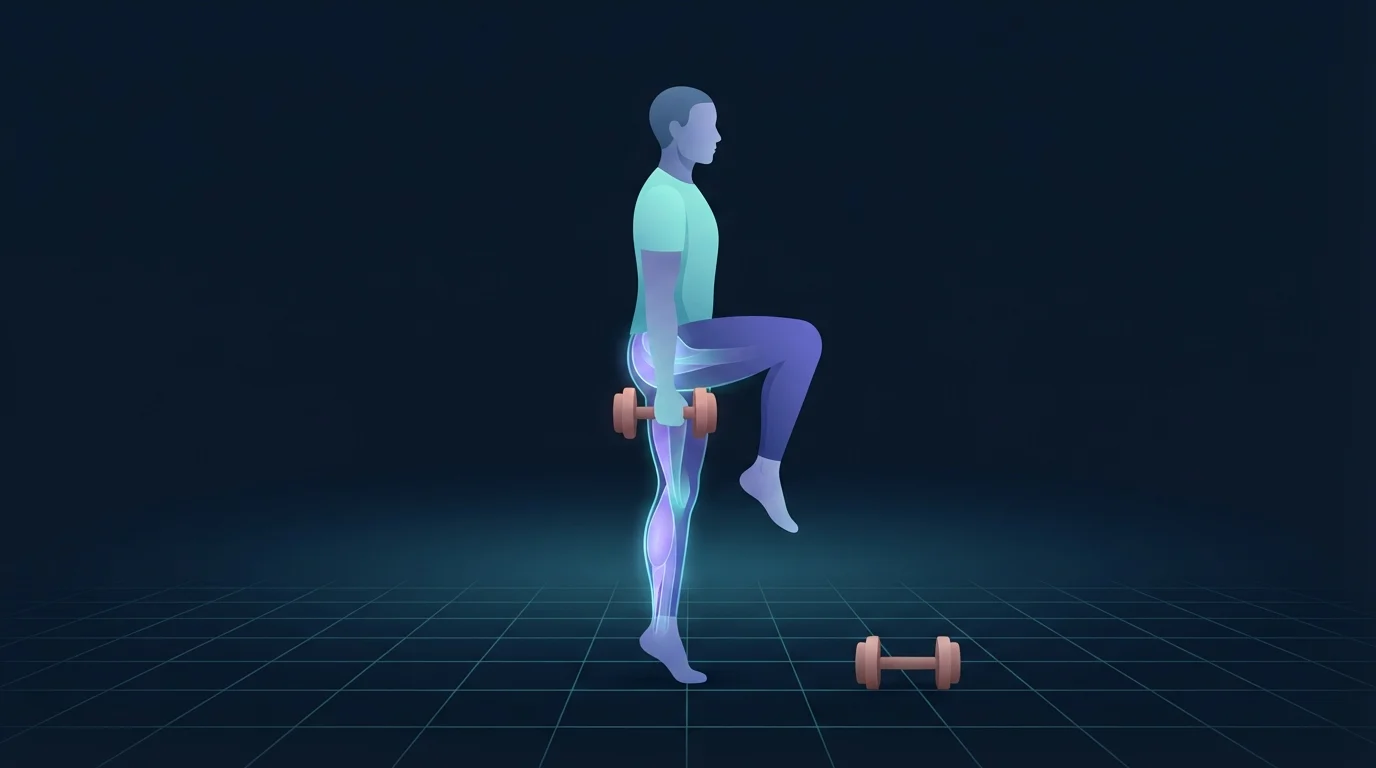
- Slow single-leg calf raises, 3 x 8 per leg. Hold a dumbbell, take three seconds to lower. The calf and achilles return a large share of the energy in each footstrike, and stiffness there is cheap speed.
- Split squats or step-ups, 3 x 6-8 per leg. Heavy enough that the last rep is genuinely hard. Running is a single-leg sport.
- Hip thrusts or single-leg bridges, 3 x 8. Glutes drive hip extension, which is where propulsion comes from.
- Nordic-style hamstring lowers or slider curls, 2 x 5. Eccentric hamstring strength is the best-evidenced protection against the injury that ends mile blocks.
- Pogo hops, 3 x 20 seconds. Minimal ground contact, stay tall, land under your hips. Start here before any jumping that involves height.
All of it fits in a living room with two dumbbells, which is the whole point. If you'd rather have the sessions programmed and progressed for you than assemble them by hand, a dumbbell workout app handles that side.
Five Ways This Goes Wrong
Running every session at the same medium effort. The most common pattern by a distance. Nothing is easy enough to recover from and nothing is hard enough to force adaptation, so the week averages out to maintenance.
Adding volume and intensity in the same week. Pick one. Nielsen and colleagues (2014), following 874 novice runners in the Journal of Orthopaedic & Sports Physical Therapy, found that increasing weekly distance by more than 30 percent over two weeks raised the rate of distance-related injuries including patellofemoral pain, iliotibial band syndrome and medial tibial stress syndrome. Adding an interval session is already a change. Keep the mileage flat while you absorb it.
Testing too often. A mile time trial is a maximal effort that costs two or three days. Test at week 0 and week 8. In between, let the interval splits tell you how it's going.
Treating hills as the whole answer. Short steep sprints are excellent for power and economy, and they pair with this plan rather than replacing the flat interval session. Our guide to hill sprints has the protocol if you want to swap one in during weeks 1 to 4.
Chasing cadence as a performance fix. Raising step rate five to ten percent reliably reduces joint loading, which is a good reason to do it if you keep getting hurt. It's not a mile-time lever. The evidence is laid out in our review of running cadence research.
What to Expect
Weeks one and two feel clumsy. Interval pace is new, you'll misjudge it, and the day after your first session will be worse than you expect. Normal. It passes.
Weeks three to five are where the sessions start to feel repeatable. The pace you held for 400 metres in week one shows up in a 600, and you notice your easy runs drifting faster at the same effort without trying.
Weeks six to eight are consolidation. Don't add anything. The urge to throw in an extra hard day right before a test is strong and it has ruined more time trials than bad weather. Retest two or three days after the final short session, on a normal day, on the same course.
The Bottom Line
To run a faster mile, stop asking your body for the same thing every time you go out. Test it once so you know where you stand. Then give it one session near its ceiling, one session at threshold, a couple of easy runs it can actually recover from, a handful of strides, and 40 minutes a week of single-leg strength. That's the whole recipe, and eight weeks is enough to watch it work.
You aren't slow. You've been running one pace, and one pace is a maintenance dose.
Frequently Asked Questions
What is a good mile time for my age?
Among people who run regularly, a mile around 6:40 for men and 7:45 for women in their twenties and thirties sits near the middle of the pack, and roughly 5:45 and 6:50 puts you in the top fifth. Those targets slow by about 20 to 40 seconds per decade after 40. The honest caveat is that every published mile table comes from databases of people who log their runs, so the numbers describe runners, not the general population.
How long does it take to run a faster mile?
Eight weeks is a realistic first block. When Helgerud and colleagues trained four groups for eight weeks at matched total workload, the two interval groups raised VO2 max by 5.5 and 7.2 percent while the steady-pace and threshold groups showed no significant change. The runners who gain the most in a first block are the ones who have only ever run steady, because every session type in the plan is new stimulus.
How should I pace a mile?
Split it into four quarters and run the first one at goal pace or a second or two slower, hold goal pace through quarters two and three, then empty the tank over the last 200 metres. For any event lasting longer than about two minutes, evenly distributed pace produces the better time (Abbiss and Laursen, 2008). Going out 10 seconds fast costs far more than 10 seconds at the end.
Do I need a track to run a faster mile?
No. A track makes the time trial cleaner because four laps is exactly 1,609 metres in lane one and the surface never changes, but a flat out-and-back road loop measured with GPS works. What matters more is using the same route every time you test, so the comparison is honest. Intervals can be run by time rather than distance on any flat stretch of path.
Does lifting weights make you a slower runner?
The opposite, when it is dosed properly. Blagrove and colleagues reviewed the strength-training literature in middle- and long-distance runners and found heavy resistance work and plyometrics improved running economy and time-trial performance without meaningful gains in body mass. Two short sessions a week of single-leg and calf work is the dose that helps. Six hypertrophy sessions a week is the dose that gets in the way.
How many days a week should I run to get faster?
Four to five running days covers almost everyone chasing a mile time, with one interval session, one tempo, and the rest genuinely easy. Adding days faster than that is the most reliable way to get hurt: a prospective study of 874 novice runners found that raising weekly distance more than 30 percent across two weeks increased distance-related injuries (Nielsen et al., 2014).