
Plyometrics has the cleanest origin story in modern training. In the 1960s and 70s, Soviet sports scientist Yuri Verkhoshansky watched track athletes step off small platforms and land into immediate, maximal vertical jumps. The athletes who trained that way produced more force on the next jump than athletes who simply jumped repeatedly from a standing start. He called the method the shock method. Western coaches translated it as "plyometrics," from the Greek for "more measure." Sixty years later, the same idea sits in the National Strength and Conditioning Association position stands, the youth athletic development literature, and the standard ACL injury-prevention warm-up used in soccer and basketball programs worldwide.
The mechanism is the stretch-shortening cycle. When a muscle is loaded eccentrically (lengthened under tension) and then immediately reverses into a concentric contraction, the connective tissue stores elastic energy on the way down and releases it on the way up. The result is more force, more quickly, than a pure concentric contraction can produce. Every fast movement humans make uses this cycle: a sprint stride, a jump, a cutting step, even the rebound of a heel after a walking step.
That is the theory. The practical question is how much of that translates into measurable performance, and at what dose, and at what risk. The peer-reviewed answer, mostly settled across three decades of meta-analyses, is encouraging.
The Research: What Studies Show
Markovic (2007): The Foundational Vertical Jump Meta-Analysis
The first rigorous accounting of plyometric training on vertical jump came from Markovic in the British Journal of Sports Medicine. He pooled randomized and non-randomized controlled trials across four standard jump tests: the squat jump (no countermovement), the countermovement jump, the countermovement jump with arm swing, and the drop jump.
The pooled improvements were practically meaningful in every test. The squat jump and drop jump both improved by 4.7%. The countermovement jump with arm swing improved by 7.5%. The countermovement jump improved by 8.7% (95% CI 7.0 to 10.4%). The countermovement-jump effect was the strongest, which fits the mechanism. Plyometrics trains the stretch-shortening cycle, and the countermovement jump is the lab test that most cleanly isolates it.
Why the numbers matter outside the lab: vertical jump correlates with peak power output, and peak power maps to sprint speed, agility, change of direction, and explosive movement in nearly every sport. A 5-9% gain on a bench-mark jump test is not a cosmetic improvement. It is the difference between catching the rebound and watching someone else catch it.
Citation: Markovic G. Does plyometric training improve vertical jump height? A meta-analytical review. Br J Sports Med. 2007;41(6):349-355.
Sáez de Villarreal et al. (2009): The Dose-Response Map
Two years later, Sáez-Sáez de Villarreal and colleagues pooled 56 studies with 225 effect sizes and asked a harder question: not "does plyometric training work" but "which plyometric protocols work best." The answer, surprisingly clean for a behavioral training literature, was a set of dose-response parameters that still guide programming today.
The variables that drove the biggest vertical jump gains:
- Duration: Programs longer than 10 weeks outperformed shorter programs.
- Frequency and volume: More than 20 sessions across the program. More than 50 jumps per session.
- Intensity: High-intensity drills (depth jumps, countermovement jumps to max effort) outperformed low-intensity ones.
- Variety: Combining squat jumps, countermovement jumps, and drop jumps in the same program outperformed any single drill type.
- Sport experience: Athletes with more sport background gained more from a given program, suggesting prior motor coordination is a multiplier.
One finding that quietly killed a whole genre of training advice: adding external weight to plyometric jumps (weighted vests, dumbbells, ankle weights) produced no additional gains compared to bodyweight jumps. The extra load slowed the movement enough to blunt the stretch-shortening cycle that plyos exist to train. If you want to train power with weight, train traditional resistance. If you want plyos, leave them light and fast.
Citation: Sáez-Sáez de Villarreal E, Kellis E, Kraemer WJ, Izquierdo M. Determining variables of plyometric training for improving vertical jump height performance: a meta-analysis. J Strength Cond Res. 2009;23(2):495-506.
Sáez de Villarreal, Requena, and Cronin (2012): Sprint Performance
The same research group then extended the question to sprinting. Sáez de Villarreal, Requena, and Cronin pooled 26 studies with 56 effect sizes and found a significant pooled effect of plyometric training on sprint time. The improvements were strongest over short accelerations (5-30 meters), where ground-contact force production matters most.
The optimization parameters for sprint were subtly different from the vertical jump parameters. Shorter programs (under 10 weeks) worked well. At least 15 sessions. More than 80 combined jumps per session. The clear pattern across both meta-analyses: bias the program toward horizontal jumps (broad jumps, bounding, single-leg horizontal hops) if sprint speed is the goal. Bias toward vertical jumps if vertical power is the goal. The plyometric stimulus needs to match the movement vector you want to improve. It is one of the few training principles where specificity is genuinely literal.
Citation: Sáez de Villarreal E, Requena B, Cronin JB. The effects of plyometric training on sprint performance: a meta-analysis. J Strength Cond Res. 2012;26(2):575-584.
Babatunde, Forsyth, and Gidlow (2012): Bone Density
Plyometrics earned its keep in vertical jump and sprint long before anyone thought of it as a bone intervention. The bone-density evidence came later. Babatunde, Forsyth, and Gidlow pooled six randomized controlled trials covering 256 premenopausal women and looked at brief high-impact jump programs, the kind that can be done in under 10 minutes a few times per week, against non-jumping controls.
The pooled increase in femoral neck bone mineral density was substantial: a standardized mean difference of 0.64 (95% CI 0.38 to 0.90, p = 0.001). That is a moderate-to-large effect size for a low-cost intervention. The trochanter showed a smaller but still significant increase. Spine bone density did not change in either direction.
The site-specificity is the whole story. Bone responds to the loading it experiences. Jumping loads the hip vertically through the femoral neck and trochanter, which is exactly where the bone density gains showed up. The spine sees less of that vertical impact loading, so it did not respond. The implication is practical: if hip-bone density is a goal, jumps work; if spine-bone density is the goal, jumps alone are not enough, and resistance training that loads the spine directly is the better tool. For background on how strength training contributes to bone and longevity, see our coverage of strength training after 60 and resistance training and mortality.
Citation: Babatunde OO, Forsyth JJ, Gidlow CJ. A meta-analysis of brief high-impact exercises for enhancing bone health in premenopausal women. Osteoporos Int. 2012;23(1):109-119.
Al Attar et al. (2022): ACL Injury Prevention
The most surprising finding in the plyometric literature is also the most consequential for the general athletic population. Al Attar and colleagues in the Journal of Physiotherapy pooled nine cluster randomised trials covering more than 14,000 athletes and asked whether structured injury-prevention warm-ups that included plyometric drills (jump-landing technique work, hops, bounding) actually reduced ACL injury rates in the field.
They did, by a lot. The pooled effect was roughly a 60% reduction in ACL injury rate per 1,000 hours of athletic exposure. The reduction was larger in male cohorts (around 79%) and smaller but still substantial in female cohorts (around 50%), with a pooled risk ratio of 0.36 (95% CI 0.23 to 0.57). The number needed to treat to prevent one ACL rupture was 71.
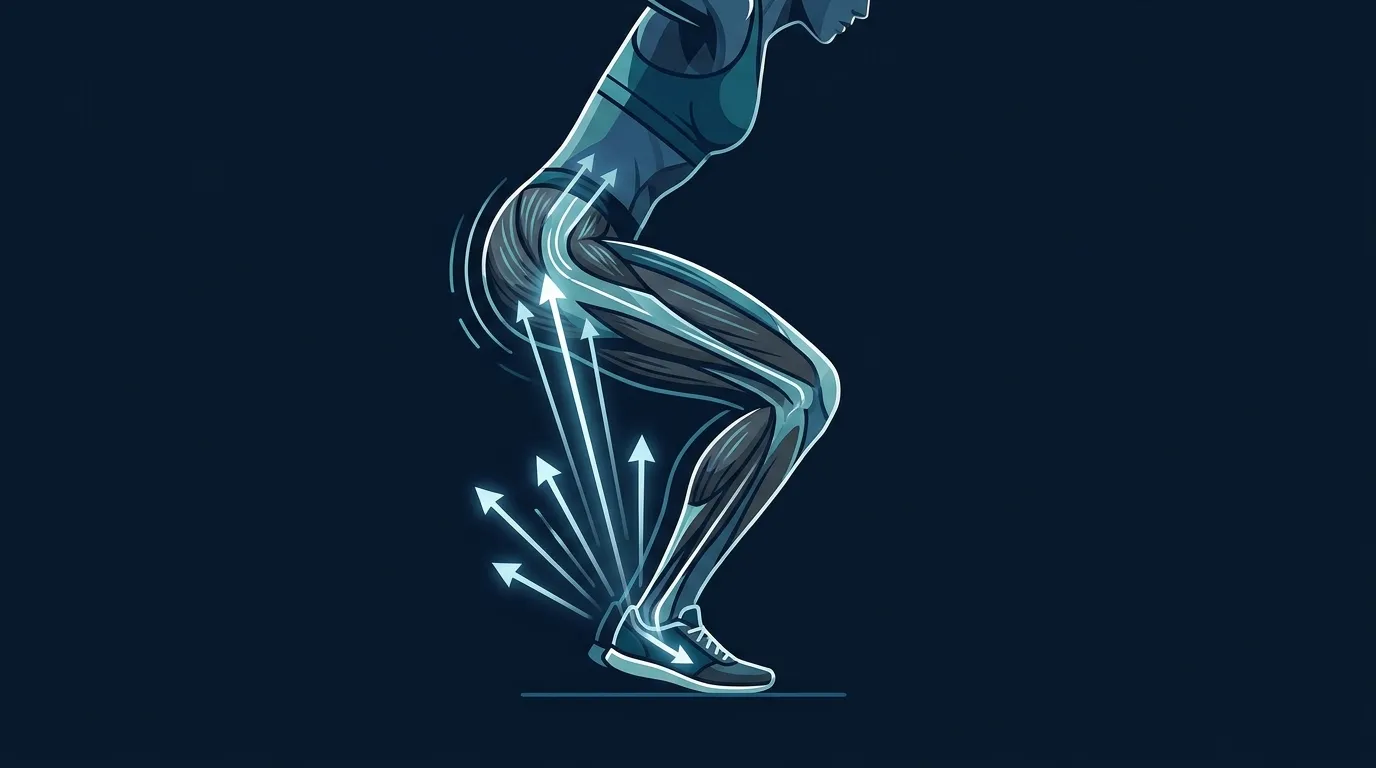
The mechanism is not strength alone. The plyometric drills in these warm-ups teach a softer landing pattern: hip and knee flexion, knees tracking over toes, weight on the midfoot, deceleration absorbed by the gluteal and hamstring chain rather than the patellar tendon. Untrained landings, especially in fatigued athletes during competition, default to stiff-knee landings that load the ACL near its tear threshold. Trained landings spread the load. The plyometric stimulus is how that motor pattern gets installed.
Citation: Al Attar WSA, Bakhsh JM, Khaledi EH, Ghulam H, Sanders RH. Injury prevention programs that include plyometric exercises reduce the incidence of anterior cruciate ligament injury: a systematic review of cluster randomised trials. J Physiother. 2022;68(4):255-261.
Why This Matters for Your Fitness
Plyometric training is one of the few modalities that hits multiple adaptations at once. Power, sprint speed, hip-bone density, and joint-protective motor patterns. Most training tools do one or two of those things. Heavy strength training builds force, but it does not train the rapid stretch-shortening cycle. Steady-state cardio builds aerobic capacity, but it leaves explosive power untouched. Mobility work improves range of motion, but it does not add bone. Plyos sit in the intersection.
The four populations where the math is most favorable:
Recreational athletes who play any cutting or jumping sport. Basketball, soccer, ultimate, pickleball, tennis. The ACL prevention evidence (Al Attar 2022) is the strongest argument here. A two-times-per-week neuromuscular warm-up that includes 15-25 jump-landing drills can cut your in-season ACL risk by half or more, with side benefits in power and acceleration.
Adults who want to age well. Vertical jump declines steeply with age, and that decline tracks with fall risk, frailty, and loss of independence. A small dose of regular jumping (lateral bounds, single-leg hops, repeated countermovement jumps) preserves the rapid force production that catches you when you trip. The bone-density finding from Babatunde 2012 maps directly onto fracture-risk reduction. The functional argument is similar to our coverage of the sit-to-stand test and longevity and grip strength as a longevity marker.
Time-constrained adults who train at home. A productive plyometric session is short. Twenty to forty jumps in 10-15 minutes is enough to drive adaptation if intensity is high. That makes plyos one of the best returns on time investment in the home-training space, alongside the soleus pushup for metabolic conditioning. See also our coverage of what bodyweight training can actually do.
Anyone whose sport or job rewards explosive power. Sprinters and jumpers, obviously. Less obviously: hikers, hunters, parents who chase toddlers, firefighters, construction workers, anyone who needs to move a body quickly under load. The stretch-shortening cycle is not a niche athletic adaptation. It is the engine behind every fast movement humans make.
The population where plyos make less sense, or need careful staging: anyone with active knee, ankle, hip, or low-back conditions; people who have not yet built foundational leg strength through traditional resistance training; and people with osteoporosis or recent fragility fractures, where impact loading needs medical clearance and progression supervision. Plyos are not bodyweight cardio with a different name. They are high-force, high-velocity events. Earn them.
How to Apply This in Practice
Here is the practical programming template, distilled from the Sáez de Villarreal dose-response parameters and the broader plyometric literature:
- Build a strength base first. If you cannot do 10 clean bodyweight squats with good knee tracking and a controlled descent, work on that for a few weeks before adding jumps. Plyometric injuries are landing injuries, and landing quality is a function of strength.
- Start with low-amplitude bilateral jumps. Squat jumps, countermovement jumps, ankle pogos, small broad jumps. Aim for 30-50 total jumps per session, twice a week, for the first 2-3 weeks. Focus on quiet landings.
- Progress volume before intensity. When 50 jumps per session feels easy and your landings are still clean, add jumps before you add height. Move to 60-80 per session before introducing higher-amplitude drills.
- Add variety and a horizontal component. By week four or five, mix in lateral bounds, broad jumps, single-leg hops, and bounding. Combination programs outperform single-drill programs in both vertical jump and sprint adaptation.
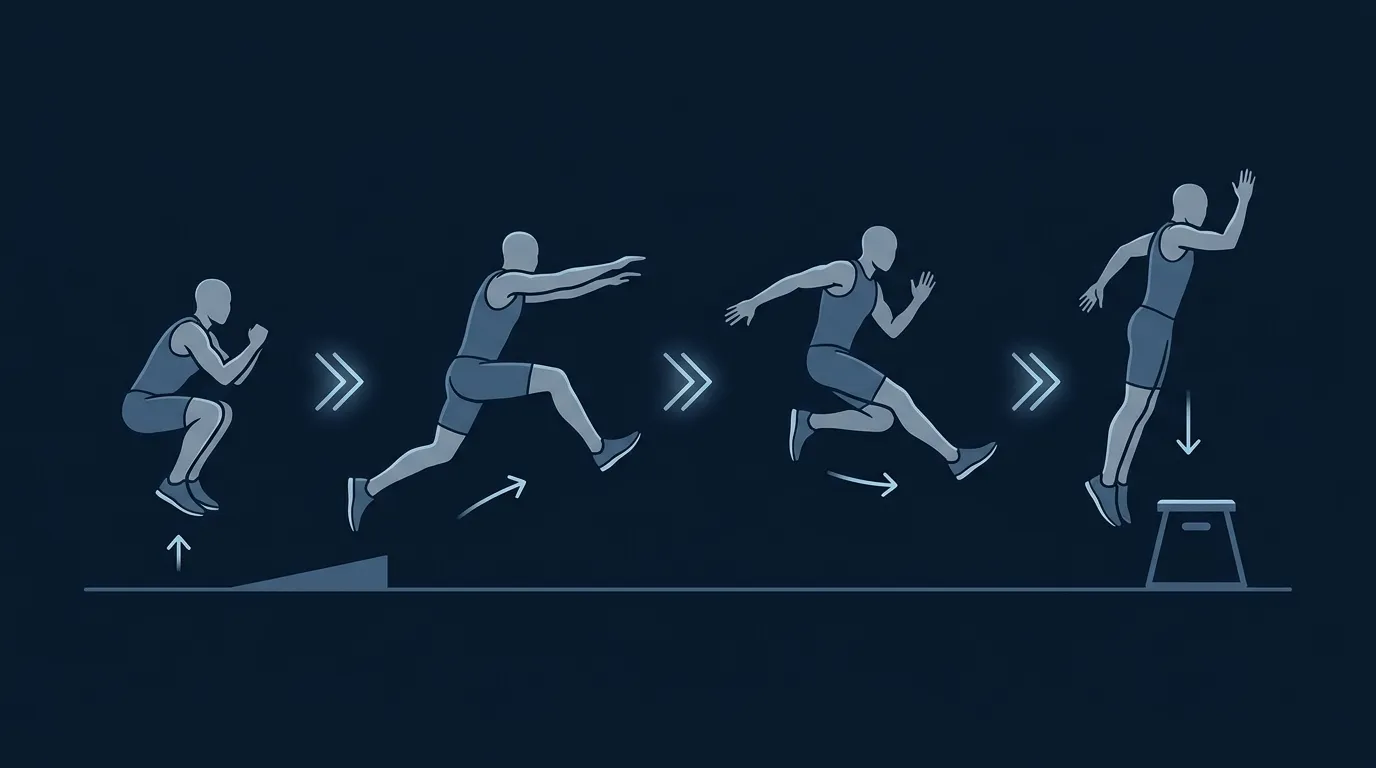
- Introduce drop jumps and depth jumps last. True depth jumps (step off a 20-40 cm box, land, immediately re-jump) are the highest-intensity plyometric drill. Earn them with 6-8 weeks of base work first. Hold the box height conservative; the goal is fast ground contact, not maximum drop.
- Cap session volume. Most evidence-backed protocols sit at 50-120 jumps per session. More is not better. Plyometric work generates high force per repetition, and the recovery cost is real.
- Rest 48-72 hours between plyometric sessions. Like heavy lifting, plyos work on a recovery cycle. Two to three sessions per week is the sweet spot. Daily plyos is a recipe for tendinopathy.
- Stop the set when landing quality breaks down. Sloppy, loud, knees-caving landings on fatigued legs are where injuries happen. The Sáez de Villarreal data is built on quality reps. Junk reps do not produce the same adaptations and they raise risk.
- Warm up. Five to eight minutes of light cardio, dynamic mobility, and ankle/hip activation before jumping. Cold tendons tolerate plyos badly.
A workable home-training block for a recreational athlete looks like this: two plyometric sessions per week on non-consecutive days, 8-12 weeks long. Each session: warm-up, 4-6 drills, 8-15 reps per drill, full rest between sets, 60-100 total jumps. Pair with two strength sessions and aerobic work. Expect vertical jump gains in the 5-9% range and noticeable improvements in short-sprint acceleration by week 8-10.
Get an evidence-based plan built for you
FitCraft, our mobile fitness app, pairs you with an AI coach who builds you a personalized plan around your goals, schedule, and fitness level. Every FitCraft program is designed by Domenic Angelino, MPH (Brown University) and NSCA-CSCS, with research published in the Journal of Strength and Conditioning Research and Medicine & Science in Sports & Exercise.
Take the Free Assessment Free • 2 minutes • No credit cardCommon Misconceptions
Misconception: "Plyometrics are only for elite athletes"
This was the old framing, and it was wrong even when it was the consensus. The bone-density evidence (Babatunde 2012) is built on programs that took less than 10 minutes per session in untrained or recreationally active women. The ACL prevention evidence (Al Attar 2022) is built on warm-up programs given to youth and adult amateur athletes, not professionals. The dose required to see adaptations is modest. What plyos require is intent: focused, quality reps, not high volume. Almost any healthy adult can start with low-amplitude bilateral jumps and progress safely.
Misconception: "More jumps equal more gains"
Within the studied range (roughly 50-120 jumps per session), more reps do produce more adaptation. Beyond that range, the dose-response curve flattens fast and the injury curve climbs. The Sáez de Villarreal 2009 meta-analysis is explicit on this point. The biggest gains came from focused, high-intensity sessions in the 50-100 jump range, not from grinding through 200-rep workouts. Plyometric training is a quality-over-quantity modality. Treat it that way.
Misconception: "Weighted vests make plyos more effective"
They do not, at least not for the adaptations plyos are designed to produce. Sáez de Villarreal et al. (2009) specifically tested added external load and found no additional benefit over bodyweight plyometrics. The extra mass slows the eccentric-to-concentric transition, blunting the stretch-shortening cycle that is the whole point. If you want to load jumps, do it with traditional resistance work on different days. Keep plyos light and fast.
Misconception: "Box jumps are the best plyometric drill"
Box jumps are popular because they are dramatic and easy to film. They are not especially effective. The "jump" portion is the trainable plyometric stimulus. The "land on a box" portion is just a way to display the result, and tall boxes can actually mask poor jump quality by allowing a deeply flexed hip-and-knee landing that hides limited ankle range and weak deceleration. Counter-jumps, broad jumps, lateral bounds, and depth jumps train the stretch-shortening cycle more directly. A 24-inch box is fine. A 60-inch box is a Instagram prop.
What the Research Suggests Going Forward
The settled findings: plyometric training improves vertical jump by 4.7-8.7% across standard tests, improves short-sprint times, increases femoral neck bone mineral density in premenopausal women, and reduces in-season ACL injury rates by roughly 60% when programmed inside a structured neuromuscular warm-up. The optimal parameters are well-mapped: 50-100 jumps per session, 2-3 sessions per week, 8-12+ weeks, multiple jump types, bodyweight load.
Open questions remain. The dose-response curve in older adults (over 60) is less mapped than in athletes. The long-term tendon and joint effects of multi-year plyometric training have been studied less than the short-term performance gains. Postmenopausal bone responses to plyos are less clear than the premenopausal data, partly because the impact tolerance in osteoporotic populations is lower. The optimal programming for in-season athletes (where plyometrics overlap with sport-induced jump load) is still debated. And the comparison to other power-development methods (Olympic-style weightlifting derivatives, ballistic resistance training) shows roughly equivalent results in trained athletes, which is interesting but not yet practice-changing for recreational populations.
For most readers, the right framing is this. Plyometric training is one of the highest-leverage no-equipment tools in the modern fitness toolbox. It trains adaptations that other modalities do not. The cost is jump quality control. If you are healthy, build a base, start low and slow, and progress over months not weeks, plyos are one of the surest paths to faster, more powerful, more resilient movement. If you have joint conditions or specific contraindications, get cleared first.
Honest Limitations
A few caveats worth flagging. Most of the plyometric performance evidence is built on athletic populations (soccer, basketball, track) aged 14-30. Direct trials in older recreational adults are scarcer, and the dose-response curve there is partly extrapolated. Bone-density evidence is strongest in premenopausal women; postmenopausal data is more mixed, with osteoporotic populations needing more careful staging. The ACL prevention evidence is real but it is built on cluster randomised trials in team sports, not on recreational gym-goers, and the prevention effect requires consistent in-season programming, not a one-off session.
The other honest limitation is practical. Plyometric injuries, when they happen, are usually tendon (patellar, Achilles) or soft-tissue, and they correlate with too-much-too-soon programming. The literature on plyometric injuries is harder to pool than the performance literature because injury reporting in training studies is inconsistent. Conservative starting volume, full recovery between sessions, and immediate cessation when landing quality breaks down are the prevention levers we have evidence for. They are not optional.
References
- Markovic G. "Does plyometric training improve vertical jump height? A meta-analytical review." British Journal of Sports Medicine 41.6 (2007): 349-355. PMID: 17347316 · doi:10.1136/bjsm.2007.035113
- Sáez-Sáez de Villarreal E, Kellis E, Kraemer WJ, Izquierdo M. "Determining variables of plyometric training for improving vertical jump height performance: a meta-analysis." Journal of Strength and Conditioning Research 23.2 (2009): 495-506. PMID: 19197203 · doi:10.1519/JSC.0b013e318196b7c6
- Sáez de Villarreal E, Requena B, Cronin JB. "The effects of plyometric training on sprint performance: a meta-analysis." Journal of Strength and Conditioning Research 26.2 (2012): 575-584. PMID: 22240550 · doi:10.1519/JSC.0b013e318220fd03
- Babatunde OO, Forsyth JJ, Gidlow CJ. "A meta-analysis of brief high-impact exercises for enhancing bone health in premenopausal women." Osteoporosis International 23.1 (2012): 109-119. DARE record · doi:10.1007/s00198-011-1801-0
- Al Attar WSA, Bakhsh JM, Khaledi EH, Ghulam H, Sanders RH. "Injury prevention programs that include plyometric exercises reduce the incidence of anterior cruciate ligament injury: a systematic review of cluster randomised trials." Journal of Physiotherapy 68.4 (2022): 255-261. PMID: 36244964 · doi:10.1016/j.jphys.2022.09.001
Frequently Asked Questions
Does plyometric training actually make you jump higher?
Yes. Markovic (2007) pooled controlled trials in the British Journal of Sports Medicine and found vertical jump improved 4.7% on the squat jump and drop jump, 7.5% on the countermovement jump with arm swing, and 8.7% on the countermovement jump. Sáez de Villarreal et al. (2009) confirmed these gains across 56 studies, with the largest effects in programs longer than 10 weeks, more than 20 sessions, and over 50 jumps per session. The mechanism is the stretch-shortening cycle: fast eccentric loading stores elastic energy in the tendon that the muscle then releases on the concentric jump.
Do plyometrics improve sprint speed?
Yes, especially over short distances. The Sáez de Villarreal et al. (2012) meta-analysis pooled 26 studies and 56 effect sizes and found plyometric training significantly improved sprint times. The biggest improvements come from programs shorter than 10 weeks, at least 15 sessions, more than 80 jumps per session, and a mix of vertical and horizontal jumps. Horizontal plyometrics (broad jumps, bounding) transfer more directly to sprint acceleration than purely vertical drills.
Do plyometrics build bone density?
Yes, at the hip. Babatunde, Forsyth, and Gidlow (2012) pooled six randomized trials of brief high-impact jump programs in premenopausal women and found a moderate-to-large increase in femoral neck bone mineral density (SMD 0.64, p = 0.001) and a smaller increase at the trochanter. Spine density did not change. Jump-landing loads, applied a few times per week for several months, drive a hip-specific bone response that walking and cycling alone do not produce.
Are plyometrics safe?
Yes when programmed appropriately, and they can actually reduce major injury risk. Al Attar et al. (2022) pooled nine cluster randomised trials covering more than 14,000 athletes and found that injury prevention programs that included plyometric exercises reduced ACL injury rates by roughly 60% per 1,000 hours of exposure. Build foundational strength first, start with low-amplitude bilateral jumps, progress volume before intensity, and stop the session when landing quality breaks down. People with knee, ankle, hip, or low-back conditions should clear plyometrics with a physical therapist first.
Can you do plyometrics at home with no equipment?
Yes. Squat jumps, countermovement jumps, broad jumps, lateral bounds, and jump rope need no equipment beyond a flat surface. Drop jumps and depth jumps from a 20-40 cm box add intensity once basic jumps feel easy. The Sáez de Villarreal et al. (2009) optimization parameters (2-3 sessions per week, 50-100 jumps per session, 10+ weeks, multiple jump types) all work in a small living room. For more no-equipment ideas, see our coverage of what bodyweight training can actually do.
Does FitCraft program plyometric training?
FitCraft programs cover bodyweight, dumbbell, resistance band, and cardio work, and many bodyweight programs include jump-based conditioning. The free FitCraft assessment builds a personalized program around your goals, schedule, and fitness level, and an AI coach demonstrates every exercise through interactive 3D models. If high-intensity plyometric drills (depth jumps, repeated maximal jumps) are appropriate for your goals, work them into the strength block of your program with adequate rest between sessions.