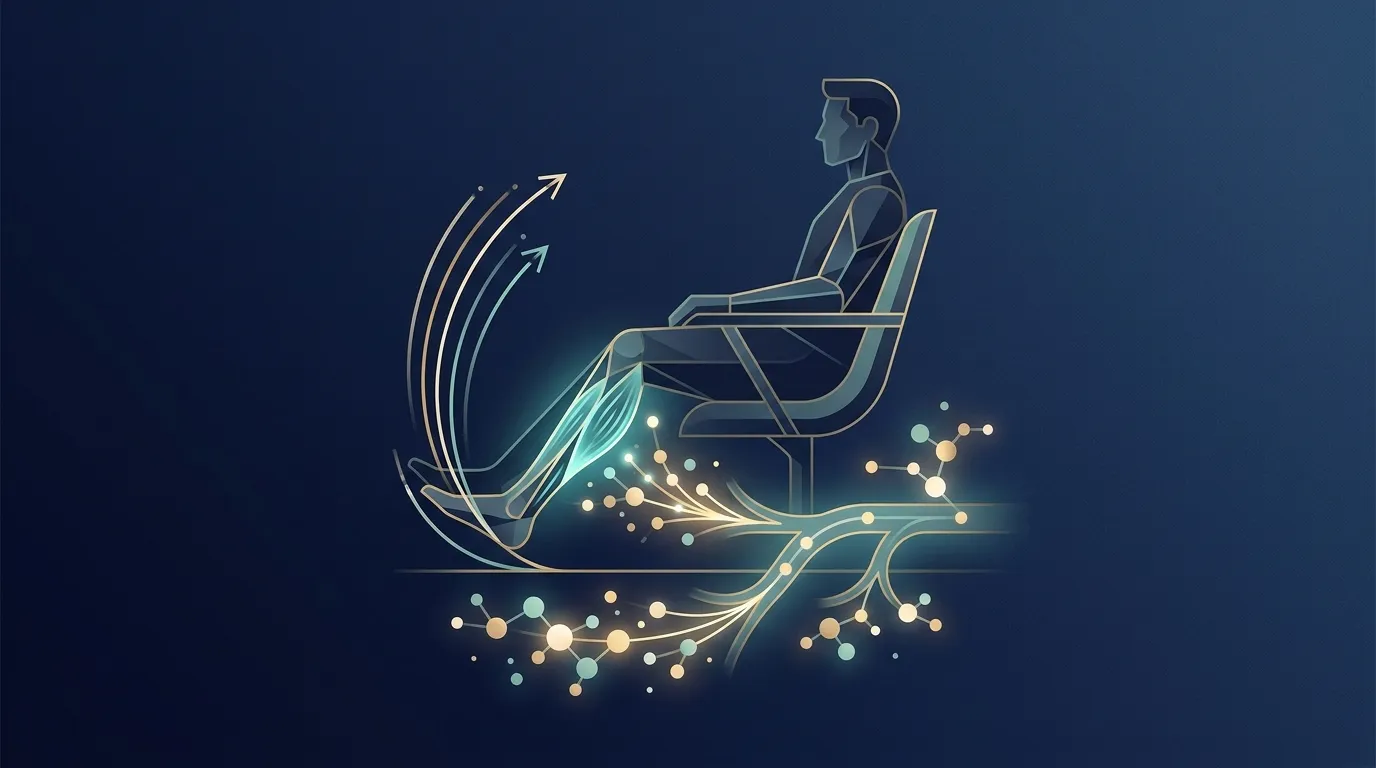
If you've ever read advice telling you to "just walk 10 minutes after every meal" and thought yeah, that's not happening at my desk job, you're the audience this research was designed for. The soleus pushup is a seated calf contraction. You stay in your chair. Your foot stays on the floor. Only the heel moves. It looks like the most boring exercise ever invented because it is.
The reason it merits a science article: when Mark Hamilton's group at the University of Houston published their original protocol in iScience in 2022, the numbers were big enough that the paper got picked up by mainstream press and then immediately got swallowed by social media misinformation. The actual study is real. The actual effect size is real. And the actual protocol is much more demanding than the "do a few calf raises after lunch" version that has been making the rounds.
Below is what the original research showed, what a follow-up trial confirmed in people with prediabetes, why the soleus is biomechanically weird enough for this to work, and what the protocol actually looks like in practice. For context this sits inside the same broader family of low-intensity sedentary-day interventions we cover in our pieces on non-exercise activity thermogenesis and exercise snacks and cancer risk.
The Research: What Studies Show
Two studies anchor the evidence: a tightly controlled 2022 lab trial reporting a 52% drop in post-meal glucose, and a 2025 prediabetes pilot that replicated a 32% drop in a real-world setting. Here is how they compare.
| Study | Design | Glucose Effect |
|---|---|---|
| Hamilton et al. (2022), iScience | 25 adults, 4.5-hour continuous contractions during OGTT | ~52% lower glucose excursion, ~60% lower insulin vs sitting |
| Elek et al. (2025), Sports | 10 prediabetic adults, 90-minute OGTT, real-world setting | ~32% lower glucose excursion vs sedentary baseline |
| Dunstan et al. (2012), Diabetes Care | 19 adults, 2-minute walking breaks every 20 minutes (related sitting-break research) | ~24 to 30% lower glucose, ~23 to 27% lower insulin |
Hamilton 2022: The Original iScience Paper
The headline study was Hamilton, Hamilton, and Zderic (2022) in iScience. The group recruited 25 adults of mixed fitness backgrounds and put them through a standardized oral glucose tolerance test. In one condition the subjects sat normally. In the other they performed continuous, low-load seated heel raises (the contraction came from the soleus, the deeper of the two calf muscles in the back of the lower leg) for 4.5 hours straight.
The results came in three layers. First, blood chemistry: postprandial glucose excursion dropped by about 52% and insulin excursion dropped by about 60% compared to sitting still. Second, muscle biopsies: the soleus was actively oxidizing fuel at multiples of its resting rate, but its own glycogen stores were barely touched. Third, fuel composition: during the contractions the muscle drew its energy from blood-borne glucose and from circulating triglyceride-rich lipoproteins. So the soleus was effectively running a low-level continuous fat and sugar burn straight from the bloodstream, for hours, without depleting itself.
The group also reported that the soleus, despite being only about 1% of body weight, could sustain a doubling or sometimes a tripling of whole-body carbohydrate oxidation during the contractions. That sounds implausibly large for one small muscle. The reason it isn't is that most muscles when you sit are essentially metabolically offline. Adding a single muscle that's deliberately running at elevated oxidative rate changes the denominator more than you'd expect.
Elek 2025: The Prediabetes Pilot
Three years later, an independent group ran a pragmatic replication. Elek and colleagues (2025) in Sports recruited 10 adults with prediabetes (mean age 53, mix of men and women) and had them perform soleus pushups during a 90-minute oral glucose tolerance test. The protocol was loose by design. Subjects sat in their normal positions and were instructed to do the contractions, with and without an EMG biofeedback cue, with no laboratory enforcement.
Postprandial glucose excursion dropped by about 32% compared to the sedentary baseline session. The drop happened whether or not EMG biofeedback was used, meaning the technique transfers to home and office settings without specialized equipment. The pilot was small and the authors are clear it needs replication at scale, but the direction of the effect lines up with Hamilton 2022, and in a population (prediabetics) where the clinical relevance is high.
Why the Soleus, and Not the Quad or the Glute?
The soleus is uniquely suited to this job because it is the most oxidative major muscle in the body, it already does sustained low-load work all day, and it pulls fuel from the bloodstream instead of its own glycogen. This isn't an arbitrary muscle choice. The soleus is unusual on three counts.
First, fiber type. Johnson et al. (1973), the foundational fiber-typing autopsy study, reported the soleus as one of the most slow-twitch-dominant muscles in the body, around 80 to 88% type 1 fiber depending on the subject. Type 1 fibers are aerobic specialists. They contain dense mitochondria, run on oxygen, fatigue extremely slowly, and prefer to oxidize fat and glucose rather than burn glycogen. The vastus lateralis (the big front quad muscle) is closer to a 50/50 mix. The gastrocnemius (the upper, more visible calf muscle) is mostly type 2 and fatigues fast. The soleus is the standout.
Second, postural geometry. The soleus is one of the few skeletal muscles that already does sustained low-load work all day in standing and walking. It's evolved for endurance. Asking it to do a few more hours of low-effort contraction while seated is well inside its normal duty cycle, not outside it.
Third, and most counterintuitive, the fuel pathway. Most muscles, when contracting, draw heavily on their own intramuscular glycogen first. The soleus, in Hamilton's data, preferentially pulled from blood-borne glucose and circulating lipoproteins, sparing its own glycogen reserves. That's the mechanistic reason it doesn't fatigue and why it acts like a continuous bloodstream pump rather than a battery that drains.
What Earlier Sedentary-Break Research Adds
The soleus pushup sits inside a broader literature on what happens when you interrupt prolonged sitting. Dunstan and colleagues (2012) in Diabetes Care ran one of the cleanest of these trials. Nineteen overweight or obese adults underwent three 5-hour sitting trials: uninterrupted, interrupted with 2-minute light walking breaks every 20 minutes, or interrupted with 2-minute moderate walking breaks. Both break conditions cut postprandial glucose by roughly 24 to 30% and insulin by about 23 to 27%. The take-home: breaking up sitting matters, and the mechanism (muscle contraction interrupting the metabolic stasis of long sitting) is the same family as the soleus protocol.
The conceptual frame for both lines of research comes from Hamilton, Hamilton, and Zderic's earlier 2007 paper in Diabetes, which argued that prolonged sitting is itself a metabolic exposure, distinct from the absence of exercise. Their phrase was "inactivity physiology." That framework is now standard. The soleus pushup is one of the cleanest interventions to come out of it.
Why This Matters for Your Health
Soleus pushups matter because they give sedentary people a way to blunt post-meal glucose spikes, the repeated stress that erodes insulin sensitivity over years. About 1 in 3 American adults has prediabetes, and most don't know it. About 1 in 10 has type 2 diabetes. The clinical lever that drives both is repeated postprandial glucose spikes, sustained over years, that gradually erode insulin sensitivity. Anything that lowers those spikes, consistently, has long-run downstream effects on cardiovascular risk, body composition, and energy stability through the day.
The conventional advice is solid: walk after meals, train regularly, manage carb load, sleep enough. All true, all well-supported. The soleus pushup doesn't replace any of that. What it adds is a sedentary-life option for the people whose jobs or contexts make the usual advice hard to apply. If you work 8 hours in a chair, drive long routes, sit through long meetings, or are recovering from an injury that limits walking, this gives you a way to do something that's substantively different from sitting still.
It's also worth noting where the effect doesn't extend. Soleus pushups don't build muscle in any meaningful sense. They don't improve cardiovascular fitness the way walking or cycling does. They don't burn enough calories to matter for weight loss as a standalone intervention. The mechanism is narrow and specific: glucose disposal during the post-meal window. The benefit, where it shows up, is metabolic regulation, not general fitness. People sometimes generalize the headline ("the soleus pushup beats exercise!") and end up wrong. The 2022 paper compared soleus contractions to sitting, not to walking or running. Against actual exercise, exercise wins on almost every outcome that isn't postprandial glucose during a sedentary day.
How Do You Do a Soleus Pushup?
Sit with your feet flat and knees bent to roughly 90 degrees, then slowly raise and lower your heels while keeping the balls of your feet planted, continuously, for an extended stretch after a meal. The protocol is genuinely simple. The hard part is the duration.
The Movement
- Position: sit in any chair, feet flat on the floor, both feet a comfortable distance forward (not tucked under the chair, not stretched far out). Knees roughly 90 degrees.
- Action: keeping the ball of your foot planted, slowly lift your heel as far as it will go, then slowly lower it. The motion is small, slow, and deliberate. You should feel the muscle in the back of your lower calf (below the bulge of your gastrocnemius) working.
- Tempo: roughly 1 second up, 1 second down, with no rest at the top or bottom. Hamilton 2022 used a continuous tempo at a self-selected rate that subjects could sustain for hours.
- Load: none. The contraction is bodyweight against gravity, which on a seated heel raise is mild. If you load it (placing a heavy book on your knee, for example) the muscle starts to fatigue and you lose the sustained-oxidative property that makes the protocol work.
The Duration Question
The original study used 4.5 hours of continuous contraction during the post-meal window. That's the upper bound of what was tested. The 2025 pilot used 90 minutes during an oral glucose tolerance test and still saw a meaningful effect, suggesting the dose-response curve is gentler than the upper-bound protocol implies. The principle is duration of low-load oxidative contraction, not number of reps. Five minutes of fast calf raises is not the same intervention.
Practical version: aim for an hour or more of intermittent soleus engagement during the 2-3 hours after a larger meal. The contraction is light enough that you can read, type, take calls, or attend meetings. If you forget for a minute, restart. The mechanism isn't fragile.
How to Tell You're Doing It Right
The most common form fault is using the gastrocnemius (the upper, more visible calf muscle) instead of the soleus. The gastrocnemius is recruited more when the knee is straight. The soleus dominates when the knee is bent past about 90 degrees, which is why the protocol specifies seated knee bend. If you feel the contraction high up the calf with a bulging visible muscle, you're probably driving the gastroc. If the work feels deeper and lower, slightly burning rather than tightening, you're closer to the soleus.
The other common fault is going too fast. Quick, snappy heel raises recruit type 2 fast-twitch fiber. The whole point of the protocol is sustained type 1 work. If your calf is fatiguing inside two minutes, slow the tempo and reduce the heel-raise height. The contraction should feel like something you could plausibly do for an hour while reading email.
Get an evidence-based plan built for you
FitCraft, our mobile fitness app, pairs you with an AI coach who builds you a personalized plan around your goals, schedule, and fitness level. Every FitCraft program is designed by Domenic Angelino, MPH (Brown University) and NSCA-CSCS, with research published in the Journal of Strength and Conditioning Research and Medicine & Science in Sports & Exercise.
Take the Free Assessment Free • 2 minutes • No credit cardCommon Misconceptions
Misconception: "Soleus pushups beat exercise for blood sugar"
This is the most-repeated and most-wrong version of the headline. The 2022 paper compared sustained soleus contractions to sitting still, not to exercise. Against sitting, soleus pushups cut postprandial glucose by about half. Against actual exercise, especially post-meal walking, the comparison hasn't been formally run, but the existing literature on post-meal walking (modest steady walking after eating) shows comparable or larger reductions in postprandial glucose with much shorter duration. The right framing is that soleus pushups beat sitting, not that they beat walking or training. Where they win is in the sedentary contexts where walking isn't an option.
Misconception: "A few reps after dinner will do it"
The mechanism is sustained low-load oxidative metabolism, not a brief burst. A set of 20 quick calf raises is essentially a different intervention (closer to a small resistance set). The original protocol used hours of contraction. The replication pilot used 90 minutes. There's no published evidence that 30 seconds of bouncing your heel up and down meaningfully changes a glucose curve.
Misconception: "Anyone can do this for as long as they want, with no downside"
Mostly true, but with a caveat. Sustained calf contractions for hours, in someone with peripheral neuropathy, peripheral artery disease, recent calf or Achilles injury, or active deep vein thrombosis risk factors, deserve a conversation with a clinician first. The motion is gentle, but "gentle and continuous for hours" is a different exposure than a brief calf raise set. If your legs are otherwise healthy, the soleus pushup is one of the lowest-risk interventions in this category of research.
What the Research Suggests Going Forward
The picture from the existing trials is interesting enough to act on but narrow enough to be honest about.
First, the primary glucose-disposal finding is genuinely strong: a 52% reduction in postprandial glucose excursion in the original Hamilton 2022 protocol is a large effect, and the 2025 prediabetes pilot reporting 32% in a less controlled setting is a meaningful directional replication. The mechanism (sustained type 1 oxidative metabolism in a muscle that doesn't deplete its own glycogen) is biologically coherent and consistent with decades of inactivity-physiology research.
Second, the long-term clinical data is still thin. We don't yet have multi-year randomized trials showing that habitual soleus pushup practice reduces incident diabetes, cardiovascular events, or mortality. The mechanistic case is strong, but the outcome data hasn't caught up.
Third, the protocol that works is more demanding than the social-media version. Hours of continuous low-load contraction is the dose. A minute of fidgeting between Zoom calls is not. Realistic intermediate practice (an hour spread across the post-meal window) is plausibly useful, but the published evidence is for sustained, not sporadic, contraction.
Fourth, the soleus pushup is best framed as a sedentary-life metabolic patch, not a replacement for exercise or a substitute for the foundational habits (training, walking, sleep, nutrition) that drive long-term cardiometabolic health. The right pairing is with the rest of the inactivity-physiology toolkit: stand more, break up long sitting bouts, walk after meals when you can, and use seated soleus contractions when you can't. We cover the broader pattern in our piece on walking after meals, which sits in the same evidence base.
The 2026 picture: this is one of the most interesting low-intensity, high-leverage findings in metabolic exercise physiology, with one strong original lab study, one directional pilot replication, and a wider community of clinical groups now running larger trials. The expected next-2-year picture is more data, almost certainly some shrinking of the effect size as replications come in, and a clearer dose-response curve. The basic finding (sustained soleus contractions move postprandial glucose more than sitting does, with no fatigue) is likely to hold.
References
- Hamilton MT, Hamilton DG, Zderic TW. "A potent physiological method to magnify and sustain soleus oxidative metabolism improves glucose and lipid regulation." iScience. 2022;25(9):104869. doi:10.1016/j.isci.2022.104869
- Elek Z, Beres-Molnar S, Dancsi A, et al. "The Efficacy of Soleus Push-Up in Individuals with Prediabetes: A Pilot Study." Sports (Basel). 2025;13(3):81. doi:10.3390/sports13030081
- Johnson MA, Polgar J, Weightman D, Appleton D. "Data on the distribution of fibre types in thirty-six human muscles: an autopsy study." J Neurol Sci. 1973;18(1):111-129. doi:10.1016/0022-510X(73)90023-3
- Hamilton MT, Hamilton DG, Zderic TW. "Role of low energy expenditure and sitting in obesity, metabolic syndrome, type 2 diabetes, and cardiovascular disease." Diabetes. 2007;56(11):2655-2667. doi:10.2337/db07-0882
- Dunstan DW, Kingwell BA, Larsen R, et al. "Breaking up prolonged sitting reduces postprandial glucose and insulin responses." Diabetes Care. 2012;35(5):976-983. doi:10.2337/dc11-1931
Frequently Asked Questions
What is a soleus pushup?
A soleus pushup is a seated calf raise done while your bodyweight stays planted in a chair. You keep the ball of your foot on the floor and let your heel rise, then drop back down, repeatedly and slowly. It looks identical to fidgety toe-tapping, but the focus is on a deliberate, sustained contraction of the soleus muscle in the back of the lower calf. Hamilton et al. (2022) developed the protocol because the soleus is almost entirely type 1 oxidative fiber and can sustain contraction for hours without fatigue, which makes it uniquely suited to draining blood glucose between meals.
How much do soleus pushups lower blood sugar?
In the original Hamilton 2022 iScience study (n=25 adults), 4.5 hours of continuous seated soleus contractions during an oral glucose tolerance test reduced the post-meal glucose excursion by about 52% and insulin by about 60% compared to sitting still. A 2025 prediabetes pilot study by Elek and colleagues (Sports, n=10) replicated the effect in a less-controlled setting and reported roughly a 32% reduction in postprandial glucose excursion. The effect depends on sustained contractions over hours, not short bursts.
Why does the soleus muscle work so well for blood sugar control?
The soleus is roughly 88% slow-twitch type 1 fiber, one of the highest oxidative-fiber proportions in the human body. Unlike most muscles, it does not lean heavily on its own stored glycogen. Hamilton 2022 reported that during sustained soleus pushups, the muscle drew its fuel from blood glucose and circulating lipoproteins rather than from intramuscular glycogen. That means the contraction acts like a continuous glucose pump for the bloodstream while you sit. The soleus is only about 1% of body weight, but during sustained pushups it can double or triple whole-body carbohydrate oxidation.
How long do you have to do soleus pushups for them to work?
The Hamilton 2022 protocol used continuous low-load contractions for 4.5 hours during the post-meal window. That sounds long, but the contractions are passive enough that subjects could read, type, or attend meetings throughout. In the prediabetes pilot study, participants completed a 90-minute oral glucose tolerance test with continuous soleus pushups and still saw a 32% glucose drop. The practical takeaway: short bursts of one or two minutes are unlikely to do much. The mechanism is duration of oxidative metabolism, not intensity.
Are soleus pushups a substitute for walking after meals?
Not a substitute, an alternative for moments when walking isn't possible. A short post-meal walk is a well-validated way to reduce postprandial glucose, but plenty of jobs and contexts make walking impractical. The soleus pushup gives sedentary workers, long-haul drivers, and people stuck in meetings a way to do similar metabolic work while seated. If you can walk after meals, do that. If you can't, soleus pushups are the next best evidence-based option.