
It starts as a warm patch on your heel around the third mile. By the time you get home there's a bubble of fluid under the skin, and the next morning your shoe feels a size too small. Blisters after running are one of the most common running injuries. Friction blisters affect up to 39 percent of marathon runners and account for more than 70 percent of medical visits in multi-stage ultramarathons, according to Lipman and colleagues (2014).
A blister is small, but it can knock over a whole week. You skip a run to let it heal, then another because it still hurts in your shoes, and a habit that took a month to build slips in a few days. It's easy to decide your feet just aren't made for running.
They are. A running blister is a friction and moisture problem, and both can be changed with gear and a few minutes of prep. Below you'll find how blisters form, the seven steps that prevent them, what the location of a blister on your foot from running tells you about its cause, and how to treat one so you can get back out.
What Causes Blisters When Running?
A blister is a small tear inside the skin, not on its surface. In their review in Sports Medicine, Knapik and colleagues (1995) described how repeated rubbing mechanically separates cells in a middle layer of the epidermis called the stratum spinosum. Pressure then fills the gap with fluid that resembles blood plasma with less protein in it. That's the clear bubble you see.
Two things decide whether it happens: how hard the skin is rubbed, and how many times. The harder the rub, the fewer cycles it takes to raise a blister. Running supplies the cycles. At a typical cadence of about 170 steps a minute, each foot lands roughly 2,500 times in a 30-minute run, and every landing nudges the foot forward and sideways inside the shoe.
Moisture sets how hard each rub is. Knapik's review found that moist skin produces more friction than dry skin, while very dry or soaking-wet skin produces less. A warm run puts your feet in the worst zone, damp but not drenched, so heat raises your risk mostly through sweat. Soles and heels are also built to blister. Their thick outer layer is anchored tightly to the tissue below, so the force lands inside the skin instead of letting the surface slide.
Hoffman (2016), writing in Current Sports Medicine Reports, lists the parts you can control: how much your foot moves inside the shoe, pressure points from poor fit or thick callus, grit and sweat against the skin, and how many rubbing cycles you pile on before your skin has adapted. Every step below targets one of those.
How to Prevent Blisters While Running: 7 Steps
Start with the first three. They deal with the shoe, the sock and the sweat, which together set the friction on every stride. The rest are for runners who still blister after fixing those, or who are building toward long runs and races.
- Fit your shoes for the end of the run.
- Choose socks by fiber, padding and fit.
- Keep your feet drier.
- Tape the spots that blister for you.
- Lubricate rub points and reapply.
- Build your skin up gradually.
- Stop at the first hot spot.
1. Fit Your Shoes for the End of the Run
Feet spread and swell over a long run, and a shoe that felt snug in the shop can pinch by mile five. Try shoes on late in the day, in the socks you run in, and leave about a thumb's width between your longest toe and the end of the shoe. The widest part of your foot should sit at the widest part of the shoe without bulging over the sole. There's no single best running shoe for blisters. The right one matches your foot's length, width and heel.
Then lock the heel. If your heel lifts when you jog, that slip is the classic cause of a blister on the back of the heel. Thread each lace through the spare top eyelet on its own side to make a small loop, then pass each lace through the opposite loop before you tie. Runners call it a heel lock or a runner's loop, and it holds the heel down without cranking the laces tight over the top of your foot.
Break new shoes in over a few short runs before you take them long. The insole matters too. Knapik's review found some evidence that closed-cell neoprene insoles lowered foot blisters, and Hoffman recommends insoles that give a little under sideways force, so some of the movement is absorbed before it reaches your skin.
2. Choose Socks by Fiber, Padding and Fit
The famous sock trial is smaller and more specific than its reputation. Herring and Richie (1990) gave 35 long-distance runners two padded socks that were identical except for fiber, one 100 percent acrylic and one 100 percent cotton. The acrylic socks produced fewer blisters, and the blisters that did form were smaller. When the same team repeated the test with a thinner, generic cushion-sole sock (Herring and Richie, 1993), the 27 runners blistered just as often in either fiber. The synthetic advantage showed up only when the sock was also well padded.
So pick a synthetic or wool running sock with padding at the heel and the ball of the foot, in your exact size. Fit matters as much as fiber. A sock that's too big folds into a ridge under the arch, and a heel pocket that sits above or below your heel puts a seam right where the shoe rubs. The American Academy of Dermatology recommends nylon or moisture-wicking socks for blister-prone feet.
Two layers can help as well. Knapik's review cites a study in Marine recruits where a thin polyester sock under a thick wool or polypropylene sock reduced blisters. For runners, the equivalent is a thin liner or a double-layer running sock, so the layers slide against each other instead of against your skin. A 2017 systematic review by Worthing and colleagues rated the overall evidence for socks as low quality, so treat this as a sensible bet rather than a guarantee.
3. Keep Your Feet Drier
Sweat is the one factor you can't train away, and the antiperspirant studies are some of the most useful in the blister research. In Darrigrand and colleagues (1992), 19 soldiers marched on a treadmill for an hour in a warm room before and after using a foot antiperspirant. Sweat on their feet fell by more than half. Blisters trended down, though not by enough to rule out chance, and irritant dermatitis went up.
The larger test came six years later. Knapik and colleagues (1998) gave West Point cadets either a 20 percent aluminum chloride solution or a placebo to apply to their feet at night before a 21 km hike. Among the 269 cadets who used it for at least three nights, 21 percent of the antiperspirant group blistered, against 48 percent on placebo. But 57 percent of the antiperspirant group reported skin irritation, compared with 6 percent on placebo. A gentler formula with added emollients did nothing for sweat or blisters in a treadmill study by Reynolds and colleagues (1995).
If you blister badly in warm weather, an aluminum chloride antiperspirant on clean, dry feet at bedtime for several nights is worth testing weeks before a race, and worth dropping if it stings or cracks your skin. Never put it on broken skin. Foot powders sound like the same idea, but Knapik's 1995 review found they don't appear to reduce blisters. On long runs, a change into dry socks at the halfway point does more, and so does pouring water over your head rather than letting it run down into your shoes.
4. Tape the Spots That Blister for You
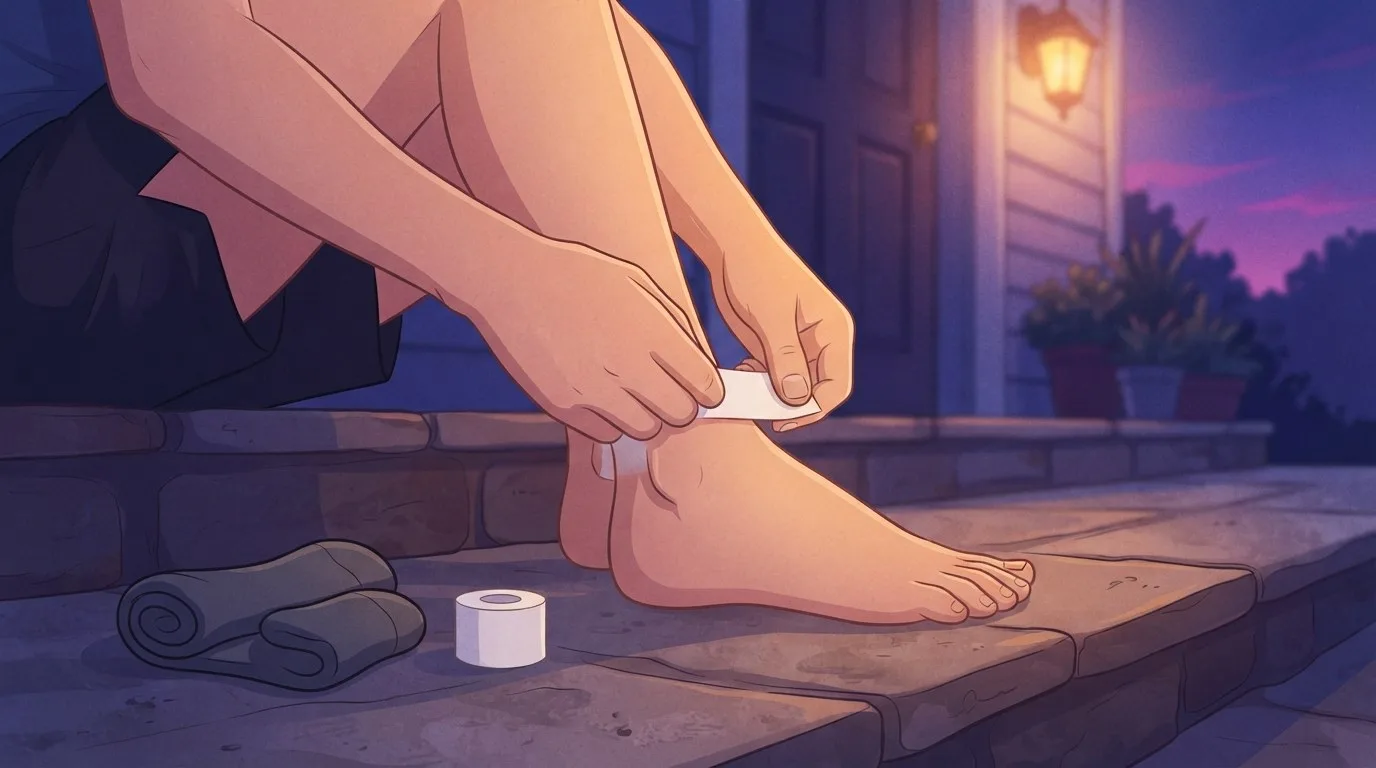
Tape is the one prevention method with a clean randomized win in runners. Lipman and colleagues (2016) put paper tape on one randomly chosen foot of 128 runners before six-stage, 250 km desert ultramarathons, over their usual blister spots, and used the untaped parts of the same foot as the comparison. Tape reduced blisters by 40 percent, which works out to one blister prevented for roughly every 1.3 runners taped. The same group's earlier trial on similar races found no significant protection, a fair reminder that tape helps most when it goes on the right spot and stays there.
Paper surgical tape is cheap, thin and gentle on skin. Put it on clean, dry skin before your socks, smooth out every wrinkle, and round the corners with scissors so they don't catch and peel. Cover the spots that have blistered before, which for most runners means the back of the heel and the tips or sides of the toes. Worthing's review concluded that, across socks, antiperspirants and barriers, paper tape had the best evidence behind it.
5. Lubricate Rub Points and Reapply
A lubricant cuts friction between skin and sock for as long as it stays on, which is why Hoffman's review lists frequent use of skin lubricants among the main prevention strategies. Petroleum jelly or an anti-friction balm on the toes and heels works for many runners. Two cautions apply. No randomized trial has tested a lubricant against nothing for running blisters, and lubricants wear off and soak into socks, so plan to reapply on runs longer than about 90 minutes. A thick layer can also leave feet soggy, which pushes the skin back toward the damp, high-friction zone.
The same products protect your thighs, underarms and chest on long runs, where the skin wears away at the surface instead of splitting underneath. Our guide on how to prevent chafing while running covers those spots.
6. Build Your Skin Up Gradually
Feet toughen with use. Knapik's review describes how repeated, low-intensity rubbing makes skin cells multiply and the outer layer thicken, which may lower blister risk. That's one reason new runners, and runners stepping up to longer distances, blister more than people who've run the same weekly mileage for months. Raise your long run a little at a time and your skin keeps pace with your legs. If you're in your first weeks, our guide to how long it takes to get used to running covers the rest of that adjustment.
There's a limit. Thick, hard callus acts as a pressure point, and blisters that form under a callus are deep and painful. Hoffman recommends removing excess callus, so file down ridges on your heels and the ball of your foot every week or two instead of letting them build.
7. Stop at the First Hot Spot
A blister announces itself first as a hot, stinging patch. The American Academy of Dermatology advises stopping when the skin turns red or starts to hurt. On a run, that means a one-minute stop instead of grinding out the last three miles: pull out the sock wrinkle, shake out grit, re-lace a slipping heel, or put a strip of tape over the spot. On long runs and races, carry a short length of tape wrapped flat around a key card.
Feet aren't the only thing that can cut a long run short. If your stomach is the other weak link, our guide on how to prevent runner's trots covers the gut side of race prep.
Find out what's really holding you back
FitCraft, our mobile fitness app, pairs you with an AI coach who builds you a personalized plan around your goals, schedule, and fitness level. Every FitCraft program is designed by Domenic Angelino, MPH (Brown University) and NSCA-CSCS, with research published in the Journal of Strength and Conditioning Research and Medicine & Science in Sports & Exercise.
Take the Free Assessment Free • 2 minutes • No credit cardWhere Your Blister Forms and What It Tells You
The spot a blister picks is the fastest diagnosis you have. In Lipman's 2016 trial, half of all blisters were on the toes and nearly a quarter on the heel. The table matches each location with its usual cause and the fix to try first.
| Where it forms | Usual cause | Fix to try first |
|---|---|---|
| Tips of the toes, under the nails | A shoe that's too short, or the foot sliding forward on downhills | A thumb's width of toe room, plus a heel lock to stop the slide |
| Between the toes | Toes rubbing each other and trapping sweat | Toe socks or a thin strip of tape, with a dab of lubricant |
| Back of the heel | The heel lifting inside the shoe | Heel-lock lacing, a snugger heel cup, tape before the run |
| Ball of the foot | Forefoot shear on long runs, hot pavement and sweat | Padded socks, a softer insole, a dry-sock change mid-run |
| Arch | A sock wrinkle or the edge of an insole | A sock in your exact size; check the insole edge |
| Outer edge of the big or little toe | A toe box that's too narrow or too pointed | A wider shoe, or a wide fit of the same model |
| Under a callus | Pressure from hard, thick skin | File the callus down between runs |
Most running blisters are friction blisters filled with clear fluid. A blood blister forms when the rubbing also breaks small blood vessels, and it usually means heavy pressure on one spot, often a toe tip under a short shoe. A hot spot is the warning stage before either. Barefoot running blisters tend to appear on the ball of the foot and the toes, because bare skin meets rough ground directly, so build barefoot time up in minutes, not miles.
How to Treat a Blister After Running
Most blisters heal on their own in one to two weeks, according to the American Academy of Dermatology. Under an intact blister roof, new skin forms quickly. Knapik's review notes that cells in the blister base are dividing rapidly within a day, and a new outer skin layer can be seen by about five days. Your job is to protect that process.
If the blister is small and doesn't hurt
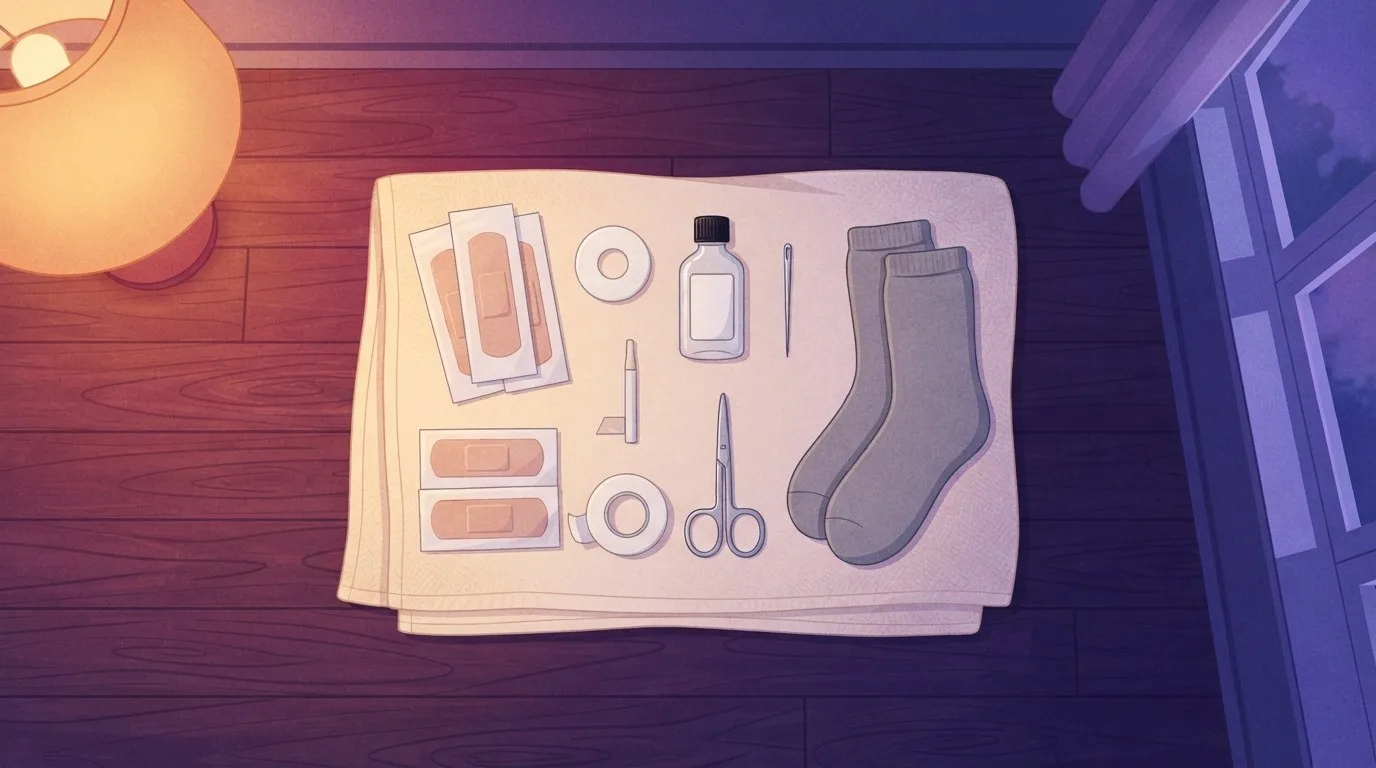
Leave it alone. Cover it loosely with a bandage so the middle sits slightly raised over the bubble. On a pressure spot such as the ball of the foot or the heel, cut a piece of padding into a ring, place the hole over the blister, and bandage over both.
If the blister is large and painful
The AAD's advice is not to pop a blister, because an opening can let infection in, but it says draining a large, painful one can be reasonable. Do it this way:
- Wash your hands and the blister with soap and warm water.
- Wipe a small needle with rubbing alcohol.
- Pierce the blister at one edge, not the top, and let the fluid drain out.
- Leave the roof of skin in place, because it's the best dressing there is.
- Wash the area again, apply petroleum jelly and cover it with a non-stick bandage.
Knapik's review reached the same conclusion from clinical experience: draining an intact blister and keeping its roof caused the least discomfort and may lower the chance of infection.
If the roof has torn off
Clean the raw skin gently and cover it. Knapik's review found that hydrocolloid dressings, the thick gel-like blister bandages, relieve pain on torn blisters and can let you keep moving if you need to. There's no evidence that antibiotics speed blister healing, so they're for a blister a doctor has diagnosed as infected. Don't peel off loose skin, and don't try to dry the blister out with alcohol or powder.
Running With Blisters: Keep Going or Rest?
The AAD's advice is to hold off on the activity until a blister has healed. In practice, many runners keep going on short, easy runs once a blister is protected, and that's reasonable for a small blister with its roof intact and no pain when you walk. Pad it with a ring, cover it with tape or a hydrocolloid dressing, and wear your best-fitting shoes.
Rest it instead if the roof has torn, if it hurts to walk, or if you catch yourself landing differently to protect it. A changed stride moves stress to tissues that aren't used to taking it. Days off your feet don't have to be days off training, either. A strength or mobility session at home keeps the habit going while the skin repairs.
When a Blister Needs a Doctor
Most running blisters are a nuisance, not a medical problem. See a doctor or a podiatrist if any of these apply.
- Signs of infection. Redness that spreads, warmth, pus, or pain and swelling that get worse instead of better. Red streaks running up from the blister or a fever need same-day care.
- Diabetes, poor circulation or reduced feeling in your feet. Small foot wounds can heal slowly and go unnoticed, so any blister deserves a professional look.
- Blisters with no clear rub. Blisters that appear on skin your shoes don't touch, or keep coming back without a cause you can find, can be a sign of a skin condition.
- A blister that hasn't improved after two weeks of care.
The Bottom Line
Blisters while running come from the same two ingredients every time: repeated rubbing and damp skin. Fit your shoes for the end of the run, wear padded synthetic or wool socks in your exact size, tape the spots that have blistered before, keep your feet drier, and stop at the first hot spot. Treat the blisters that still get through gently, and keep the roof on.
The bigger risk for a new runner isn't one blister. It's the week off that turns into a month. If staying consistent is the hard part, our roundup of workout apps for beginners compares the options built for people who are just starting. FitCraft is one of them: an AI coach demonstrates each exercise as a 3D character, says your name mid-workout, and keeps a streak going, with strength, mobility, yoga and cardio workouts you can do at home on the days your feet need a break.
Frequently Asked Questions
Why do runners put petroleum jelly on their feet?
Runners smear petroleum jelly on their toes and heels to lower friction between skin and sock, which is how blisters start. It only works while it stays on, so reapply it on runs longer than about 90 minutes. No randomized trial has shown that it prevents running blisters, and paper tape has stronger evidence for known trouble spots.
How do you toughen up your feet to prevent blisters?
Run regularly and raise your distance gradually. Repeated, low-level rubbing makes the outer layer of skin on your feet thicken over weeks, which may lower blister risk. File down thick callus instead of letting it build, because hard callus becomes a pressure point with deep, painful blisters underneath.
Do two socks prevent blisters?
They can. A thin polyester liner under a thicker wool or polypropylene sock reduced blisters in Marine recruits, because the layers slide against each other instead of against your skin. A double-layer running sock does the same job with less bulk. The overall evidence for socks is low quality, so size and padding matter as much as the number of layers.
What dries up a blister fast?
Nothing safely dries up a blister fast, and putting alcohol or powder on it mostly irritates the healing skin. Most blisters heal in one to two weeks when they're covered and protected. If a blister is large and painful, drain it from the edge with a sterilized needle, keep the roof of skin in place and cover it.
Can you run with a blister on your foot?
Yes, if the blister is small, its roof is intact and walking doesn't hurt. Protect it with a ring of padding and tape or a hydrocolloid dressing, and keep the run short and easy. Rest instead if the skin has torn, the blister is painful, or it changes the way you land.
Why do I get blisters in the same spot every run?
A blister that keeps coming back in one spot points to a fixed cause in your shoe or sock. Heel blisters usually mean the heel is slipping, toe-tip blisters a shoe that's too short, and arch blisters a sock that wrinkles. Fix the cause, and tape the spot before each run while you do.