Ten kilometres is 6.2 miles, and for someone starting from the couch it means an hour or more of running. That number is what makes a 10K running plan feel out of reach. Maybe you jogged around the block once and were done by minute three.
If you've started running before and stopped, it probably wasn't a lack of grit. Plans usually lose beginners on the calendar. The long run jumps too fast, a shin starts to ache in week five, and one missed week quietly turns into a missed month.
This plan is built around the one thing that separates a 10K from a 5K: the long run, and how quickly you let it grow. Everything else is kept deliberately simple, so the only decision you make each week is to show up for three runs.
How Long Does Couch to 10K Take?
It takes 14 weeks, for someone who can walk briskly for 30 minutes but doesn't run. That's five or six weeks longer than a typical couch to 5K schedule, and nearly all of the extra time goes into the long run, which has to grow from 30 minutes of run-walk to an hour of easy running.
Fitness isn't the bottleneck. Plenty of people could gasp their way through 6.2 miles after eight weeks. What takes longer is getting your shins, calves and Achilles used to an hour of landings, and that's why no long run in this plan is more than 10 percent longer than the longest one you ran in the previous four weeks.
If you've never run before, the beginner basics don't change with the distance, and our 5K training plan for beginners covers them in detail: run slowly enough to talk, keep runs on non-consecutive days, buy a shoe that feels comfortable, and repeat a week whenever life gets in the way. Walk breaks aren't cheating either, and our look at the run-walk method covers the trial behind that. This page takes those rules as given and spends its time on what changes when the target doubles.
The 14-Week Couch to 10K Plan
Three runs a week on non-consecutive days, each one after a 5-minute brisk walk. Every number below is minutes of moving, walk breaks included. The two easy runs build the habit. The long run builds the distance, so it's the one to protect in a week when you can only fit in two.
| Week | Easy run 1 | Easy run 2 | Long run | Time on feet |
|---|---|---|---|---|
| 1 | 24 min: run 1, walk 2, eight times | Same as easy run 1 | 30 min: run 1, walk 2, ten times | 78 min |
| 2 | 24 min: run 2, walk 2, six times | Same as easy run 1 | 32 min: run 2, walk 2, eight times | 80 min |
| 3 | 25 min: run 3, walk 2, five times | Same as easy run 1 | 35 min: run 3, walk 2, seven times | 85 min |
| 4 | 24 min: run 4, walk 2, four times | Same as easy run 1 | 36 min: run 4, walk 2, six times | 84 min |
| 5 | 27 min: run 7, walk 2, three times | Same as easy run 1 | 36 min: run 7, walk 2, four times | 90 min |
| 6 | 28 min: run 12, walk 2, twice | Same as easy run 1 | 39 min: run 11, walk 2, three times | 95 min |
| 7 (lighter) | 20 min without stopping | 25 min without stopping | 30 min: run 14, walk 2, run 14 | 75 min |
| 8 | 25 min easy | 30 min easy | 42 min: run 20, walk 1, twice | 97 min |
| 9 | 30 min easy | 30 min easy, then 4 strides | 46 min, walking only if you need to | 106 min |
| 10 | 30 min easy | 35 min with two 6-min steady blocks | 50 min easy | 115 min |
| 11 (lighter) | 25 min easy | 25 min easy, then 4 strides | 40 min easy | 90 min |
| 12 | 30 min easy | 40 min with two 8-min steady blocks | 55 min easy | 125 min |
| 13 | 30 min easy | 40 min with one 15-min steady block | 60 min easy | 130 min |
| 14 (race week) | 25 min easy, then 4 strides | 15 min easy | Race: 10K | Race day |
A few definitions and rules sit behind the table.
- Easy means you could speak in full sentences the whole way. If you can't, slow down or walk for a minute.
- Steady means comfortably hard: you can get out a short phrase, but you wouldn't want to hold a conversation. Jog easily for 2 minutes between steady blocks.
- Strides are 20-second relaxed accelerations to a quick but smooth pace, with a full walk back between each one. They're never a sprint.
- Weeks 7 and 11 are lighter on purpose. They give your legs a chance to absorb the block before it, and they don't reset the long-run benchmark.
- If your 10K will take more than about 80 minutes, add one extra week before race week with a 65-minute long run. That makes it a 15-week plan, which is fine.
- Missed a week? Repeat the last week you completed before moving on.

How the 10K Running Plan Works, Phase by Phase
The table looks like 14 separate weeks. It's really four phases, and knowing what each one is for makes it easier to stay patient in the parts that feel slow.
Weeks 1 to 6: Turn walking into running
The long session barely grows in the first six weeks, from 30 to 39 minutes. What changes is the mix inside it. At the start you run one minute in every three. By week 6 you run eleven minutes in every thirteen. Your total time on your feet stays almost flat while the share of it spent running climbs quickly, which is the gentlest way to get your legs used to impact.
Weeks 7 to 10: Run without stopping
Week 7 eases off so the first block can settle in. From week 8 the long run is mostly continuous, and from week 9 you walk only when you choose to. The easy runs reach 30 minutes, which is about the length of a 5K for many people. Strides arrive in week 9: four short accelerations at the end of one easy run that teach your legs a quicker rhythm without tiring them. Week 10 adds the first two short steady blocks.
Weeks 11 to 13: Reach the hour
After a second lighter week, the long run climbs to 55 and then 60 minutes, and the steady blocks in one easy run get longer. Steady running is close to how a first 10K feels once you've settled in after the opening kilometre, so it's race practice without a stopwatch.
Week 14: Race week
Two short runs, then the race. Training drops to 40 minutes before race day so you arrive with fresh legs. A last long run that week can't build fitness in time for the race, but it can leave you tired for it, so skip it.
How Often Beginners Get Injured on a Running Plan
Running injuries in beginners are common enough that you should plan for one rather than hope to dodge it. The best data on a structured beginner programme comes from the Netherlands. Kluitenberg and colleagues (2015) followed 1,696 novices through a supervised 6-week Start to Run programme and found that 10.9 percent sustained a running-related injury, counted as a running-related complaint that got in the way of running for three sessions in a row. Older age, a higher BMI, previous joint or muscle complaints that didn't come from sport, and never having run before all raised the risk.
Two things follow from that. A 14-week plan gives you more than twice that programme's weeks of exposure, so the habits that keep you healthy matter more than any single number in the table. And if you tick some of those risk boxes, the gentle first six weeks aren't padding. They're where your legs earn the right to the longer runs that come later.
Per hour of running, novices get hurt at more than twice the rate of experienced recreational runners, according to a 2015 meta-analysis by Videbæk and colleagues. Weekly volume plays a part as well, though the evidence is softer than the old 10 percent rule suggests. In Nielsen and colleagues' (2014) study of 874 novices given GPS watches, those who raised their weekly distance by more than 30 percent over two weeks had more overuse injuries such as runner's knee and shin splints, but the result fell just short of statistical significance (hazard ratio 1.59, 95% CI 0.96 to 2.66).
If something hurts on two runs in a row, gets worse as a run goes on, or changes the way you move, repeat the previous week at the same volume. Sharp pain in one bony spot, especially on the shin or the top of the foot, is a reason to see a clinician rather than to keep going.
How to Build the Long Run Without Getting Hurt
The long run turns a 5K runner into a 10K runner, and it's also the session most likely to hurt you. The best evidence on how fast to grow it is recent. Frandsen and colleagues (2025) tracked 5,205 adult runners for 18 months through their GPS watches, 588,071 sessions in all, and compared every run with the longest run that person had done in the previous 30 days. Over the study, 1,820 of them developed an overuse injury.
Compared with runs no more than 10 percent longer than that benchmark, runs 10 to 30 percent longer came with a 64 percent higher rate of overuse injury, runs 30 to 100 percent longer a 52 percent higher rate, and runs more than twice as long a 128 percent higher rate. In the same data, week-to-week changes in total distance showed no clear link with injury. It's an observational study, so it shows an association rather than proof, but it's the largest dataset on the question so far.
Notice what that rule measures: one run against your recent longest, not your weekly total. That's why the long run in this plan climbs a few minutes at a time, never more than 5, and why the two lighter weeks don't reset the benchmark. After week 7's 30-minute long run, week 8 is compared with week 6's 39 minutes, so 42 minutes is a 7.7 percent step rather than a 40 percent one.
Three habits make the rule easy to keep:
- Count minutes, not miles. The study measured distance, but a new runner's pace changes from week to week. Timing the long run means a slow day never turns into an accidentally longer one.
- Don't bank missing minutes. A long run cut short stays short. Adding the shortfall to tomorrow's run creates exactly the kind of spike the data warn about.
- Keep it easy all the way. Pace is irrelevant on a long run. If you can't speak in full sentences, walk for a minute and carry on.
For most beginners the 60-minute long run in week 13 is shorter than the race itself. That gap is deliberate. Covering the full distance in training would mean one more big step up two weeks before the race, when you'd rather be absorbing the work you've already done. On race day the crowd, the rest and the occasion carry you the rest of the way.
5K to 10K Training Plan: The 7-Week Version
If you can already run 5K without stopping, or about 30 to 35 minutes of easy running, you don't need the first half of the plan. This 7-week 5K to 10K training plan picks you up from there. It assumes you've been running three times a week for at least a month and that your longest run in that time was about 36 to 40 minutes. If your longest run is shorter, start the long-run column 10 percent above it and climb from there.
| Week | Easy run | Quality run | Long run | Optional 4th run |
|---|---|---|---|---|
| 1 | 30 min | 30 min, then 6 strides | 40 min | 20 min easy |
| 2 | 30 min | 35 min with two 8-min steady blocks | 44 min | 20 min easy |
| 3 | 30 min | 35 min with two 10-min steady blocks | 48 min | 25 min easy |
| 4 (lighter) | 25 min | 30 min, then 6 strides | 38 min | Rest |
| 5 | 35 min | 40 min with one 15-min steady block | 52 min | 25 min easy |
| 6 | 35 min | 40 min with one 20-min steady block | 57 min | 25 min easy |
| 7 (race week) | 25 min, then 4 strides | 15 min easy | Race: 10K | Rest |
For a 5K runner, the jump to 10K is mostly the long run plus some steady running in one session a week. Add the fourth easy run only if you've been running three times a week for at least two months and nothing aches. If anything starts to niggle, the fourth run is the first thing to drop.
The trap for 5K runners is speed. You're fit enough to run every session at a medium effort, and it feels productive. But an hour of running asks your legs for durability more than pace. Keep the easy runs and the long run genuinely easy, and let the steady blocks be the only place you push.
Find out what's really holding you back
FitCraft, our mobile fitness app, pairs you with an AI coach who builds you a personalized plan around your goals, schedule, and fitness level. Every FitCraft program is designed by Domenic Angelino, MPH (Brown University) and NSCA-CSCS, with research published in the Journal of Strength and Conditioning Research and Medicine & Science in Sports & Exercise.
Take the Free Assessment Free • 2 minutes • No credit cardHow Fast to Run Each Session
Most beginners run their easy days too hard and the start of their race too fast. A 10K rewards the opposite. Three effort levels cover everything in this plan, and none of them needs a watch:
- Easy: full sentences. This is most of your running, including every long run.
- Steady: short phrases. It's roughly the effort a beginner can hold for an hour by the end of the plan, which is what a first 10K asks for.
- Strides: 20 seconds, quick and relaxed, with full recovery between them.
Keeping most running easy isn't only caution. Muñoz and colleagues (2014) randomly assigned 30 recreational runners to 10 weeks of heart-rate-guided training. One group did most of its running easy with a small amount of hard work, a pattern called polarized training. The other spent far more time at a moderate effort, between easy and hard. Both groups raced a 10K on the same course before and after.
Both groups got faster, by 5.0 and 3.6 percent, and the difference between them wasn't statistically significant. Among the runners who stuck most closely to their assigned training, the mostly-easy group improved more. The fair reading is that plenty of easy running plus a little harder work gets you at least as far as running every session at a medium effort, and it's much easier to recover from.
Don't pick a goal time for your first 10K. Pick an effort: easy to steady for the first 8 kilometres, then whatever you have left. For a sense of scale, 6.2 miles at 11 minutes per mile takes about 68 minutes, at 12 minutes about 75, and at 13 minutes about 81.
Fuelling and Drinking for an Hour of Running
A run of about an hour doesn't need much food during it. What you eat beforehand, and a sip of something sweet near the end, can still help.
Before the long run or the race, eat a carbohydrate-based meal two to four hours ahead, or a small snack an hour before if you run early in the morning. Our guide to what to eat before a long run sets out gram amounts by body weight and example meals for each time window.
During the run, carbohydrate in the mouth seems to matter more than carbohydrate in the muscles at this distance. Rollo and colleagues (2010) had 10 trained male runners run as far as they could in an hour on a treadmill after an overnight fast, rinsing their mouths with either a 6.4 percent carbohydrate drink or a placebo before the start and every 15 minutes. They covered about 211 metres more with the carbohydrate rinse, roughly 1.5 percent, with no change in blood glucose. For a beginner's 10K, a few sips of sports drink at the water stations is the practical version. If your race or your longest training runs will take more than about 75 minutes, practise eating a small carbohydrate snack partway through on your long runs first.
Drink to thirst. The international consensus on exercise-associated hyponatremia (Hew-Butler and colleagues, 2015) recommends letting thirst guide drinking during exercise, because forcing down extra water over a long effort can dilute the sodium in your blood. At 10K, a few mouthfuls at each station is plenty for most people unless the day is hot.
The Two Strength Sessions: Dumbbells and Bodyweight, 20 Minutes Each
Strength work earns its place in a 10K plan mainly because it makes each stride cheaper. Balsalobre-Fernández and colleagues (2016) pooled five controlled trials in 93 competitive middle- and long-distance runners and found that two to three strength sessions a week for 8 to 12 weeks produced a large improvement in running economy, the oxygen it costs you to hold a given pace. Those were well-trained runners, so don't expect the same size of effect, but the direction is consistent.
The injury story is less tidy than most running articles admit. In Toresdahl and colleagues' (2020) randomised study of 720 first-time New York City Marathon runners, a self-guided 10-minute programme of thigh, hip and core exercises three times a week didn't reduce the overuse injuries that stopped people finishing (7.1 percent against 7.3 percent). Read it as a case against token strength work done alone from a handout. The two sessions below take longer, use dumbbells, and get harder as you go.
Strength A: calves and knees
| Exercise | Sets and reps |
|---|---|
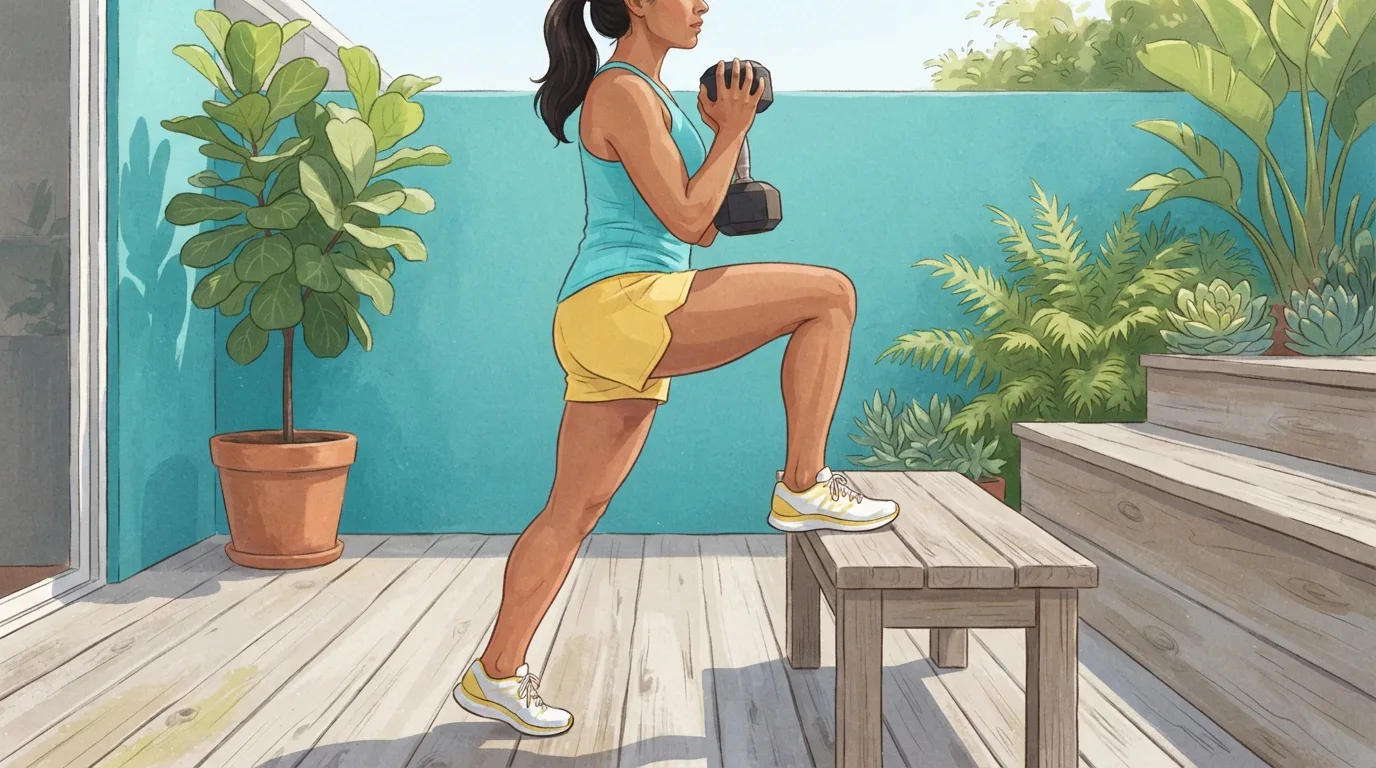
| Dumbbell step-up onto a sturdy step or bench | 3 x 8 each leg |
| Dumbbell reverse lunge | 2 x 8 each leg |
| Bent-knee calf raise holding a dumbbell | 3 x 15 |
| Single-leg calf raise off a step | 2 x 12 each leg |
| Suitcase carry with one dumbbell | 3 x 30 seconds each side |
Strength B: hips and the back of the legs
| Exercise | Sets and reps |
|---|---|
| Single-leg Romanian deadlift with one dumbbell | 3 x 8 each leg |
| Glute bridge with a dumbbell across the hips | 3 x 12 |
| Lateral lunge holding one dumbbell | 2 x 8 each side |
| Bird dog | 2 x 8 each side |
| Plank with shoulder taps | 2 x 10 each side |
Most of the list works one leg at a time, because running is a series of single-leg landings. The bent-knee calf raise targets the deeper calf muscle that absorbs a big share of each landing, and the carry teaches your trunk to stay upright when one side is loaded, which is roughly what happens every time a foot hits the ground.
Do Strength A after easy run 1 or on a day off, and Strength B at least two days before your long run. Choose a weight you could lift two or three more times at the end of each set, and add two reps or a slightly heavier dumbbell every two weeks. In race week, do one short session early in the week and skip the other.
If planning those sessions yourself is the part you'd skip, FitCraft's strength workouts use exactly this equipment. An AI coach demonstrates each exercise as a 3D character you can rotate and zoom, says your name during the session, and keeps a streak going so the strength days don't quietly disappear by week six.
Your First 10K Race Day
Everything you need for race day you've already rehearsed on your long runs. The race just strings it together.
- Eat the breakfast you've tested two to three hours before the start, and wear the shoes and clothes from your long runs.
- Warm up for 10 minutes: brisk walking, a few minutes of easy jogging and two or three strides.
- Run the first 2 kilometres slower than feels right. The easiest mistake in a 10K is an opening kilometre a minute too fast, which you then pay for between kilometres 6 and 9.
- Settle into steady by kilometre 3. Short phrases, not full sentences.
- Expect kilometres 7 to 9 to be hard. That stretch is what the 55- and 60-minute long runs were for. Keep your effort level and let the pace drift if it has to.
- Walk through the water stations if you trained with walk breaks. Thirty seconds of walking while you drink costs very little.
- Pick it up in the last kilometre if you have anything left. If you don't, finishing is the whole point of a first 10K.
What Changes by Week 14
Fourteen weeks from now, an hour of running is an ordinary Saturday instead of a fantasy. You'll know what easy feels like, you'll have a race behind you, and you'll have proof that you can stick with a plan for three months, which is the part most people never get to see.
If you'd like your strength days planned for you and a streak that keeps you turning up, our roundup of the best fitness apps for beginners compares how the main options handle someone starting from zero. And when 10K starts to feel routine, our 12-week half marathon training plan builds directly on this base.
Frequently Asked Questions
How long does it take to go from couch to 10K?
About 14 weeks for someone who can walk briskly for 30 minutes but doesn't run yet, with three runs and two short strength sessions a week. Published plans for complete beginners usually run 10 to 16 weeks. If you can already run 5K without stopping, a 7-week build is enough.
Can you go from couch to 10K in 8 weeks?
Only if you can already run for 20 to 30 minutes without stopping. From zero, eight weeks means turning walking into running and doubling the long run at the same time, with no lighter weeks and no room for a missed week. A 2025 study of 5,205 runners found that single runs more than 10 percent longer than the longest run of the previous 30 days raised the overuse injury rate, which is why this plan takes 14 weeks.
How many days a week should I run to train for a 10K?
Three runs a week on non-consecutive days is enough for a first 10K, plus two short strength sessions with dumbbells and bodyweight. A fourth easy run is worth adding only once you've been running three times a week for a couple of months without aches.
What is a good 10K time for a beginner?
Any finish is a good first 10K time. For a sense of scale, 6.2 miles at 11 minutes per mile takes about 68 minutes, at 12 minutes about 75 and at 13 minutes about 81. Race your first one by effort, not by a goal time, and use the result to set a target for the next one.
Should I run 10K in training before race day?
You don't need to. This plan peaks at a 60-minute long run in week 13, which is shorter than the race for most beginners. Covering the full distance in training would mean one more big jump in the long run two weeks before the race, when the goal is to arrive rested.
How do I go from 5K to 10K?
Keep three runs a week and grow the long run from about 40 to 57 minutes over six weeks, never by more than 10 percent at a time, with one lighter week in the middle. Add some steady running to one session a week, then race in week 7. A fourth easy run is optional.