
Somewhere around mile 8 of a 12-mile run, your brain starts pitching alternate plans. "You could cut it short at the next intersection." "You're overdoing it today." "Your calves feel weird, maybe stop and stretch." "Nobody's watching. Nobody cares."
The Reddit thread that prompted this article put the same question directly: how do you continue running long runs without letting your mind win? It's the most honest framing I've seen of what long-run failure actually feels like. It's not usually muscles giving out. It's a negotiation with yourself, and most of the time you lose.
Turns out there's a real research literature on exactly this. It's called the psychobiological model of endurance, and the interventions it points to are cheap, teachable, and evidence-backed. Here's the plain-language version, plus a practical toolkit.
Why Long Runs End: The Psychobiological Model
Traditional exercise physiology used to argue that endurance stopped when muscles hit some hard limit: lactate accumulation, glycogen depletion, cardiac output ceiling. Peripheral fatigue, the muscles saying no.
Then Samuele Marcora and colleagues at the University of Kent published a series of studies starting in 2009 showing something inconvenient. When cyclists reached "exhaustion" in a time-to-exhaustion test, they could still generate substantially more power than the fixed load they'd been holding. Their muscles weren't out. Something else was.
Marcora's psychobiological model reframed the whole question. Endurance ends when perception of effort exceeds what the person is willing to sustain, given their motivation. Muscles set the floor of what's physiologically possible. Perceived effort and motivation set where inside that range you actually stop.
This isn't a "mind over matter" cliche. It's a testable claim, and it's been tested a lot. If perception of effort drives the stop signal, then anything that lowers perceived effort at the same physiological load should let you go longer. If motivation shifts what you're willing to endure, then anything that raises motivation should have the same effect. Both predictions have held up.
The most useful implication for a Sunday-long-run runner: your ceiling is not a hard biological wall. It's a moving target. And you can move it. The mental tools pay off most once the physical side is settled, so if you are still fading inside the first ten minutes, start with why you get tired so fast and come back to the cues afterwards.
The Self-Talk Study That Changed the Conversation
The cleanest test of the psychobiological model comes from Blanchfield, Hardy, De Morree, Staiano, and Marcora (2014), published in Medicine & Science in Sports & Exercise. Twenty-four recreational cyclists were randomly split into two groups and given the same test: hold a fixed cycling power to exhaustion, twice, two weeks apart.
Between the two tests, the experimental group learned motivational self-talk. They picked short cues that felt natural (things like "feeling good", "push through this", "drive with your legs"), practiced them during their training rides, and used them during the second time-to-exhaustion test. The control group did nothing new.
The result:
- Self-talk group: time to exhaustion increased by 18% at the same fixed load
- Control group: essentially unchanged
- Perceived exertion: significantly lower in the self-talk group at matched time points during the second test
- Physiology: heart rate and blood lactate were similar between groups. The body was doing the same amount of work. The brain reported less of it.
Eighteen percent is a big number in endurance research. It's roughly what a well-designed 4-week training block might buy you, achieved in two weeks with zero additional physical training. And it's a clean demonstration of the psychobiological model's core claim: shift the perception, shift the ceiling.
The mechanism isn't magic. Cues that reframe effort ("I'm strong right now") or focus attention ("relax my shoulders, quicken cadence") appear to modulate the same anterior cingulate cortex activity that generates the sensation of effort. Practically: they change what the internal "how hard is this?" reading actually reports.
For a full breakdown of how habit-loop research applies to sustained running, see our piece on the willpower myth in exercise adherence.
Mental Fatigue Is Real, and It Costs You
If self-talk can add 18% to endurance, mental fatigue can subtract about as much. Van Cutsem and colleagues (2017) systematically reviewed 11 studies that used the standard "AX-CPT" or similar cognitively demanding tasks before an endurance test. Participants sat and did mentally hard computer work for 30 to 90 minutes, then performed the endurance test.
Across the review, mentally fatigued participants:
- Terminated endurance tasks earlier at the same fixed physiological load
- Reported higher perceived exertion throughout the effort
- Showed no drop in maximal strength or anaerobic power. The effect was specific to endurance and specific to perceived effort.
This is why the mental preparation for a long run starts hours before the run itself. If you've been in back-to-back meetings, or trying to hit a deadline, or scrolling through emotionally draining social feeds for two hours, you are not showing up to the run the same person who could handle it fresh. The physiology is identical. The mental "battery" you draw on for perception-of-effort management is not.
Practical: for planned long runs, protect the 90 minutes before them. Not with a nap necessarily. Just with something low-demand. Read something light, walk the dog, listen to music, do house tasks that don't require heavy decision-making.
The Practical Toolkit
Here are the techniques the research supports, arranged as an actual pre-run and mid-run kit you can use tomorrow.
Before the Run
Protect the previous 90 minutes. Low cognitive load, low emotional intensity. This is not laziness. It's setting up the resource you're about to spend.
Rehearse your self-talk cues. Pick 3 to 5 short phrases. Make them yours. Blanchfield's participants used cues like "feeling good", "strong finish", "drive the arms", "quick and light". Say them aloud in your head during easy runs so they're automatic when you need them.
Pre-commit to a plan. Decide the route, the distance, and roughly the pace before you leave the house. Deciding mid-run costs mental energy you'll need later.
In the First Third
Go easier than you think. The classic long-run mistake is starting at the pace you want to average. Perceived effort in the first miles is your baseline, and if that baseline is already 6/10, you have nowhere to go when it climbs in mile 8.
Externalize attention. Look at things. Notice the neighborhood, the tree lines, the sky. Associative attention (checking heart rate, monitoring form) has its uses, but early in a long run it just makes you more aware of the effort you're supposed to be building up to.
In the Middle Third (The Hard Part)
This is where most long runs get lost. Nothing hurts yet, exactly, but the finish is far. This is when the brain starts pitching exit strategies.
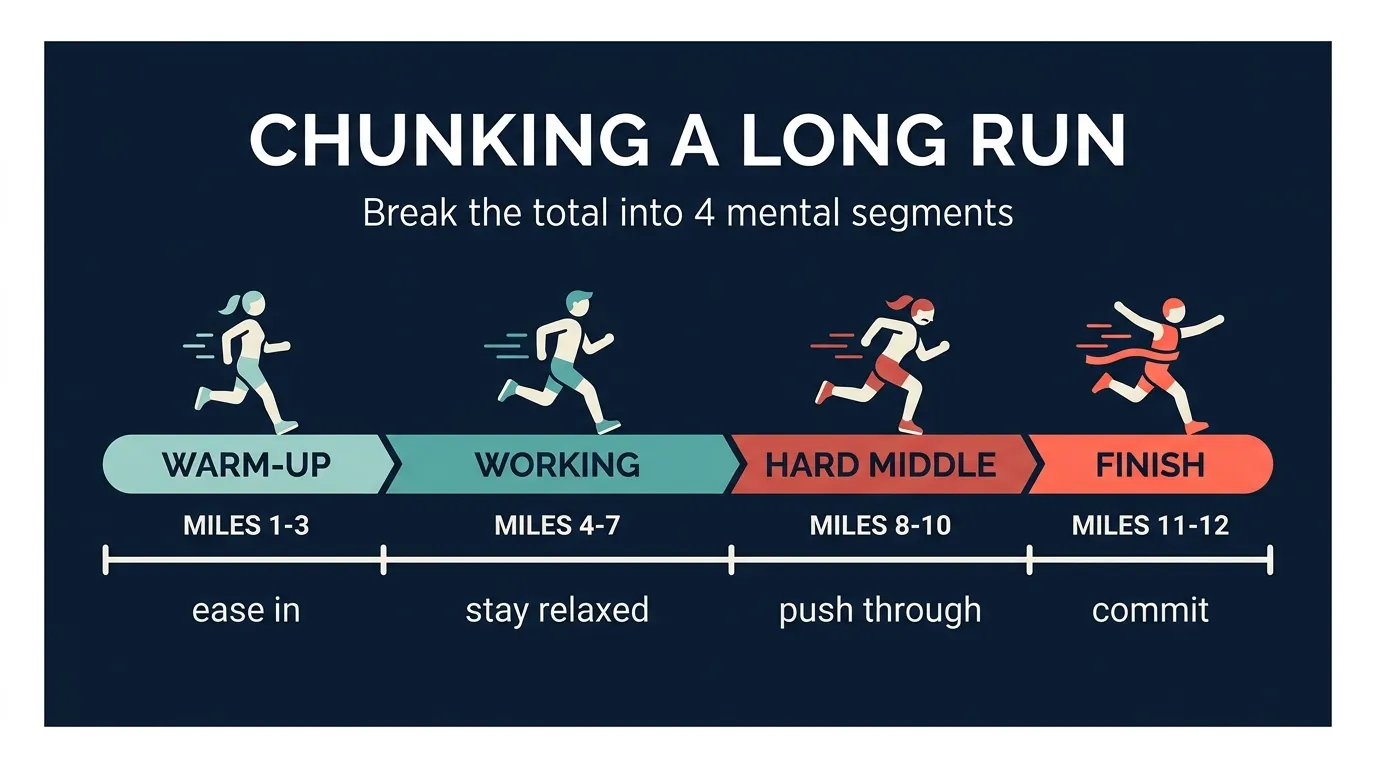
Chunk aggressively. Do not think about the remaining distance as a whole. Break it into pieces the size of a lamp post, the next mile marker, the next 90 seconds. The trick is not that the small chunk is easy. It's that "get to the next lamp post" is a task the perception-of-effort system can accept, whereas "run five more miles" prompts the shutdown negotiation.
Deploy the self-talk cues. This is what you rehearsed for. When the "why are we doing this" thought comes up, respond with a pre-rehearsed cue. Do not argue with the intrusive thought. Replace it.
Reframe the sensation. The tightness in your quads is your legs working, not your legs failing. The heavy breathing is oxygen doing its job. These reframes sound cheesy in isolation. In the middle of a long run they're the difference between finishing and cutting it short.
In the Last Third
Shift to internal, effort-focused attention. Now is when checking your form, cadence, and breathing pays off. You're close enough that awareness sharpens performance rather than draining it.
Break the finish into micro-goals. The last mile becomes four quarter-miles. The last quarter-mile becomes four eighths. This is the pattern elite marathoners use in the final 10K, and it works at any level.
Commit to finishing at the pace you set. Not faster, not slower. The commitment itself is a mental training rep for the next long run.
Knowing what to do is the easy part.
FitCraft, our mobile fitness app, pairs you with an AI coach who builds you a personalized plan around your goals, schedule, and fitness level. Every FitCraft program is designed by Domenic Angelino, MPH (Brown University) and NSCA-CSCS, with research published in the Journal of Strength and Conditioning Research and Medicine & Science in Sports & Exercise.
Take the Free Assessment Free • 2 minutes • No credit cardWhere the Common Advice Gets It Wrong
"Just push through." This is the advice most long-runners have been given. It's not wrong exactly, but it's incomplete. Pushing through with no framework tends to end in one of two ways: a heroic effort that leaves you dreading the next long run, or a mid-run bailout you feel bad about. Framework beats grit.
"Distract yourself and don't think about the miles." Distraction works up to a point. Music helps. Podcasts help. But Oswald et al. (2020), in a scoping review of 116 studies on running and mental health, note that the strongest mental-health benefits of running come from at least some conscious engagement with the physical experience, not pure escape. Full distraction can also mask legitimate signals (persistent knee pain, cardiovascular symptoms) you want to hear.
"You have to want it more." Motivation is real and it matters. But motivation as a stable trait ("some people just want it more") is mostly a story. The research shows motivation is state-dependent and context-dependent. On any given day it's what you built into your setup: pre-run rest, self-talk rehearsal, chunked structure, appropriate starting pace. Design the day so that when motivation dips, the structure carries you.
What This Looks Like Over Weeks and Months
The techniques above are not one-time hacks. They're skills that improve with practice, and they compound.
A runner who starts pre-run resting, self-talk rehearsal, and mid-run chunking today will not use them well on their first attempt. In week 2 or 3, the cues start to feel natural. By week 6 or 8, the whole mental approach to a long run has shifted. What used to be a coin-flip finish becomes a reliable one. What used to feel like a 9-out-of-10 effort now feels like a 7.
Blanchfield's cyclists needed only two weeks of self-talk practice to move their endurance ceiling by 18%. Your runs will see similar effects on a similar timeline if you actually practice, not just read about, the toolkit.
The most consistent runners aren't necessarily the ones with the strongest wills or the highest VO2 max. They're the ones who've built a mental infrastructure around the run so that willpower is not the resource being burned. If you want a broader view of why willpower isn't the useful variable to optimize, our breakdown of the willpower myth covers the underlying research. And if the harder problem is starting rather than sustaining, our piece on how to keep going when you hate working out tackles the motivation side directly.
The Honest Summary
Your mind isn't your enemy on long runs. It's the operating system running the effort calculation. And that calculation is trainable, in the same way a training plan is trainable.
The research on perception of effort, self-talk, mental fatigue, and cognitive strategy has grown big enough to give practical recommendations, not just theory. Prepare rested. Chunk aggressively. Rehearse self-talk. Externalize attention early, internalize it late. Design the day so willpower isn't what you're leaning on.
You'll still have hard long runs. Some days everything conspires against you, and you'll cut one short anyway. That's fine. It's not evidence you're weak. It's evidence you're human, and it's data for how to set up next weekend a little better.
Frequently Asked Questions
How do you run longer mentally?
Treat the ceiling as psychological, not physical. Blanchfield et al. (2014) trained cyclists to use motivational self-talk over two weeks and improved time to exhaustion by 18% at the same physiological load, with lower reported perceived exertion. The intervention was simple: pick 4 short cues (like "feeling good", "push through", "drive with your arms"), rehearse them during training, then deploy during hard efforts. Combined with chunking the run into 3 to 5 mental segments and rested pre-run mental state, most runners can hold effort noticeably longer than they think.
Is running long distance more mental or physical?
Both, but the mental piece is bigger than most people think. Samuele Marcora's psychobiological model, tested in dozens of studies since 2009, argues that endurance ends when perception of effort exceeds what the person is willing to sustain, not when muscles physically fail. Van Cutsem et al. (2017) systematically reviewed the mental-fatigue literature and found mentally fatigued participants terminated endurance tasks earlier at the same physiological load. Cardiovascular and muscular fitness set the range. Perception of effort and motivation set where inside that range you actually stop.
Does self-talk actually help running performance?
Yes, in randomized trials. Blanchfield and colleagues (2014, Med Sci Sports Exerc) randomized 24 participants to a two-week motivational self-talk intervention or a control condition. The self-talk group improved cycling time to exhaustion by 18% at the same fixed load and reported significantly lower perceived exertion at matched time points. Motivational (encouragement) and instructional (technique cue) self-talk both work; personalized cues that feel natural to you work better than generic ones.
How do you break up a long run mentally?
Chunking is the technique most experienced distance runners use, and it aligns with what the psychobiological model predicts. Split the run into 3 to 5 segments and treat each as its own effort. The first is a warm-up, the middle segments are the workout, the last is the finish. Small in-run goals (get to the next lamp post, the next mile marker, the next water station) shrink an intimidating total into a series of achievable subtasks and keep perception of effort in check.
Does mental fatigue before a run make it harder?
Yes, and this is one of the most reproducible findings in the exercise psychology literature. Van Cutsem et al. (2017) systematically reviewed studies where participants performed a demanding cognitive task before an endurance test. Across the review, mentally fatigued participants stopped earlier at the same physiological load and rated the effort as harder throughout. Practical takeaway: if you have a long run planned, protect the hours before it. Avoid a demanding work session or a long doom-scroll immediately beforehand.