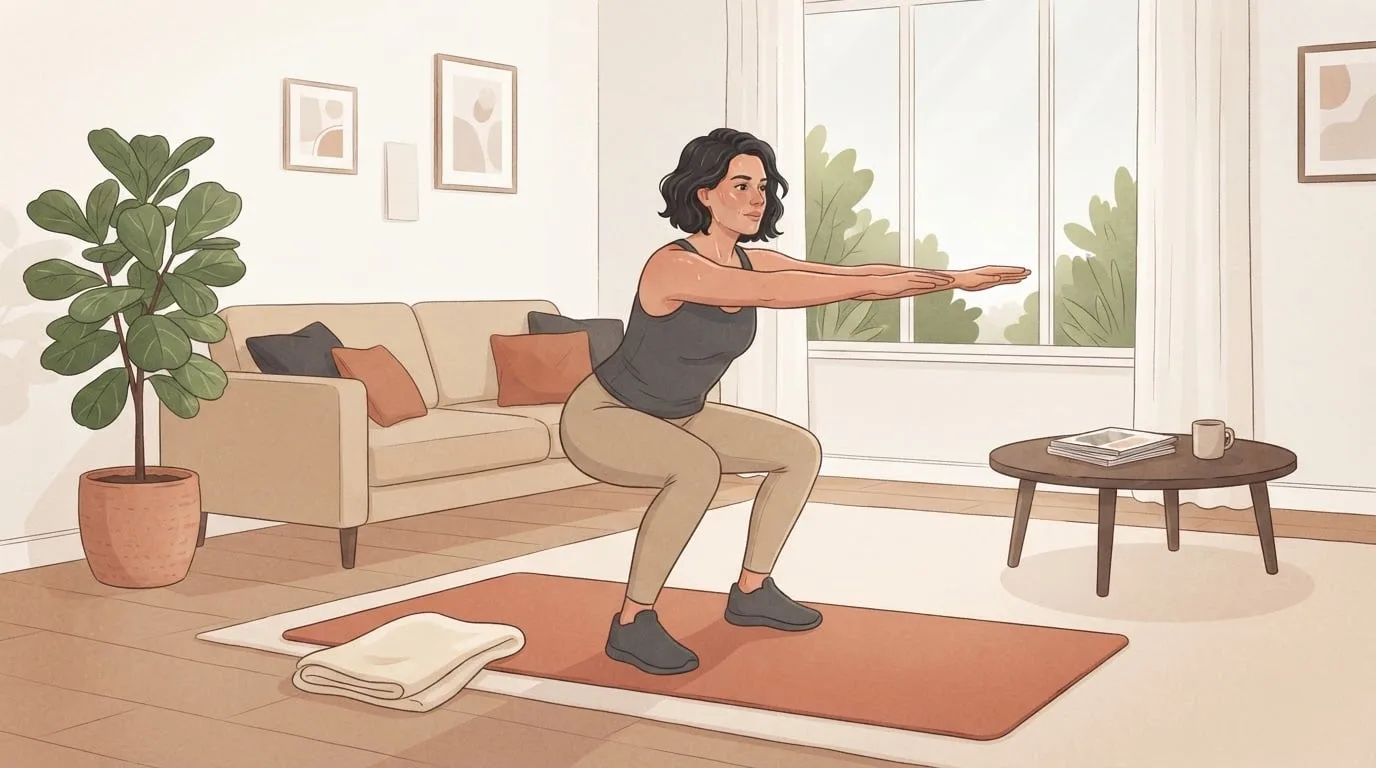
You can do the first ten squats easily. By rep 25 your thighs burn, and by rep 40 you're done, even though the load never changed. That point, where a muscle gives out on a weight it handled fine at the start, is what muscular endurance measures. Some people call it muscle stamina.
The simple definition of muscular endurance: how long a muscle can keep going before it quits. It's one of the five health-related components of fitness, and it's the one you lean on most in daily life, every time you carry bags from the car, climb stairs, garden on your knees or hold a child on one hip.
Below you'll find the formal definition, how muscular endurance differs from strength, what makes a muscle last longer, the dynamic and static types, six tests you can do at home, why it matters for your back and long-term health, and a bodyweight and dumbbell workout to build it.
What Is the Definition of Muscular Endurance in Physical Fitness?
In physical fitness, muscular endurance is the ability of a muscle or group of muscles to repeat a contraction, or sustain one, against a submaximal resistance over time. Submaximal is the key word. The load is always below the most you could lift once, which is what separates endurance from strength.
That's why muscular endurance is measured in reps or seconds, not kilograms. A push-up test counts how many you can do. A plank test times how long you can hold. A wall sit, a set of bodyweight squats and a 30-second chair stand all work the same way.
Exercise scientists also split it two ways:
- Absolute endurance uses the same load for everyone, like a fixed-weight bench press test. It depends heavily on strength. If you're stronger, the fixed weight is a smaller share of your max, so you can lift it more times.
- Relative endurance scales the load to the person, as a percentage of their one-rep max or their own body weight. It's closer to pure fatigue resistance.
Muscular endurance is one piece of a bigger picture. Our overview of the 5 components of fitness shows how it fits alongside cardio endurance, strength, flexibility and body composition.
Muscular Strength vs Muscular Endurance
Muscular strength is the most force a muscle can produce in a single effort. Muscular endurance is how long it can keep producing a smaller force. They sit on the same scale, and how you train decides which end you move toward. Here's how the two compare, with the loading guidance from the American College of Sports Medicine's resistance training position stand (ACSM, 2009):
| Muscular strength | Muscular endurance | |
|---|---|---|
| What it is | The most force a muscle produces once | Repeating or holding a smaller force before tiring |
| Measured in | Kilograms or pounds lifted | Reps or seconds |
| Training load | Heavy, emphasis on 1 to 6 reps for experienced lifters | Light to moderate, 40 to 60% of your max |
| Reps per set | Low | More than 15 |
| Rest between sets | 3 to 5 minutes | Under 90 seconds |
| Common tests | One-rep max, grip strength | Push-up test, plank, wall sit, sit-up test |
| Everyday example | Lifting a heavy box onto a shelf once | Carrying shopping bags up three flights of stairs |
The clearest test of the split in experienced lifters comes from Schoenfeld and colleagues (2015). They matched 18 trained young men on strength and split them into two groups for 8 weeks. Both did 3 sets of 7 exercises, 3 times a week, taking every set to failure. One group used heavy loads for 8 to 12 reps. The other used light loads for 25 to 35 reps.
The heavy group gained more strength: their back squat rose 19.6%, against 8.8% for the light group. The light group gained more endurance: the number of bench press reps they could do at half their max rose 16.6%, while the heavy group's dipped 1.2%. Muscle thickness grew about the same in both. So muscle growth and muscular endurance aren't the same thing. Both rep ranges built muscle, but only the long sets built the ability to keep going.
An earlier study in untrained men found the same pattern across three rep zones, and our guide on how to build endurance walks through it alongside the cardio side of endurance.
What Makes a Muscle Last Longer?
Inside the muscle, endurance comes down to fuel supply and fatigue. Slow-twitch (type I) fibers resist fatigue far better than fast-twitch fibers, and most muscles contain a mix of both. When you train with long sets, the muscle adapts in ways that keep it working longer:
- More capillaries around each fiber, so oxygen arrives faster and waste leaves faster.
- More mitochondria inside the fibers, so more energy comes from aerobic metabolism instead of fast, fatiguing pathways.
- Better buffering of the acidity that builds up during hard sets, which is part of the burn you feel near the end.
Strength still matters. A stronger muscle works at a smaller share of its capacity for any given task, so the same bag of groceries costs it less. That's why a little heavy work helps your endurance too, and why the best plans include both.
Dynamic vs Static Muscular Endurance
Muscular endurance comes in two forms, and they don't fully transfer to each other.
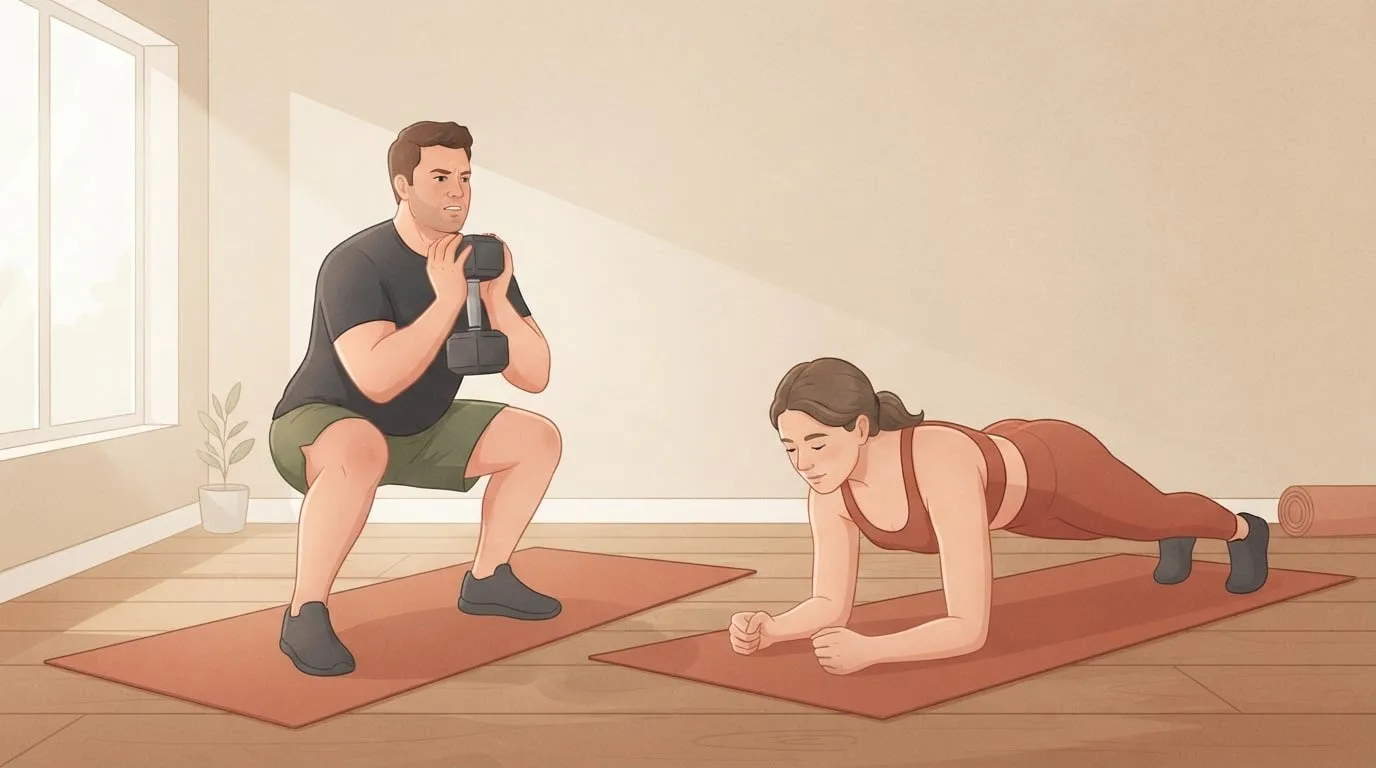
- Dynamic muscular endurance is repeating a movement through a range of motion: push-ups, squats, lunges, rows, cycling or climbing stairs. It's tested by counting reps.
- Static (isometric) muscular endurance is holding a position without moving: a plank, a wall sit, a dead hang or carrying a heavy bag at your side. It's tested with a stopwatch.
Holding a 2-minute plank doesn't guarantee 30 push-ups, and someone who can do 50 squats may shake through a 60-second wall sit. Static gains also tend to be largest near the joint angle you train. So if you want endurance for real life, train both: a few moving exercises for reps and a couple of holds.
Knowing what to do is the easy part.
FitCraft, our mobile fitness app, pairs you with an AI coach who builds you a personalized plan around your goals, schedule, and fitness level. Every FitCraft program is designed by Domenic Angelino, MPH (Brown University) and NSCA-CSCS, with research published in the Journal of Strength and Conditioning Research and Medicine & Science in Sports & Exercise.
Take the Free Assessment Free • 2 minutes • No credit cardHow to Test Your Muscular Endurance
Pick two or three of these, write down your numbers and retest in 4 to 6 weeks under the same conditions: same time of day, same surface, same rest beforehand.
- Push-up test (upper body, dynamic). Do as many full push-ups as you can with a straight body and chest to a fist's height off the floor. Use your knees if you can't do five full ones. Our free fitness test scores your result for your age and sex.
- Plank hold (core, static). Hold a forearm plank until your hips sag or lift. Stop the clock at the first form break, not when you collapse.
- Wall sit (legs, static). Slide down a wall until your thighs are parallel to the floor and hold. Knees stay over your ankles.
- Sit-up or curl-up test (abdominals, dynamic). Count how many controlled curl-ups you can do in one minute with your feet flat and knees bent.
- 30-second chair stand (legs, dynamic). Count full stand-ups from a standard chair in 30 seconds, arms crossed on your chest. Jones and colleagues (1999) validated it in 76 adults with an average age of 70.5. Scores tracked leg press strength (r = 0.78 in men and 0.71 in women), which shows how much strength and endurance overlap in the legs.
- Back extensor hold (lower back, static). Lie face down with your hips at the edge of a bench or bed and a partner holding your ankles, then hold your upper body level with the floor for as long as you can. Skip this one if you have back pain.
The back extensor hold has an interesting history. In a Danish study of 928 adults aged 30 to 60, Biering-Sørensen (1984) found that men with good isometric endurance in their back muscles were less likely to have a first episode of low back trouble over the following year. The hold that grew out of his work is now one of the most widely used back endurance tests.
Why Muscular Endurance Matters
Most of what your body does in a day is submaximal and repeated. You rarely lift the heaviest thing you can, but you carry, climb, squat and hold all day long. When endurance is low, those tasks tire you early and your form slips, which is when strains happen.
It also tracks with long-term health. Katzmarzyk and Craig (2002) followed 8,116 Canadians aged 20 to 69 from the 1981 Canada Fitness Survey for 13 years. After adjusting for age, smoking, body mass and estimated aerobic fitness, men in the lowest quarter for sit-ups had 2.72 times the risk of dying of those in the top quarter, and women 2.26 times. Push-ups and trunk flexibility showed no clear pattern in that study.
Push-ups did show a link in a different group. Yang and colleagues (2019) counted push-ups in 1,104 male firefighters in Indiana, average age about 40, and tracked heart problems for 10 years. After adjusting for age and BMI, those who managed more than 40 push-ups had a 96% lower incidence of cardiovascular events than those who managed fewer than 10. The group was young, active and all male, so treat the number as a signal, not a target everyone has to hit.
Neither study proves that training endurance adds years. Both suggest that muscles able to keep working are a marker of a body that's in good shape overall.
How to Increase Muscular Endurance
Endurance responds to long sets, short rests and steady practice. The core rules, from the ACSM's loading guidance and the training studies above:
- Use light to moderate loads: about 40 to 60% of your max, or your own body weight.
- Go long: more than 15 reps per set, or holds of 30 to 60 seconds.
- Keep rests short: under 90 seconds between sets, or 30 seconds between exercises in a circuit.
- Work close to the limit: light sets only pay off when they get hard. Finish most sets 1 to 3 reps short of failure.
- Train 2 to 3 days a week, the frequency the ACSM's position stand for healthy adults recommends for resistance work (Garber and colleagues, 2011).
- Keep some strength work in the week, because a stronger muscle can sustain the same load longer.
If you're unsure which rep range fits which goal, our breakdown of how many reps you should do covers strength, muscle and endurance ranges side by side.
A muscular endurance workout you can do at home
Run this as a circuit: do each exercise once, rest about 30 seconds between exercises and 1 to 2 minutes between rounds. It takes 25 to 30 minutes and needs one light dumbbell.
| Exercise | Reps or time | Notes |
|---|---|---|
| Bodyweight squats | 20 to 25 | Sit back to a depth you control, stand tall at the top |
| Push-ups | 12 to 20 | Use a counter or your knees to reach the range |
| One-arm dumbbell rows | 15 to 20 per side | A dumbbell you could row about 25 times when fresh |
| Reverse lunges | 12 to 15 per leg | Hold a wall or counter for balance at first |
| Glute bridges | 20 to 25 | Squeeze at the top for a second |
| Forearm plank | 30 to 60 seconds | Stop when your hips sag |
| Wall sit | 30 to 60 seconds | Thighs as close to parallel as you can hold |
Do 2 rounds at first and build to 3. Train it 2 or 3 times a week on nonconsecutive days, and keep one shorter strength session with heavier dumbbells somewhere in the week.
How to progress from week to week
Add reps until you reach the top of each range in every round. Then make the workout harder in one way at a time: add a fourth round, cut the rest between exercises from 30 seconds to 15, move push-ups from the counter to the floor, or hold a pair of light dumbbells for the squats and lunges. Changing one thing at a time tells you what's working.

What This Means for You
If your arms give out halfway through carrying the groceries, or your legs burn on the second flight of stairs, your muscles just haven't been asked to go long yet. That's good news, because endurance responds quickly. The light-load group in Schoenfeld's study added 16.6% to its endurance in 8 weeks.
The catch is that high-rep work is uncomfortable, and the burn near the end of a set is exactly why most people drop it. What keeps you coming back is a plan you don't have to think about and a reason to show up on the days you'd rather skip.
FitCraft's AI personal trainer app builds you a personalized plan with bodyweight and dumbbell strength workouts, and your workouts adjust as you progress. A 3D AI coach demonstrates each exercise and says your name while you work through the set, and your streaks and calendar keep a record of every session. As one FitCraft user, Mike, put it: "The streak system got me hooked. I didn't want to break my chain."
Frequently Asked Questions
What is the short definition of endurance?
Endurance is the ability to keep going. For your heart and lungs, that means sustaining whole-body exercise like running or cycling. For a single muscle, it means repeating or holding an effort before the muscle tires, which is muscular endurance.
How to explain endurance to a kid?
Endurance is how long your body can keep doing something before it needs a rest. A kid can test it by counting how many jumping jacks they can do before stopping, or how long they can hold a plank, then trying to beat that number the next week.
What are the four types of endurance?
There's no official list, but coaches usually name four: cardiovascular (aerobic) endurance, anaerobic endurance for short hard efforts, muscular endurance, and speed endurance, which is holding a fast pace. Muscular endurance itself comes in two forms, dynamic and static.
What causes poor muscular endurance?
The usual causes are inactivity, training only with heavy low-rep sets or only with cardio, low muscle strength, and poor sleep or eating too little to recover. Muscular endurance also fades with age when it isn't trained. Fatigue that comes on suddenly or keeps getting worse can have a medical cause, so see a doctor if that happens.
Is it better to lift heavy or do more reps?
It depends on your goal. In an 8-week study of trained men, heavy sets of 8 to 12 reps built more squat strength (19.6% vs 8.8%), light sets of 25 to 35 reps built more muscular endurance, and both built similar muscle size when taken to failure. Most people do best with some of each.
What are 5 exercises for muscular endurance?
Five good muscular endurance exercises that need no gym are push-ups, bodyweight squats, reverse lunges, the forearm plank and the wall sit. Do the moving exercises for 15 to 25 reps and hold the static ones for 30 to 60 seconds, 2 to 3 times a week.
What are some examples of endurance workouts?
Good examples of muscular endurance workouts are a bodyweight circuit of squats, push-ups, lunges and glute bridges for 15 to 25 reps each, timed holds like the plank and wall sit, and long sets of light dumbbell rows. For whole-body endurance, brisk walking, stair climbing, cycling and swimming all count.
What is the role of power in physical fitness?
Power is how fast you can produce force, as in jumping, throwing or standing up quickly from a chair. It's a skill-related component of fitness, separate from muscular endurance, and it matters for sport and for reacting quickly when you trip.