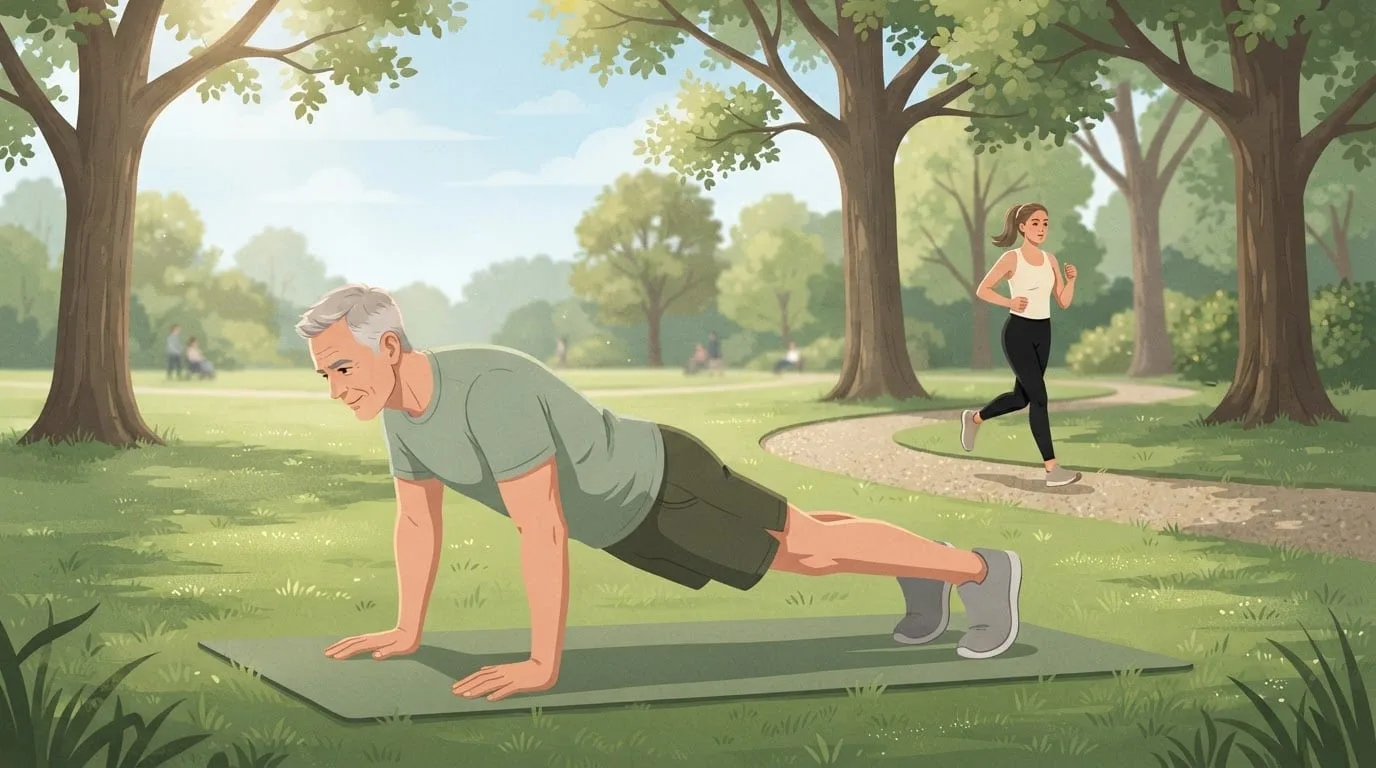
If you've ever wondered what being "fit" is supposed to mean, you're in good company. One person runs a half marathon and can't touch their toes. Another lifts heavy and gets winded on the stairs. Each is fit in one way and unfit in another, and that's why exercise scientists break fitness into 5 fitness components instead of one number.
Physical fitness has 5 components that relate to health, usually called the health-related components of fitness. They cover how well your heart and lungs keep you going, how much force your muscles make, how long they keep working, how far your joints move and what your body is made of. PE classes teach them, fitness tests measure them and exercise guidelines are built around them.
Below you'll find each of the five aspects of fitness explained with the research behind it, a simple way to test it and the basic training dose. Then come the skill-related components that turn the list into 11, what PE classes actually test, and a weekly bodyweight and dumbbell plan that covers all five.
The 5 Components of Fitness at a Glance
This table sums up the five health-related fitness components, with one simple test and the basic training dose for each. The sections below explain the evidence.
| Component | What it means | A simple test | How to train it |
|---|---|---|---|
| Cardiorespiratory endurance | How well your heart, lungs and blood vessels supply oxygen during sustained effort | 3-minute step test or a 12-minute run for distance | 150 to 300 minutes of moderate cardio a week, or 75 to 150 vigorous |
| Muscular strength | The most force a muscle group can produce in one all-out effort | Grip dynamometer, or the heaviest dumbbell you can lift for 5 clean reps | Every major muscle group, 2 to 3 days a week, with challenging loads |
| Muscular endurance | How many times a muscle can repeat an effort, or how long it can hold one | Push-up test, plank hold or wall sit | Higher reps and timed holds, 2 to 3 days a week |
| Flexibility | The range of motion around a joint | Sit-and-reach or a behind-the-back shoulder reach | Stretch each major muscle group on 2 or more days, about 60 seconds per stretch |
| Body composition | How much of your weight is fat and how much is muscle, bone and water | Waist-to-height ratio, ideally under 0.5 | Strength training and cardio, with eating habits doing much of the work |
You can check three of these at home in about 15 minutes with our free fitness test, which scores a push-up test, a sit and reach, a plank, a wall sit and a step test for your age and sex.
What Is the Definition of Fitness?
Physical fitness is a set of measurable attributes that let you do physical activity, and those attributes fall into two groups: health-related and skill-related. That split comes from a 1985 paper in Public Health Reports by Caspersen, Powell and Christenson. They wrote it because researchers kept using "physical activity," "exercise" and "physical fitness" as if they meant the same thing.
They don't. Physical activity is any movement of your muscles that burns energy, from gardening to carrying groceries. Exercise is the planned, structured, repeated part of it that you do to get or stay fit. Fitness is what you have as a result: the capacity your body brings to the next task, whether that's a hike, a house move or getting up off the floor.
The health-related group is the five components on this page, because each one is tied to disease risk and to how well you function as you age. The skill-related group covers athletic abilities like speed and agility. The American College of Sports Medicine's position stand for healthy adults (Garber and colleagues, 2011) sets a training dose for cardio, resistance and flexibility work, which covers the first group, plus balance and coordination work from the second.
1. Cardiorespiratory Endurance
Cardiorespiratory endurance, also called cardio fitness or aerobic fitness, is how well your heart, lungs and blood vessels deliver oxygen to working muscles over minutes or hours, and how well those muscles use it. The lab measure is VO2 max, the most oxygen your body can use per minute. In daily life, it's the difference between climbing four flights of stairs and chatting at the top, or stopping on the second landing.
Of the five components, this one has the strongest link to how long people live. Kodama and colleagues (2009) pooled 33 studies with 102,980 healthy adults. Each 1-MET increase in aerobic capacity, about what it takes to jog 1 km/h faster, was associated with a 13% lower risk of death from any cause and a 15% lower risk of heart disease events. People with low fitness, under 7.9 METs, had a 70% higher risk of death than people with high fitness.
A MET is one unit of resting energy use. So an aerobic capacity of 8 METs means your body can work at eight times its resting rate at its peak.
How to train it
The World Health Organization's 2020 guidelines (Bull and colleagues, 2020) ask adults for 150 to 300 minutes of moderate activity a week, such as brisk walking or easy cycling. The alternative is 75 to 150 minutes of vigorous activity like running, or a mix of the two. Moderate means you can talk but not sing. Steady walking counts, and a fast bodyweight circuit can count too if it keeps you breathing hard.
2. Muscular Strength
Muscular strength is the most force a muscle or muscle group can produce in a single all-out effort. Think of lifting a heavy suitcase into an overhead bin, pushing a stalled car or standing up from a low couch without using your hands. In a lab it's measured with a one-repetition maximum or a hand grip dynamometer.
Grip strength turns out to be a useful window into whole-body strength and health. The PURE study (Leong and colleagues, 2015) measured grip in 139,691 adults aged 35 to 70 across 17 countries with very different incomes. Over a median of 4 years, every 5 kg lower grip strength was linked with a 16% higher risk of death from any cause. The pattern held in rich and poor countries alike.
Strength isn't only about lifting. It keeps everyday tasks easy as you age, and it gives you a reserve for the day you slip on a step.
How to train it
The ACSM recommends resistance exercise for each major muscle group on 2 to 3 days a week. At home, that means dumbbell goblet squats, Romanian deadlifts, rows, floor presses and harder push-up variations, done for sets that end a rep or two short of failure. Strength responds best to challenging loads. When the top of your rep range gets easy, add weight or move to a harder variation.
3. Muscular Endurance
Muscular endurance is how many times a muscle can repeat an effort, or how long it can hold one, before it tires. Strength is one heavy lift. Endurance is the 30th rep, the plank you hold for a minute or the shopping bags you carry from the car in one trip. It matters for health as well as for sport: in a 10-year study of 1,104 male firefighters, men who could do more than 40 push-ups had a 96% lower rate of heart disease events than men who managed fewer than 10 (Yang and colleagues, 2019). Our full guide to what muscular endurance is covers how it differs from strength, the standard tests and how to build it with bodyweight and dumbbells.
Knowing what to do is the easy part.
FitCraft, our mobile fitness app, pairs you with an AI coach who builds you a personalized plan around your goals, schedule, and fitness level. Every FitCraft program is designed by Domenic Angelino, MPH (Brown University) and NSCA-CSCS, with research published in the Journal of Strength and Conditioning Research and Medicine & Science in Sports & Exercise.
Take the Free Assessment Free • 2 minutes • No credit card4. Flexibility
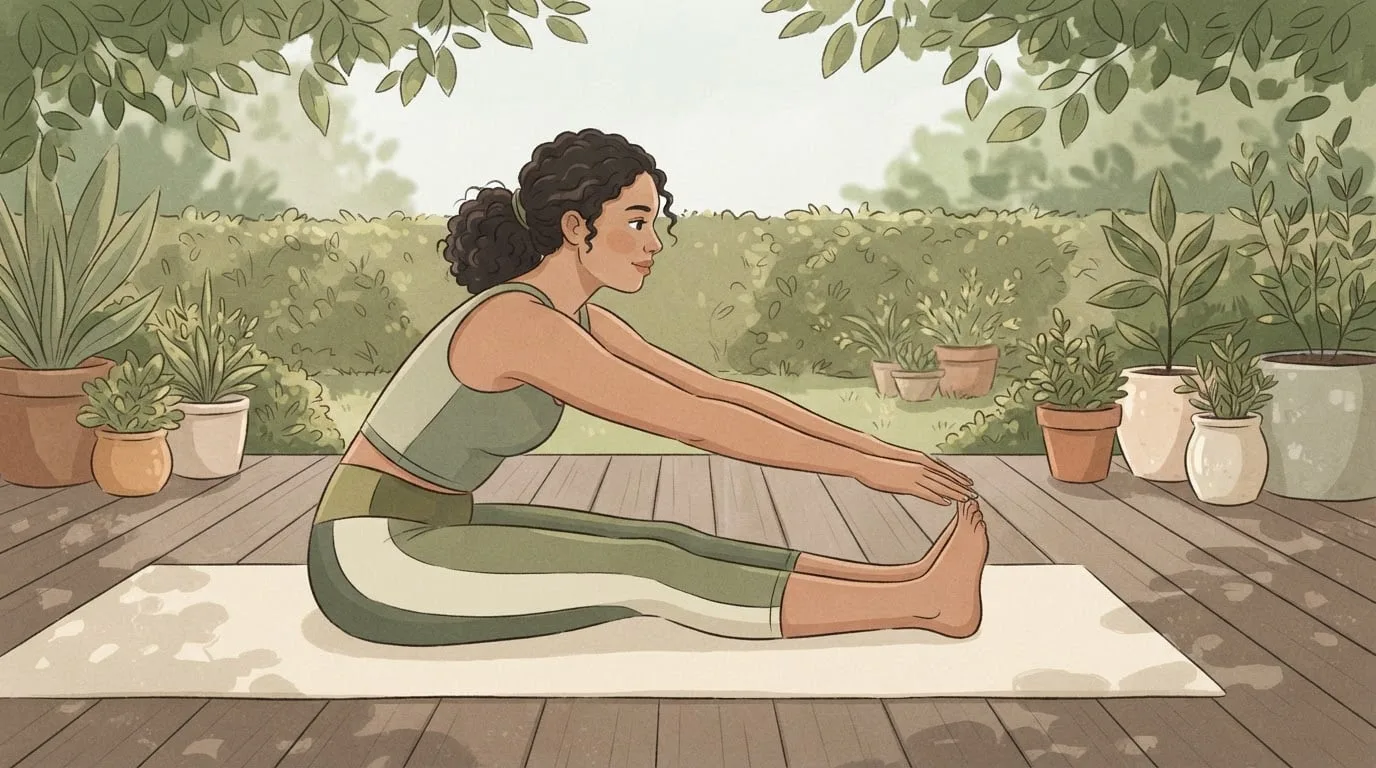
Flexibility is the range of motion around a joint: how far you can move it before your muscles, tendons or the joint itself stop you. It's specific to each joint. You can have loose hips and tight shoulders, so one toe-touch test doesn't tell you everything. You use it every time you reach a high shelf, check your blind spot or pull on a sock while standing.
For a long time flexibility had the thinnest health evidence of the five. A 2024 cohort study filled some of that gap. Araújo and colleagues (2024) scored 3,139 adults aged 46 to 65 on 20 movements across seven joints, then followed them for an average of 12.9 years. Women were about 35% more flexible than men. After adjusting for age, body mass index and health status, the least flexible men had 1.87 times the risk of dying of the most flexible men. For women the gap was larger, 4.78 times, though that estimate is less precise because fewer women died.
It's an association, and the authors say future studies need to test whether stretching itself adds years. Still, a body that moves well makes the other four components easier to train.
How to train it
The ACSM recommends flexibility exercises for each major muscle and tendon group on at least 2 days a week, with about 60 seconds of total stretching per exercise. You can split that into two 30-second holds. Our guide on how to become more flexible covers the weekly dose and which kind of stretching to use when.
5. Body Composition
Body composition is what your body weight is made of: fat mass on one side, and fat-free mass (muscle, bone, organs and water) on the other. Two people can weigh the same and stand the same height with very different compositions. That's why the bathroom scale and BMI miss so much. BMI can't tell 10 kg of muscle from 10 kg of fat.
Where fat sits matters as much as how much there is. Fat around the waist carries more risk for the heart and metabolism, and a simple ratio captures it. Ashwell and colleagues (2012) pooled 31 papers covering more than 300,000 adults. Waist-to-height ratio picked out high blood pressure, type 2 diabetes, unhealthy cholesterol and heart disease better than waist size or BMI did, in men and women. A common screening cut-off is 0.5, which means keeping your waist measurement under half your height.
Body composition is the one component you don't train directly. It shifts as a result of the other four and of how you eat. Strength training helps more than most people expect. In a meta-analysis of 58 studies, Wewege and colleagues (2022) found that full-body resistance training lowered body fat by about 1.46 percentage points compared with no exercise. It also reduced visceral fat, the deep fat around the organs.
For typical ranges by age and sex, see our guide to a healthy body fat percentage.
The 6 Skill-Related Components of Fitness
The second group in that split, the skill-related components of fitness, covers six abilities. They decide how well you perform in sport and how quickly you catch yourself when you trip. Add them to the five health-related components and you get the "11 components of fitness" that many PE textbooks and exam boards teach.
- Agility: changing direction quickly while staying in control.
- Balance: keeping your body steady over its base, whether you're still or moving.
- Coordination: getting your senses and muscles to work together for smooth, accurate movement.
- Power: producing force fast, as in a jump or a throw.
- Reaction time: how quickly you respond to a signal, like a ball coming at you.
- Speed: covering a distance or finishing a movement in as little time as possible.
Lists of 7, 10 or 12 components shuffle the same items. Some merge muscular strength and endurance into one, and some drop reaction time or split speed in two.
Skill-related doesn't mean only for athletes. The ACSM recommends neuromotor exercise for balance, agility and coordination on 2 to 3 days a week, and balance work becomes more valuable with age, when one quick step can stop a fall.
What Are the Components of Fitness in Physical Education?
In physical education, the components of fitness are usually taught as the same two groups: five health-related and six skill-related. What schools actually test is narrower. In 2012 the Institute of Medicine reviewed which youth fitness tests are tied to health (Institute of Medicine, 2012).
Its committee recommended that schools measure three things:
- Body composition: height and weight, used to calculate BMI.
- Cardiorespiratory endurance: a progressive shuttle run, such as the 20-meter shuttle run.
- Musculoskeletal fitness: handgrip strength and the standing long jump.
Push-ups, curl-ups, timed runs and the sit-and-reach were listed as optional extras. They're valid and practical, but they hadn't yet been shown to relate to health in young people. On flexibility, the committee found too little evidence to recommend any health-related flexibility measure for youth.
"Musculoskeletal fitness" is the committee's umbrella for strength, muscular endurance and power together. If your PE class split them into separate components, it was describing the same muscles from different angles.
What Are the Two Main Types of Fitness?
The two main types of fitness are health-related fitness and skill-related fitness. Health-related fitness is the five components above, the ones tied to disease risk and daily function. Skill-related fitness is the six athletic abilities. Some coaches split fitness another way, into aerobic fitness (long, steady efforts fueled by oxygen) and anaerobic fitness (short, hard bursts). That second split describes your energy systems rather than fitness as a whole.
How to Improve Your Physical Fitness Across All 5 Components
Most people train the component they already like. Runners run, lifters lift and yoga fans stretch. It's what happens when nobody hands you a plan that covers everything. Here's a week that trains all five with bodyweight, a pair of dumbbells and about 4 hours of total time.
| Day | Session | Main components |
|---|---|---|
| Day 1 | Strength A: goblet squats, push-ups, one-arm dumbbell rows and dumbbell Romanian deadlifts, 3 sets of 6 to 12 reps, then 10 minutes of stretching | Strength, flexibility |
| Day 2 | 40 to 50 minutes of brisk walking, cycling or easy jogging | Cardio endurance |
| Day 3 | Endurance circuit: bodyweight squats, push-ups, reverse lunges and glute bridges for 15 to 20 reps each, plus a wall sit and a plank held 30 to 60 seconds, 2 to 3 rounds | Muscular endurance |
| Day 4 | 40 to 50 minutes of cardio, then 5 minutes of single-leg balance work | Cardio endurance, balance |
| Day 5 | Strength B: split squats, dumbbell floor presses, bent-over rows, step-ups and side planks, then 10 minutes of stretching | Strength, flexibility |
| Day 6 | 45 to 60 minutes of easy cardio you enjoy, like a hike, a long walk or a bike ride | Cardio endurance |
| Day 7 | Rest, or 20 to 30 minutes of yoga or mobility work | Flexibility, recovery |
That adds up to roughly 150 minutes of moderate cardio, three days of muscle work and three short stretching sessions, which lines up with both the WHO and ACSM numbers. Body composition doesn't get its own day. It moves as the other four improve and as your eating habits change.
New to training? Start with half the sets and the shorter cardio times, and add a little each week. When you can hit the top of a rep range on every set, add weight, add reps or pick a harder variation. For strength days that usually means a heavier dumbbell, and for endurance days it means more reps or a longer hold. Retest every 6 to 8 weeks with the same tests so you can see which component is lagging.
What This Means for You
You don't need to be great at all five. You just need to stop skipping the ones that don't come naturally. If you can run for an hour but haven't lifted anything heavier than groceries in years, two short strength sessions a week will change more than another long run. If you lift but can't reach past your knees, ten minutes of stretching after each session is the cheapest upgrade you'll ever make.
The hard part isn't knowing the list. It's showing up for the parts you'd rather avoid, week after week, until they stop feeling like a chore. That's a planning problem, and plans can be fixed.
FitCraft's AI personal trainer app builds you a personalized plan from the same building blocks: dumbbell and bodyweight strength workouts, cardio, yoga and mobility sessions. A 3D AI coach demonstrates each exercise and says your name as you train, and your streaks and calendar show which days you showed up. As one user, Katie, put it: "I've tried everything. This is the first time I've stuck with something past two weeks."

Frequently Asked Questions
What are the 5 main components of health?
There's no single official list of the 5 main components of health. The World Health Organization defines health as complete physical, mental and social well-being, and many health courses add emotional and spiritual (or intellectual) health to make five. The 5 components of fitness all sit inside physical health.
What does "fitness" mean in one word?
Capacity. Fitness is your body's capacity to do physical work, and it's measured across five health-related components: cardio endurance, muscular strength, muscular endurance, flexibility and body composition.
Which component of fitness is most important?
Cardiorespiratory endurance has the strongest link to a longer life: in a meta-analysis of 102,980 adults, each 1-MET gain in aerobic fitness was linked with a 13% lower risk of death. Muscular strength comes next, with grip strength predicting mortality across 17 countries. The best plan still trains all five, because each one makes the others easier to build.
Is BMI one of the components of fitness?
No. BMI is a quick estimate of body size from height and weight, and it's often used as a rough stand-in for body composition. It can't tell fat from muscle, so a waist-to-height ratio or a body fat estimate tells you more about the body composition component.
How can I test the 5 components of fitness at home?
Use a 3-minute step test for cardio endurance, a push-up test and a plank hold for muscular endurance, a sit-and-reach for flexibility and your waist-to-height ratio for body composition. Muscular strength is harder to test at home, so the heaviest dumbbell you can lift for 5 clean reps is a practical stand-in. Retest every 6 to 8 weeks.
How often should you train each component of fitness?
Most adults need 150 to 300 minutes of moderate cardio a week, strength training for every major muscle group on 2 to 3 days and stretching on at least 2 days, according to the WHO and the American College of Sports Medicine. Muscular endurance comes from the same muscle work done with lighter loads and more reps, and body composition improves as a result of all of it.