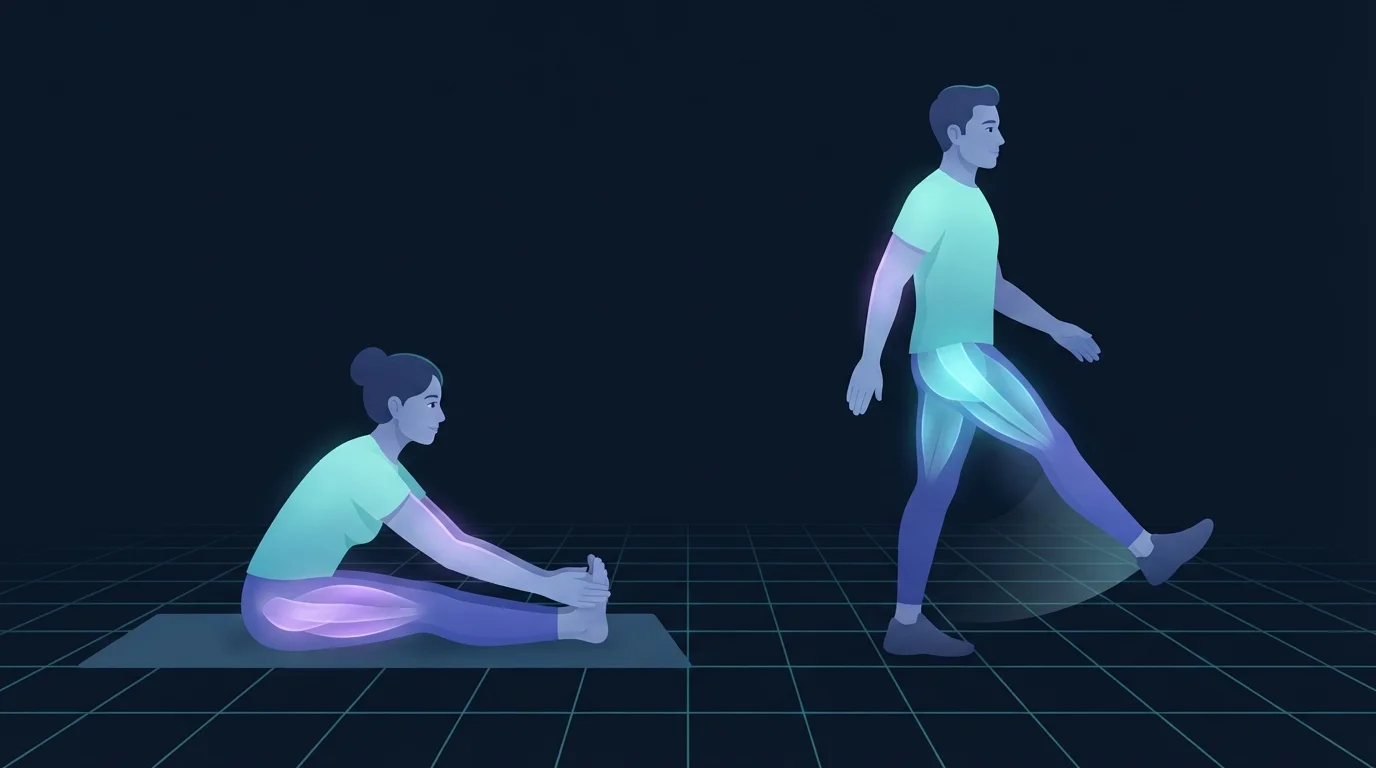
You can't sit on the floor with your legs straight and your back tall. Reaching the top shelf involves a small shrug and a compromise. Getting off the floor is a three-step process you'd rather nobody watched.
And every time you decide to fix it, the plan dies the same way. Twenty minutes of stretching on a Sunday, nothing measurable by the following Sunday, and the quiet conclusion that some people are just built bendy and you aren't one of them.
Here's what's actually going on. Flexibility is one of the most dose-sensitive qualities in the body, and the effective dose is small, frequent and boring. Most people do a large amount of it once and then nothing for eleven days, which is close to the worst possible way to spend the same total minutes. Fix the distribution and the same effort starts working.
What Changes When You Stretch, and What Doesn't
Two things move when you stretch regularly, and neither one is the thing most people picture.
Ingram and colleagues (2025), in a separate meta-analysis in Sports Medicine looking specifically at mechanisms, separated the acute response from the chronic one. After a single session, muscle stiffness dropped (a small to moderate effect, g = 0.42) while the amount of stretch people were willing to tolerate didn't change at all. After weeks of training, both moved: stiffness fell (g = 0.37) and maximum tolerable passive resistive torque rose (g = 0.74). That second number is the bigger one, and it's a measure of tolerance rather than tissue.
The finding people usually get wrong is the third one. Fascicle length, the actual length of the muscle's contractile units, didn't change in either case. Static stretching on its own doesn't appear to make muscles longer.
So what are you training? Roughly two thirds a nervous system that's learning a position isn't dangerous, and one third a muscle that's becoming less stiff at the same length. That explains two things you've probably noticed: why the same stretch feels easier in the evening than the morning, and why range disappears when you're stressed, cold or underslept. You're negotiating with a protective system, and protective systems respond to repeated, unthreatening exposure rather than to force.
What Poor Flexibility Actually Costs You Day to Day
Being honest here matters, because the claims made for flexibility training are frequently bigger than the evidence.
What's well supported: stiff joints change how you complete tasks. Limited ankle range makes a squat shallower and pushes your chest forward. Limited hip extension shortens your stride. Limited overhead shoulder range turns reaching into a lean. Limited hip and hamstring range makes getting down to the floor and back up a strategy problem rather than a movement. Every one of those is a compensation, and compensations cost energy and load other tissue.
What's less supported: that stretching then fixes the downstream outcomes. Stathokostas and colleagues (2012), reviewing 22 flexibility interventions in adults over 65 for the Journal of Aging Research, found flexibility training reliably improved range of motion but that the evidence linking those gains to better daily function was conflicting. Range improved. Whether that turned into meaningfully easier daily tasks was not consistently shown.
The useful takeaway isn't to skip it. It's to target it. Train the joints that are actually limiting a task you care about, rather than doing a generic full-body stretch routine and expecting your life to change. If your squat stops at parallel, our guide to ankle mobility exercises has a two-minute wall test that tells you whether the ankle is the culprit.
The Four Ways to Train for Flexibility
All four raise range. They differ mostly in where they belong in your week.
| Method | What it is | Best used |
|---|---|---|
| Static holds | Hold near end range, relaxed, about 30 seconds | After training, or in a standalone session |
| Dynamic | Slow controlled reps in and out of range, 8-10 per side | Warm-ups, before anything fast or heavy |
| Contract-relax (PNF) | Push against resistance 5 sec, relax, move deeper | Standalone sessions, when you have a wall or partner |
| Full-range strength | Lifting through the deepest position you can control | Your existing training, no extra time cost |
For the immediate effect they're interchangeable. Behm and colleagues (2023), meta-analysing acute stretching studies in Sports Medicine Open, concluded that all forms of stretching produce similar short-term range increases despite wildly different protocols.
For long-term change there's a small separation. Konrad and colleagues (2024), in the Journal of Sport and Health Science, found that stretch training lasting two weeks or more chronically increased joint range, and that static and PNF protocols outperformed dynamic and ballistic ones for those lasting gains. Dynamic work still earns its place in the warm-up. It's just not the tool that changes your baseline. Our review of static versus dynamic stretching covers the performance and soreness evidence behind that split.
How Much Stretching You Need Each Week
This is the section that changes outcomes, so here are three numbers worth remembering.
Thirty seconds per hold. Longer holds don't add much, and the classic dose-response work on this found 30 seconds matched 60 and beat 15.
Four minutes per muscle group per session, ten minutes per week. Ingram and colleagues (2025), in a meta-regression of 189 studies and 6,654 adults published in Sports Medicine, found chronic static stretching improved flexibility with a large pooled effect and that the returns flattened near four minutes per session and roughly ten minutes per week per muscle group. Past that you're spending time for very little.
Five days a week beats two long ones. Thomas and colleagues (2018), reviewing 23 studies in the International Journal of Sports Medicine, found weekly frequency was positively associated with range gains and recommended stretching at least five days a week, with a minimum of about five minutes per week per muscle group, using static protocols.
Put together, the whole prescription for one stiff area is: four holds of 30 seconds, most days, on warm tissue. Two minutes. That's the entire intervention people have been describing as "not working for me".
Find out what's really holding you back
FitCraft, our mobile fitness app, pairs you with an AI coach who builds you a personalized plan around your goals, schedule, and fitness level. Every FitCraft program is designed by Domenic Angelino, MPH (Brown University) and NSCA-CSCS, with research published in the Journal of Strength and Conditioning Research and Medicine & Science in Sports & Exercise.
Take the Free Assessment Free • 2 minutes • No credit card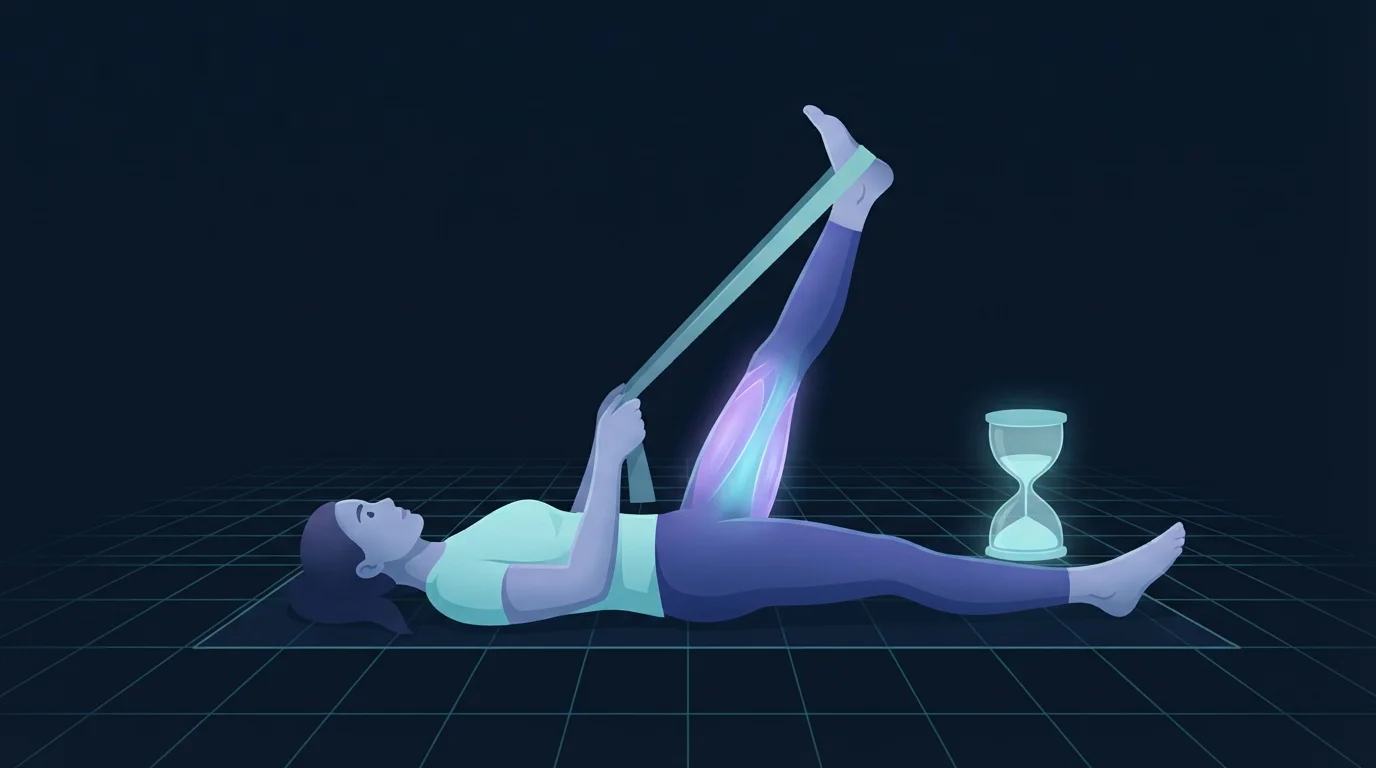
How to Get Flexible Fast, and What "Fast" Actually Means
There are two honest answers, on two very different timescales.
Within the hour: you can add real range today. Takeuchi, Akizuki and Nakamura (2021), in PLOS ONE, measured knee extension range after hamstring stretching at two intensities and found the increase was still present 20 minutes later in both conditions. That's why a long warm-up before a yoga class works, and why the depth you hit at the end of a session isn't the depth you'll have tomorrow morning.
Within weeks: the tissue responds to volume more than most people realise, and the extreme end of the literature makes that vivid. Warneke and colleagues (2022), in Frontiers in Physiology, had 55 active adults stretch one calf for a full hour a day, six weeks straight, using a stretching orthosis. Range of motion rose 13 to 27 percent, muscle thickness rose 15 percent, and maximal strength rose 14 to 22 percent in the stretched leg.
Nobody should stretch for an hour a day. The point of that study is the ceiling it demonstrates: flexibility is not a fixed trait, and the limiting factor for most people is accumulated exposure rather than genetics. The fastest sensible version is the same dose spread daily, always on warm tissue, always aimed at the two or three joints that actually restrict you rather than a whole-body routine you'll abandon in a fortnight.
How Long It Takes to Become More Flexible
| Timeframe | What changes |
|---|---|
| One session | Real range increase that fades within roughly an hour |
| 2 weeks | The floor for lasting change; morning stiffness starts easing |
| 4 weeks | Everyday positions feel different: floor sitting, reaching, squatting |
| 8-12 weeks | Most of the available gain for that dose is banked |
| After stopping | Gains fade over weeks, faster than they were built |
The two-week floor comes from Konrad and colleagues (2024), whose meta-analysis found stretch training needs to run at least that long before joint range changes chronically. Week four is where most people first notice it outside the stretch itself, which is unhelpfully about two weeks after the average person quits.
Strength Training for Flexibility
The most underused route to more range is one you might already be doing badly.
Alizadeh and colleagues (2023), meta-analysing the resistance training literature in Sports Medicine, found resistance training improves range of motion, with full-range work producing gains broadly comparable to stretching. Afonso and colleagues (2021) pooled 11 randomised trials with 452 participants in Healthcare and reached the same conclusion: strength training and stretching produced similar improvements in range.
Three practical implications:
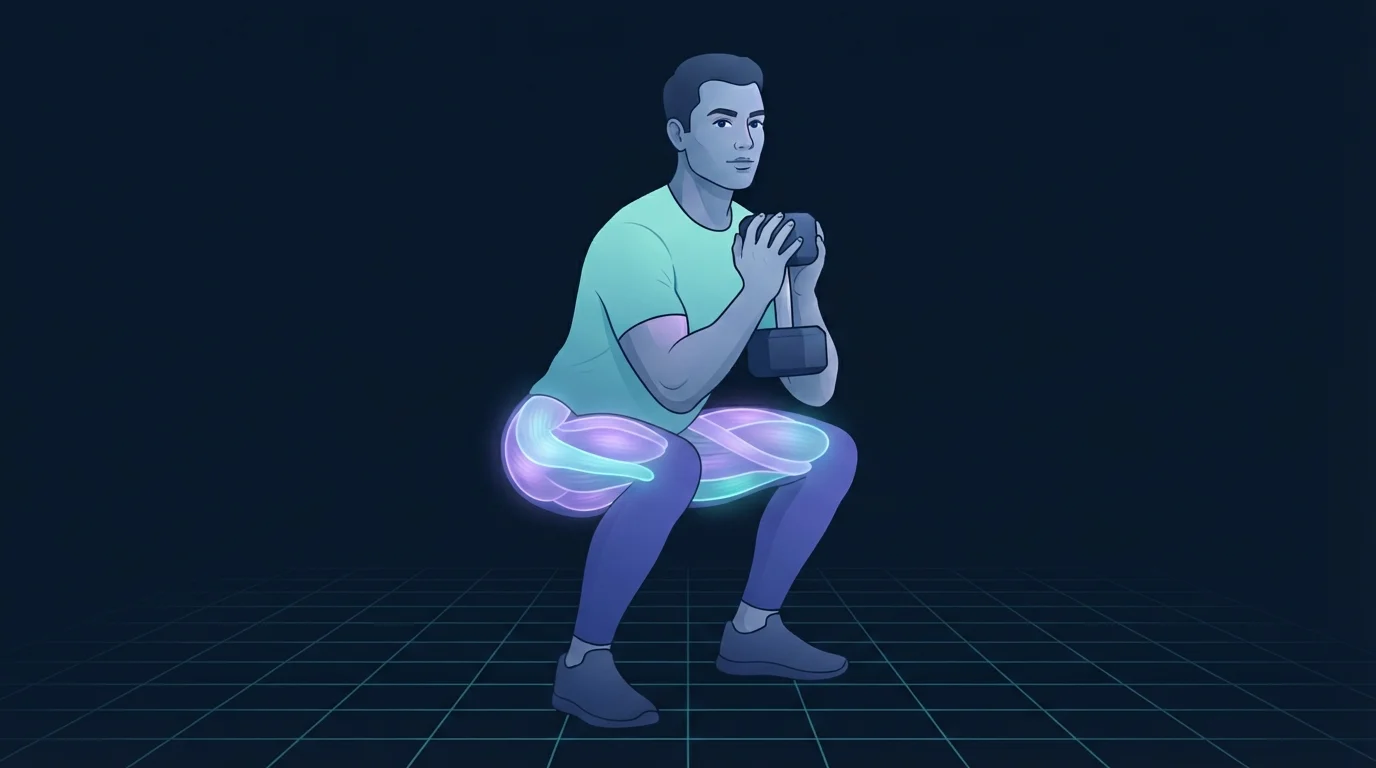
- Depth is the variable. A goblet squat to a full depth you control does more for hip and ankle range than a partial squat plus a stretch afterwards.
- Slow lowering counts. Eccentric training, where you take three seconds to lower into the hardest position, is the version with the most flexibility evidence behind it.
- It's free time. Range built through lifting costs no extra minutes, and it comes with strength in that position, which passive holds don't give you.
The practical shortlist: deep goblet squats, Romanian deadlifts lowered slowly, split squats with the back knee dropping below the front foot's level, and overhead pressing through a full range. If your overhead range is the problem rather than your hips, our guide to shoulder mobility exercises has a floor test that identifies which link is short.
Who Gains Fastest: Starting Point, Sex and Age
Three moderators show up repeatedly, and two of them are good news if you feel behind.
The least flexible gain the most. Ingram and colleagues (2025) found baseline flexibility moderated the response, with the stiffest participants improving most. Starting from "I can't touch my knees" is a better position than it feels like.
Women gain more range from the same training. Konrad and colleagues (2024) found females showed greater range improvements than males after long-term stretch training. Men typically start stiffer and progress slower, which is a reason to train more frequently rather than to give up.
Age slows it but doesn't stop it. Stathokostas and colleagues (2012) found flexibility interventions improved range in adults over 65 across a large majority of the studies they reviewed. The range responds at any age. The honest caveat is the one from earlier: improved range didn't reliably translate into measurably better daily function in those trials.
A Weekly Routine You'll Actually Keep
Pick two or three rows, not all five. A routine you complete four times a week beats a complete one you do twice a month, and this is the single decision that determines whether you get more flexible this year.
| Area | Position | Weekly dose |
|---|---|---|
| Hamstrings | Supine strap stretch, one leg at a time | 4 x 30 sec per side, 4 days |
| Hip flexors | Half-kneeling lunge, tailbone tucked | 3 x 30 sec per side, 4 days |
| Inner thighs | Butterfly or seated straddle | 3 x 45 sec, 3 days |
| Shoulders and chest | Doorway stretch at two arm heights | 3 x 30 sec per side, 3 days |
| Ankles | Knee-to-wall, loaded through the range | 10 slow reps per side, 4 days |
Two rules make it stick. Do it on warm tissue, which means after a walk, after training, or after a shower rather than first thing out of bed. And attach it to something you already do daily, because the failure mode for a two-minute habit is never effort, it's forgetting. If you want the sessions scheduled alongside your training rather than designed by you, a no-equipment workout app can drop the mobility work into the same week as the lifting.
Looking for one measurable goal to aim the work at? A toe touch is the cleanest first target, and our guide to how to touch your toes has a home test and a four-week plan. If you want something more ambitious, how to do the splits turns the same dosing principles into a front and middle split progression with realistic timelines.
What Stretching Will Not Do
Three claims to retire, because believing them is how people end up disappointed enough to quit.
It won't prevent injuries on its own. Lauersen, Bertelsen and Andersen (2014), meta-analysing randomised controlled trials of injury prevention in the British Journal of Sports Medicine, found favourable estimates for every intervention category except stretching. Strength training was the standout. Stretch because you want range, and lift because you want fewer injuries.
It won't fix posture by itself. A short muscle is rarely the whole story of a rounded upper back or a tipped pelvis. Position is a habit and a strength question as much as a length question.
It shouldn't go right before heavy or explosive work. Behm and colleagues (2016), in Applied Physiology, Nutrition, and Metabolism, found static holds of 60 seconds or longer per muscle group produced a mean performance decrement around 4.6 percent, against roughly 1.1 percent for shorter holds inside a full warm-up. Long holds go after the session.
The Bottom Line
Becoming more flexible is a frequency problem, not a willpower problem. Thirty-second holds, about four of them per area, most days of the week, on warm tissue, aimed at the two or three joints that actually limit something you care about. Add full-range lifting and you're running both levers at once.
Two weeks before anything holds. Four weeks before you notice it in ordinary life. And if you're currently the stiffest person you know, the research says you're the one with the most to gain.
Frequently Asked Questions
How can I become flexible if I'm not flexible at all?
Start with supported versions of three positions rather than four minutes on the floor: a seated hamstring stretch with a strap, a half-kneeling hip flexor stretch, and a doorway chest stretch. Two minutes per position, three days a week, after a short walk. Being very inflexible is the best starting point statistically. Ingram and colleagues (2025) found baseline flexibility moderated the response and the least flexible participants gained the most range.
How long does it take to become flexible?
Range improves within a single session but returns to baseline within about an hour. Lasting change needs roughly two weeks of repeated sessions before it holds, which is where Konrad and colleagues (2024) put the floor, and most trials show clear gains by four to eight weeks. Expect to notice everyday positions feeling easier around week four, several weeks before the measured number looks impressive.
How often should I stretch to improve flexibility?
Five days a week is where the evidence points if you want the fastest progress. Thomas and colleagues (2018) found weekly frequency was positively associated with range gains and that at least five minutes per week per muscle group was the useful minimum. Ingram and colleagues (2025) found returns flatten near four minutes per session and about ten minutes per week per muscle group, so more than that buys very little.
Can you get flexible fast?
Faster than most people assume, but not in a weekend. Warneke and colleagues (2022) had participants stretch their calves for an hour a day for six weeks and measured range increases of 13 to 27 percent, which shows the tissue responds to volume. Nobody needs to do that. Short daily doses on warm tissue, spread across the joints that actually limit you, produce most of the available gain in about eight weeks.
Does strength training improve flexibility?
Yes, and by about as much as stretching does. Alizadeh and colleagues (2023) meta-analysed the resistance training literature in Sports Medicine and found training through a full range of motion improved flexibility, while Afonso and colleagues (2021) pooled 11 randomised trials with 452 participants and found strength training and stretching produced comparable range gains. Deep squats, full-range lunges and controlled hinges count as flexibility work.
Should I stretch before or after a workout?
Use dynamic movement before and save long holds for after or for a separate session. Behm and colleagues (2016) found static holds of 60 seconds or more per muscle group produced an average performance drop of about 4.6 percent, against roughly 1.1 percent for shorter holds. If your schedule only allows one slot, take it whenever you will actually use it, because the weekly total matters far more than the timing.