
Somebody on Reddit asked the question most beginners have: is it better to do 10 minutes of yoga every day, or longer sessions three times a week? The replies split down the middle, and both camps were partly right. The research doesn't crown a single schedule. It does show a clear range that works, and it shows the number changes with what you want yoga to do for you.
That's why "how often do yoga" questions get vague answers. Yoga for a stiff back, yoga for anxious evenings and yoga for stronger legs are three different prescriptions. Below you'll find how often to do yoga for each goal, the trial that sits behind each number, whether daily practice is safe, whether 20 minutes is enough, how to start as a beginner and how to fit yoga around strength training without one getting in the way of the other.
How Often Should You Do Yoga? The Answer by Goal
Start with this table. Each row comes from a trial or review discussed further down the page.
| Your goal | How often | What the evidence shows |
|---|---|---|
| Flexibility and balance | 2 to 3 sessions a week, plus short daily stretching if you can | Ten weekly 90-minute beginner classes improved balance, flexibility and core strength |
| Stress, anxiety and mood | 3 to 5 sessions a week, short ones count | More sessions per week went with larger drops in depressive symptoms |
| Low back pain | 1 to 2 classes a week, plus 15 to 30 minutes at home on other days | One weekly class worked as well as two over 12 weeks |
| Strength | 2 yoga sessions plus 2 strength sessions a week | Twice-weekly hatha raised strength in untrained adults over 8 weeks |
| Weight loss | 2 to 3 longer sessions a week, alongside walking and diet changes | Yoga alone doesn't move weight much; with diet guidance, waists shrank |
| General health | Most days, any length | How often people practiced at home predicted health better than years of practice |
How Many Times a Week Should I Do Yoga to See Results?
Two to three times a week, for at least 8 to 12 weeks, is where most yoga trials found results. Very few tested more than that, and some found once a week was enough when people also practiced at home.
The clearest test of dose comes from back pain. Saper and colleagues (2013) randomized 95 adults with moderate to severe chronic low back pain to either one or two 75-minute yoga classes a week for 12 weeks. Both groups improved, and they improved by the same amount. Pain fell 2.1 points on an 11-point scale with one class and 2.4 points with two, and back-related function improved 5.1 and 4.9 points on a 23-point scale. The detail most write-ups miss is what happened between classes. Teachers asked everyone to practice for 30 minutes on non-class days, and both groups logged about 93 to 97 minutes of home practice a week. The once-a-week group was really doing yoga on several days a week. Only one of those days was in a studio.
A national survey points the same way. Ross and colleagues (2012) asked 1,045 practitioners from 15 US Iyengar yoga studios about their practice and their health. How often people practiced at home predicted better well-being, mindfulness, sleep, less fatigue and a lower BMI, and it predicted health better than either years of practice or how often they went to class. It's a survey, so it can't prove cause, but it fits the trial data. Frequency at home matters more than attendance in a studio.
How Often to Do Yoga for Flexibility and Balance
For flexibility and balance, two or three sessions a week is a solid target, and even one weekly class gets a beginner moving. Csala and colleagues (2021) tested exactly that question in Frontiers in Public Health. They put 49 healthy young women with no yoga experience through ten weekly 90-minute beginner hatha classes and compared them with 33 women who did nothing new. The yoga group improved on balance tests, a side-bend test and a sit-and-reach test, and held a plank longer. Their BMI, body fat, resting heart rate and heart rate variability didn't change, which the authors read as a sign that those outcomes need more frequent or more intense practice.
So a weekly class works for a start. If range of motion is your main goal, though, adding short sessions on other days pays off, because stretching research favors spreading the work across the week over cramming it into one long session. Our guide to how to become more flexible lays out that weekly stretching dose and how long real gains take. A practical version is one or two full classes a week plus 10 minutes of poses for your tightest areas on most other days.
How Often to Do Yoga for Back Pain
For chronic low back pain, one or two classes a week plus short home practice is the dose with the best evidence. Beyond the Saper dosing trial above, the larger trial is Sherman and colleagues (2011) in the Archives of Internal Medicine. They randomized 228 adults to 12 weekly 75-minute yoga classes, 12 weekly stretching classes or a self-care book, and asked the class groups to practice for 20 minutes on days without class. After 12 weeks, yoga beat the book for function and symptoms, and the function benefit was still there at 26 weeks. Yoga didn't beat the stretching classes, which suggests the regular movement matters more than the yoga label.
So for a sore back, aim for at least one guided session a week where someone can check your positions, and 15 to 30 minutes of gentle poses on most other days. If your back pain is the reason you're comparing practices, our guide to Pilates vs yoga covers how the back pain evidence compares between the two.
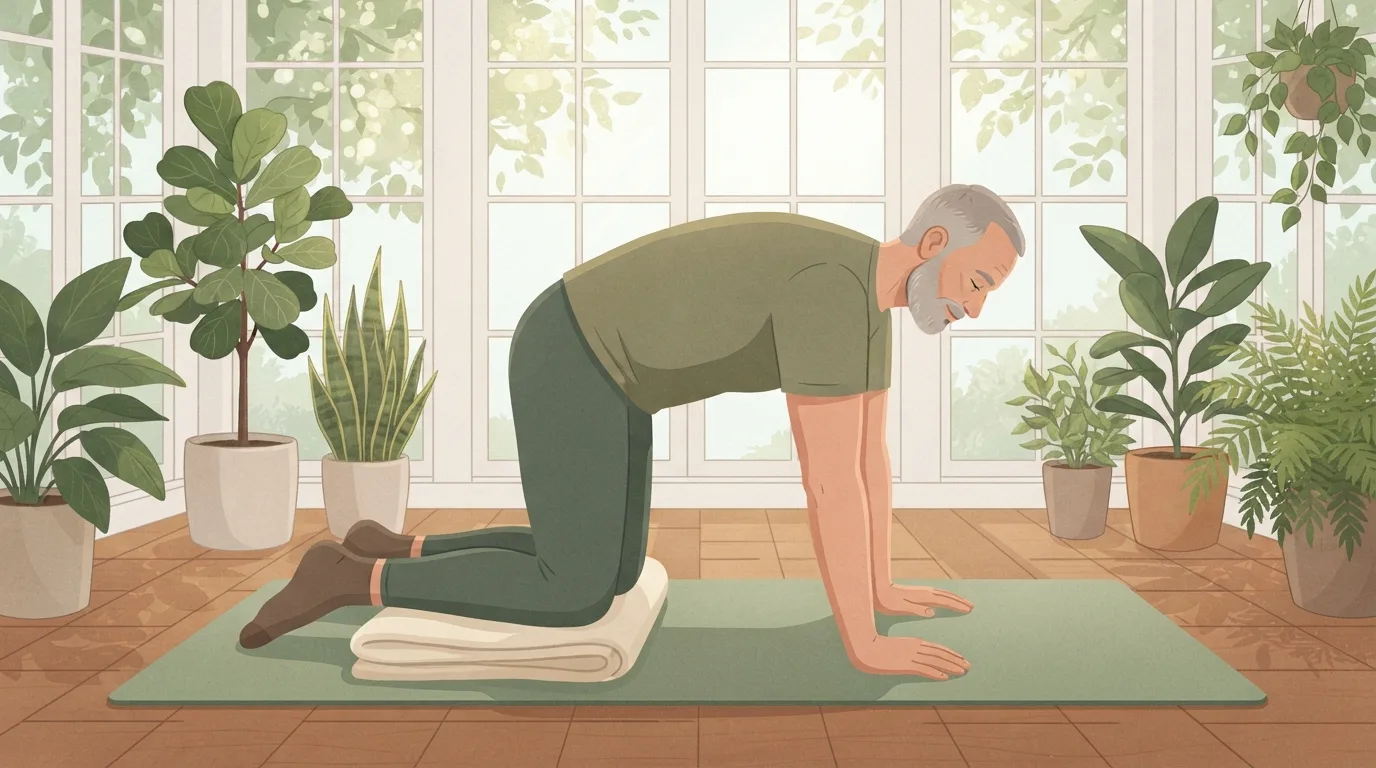
How Often to Do Yoga for Stress, Anxiety and Mood
This is the goal where frequency seems to matter most. Brinsley and colleagues (2021), in the British Journal of Sports Medicine, pooled 13 randomized trials of physically active yoga in 632 people with diagnosed mental health conditions, including depression, anxiety and post-traumatic stress. Yoga reduced depressive symptoms more than the comparison groups did. The more sessions per week a trial prescribed, the bigger the drop in symptoms.
The largest review of exercise for depression agrees that yoga belongs on the list. Noetel and colleagues (2024) analyzed 218 trials and 14,170 participants in the BMJ and found moderate reductions in depression for yoga (Hedges' g of minus 0.55 against active controls), close to walking or jogging and slightly ahead of strength training. Yoga and strength training were also the best-tolerated options, which matters when the goal is to keep going for months.
Some of the effect shows up in your body, not just on a questionnaire. Pascoe and colleagues (2017) pooled 42 studies that compared yoga postures with active control groups and found lower evening and waking cortisol, lower resting heart rate and lower ambulatory systolic blood pressure in the yoga groups. For stress, then, think in terms of many short sessions rather than one big one: 15 to 20 minutes on three to five days a week is a schedule most people can keep.
Knowing what to do is the easy part.
FitCraft, our mobile fitness app, pairs you with an AI coach who builds you a personalized plan around your goals, schedule, and fitness level. Every FitCraft program is designed by Domenic Angelino, MPH (Brown University) and NSCA-CSCS, with research published in the Journal of Strength and Conditioning Research and Medicine & Science in Sports & Exercise.
Take the Free Assessment Free • 2 minutes • No credit cardHow Often to Do Yoga for Strength
Twice a week is enough for yoga to build some strength if you're new to exercise. Tran and colleagues (2001) had ten untrained young adults attend at least two hatha classes a week for 8 weeks. Isokinetic strength rose 31% for elbow extension, 19% for elbow flexion and 28% for knee extension, and a knee-flexion endurance test improved 57%. That's a small study with no control group, so treat the numbers as a direction, not a promise.
The limit is load. Body weight is the only resistance in most yoga, and once a chair pose or a plank stops being hard, more sessions mostly add more of the same. That's why more yoga isn't the best route to more strength. The World Health Organization's 2020 guidelines (Bull and colleagues) recommend muscle-strengthening activity at moderate or greater intensity on two or more days a week. Two yoga sessions plus two sessions with dumbbells covers that and leaves your yoga time for what yoga does best.
How Often Should I Do Yoga for Weight Loss?
If weight loss is the goal, two or three longer sessions a week helps most when it sits inside a plan that also changes what you eat and how much you walk. On its own, yoga is a weak weight-loss tool. Lauche and colleagues (2016) reviewed 30 randomized trials with 2,173 participants and found no overall effect of yoga on body weight, BMI, body fat or waist size. In the trials limited to people with overweight or obesity, BMI did fall compared with usual care, but the authors warned the result wasn't robust.
The calorie math explains it. The 2024 Adult Compendium of Physical Activities rates hatha yoga at 2.3 METs, vinyasa at 2.7, hot yoga at 3.0 and power yoga at 4.0. For a 150 lb (68 kg) person, an hour comes to roughly 155 calories for hatha, 185 for vinyasa and 270 for power yoga. Csala's group measured about 195 calories across a whole 90-minute beginner class. That's a useful amount of movement, but it's well short of what a brisk walk of the same length burns.
Does yoga reduce belly fat?
It can help, when it comes with changes to how you eat. Cramer and colleagues (2016) randomized 60 women with abdominal obesity to 12 weeks of two 90-minute hatha classes a week or a waiting list. The yoga program also included advice on mostly plant-based, less processed food and mindful eating, without a calorie target. Waist size fell 3.8 cm more in the yoga group, and body weight fell 2.4 kg more. Participants attended about two-thirds of the classes, roughly 16 of 24. No exercise burns fat from one spot, so treat the waist result as a sign of overall fat loss from the whole package.
How to Combine Yoga With Strength Days
Yoga and strength training fit together well as long as you watch the order. Long, static holds right before lifting can sap a little strength for that session. Simic and colleagues (2013) pooled 104 studies and found pre-exercise static stretching cut maximal strength by about 5.4%, with the smallest losses when each stretch lasted 45 seconds or less. That doesn't make yoga bad for lifters. It means a gentle, flowing warm-up suits the start of a strength session, and the deep holds belong afterward or on another day.
Here's a week that keeps both, built for someone training at home with a pair of dumbbells.
| Day | Session | Yoga style |
|---|---|---|
| Monday | Dumbbell strength, about 40 minutes, then 10 minutes of yoga | Slow holds for the hips and shoulders after lifting |
| Tuesday | Yoga class or a 45-minute home flow | Vinyasa or hatha |
| Wednesday | Walk 30 minutes, then 15 minutes of yoga | Gentle or restorative |
| Thursday | Dumbbell strength, about 40 minutes | Short flowing warm-up only |
| Friday | Yoga, 30 to 45 minutes | Hatha, with balance poses |
| Saturday | Longer walk, hike or bike ride | None, or 10 minutes of stretching |
| Sunday | Rest | Optional 10 to 15 minutes of breathing and floor poses before bed |
That week gives you about 2.5 hours of yoga, two strength sessions that meet the guideline, and plenty of walking. Keep yoga's hardest balance and power work away from the morning of a heavy leg day, and keep your dumbbell sessions progressive: when a weight gets easy for all your sets, pick up the next pair.

Can You Do Yoga Every Day?
Yes. For most healthy adults, daily yoga is safe, as long as not every session is hard. Cramer and colleagues (2015) reviewed 94 randomized trials with 8,430 participants that reported side effects and found no difference in adverse events between yoga and usual care or other exercise. The authors concluded yoga appears as safe as usual care and exercise.
So what will happen if you do yoga every day? Most people feel looser and find the habit easier to keep, since a daily session takes no deciding, and the survey above linked more frequent home practice with better sleep. The risk comes from intensity, not frequency. Seven days of power yoga or deep backbends can leave wrists, shoulders and lower backs irritated. A sensible daily rhythm alternates harder flow or power sessions with gentle, restorative or breathing-focused ones, with no more than three or four demanding days a week.
Should you do yoga every day if you also lift or run? You can, as long as the yoga on your training days is the gentle kind, as in the sample week above.
Is 20 Minutes of Yoga Enough?
Twenty minutes is enough to feel a difference that day, and enough to build a habit, though not the full dose most trials used. In a lab study by Gothe and colleagues (2013), 30 female college students did a single 20-minute hatha session of standing, seated and lying poses ending with breathing and meditation. Straight afterward they were faster and more accurate on tests of working memory and of ignoring distractions than after 20 minutes of moderate-to-vigorous treadmill exercise or after no exercise.
For longer-term change, add it up across the week. Twenty minutes on six days is 120 minutes, which is close to two full classes. So back to the Reddit question: 10 minutes a day and three longer sessions both work, and the best schedule is often a mix of the two. A short daily practice keeps the habit alive. One or two longer sessions give you time for the poses and holds that a 10-minute routine skips.
How Often Should You Do Yoga as a Beginner?
As a beginner, start with two or three sessions a week and build toward four or five over two months. The early weeks are about learning the basic poses and finding out which ones your body argues with. Here's a simple progression.
- Weeks 1 and 2: two sessions of 20 to 30 minutes, beginner or gentle hatha. Learn downward dog, a low lunge, a forward fold, cat-cow, child's pose and a supported bridge.
- Weeks 3 and 4: three sessions of 30 minutes. Add a short balance sequence such as tree pose and warrior three with a hand on a wall.
- Weeks 5 to 8: three longer sessions of 45 to 60 minutes, plus one or two 10-minute practices on other days. Try one faster vinyasa class a week if you enjoy it.
- After 8 weeks: settle into the schedule from the goal table that matches what you want most.
Expect to feel looser within a week or two. Measurable changes in balance, flexibility and strength took 8 to 12 weeks in the trials above, which is right around the point many people drift away. Plan for that week before you reach it. Put your sessions on the calendar like appointments, and keep a 10-minute fallback routine for days when the full session won't happen.
What This Means for You
You don't need a perfect schedule. You need one you'll still be following in three months. For most goals, that's two or three real sessions a week plus a few short ones, with the mix tilted toward whatever you want most: more short sessions for stress, a guided class for your back, two strength days alongside yoga if you want to get stronger.
Missing a week isn't failure. It's the most common way yoga habits fade, and the fix is a smaller session, not a bigger promise. If structure is what you're missing, our comparison of the best workout apps for beginners looks at which ones plan your week for you. FitCraft is one of them. Its programs include yoga, mobility and dumbbell strength sessions, a 3D AI coach demonstrates each pose and exercise and says your name as you go, and a streak gives the short days a reason to happen. Tim, a FitCraft user, went from zero flexibility to completing a yoga program in 60 days. For yoga and strength in one plan at home, our guide to yoga and mobility at home shows how the pieces fit together.
Frequently Asked Questions
What is the best time to do yoga?
The best time to do yoga is the time you can repeat most weeks. Morning practice is easier to protect from a busy day, while evening practice suits slower, calmer styles that help you wind down. Avoid a hard, fast session right before bed, and many people prefer to wait a couple of hours after a big meal before twists or inversions.
How long is a yoga class?
Most studio yoga classes run 60 to 75 minutes, with 45-minute express classes and 90-minute workshops at either end. Many of the clinical trials on this page used 75- to 90-minute classes once or twice a week, but home sessions of 15 to 30 minutes on the days in between counted for a large share of the total practice.
What not to do after yoga?
Don't jump straight into heavy lifting or sprinting after a long session of deep holds, because long static stretches can briefly reduce strength. Get up slowly from the final resting pose, since standing too fast can make you light-headed, and drink some water after a hot yoga class. The popular rule against showering or eating right after yoga has no evidence behind it.
Is there a downside to yoga?
Yoga is about as safe as other exercise. A 2015 meta-analysis of 94 randomized trials with 8,430 participants found no difference in adverse events between yoga and usual care or other exercise. The real downsides are that it builds little strength once you're past the beginner stage, burns modest calories, and that forcing deep end-range poses can strain the neck, back, hips or wrists.
How many times a day can you do yoga?
Once a day is plenty for most people, and two short sessions also work well, such as 10 minutes of gentle stretching in the morning and 10 minutes of slow breathing and floor poses at night. Splitting your practice doesn't reduce the benefit, because what matters most is the weekly total and how many days you practice.
Should I do yoga before or after a workout?
Do a short, flowing sequence before a workout and save long holds for afterward or for a separate day. A 2013 meta-analysis of 104 studies found static stretching before exercise cut strength by about 5.4 percent, with the smallest losses when each hold lasted 45 seconds or less.