You found a thirty-day splits challenge, did it, and finished thirty days later about four inches off the floor. Then you found another one, and the same thing happened.
That's demoralising in a specific way, because the splits feel like a pass or fail. Either you're on the floor or you're not, and every plan you try seems to promise the floor by a date that keeps not happening.
Here's the reframe that changes the next six months. The splits are not one skill. They're two positions with different limiters, different timelines, and different ceilings, and the reason generic challenges fail is that they treat your front leg, your back leg and your hip socket as if they were the same tissue. Once you know which part of the position is actually holding you up, the work gets specific and the floor stops being a lottery.
What the Splits Actually Require
Range of motion at a joint is limited by whichever structure runs out first: muscle length, nervous system tolerance, or bone meeting bone. Which one stops you depends entirely on the position, and the two splits sit at opposite ends of that spectrum.
The front split: two tissues pulling in opposite directions
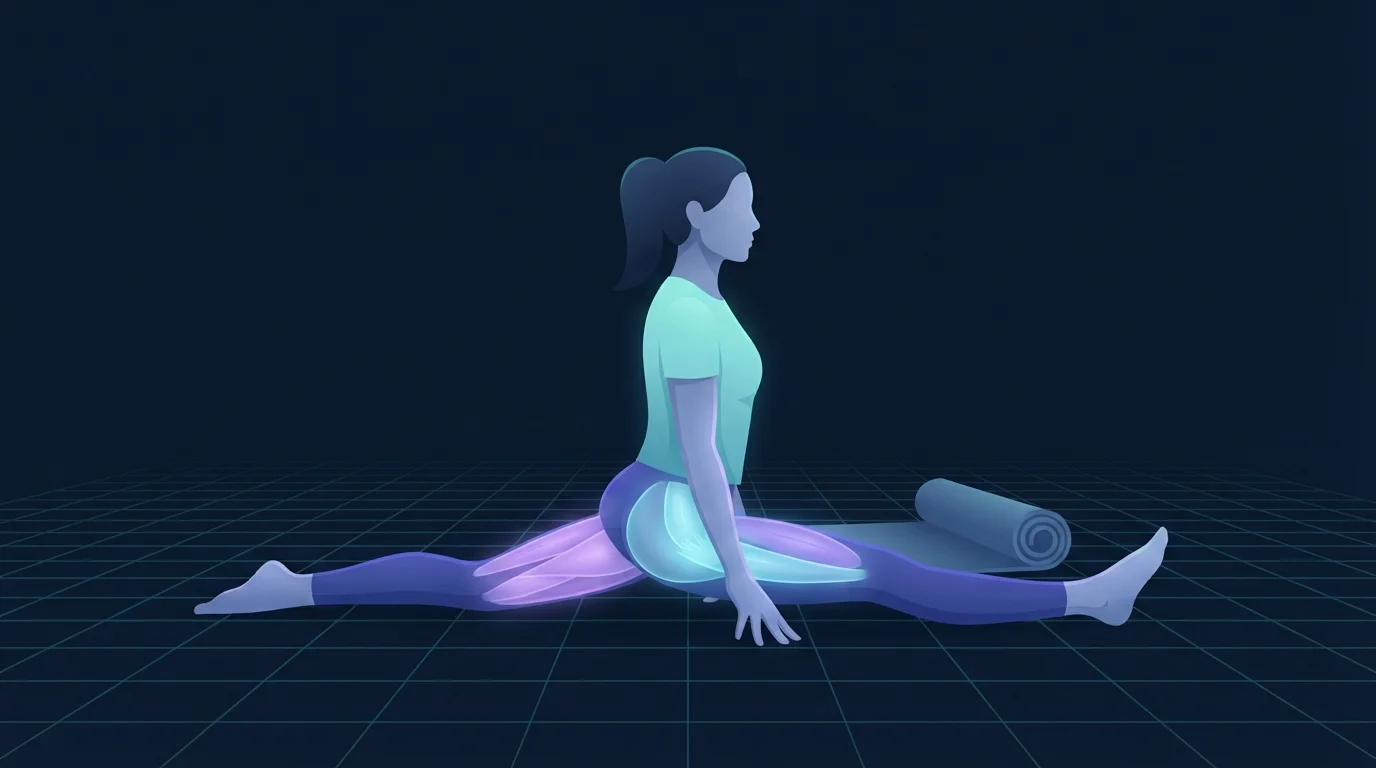
A front split asks the front leg's hamstrings to lengthen while the back leg's hip flexors lengthen in the other direction, with the pelvis staying square between them. Most people train the first half and ignore the second. That's why the classic stall pattern is a front leg flat on the floor, a back knee that won't straighten, and hips that have quietly rotated open to hide the gap.
The tell is easy. Sit in your deepest front split, then deliberately square your hips so both hip bones face forward. If you rise several inches off the floor when you do that, your back-leg hip flexors are the limiter, not your hamstrings. Our guide to tight hip flexors covers the testing and the loading work for that side in detail.
The middle split: adductors, and the shape of your hip
The middle split, also called the side split or straddle, is mostly an adductor problem. It's also the one common stretching goal where bone genuinely enters the conversation. Han and colleagues (2020), publishing in the Journal of Orthopaedic Research, measured range of motion in eight cadaveric hips across 17 different positions and then rebuilt each position in software using CT models to find where bone collided. In normal, healthy hips, bony impingement showed up during exactly two categories of movement: high abduction combined with flexion, and deep flexion combined with adduction and internal rotation. Everywhere else, soft tissue ran out first, and by wildly different amounts, from about 5 degrees of soft-tissue restriction in one position to 80 degrees in another.
High abduction is the middle split. So the honest version of this advice is that your inner thighs are the limiter right up until they aren't, and where that handover happens is set by the depth and angle of your hip socket rather than by how much you want it.
How to tell them apart: a soft-tissue limit feels like a broad, warm pull along the inner thigh that eases slightly as you hold it. A bony limit feels like a hard stop with a pinch at the front or side of the hip crease, it doesn't ease with time, and it appears at the same depth every session regardless of how warm you are.
Can You Do the Splits in One Day?
No. But the articles promising it are describing something real, so it's worth knowing what they're actually selling.
A single stretching session does increase range immediately. Behm and colleagues (2023), meta-analysing the acute stretching literature in Sports Medicine Open, found every technique tested produces a similar short-term range increase. Takeuchi, Akizuki and Nakamura (2021), in PLOS ONE, tracked how long that lasts and found the gain was still measurable 20 minutes after the session at both moderate and high stretching intensities.
So yes, you'll be closer to the floor at the end of a long session than you were at the start. That range is borrowed from a nervous system that stopped guarding, and it goes back where it came from within the hour. Lasting change is a different process on a different clock: Konrad and colleagues (2024), reviewing the chronic stretching literature in the Journal of Sport and Health Science, found that stretch training needs to run for at least two weeks before joint range changes in a way that sticks.
The practical danger of the one-day version is that people chase the borrowed range with force. Bouncing, or having a friend press on your back, is how adductor and hamstring strains happen in this exact goal, and a strained adductor sets your middle split back by months rather than days.
How to Do the Splits: The Front Split Progression
Five stages. You move up when you can hold the current stage for 30 seconds with square hips and normal breathing, not when a calendar says so. Most people spend two to four weeks per stage, and stages three and four take the longest.
| Stage | Position | Dose per side |
|---|---|---|
| 1 | Half-kneeling hip flexor stretch | 3 x 30 sec |
| 2 | Kneeling half split (front leg straight) | 3 x 30 sec |
| 3 | Supported low lunge, hands on books | 4 x 30 sec |
| 4 | Sliding front split with a cushion under the front thigh | 4 x 30 sec |
| 5 | Full front split, hips square | 2 x 60 sec |
Stage 1: half-kneeling hip flexor stretch
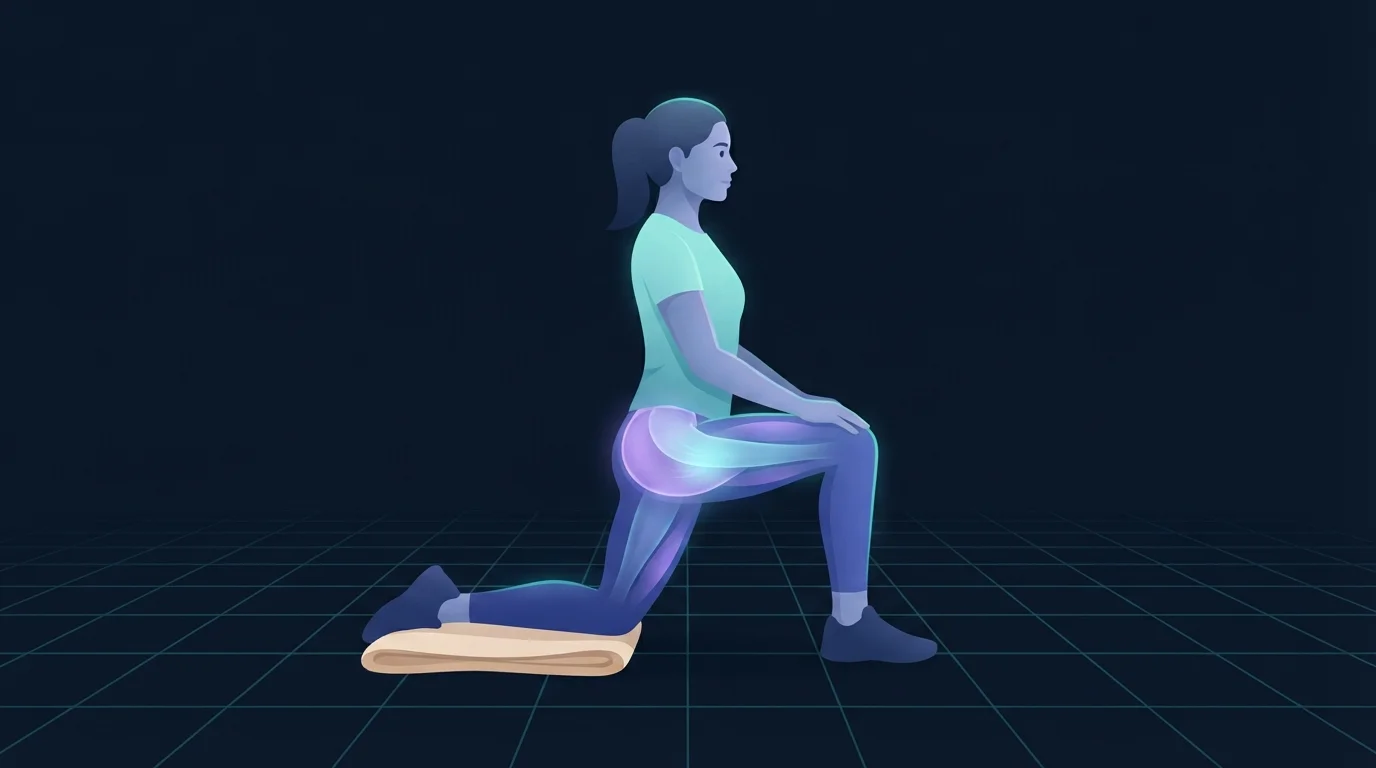
Kneel on one knee with the other foot planted in front, back knee on a folded towel. Now do the part everyone skips: squeeze the glute on the kneeling side and tuck your tailbone under so your lower back flattens. The stretch should move to the front of your back hip. If you feel it in your low back instead, you're arching rather than stretching. Stay tall and resist the urge to lean forward.
Stage 2: kneeling half split
From that same half-kneeling base, shift your hips backward and straighten the front leg with the heel on the floor and toes pulled up. Keep your chest lifted and hinge from the hip crease with a flat back. This is the front-leg half of the split, and the kneeling base makes it very hard to cheat by rounding your spine.
Stage 3: supported low lunge
Step one foot forward into a long lunge, drop the back knee, and put a hand on a stack of books or a low chair either side of your front foot. Let your hips sink while keeping them square. The support is the point: propping your upper body means your hip can relax into depth instead of your arms holding you in a plank.
Stage 4: sliding front split
From stage three, slide the front heel forward and the back knee backward, with a folded cushion under the front thigh so you're never at your true end range unsupported. Keep both hip bones pointing straight ahead. Lower the cushion height as the weeks pass. This is the stage where hip squareness quietly disappears, so check it every rep.
Stage 5: full front split
Front leg straight with the kneecap facing the ceiling, back leg straight behind with the kneecap facing the floor, both hip bones square, torso tall. Hold for 60 seconds twice per side, and treat every session as maintenance rather than a new depth attempt.
Find out what's really holding you back
FitCraft, our mobile fitness app, pairs you with an AI coach who builds you a personalized plan around your goals, schedule, and fitness level. Every FitCraft program is designed by Domenic Angelino, MPH (Brown University) and NSCA-CSCS, with research published in the Journal of Strength and Conditioning Research and Medicine & Science in Sports & Exercise.
Take the Free Assessment Free • 2 minutes • No credit card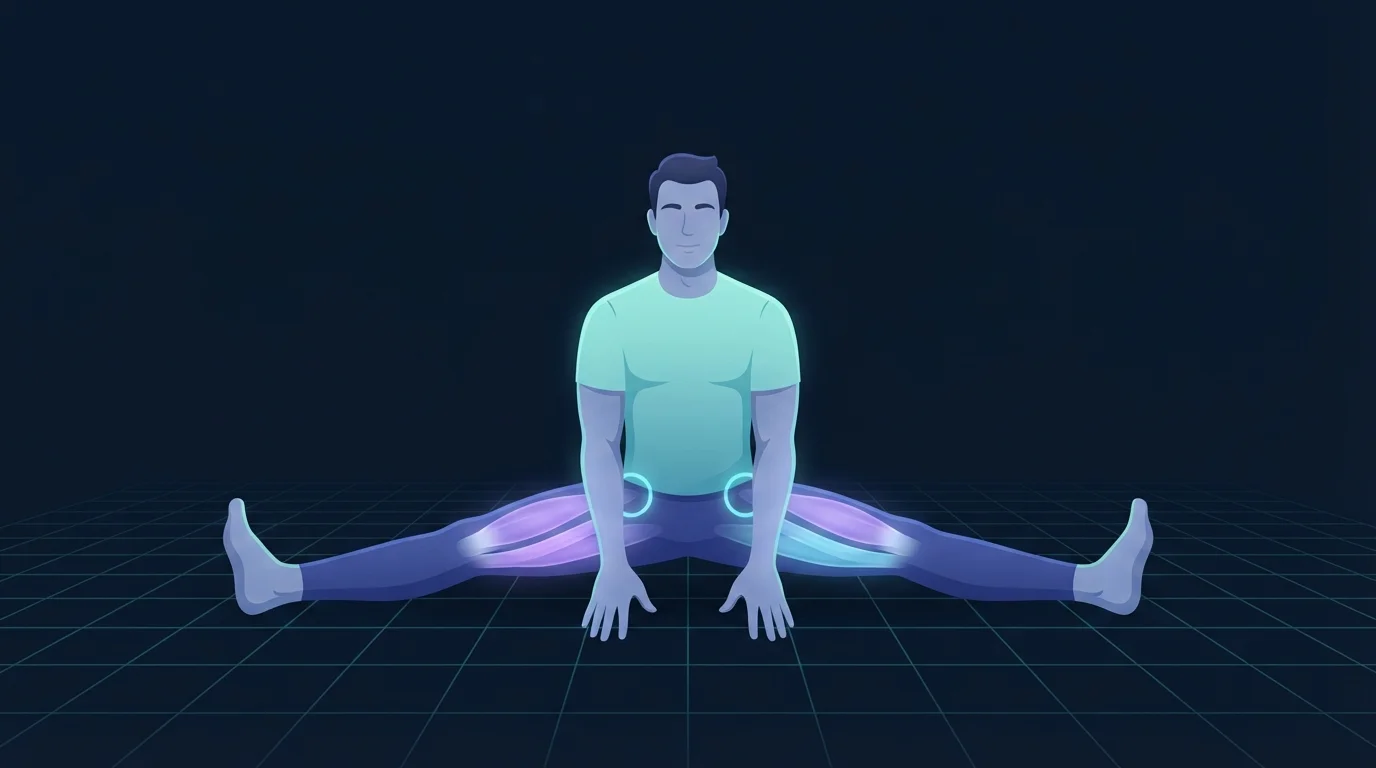
The Middle Splits Progression
Same rule: hold the stage until 30 seconds is quiet, then move on. The middle split rewards patience more than any other flexibility goal because the adductors are a large group crossing two joints, and because the ceiling is partly fixed.
| Stage | Position | Dose |
|---|---|---|
| 1 | Butterfly pose, soles together, knees relaxed | 3 x 45 sec |
| 2 | Wide-stance standing hinge, hands on a chair | 3 x 30 sec |
| 3 | Frog stretch, knees wide, shins parallel | 3 x 45 sec |
| 4 | Seated straddle with a tall back, hinging forward | 4 x 30 sec |
| 5 | Sliding middle split, feet on towels or against a wall | 3 x 45 sec |
One cue does more than the rest combined. In every straddle and frog position, keep your kneecaps pointing at the ceiling rather than rolling forward toward the floor. Rolling them forward turns the position into hip internal rotation, which makes you look wider without loading a single adductor fibre. If turning your knees up costs you a third of your depth, that third was never real.
Stage 5 is where the middle split diverges from the front split. Slide out on towels or a smooth floor, but keep your hands down and your weight supported, and stop at a firm pull rather than a hard stop. A blocked pinch at the front of the hip crease is the bony end point Han and colleagues described. Pushing into that doesn't make it move. It makes the joint angry.
Warm Up Before You Stretch, Not After
Five to ten minutes of easy movement before any split session. Brisk walking, marching in place, easy squats, leg swings, anything that raises your body temperature and gets blood into the tissue you're about to ask for range. Cold stretching is where most of the strain stories start.
There's a timing rule attached. Behm and colleagues (2016), in Applied Physiology, Nutrition, and Metabolism, found a clear dose response in acute performance: static holds of 60 seconds or more per muscle group cost about 4.6 percent in subsequent performance, while holds under 60 seconds cost roughly 1.1 percent. So if you lift, sprint or play a sport later the same day, put the long split holds after that session or in their own slot, and use dynamic movement beforehand. Our review of static versus dynamic stretching covers that split in detail, and the worlds greatest stretch works well as the dynamic half of the warm-up because it already hits the lunge and hamstring positions you're about to train.
How Often to Train the Splits, and How Long to Hold
Thirty seconds per hold. Bandy, Irion and Briggler (1997), in Physical Therapy, randomised 93 adults across five weeks of stretching at different durations and found 30-second holds produced significantly more range than 15-second holds, while 60-second holds added nothing beyond 30.
Then the weekly total decides the rest. Ingram and colleagues (2025), in a meta-regression of 189 studies and 6,654 adults published in Sports Medicine, found chronic static stretching improved flexibility with a large pooled effect, and that returns flattened near four minutes per session and about ten minutes per week per muscle group. Splits training involves three muscle groups, so a sensible session lands at 20 to 30 minutes and you want three or four of them a week with rest days between, which is close to what experienced practitioners recommend to each other on forums without knowing the citation.
| Session part | What you do | Time |
|---|---|---|
| Warm-up | Walking, marching, leg swings, easy squats | 5-10 min |
| Front split work | Two positions, 3-4 holds of 30 sec per side | 8-10 min |
| Middle split work | One or two positions, 3-4 holds of 30-45 sec | 6-8 min |
| End-range strength | Active leg lifts and one loaded hinge or adduction move | 5 min |
Contract-relax is optional. Rubini and colleagues (2011), in the Journal of Dance Medicine and Science, gave 45 female ballet dancers four 30-second sets of either static or contract-relax PNF stretching for the hip adductors. Both groups improved adductor flexibility significantly, and neither beat the other. Use it if you like pushing against a wall for five seconds before sinking deeper, and skip it if it makes the session feel like a chore you'll cancel. If you want the whole-body version of this dosing question rather than the splits version, our guide to how to become more flexible lays out the weekly budget across every joint.
How to Do Splits for Beginners: Your First Four Weeks
If you're starting from a body that doesn't sit on the floor comfortably, don't open with a straddle. Four weeks of this builds the positions that everything later depends on.
| Week | Focus | Sessions |
|---|---|---|
| 1 | Half-kneeling hip flexor and kneeling half split only | 3 per week |
| 2 | Same two, add butterfly and a wide-stance hinge | 3 per week |
| 3 | Add the supported low lunge and the frog stretch | 3-4 per week |
| 4 | Add seated straddle, add active leg lifts at the end | 4 per week |
Two extras worth folding in from week two. Half pigeon targets the outside of the hip, which often tightens as the front split deepens, and a few minutes on the back of the legs helps the front leg specifically. Our guide to the best stretches for hamstrings has the positions and the dosing for that half.
How Long It Takes to Get Your Splits
Timelines below assume three or four sessions a week and no month-long gaps. They're ranges because the starting point matters more than anything else you control.
| Starting point | Front split | Middle split |
|---|---|---|
| Already sit cross-legged easily, hands near the floor in a fold | 3-4 months | 6-9 months |
| Can sit on the floor but knees ride high | 4-6 months | 9-12 months |
| Floor sitting is uncomfortable, fold stops at the knees | 6-9 months | 12+ months, possibly never |
Two findings make those numbers less bleak than they look. Ingram and colleagues found the least flexible participants gained the most, so the worst starting point has the steepest early slope. And Konrad and colleagues (2024) found women gained more range than men from long-term stretch training, and that static and PNF protocols beat ballistic ones for chronic gains.
What you'll actually notice, in order: the warm-up feels different by week two, your depth on a given day stops swinging wildly by week four, and around week six you catch yourself sitting on the floor without thinking about it. The visible split depth changes last, which is the part nobody warns you about.
Strength at the End of Your Range Is What Makes the Split Stick
Passive range is range somebody else could push you into. Active range is range you can produce and hold, and it's the difference between a split you sink into and one you can get into and out of under control.
Alizadeh and colleagues (2023), meta-analysing 55 studies in Sports Medicine, found resistance training improves range of motion, with full-range training producing gains comparable to stretching. So loading a muscle at long length is flexibility work, not a competing priority.
Three additions cover it. Lie on your side and lift the top leg as high as you can without hands, ten slow reps per side, which trains the abduction you're chasing in the middle split. Do a hinge with a dumbbell through a full range, three sets of eight, for the front leg. And add a Copenhagen-style adduction hold: side plank with the top foot on a chair, lifting the bottom leg to meet it. Haroy and colleagues (2019), in a cluster-randomised trial of 35 Norwegian football teams published in the British Journal of Sports Medicine, found an adductor strengthening programme built on that exercise reduced self-reported groin problems by about 41 percent across a season. Strong adductors tolerate the middle split. Weak ones strain in it.
None of this needs equipment beyond a towel and something to put your foot on. If you'd rather not assemble the strength half yourself, a home workout app with no equipment can sit the loading sessions alongside your stretching days so the week is already planned.
Why Splits Progress Stalls
- Depth-testing every session. Sinking to your absolute limit daily is a stress dose, not a training dose. Train at a firm pull and test depth once a fortnight.
- Hips rotating open. The single most common front-split cheat. Square them, accept the lost inches, and progress from the honest position.
- Only training the front leg. The back-leg hip flexor is half of the split and gets a tenth of the attention.
- Knees rolling forward in the straddle. Turns an adductor stretch into hip rotation and trains nothing you need.
- Stretching cold. Five minutes of movement first changes both how the session feels and how much of it you can tolerate.
- Stopping during weeks three to five. That's the flat stretch where sensation has changed but depth hasn't. It's also when the adaptation is being built.
The Bottom Line
Learning how to do the splits is a dosing problem dressed up as a talent problem. Thirty-second holds, three or four sessions a week, warm first, both legs of the front split trained, kneecaps up in the straddle, and end-range strength so the range is yours rather than borrowed.
Give it three months before you judge it, and judge the front split first. If your middle split hits a hard pinch at the hip crease and stays there, that's your hip socket, not your discipline, and there's no version of trying harder that changes bone.
Frequently Asked Questions
How do you do the splits for beginners?
Start with the two positions that sit underneath the split rather than the split itself: a half-kneeling hip flexor stretch for the back leg and a kneeling half split for the front leg. Hold each for 30 seconds, three rounds per side, three or four days a week, after five to ten minutes of walking or easy movement. Add a supported low lunge in week three and only start sliding toward the floor once you can hold the half split with a flat back.
Can you learn to do the splits in one day?
No, and the one-day articles are describing something real but temporary. A single stretching session does produce a genuine range increase, and Takeuchi and colleagues (2021) measured that increase still present 20 minutes later. That is borrowed range from a nervous system that relaxed, not a lasting change in what your hips can do. Lasting gains need at least two weeks of repeated sessions, and a full split usually takes months.
How long does it take to do the splits?
For an adult who already sits comfortably on the floor and trains the positions three to four days a week, a front split usually takes three to six months and a middle split six to twelve. If you cannot currently sit cross-legged without your knees riding high, add two to three months to both. The least flexible people gain the most range in percentage terms, which Ingram and colleagues (2025) found across 189 studies, so a poor starting point is not a poor prognosis.
Is it bad to force yourself into the splits?
Bouncing, pushing into sharp pain, or having somebody press down on your back is how hamstring and adductor strains happen in this exact goal. The useful intensity is a firm, tolerable pull you can breathe through and hold still for 30 seconds. If the sensation is sharp, hot or concentrated at a tendon attachment near the sit bone or groin, back off that day and reduce depth for a week.
Is PNF stretching better than static stretching for the splits?
Not meaningfully, at least acutely. Rubini and colleagues (2011) put 45 female ballet dancers through four 30-second sets of either static or contract-relax PNF stretching for the hip adductors and found both increased adductor flexibility with no difference between them. Contract-relax is useful if you enjoy it and have a wall or a partner to push against. The weekly total still decides the outcome.
Can adults still learn to do the splits?
Most adults can get a front split. The middle split is less universal because high hip abduction is one of the few positions where healthy hips meet bone rather than soft tissue, which Han and colleagues (2020) demonstrated in cadaveric hips. If your middle split stalls with a hard, blocked pinch at the front of the hip socket rather than a pull in the inner thigh, that is your anatomy talking and the front split is the better goal.