
You press a dumbbell overhead and it drifts forward instead of stacking over your ear. You reach for something on the top shelf and your ribs flare to meet it. You try a plank on your hands and one shoulder feels like it's carrying twice the load of the other.
The internet's answer is usually a rotator cuff band routine or a lecture about posture. Both miss the point for most people, because the shoulder is rarely where the range ran out. It's just where you felt it.
Overhead reach is a chain with three links: the upper back has to extend, the shoulder blade has to rotate up across the ribcage, and the lats and the back of the shoulder have to allow it. Fix the wrong link and nothing changes. This guide sorts out which link is yours, then gives you eight movements and a dose for each.
What Actually Limits Overhead Range
Link one: the thoracic spine
Your upper back has to extend slightly for your arm to finish the last stretch of the way overhead. Researchers made this measurable by seating 34 healthy adults in an erect posture and then a slouched one and measuring the same arm. Slouched, active shoulder abduction range was 23.6 degrees smaller, and isometric abduction force with the arm horizontal was 16.2% lower (Kebaetse et al., Archives of Physical Medicine and Rehabilitation, 1999).
Twenty-three degrees is a lot to lose to a seated position. It's also the reason the first test below has you compare the same reach in two postures.
Be careful with the leap from there to "your posture is causing your pain", though. A systematic review on exactly that question found resting thoracic kyphosis is very similar in people with and without shoulder pain and concluded increased kyphosis may not be a key contributor to it, while agreeing that greater shoulder range is available in an erect posture (Barrett et al., Manual Therapy, 2016). So train the upper back for range. Don't sell yourself a posture cure.
Link two: the lats
The latissimus dorsi runs from the upper arm all the way down to the pelvis. Its job is to pull the arm down and back, which makes it the exact opposite of overhead reach. A lat that only ever gets trained short, through rows and pulldowns and a lot of sitting, becomes the thing that stops your arm at 160 degrees and then flares your ribs to find the last twenty.
The tell is simple: if your arms reach the floor overhead when you're lying down with the ribs pinned, but not when you're standing, the lats and the upper back are the likely culprits rather than the shoulder joint.
Link three: the joint and its capsule
The shoulder itself contributes rotation, and rotation is where the clearest injury data sits. In professional baseball pitchers, a glenohumeral internal rotation deficit is defined as a loss of 20 degrees or more of internal rotation in the throwing shoulder compared with the other side. Pitchers carrying that deficit, and those whose total rotational motion fell more than 5 degrees short of the non-throwing side, were roughly twice as likely to sustain a shoulder injury (Wilk et al., American Journal of Sports Medicine, 2011).
Some asymmetry between arms is normal. In 280 people aged 4 to 70, dominant shoulders had significantly more external rotation while non-dominant shoulders had more internal rotation and extension, and range declined with age for every motion except internal rotation (Barnes et al., Journal of Shoulder and Elbow Surgery, 2001). A small difference is your handedness. A 20-degree one is worth working on.
The Floor Test: Find Out Which Link Is Yours
Three checks, five minutes, nothing but a floor and a wall. Do them in this order.
| Test | How to run it | What the result means |
|---|---|---|
| 1. Supine overhead reach | Lie on your back, knees bent, feet flat. Flatten the lower back into the floor and keep it there. Reach both arms overhead with straight elbows. | Backs of the hands touch the floor with the ribs down: overhead range is fine. Arms stop short or the ribs pop up: keep going. |
| 2. Seated tall versus slouched | Sit tall and raise one arm as high as it goes. Then slump and repeat. Eyeball the difference. | A large drop when you slump points at the thoracic spine. That's the link to train first. |
| 3. Cross-body reach, both sides | Lying on your back, draw one straight arm across your chest with the other hand, keeping the shoulder blade flat on the floor. | A clear side-to-side difference points at the back of the shoulder rather than the upper back. |
Two notes. Keeping the lower back flat in test one is the whole test, because an arched back manufactures fake overhead range and most people do it without noticing. And in test three, letting the shoulder blade lift off the floor turns the stretch into a shoulder blade slide and hides the thing you came to measure.
Find out what's really holding you back
FitCraft, our mobile fitness app, pairs you with an AI coach who builds you a personalized plan around your goals, schedule, and fitness level. Every FitCraft program is designed by Domenic Angelino, MPH (Brown University) and NSCA-CSCS, with research published in the Journal of Strength and Conditioning Research and Medicine & Science in Sports & Exercise.
Take the Free Assessment Free • 2 minutes • No credit cardEight Shoulder Mobility Exercises, With Sets and Reps
The list runs top-down through the chain: upper back first, then the lats, then the joint, then load. Do them in that order and each one makes the next one work better.
| Exercise | Which link it opens | Sets and reps | Progression |
|---|---|---|---|
| Cat cow | Thoracic flexion and extension | 10 slow reps, 3 sec each direction | Pause 5 sec at the top of the extension |
| Quadruped thread the needle | Thoracic rotation | 8 reps per side | Hold the open position 3 sec and reach further |
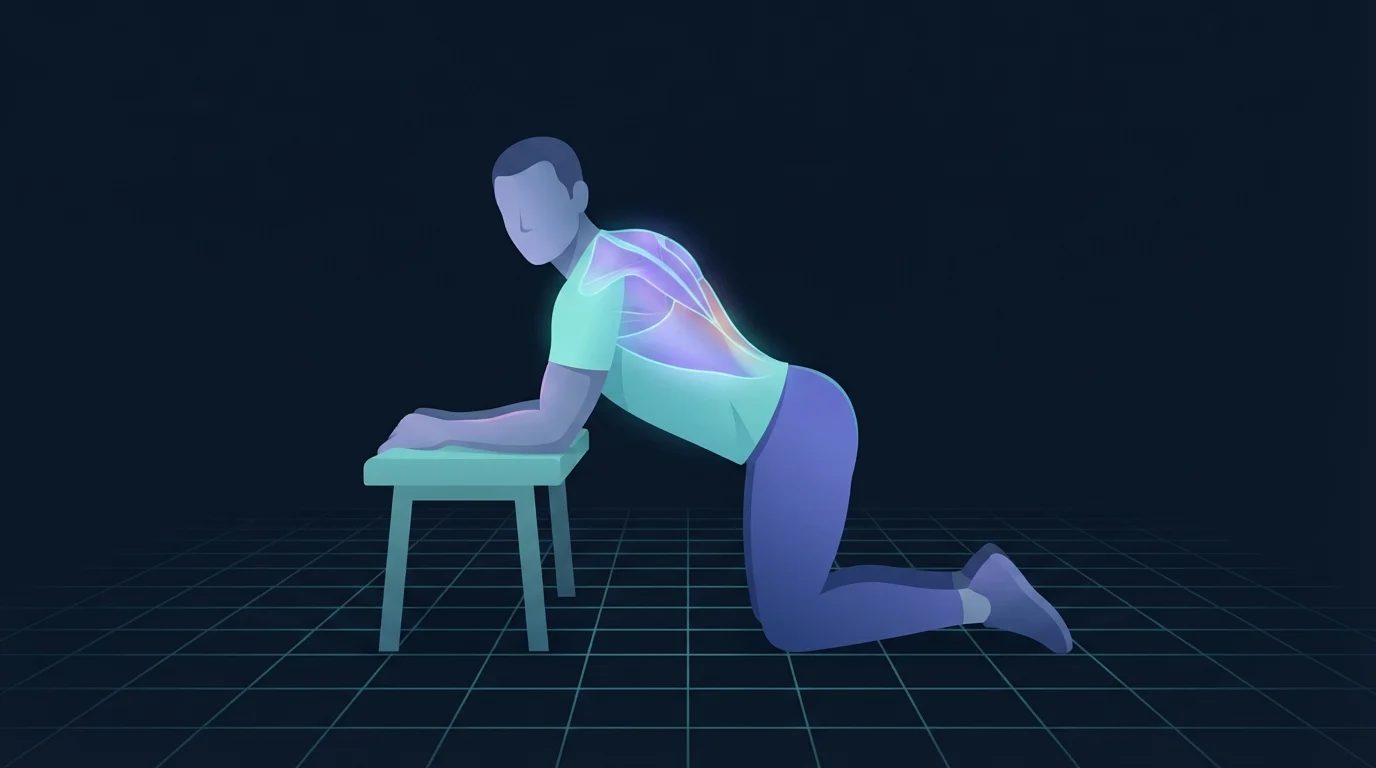
| Bench thoracic extension | Thoracic extension, shoulder flexion | 2 × 45 sec | Lower the bench, then add a light dumbbell in the hands |
| Tricep and lat stretch | Lats and triceps | 45 sec per side | Side bend gently away from the stretched side |
| Cross-body rear delt stretch | Back of the shoulder and capsule | 3 × 30 sec per side | Pin the shoulder blade down before you pull |
| Supine overhead reach, ribs down | Active overhead range | 2 × 8, 3 sec at the end position | Straighten the legs, which makes the ribs harder to control |
| Band pull-aparts | Upper back strength at the new range | 2 × 15 | Raise the band to eye level, then shorten your grip |
| Overhead pullover, light dumbbell | Loaded end-range shoulder flexion | 3 × 10, 3 sec lower | Add weight only once the ribs stay down for all 10 |
Two notes on running it. The pullover is the movement that converts range into range you keep, so start embarrassingly light and let the ribs, not the weight, set the ceiling. And if the overhead reach still feels blocked after four weeks, add a prone Y-raise for the lower traps and a short dead hang, which loads overhead flexion with your own bodyweight.
The 10-Minute Shoulder Mobility Routine
On a mat, next to a chair or low bench. A light band and one light dumbbell cover the last two movements and nothing else needs equipment.
- Shoulder rolls, 30 sec. Big and slow, both directions, purely to warm the area up.
- Cat cow, 1 min. Ten reps, three seconds each way.
- Thread the needle, 1 min 30 sec. Eight per side, pausing where it opens.
- Bench thoracic extension, 1 min 30 sec. Two holds of 45 seconds, hips back over the heels.
- Lat stretch, 1 min 30 sec. Forty-five seconds per side.
- Cross-body stretch, 1 min 30 sec. Three holds of 30 seconds per side, alternating.
- Supine overhead reach, 1 min. Two sets of eight with the lower back flat.
- Pull-aparts and pullovers, 2 min. One set of 15, then one set of 10 with a light dumbbell.
If ten minutes is the barrier, the two-minute version is the bench thoracic extension and one set of cross-body holds. That still clears the weekly threshold below for the two links most people are missing.
How Often, and What the Evidence Actually Supports
Frequency does the heavy lifting. A systematic review pooling stretching trials concluded that at least five minutes per week per muscle group, spread across at least five days a week, improves range of motion, while the time spent stretching within any single session had no significant effect (Thomas et al., International Journal of Sports Medicine, 2018). Short and often wins.
For the back of the shoulder, there's a head-to-head trial worth knowing. Fifty-four subjects with posterior shoulder tightness were randomised to a cross-body stretch, a sleeper stretch, or a control group for four weeks. The cross-body group gained 20.0 degrees of internal rotation against 5.9 degrees for controls, a statistically significant difference, while the sleeper stretch group's gain was not significantly different from control (McClure et al., Journal of Orthopaedic and Sports Physical Therapy, 2007). The sleeper stretch is the more famous of the two and it's the one to drop if you're short on time.

Then there's the half most mobility routines leave out. A meta-analysis of 11 studies and 452 participants compared strength training against stretching for improving range of motion and found no statistically significant difference between them (Afonso et al., Healthcare, 2021). Training a muscle through a full range buys about as much flexibility as stretching it does, and the range comes with control attached. That's why the pullover and the pull-apart sit at the end of the routine, and why they should progress the way anything else does, with ordinary progressive overload applied to range before weight.
If pain is part of the picture, the picture changes. A systematic review and meta-analysis of randomised trials in adults with shoulder impingement concluded that exercise should be considered for these symptoms, with tape, shockwave, laser or manual therapy as possible additions, while explicitly rating the evidence as very low quality (Steuri et al., British Journal of Sports Medicine, 2017). Exercise first, modest expectations, and a clinician if it isn't moving.
None of this needs a gym: a mat, a light band and one dumbbell cover the whole routine, and if you'd like the progressions decided for you rather than improvised, our roundup of the best no-equipment workout apps covers what to look for.
Before or After Training?
Keep the long holds away from the start of a hard upper-body session. A systematic review of acute stretching in healthy active people found static stretching reduced subsequent performance by an average of 3.7% while dynamic stretching improved it by 1.3%, with a clear dose response: holds of 60 seconds or more cost 4.6% against 1.1% for holds under 60 seconds (Behm et al., Applied Physiology, Nutrition, and Metabolism, 2016).
So before pressing or pulling, move through the positions instead of parking in them: cat cow, thread the needle, a few overhead reaches, ninety seconds total. Take the 30 and 45-second holds afterwards or on a rest day. Our breakdown of static versus dynamic stretching works through the timing in more detail.
What Shoulder Mobility Exercises Will Not Do
- They won't straighten your posture. Resting thoracic kyphosis looks much the same in people with and without shoulder pain. Train the upper back because range is useful, not because a curve is a diagnosis. Our guide to exercises for posture covers how small those angle changes really are, and how to fix rounded shoulders goes further into the strength side.
- They won't make shoulder pain uncommon. A systematic review of general-population data put point prevalence of shoulder pain between 6.9% and 26% depending on the case definition (Luime et al., Scandinavian Journal of Rheumatology, 2004). Some of it is training. Some of it is just shoulders.
- They won't erase normal asymmetry. Your dominant arm rotates differently from the other one and always has. Chase the 20-degree gaps, not the 5-degree ones.
- They won't outrun eight hours at a desk. Ten minutes of mobility work doesn't compete with a full working day in one position. Break the day up as well as adding the routine.
- They won't survive a break. Range detrains like anything else. This is a habit, not a project with a finish line.
Red Flags: When to See a Clinician
Most stiff shoulders are under-used shoulders. A few are something else. Get it looked at if:
- Range is gone in every direction, not just overhead, and someone else moving your arm for you is no better than moving it yourself. That pattern suggests adhesive capsulitis, the frozen shoulder presentation, which affects roughly 2% to 5% of the general population and moves through predictable stages that mobility drills won't shortcut (Le et al., Shoulder and Elbow, 2017).
- Night pain wakes you or you cannot lie on that side.
- Weakness rather than stiffness, especially if you can't hold the arm out to the side against gentle pressure.
- Numbness, tingling or pain running down the arm, which points at the neck rather than the shoulder.
- Stiffness that has been getting worse for weeks despite sensible training, or that followed a fall or a dislocation.
The Bottom Line
Shoulder mobility exercises work when you find the missing link before you start. Run the three floor tests, notice whether the range disappears when you slump, whether it comes back lying down, and whether one side loses more than the other. That takes five minutes and it decides which two thirds of the routine actually matter for you.
Then spend ten minutes most days rather than an hour on Sunday, use the cross-body stretch instead of the sleeper stretch, and finish with something loaded. Stretching buys the range. Load is what stops you re-reading this page in six months.
Frequently Asked Questions
What are the best shoulder mobility exercises?
The best shoulder mobility exercises cover all three things that limit overhead reach: the upper back, the lats, and the joint itself. A complete set is a supine overhead reach with the ribs down, quadruped thread the needle for thoracic rotation, cat cow, a bench thoracic extension, a kneeling lat stretch, a cross-body stretch for the back of the shoulder, band pull-aparts, and a light dumbbell overhead pullover. Eight moves, about 10 minutes, and the last two are the ones that make the new range usable.
How do I test my shoulder mobility at home?
Lie on your back with your knees bent and your lower back flat against the floor, then reach both arms overhead with the elbows straight. If the backs of your hands reach the floor while the ribs stay down, your overhead range is fine. If the ribs flare or the arms stop short, something above the shoulder is limiting you. Then repeat the reach while sitting tall versus slouched: shoulder abduction range was 23.6 degrees smaller in a slouched posture than an erect one in one laboratory study (Kebaetse et al., 1999), so a big difference between the two points at the upper back rather than the shoulder.
Why can't I get my arms straight overhead?
Overhead reach is a chain, and the shoulder is only the last link. The upper back has to extend, the shoulder blade has to rotate upward on the ribcage, and the lats and the back of the shoulder capsule have to lengthen. A slouched thoracic posture alone cost 23.6 degrees of shoulder abduction range and 16.2% of isometric abduction force in 34 healthy subjects (Kebaetse et al., 1999). If your arms go overhead lying down but not standing, the limit is usually the upper back or the ribs, not the shoulder joint.
Is the cross-body stretch or the sleeper stretch better?
The cross-body stretch has the better trial evidence. In a randomized controlled comparison of 54 subjects over four weeks, the cross-body stretch group gained 20.0 degrees of shoulder internal rotation against 5.9 degrees in the control group, a statistically significant difference, while the sleeper stretch group's gain was not significantly different from control (McClure et al., 2007). If you only do one, do the cross-body stretch, three holds of 30 seconds per side.
How often should you do shoulder mobility exercises?
Most days, in short sessions. A systematic review of stretching trials concluded that at least five minutes per week per muscle group spread across at least five days a week improves range of motion, while the time spent stretching within any single session had no significant effect (Thomas et al., 2018). Ten minutes on five or six days beats an hour on Sunday, and the loaded half of the routine is what keeps the range between sessions.
Do shoulder mobility exercises fix shoulder pain?
Exercise helps, but not because it corrects your posture. A systematic review found resting thoracic kyphosis is very similar in people with and without shoulder pain, and that increased kyphosis may not be a key contributor to it, though greater shoulder range is available in an erect posture (Barrett et al., 2016). For shoulder impingement symptoms specifically, a meta-analysis of randomised trials concluded that exercise should be considered the first option, while rating the evidence quality as very low (Steuri et al., 2017).
When should shoulder stiffness be checked by a clinician?
See a clinician if range is lost in every direction rather than one, if passive range is as limited as active range, if night pain wakes you, or if stiffness has been getting worse for weeks despite sensible training. Adhesive capsulitis, the frozen shoulder pattern, affects roughly 2% to 5% of the general population and progresses through predictable stages that mobility drills alone won't shortcut (Le et al., 2017).