The reason so many home lifters have shoulders that look fine from the front and flat from every other angle is arithmetic. A week of push-ups, bench pressing and overhead pressing might put 20 hard sets through the front of the shoulder. The side of the shoulder gets whatever lateral raises you remembered, and the back of it gets a fraction of a set from a row that was really training your lats.
This page is organised around that imbalance. It counts each deltoid head separately, picks the movement that actually reaches each one, and spends real time on the joint itself, because the shoulder has a smaller margin for a bad rep than the elbow or the hip does.
Three Deltoid Heads, and Two of Them Never Get Loaded by Accident
The anterior deltoid runs from the outer third of the collarbone to the upper arm bone, and it flexes the shoulder: any time your hand travels forward or upward in front of you, it works. That is a wide net. It is loaded on the bench press, the push-up, the overhead press, even a heavy front-loaded carry. Almost nobody who trains their upper body has an under-trained front delt, which is why this session gives it the fewest direct sets of the three.
The medial deltoid attaches to the acromion, the bony shelf at the top of the shoulder blade, and its fibres run in a multipennate arrangement built for lifting the arm out to the side. That is a movement pattern nothing else in a normal program performs. Not a row, not a press, not a curl. If you want the capped look from the front and the shoulder width that changes how a shirt sits, the medial head is the piece doing it, and a lateral raise is essentially the only way to load it directly.
The posterior deltoid runs from the spine of the shoulder blade forward to the upper arm and pulls the arm backwards and outwards. Rows touch it on the way past, but a row's job is the lats and the mid-back, and the elbow path of a row keeps the upper arm close to the torso instead of out at shoulder height. Loading the rear delt properly requires the upper arm to travel backwards at roughly 90 degrees of abduction, which is what a fly does and a row does not. Miss it and the shoulder stays flat in profile while the front keeps growing, which is both a look problem and, over years, a posture one.
What EMG Says About Which Raise Reaches the Middle Delt
Campos and colleagues (2020) put surface electrodes on all three deltoid portions in resistance-trained participants and ran them through a set of common shoulder exercises. The finding that matters for programming is the absence of a winner: the exercises that produced the highest anterior activation were not the ones that produced the highest medial activation, and neither of those was the one that produced the highest posterior activation. There is no single shoulder movement that trains the whole deltoid well, which is why a session built on one press and nothing else leaves two thirds of the muscle short.
Coratella and colleagues (2020) narrowed in on the raise itself, comparing several lateral raise variations against the front raise in competitive bodybuilders. The lateral raises reached the middle deltoid substantially better than the front raise did, and the front raise leaned on the anterior head, the one your pressing already covers. Among the lateral variations, changing torso position changed which part of the range was loaded hardest, which is the practical argument for leaning slightly away from a rack or bench upright on some sets: it shifts more of the work toward the bottom of the arc, where a plain standing raise is easiest.
Two conclusions follow. Drop the front raise unless you have a specific reason for it, because it's a duplicate. And treat the lateral raise as a movement you vary by body position rather than by load, because the load available on a strict raise is small and stays small.
The 30-Minute Dumbbell Shoulder Workout
One movement per deltoid head plus a rotational press, ordered so the heaviest work happens first and the joint gets its warm-up before anything goes overhead. Budget 30 to 40 minutes including rest. Loads here are a starting point for a general trainee; the raises in particular are lighter than people expect.
Warm-up (5 minutes)
- 20 shoulder rolls backwards, then 10 slow arm swings across the body
- 2 sets of 12 external rotations with a very light dumbbell, elbow tucked at the side
- 10 wall slides, keeping the forearms in contact with the wall through the range
- 1 ramp-up set of the overhead press at about half your working load
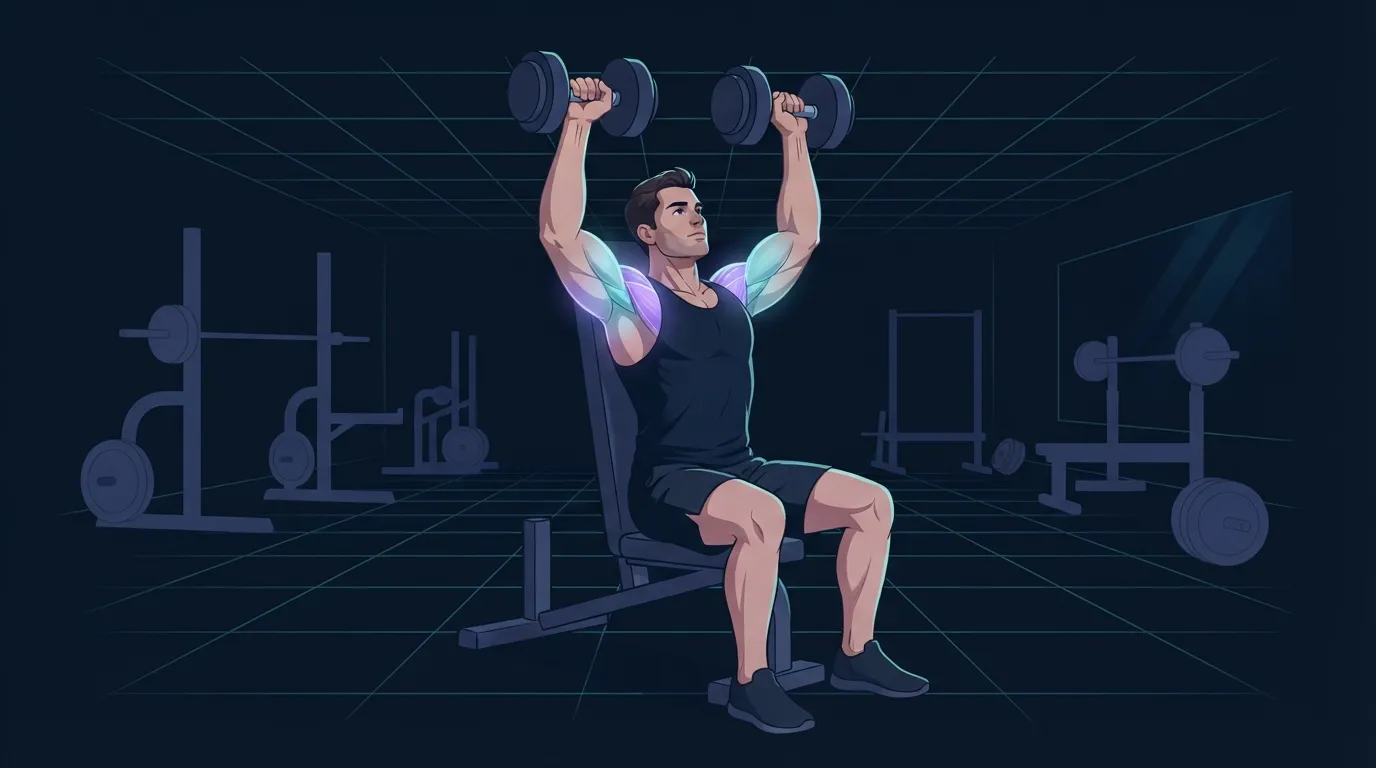
A) Seated Dumbbell Overhead Press: 4 sets of 6 to 10 reps
Bench upright, feet flat, ribs down rather than flared. Start with the dumbbells at ear height and the elbows roughly 30 degrees in front of the frontal plane, not splayed straight out to the sides. Press up and slightly inward until the arms lock out with the dumbbells close together. Lower on a three-count back to ear height. That elbow position is the single most useful cue on this page, and the reason for it is in the impingement section below. Two reps in reserve on every set but the last. See our dumbbell shoulder press exercise page for the muscles worked and the common errors.
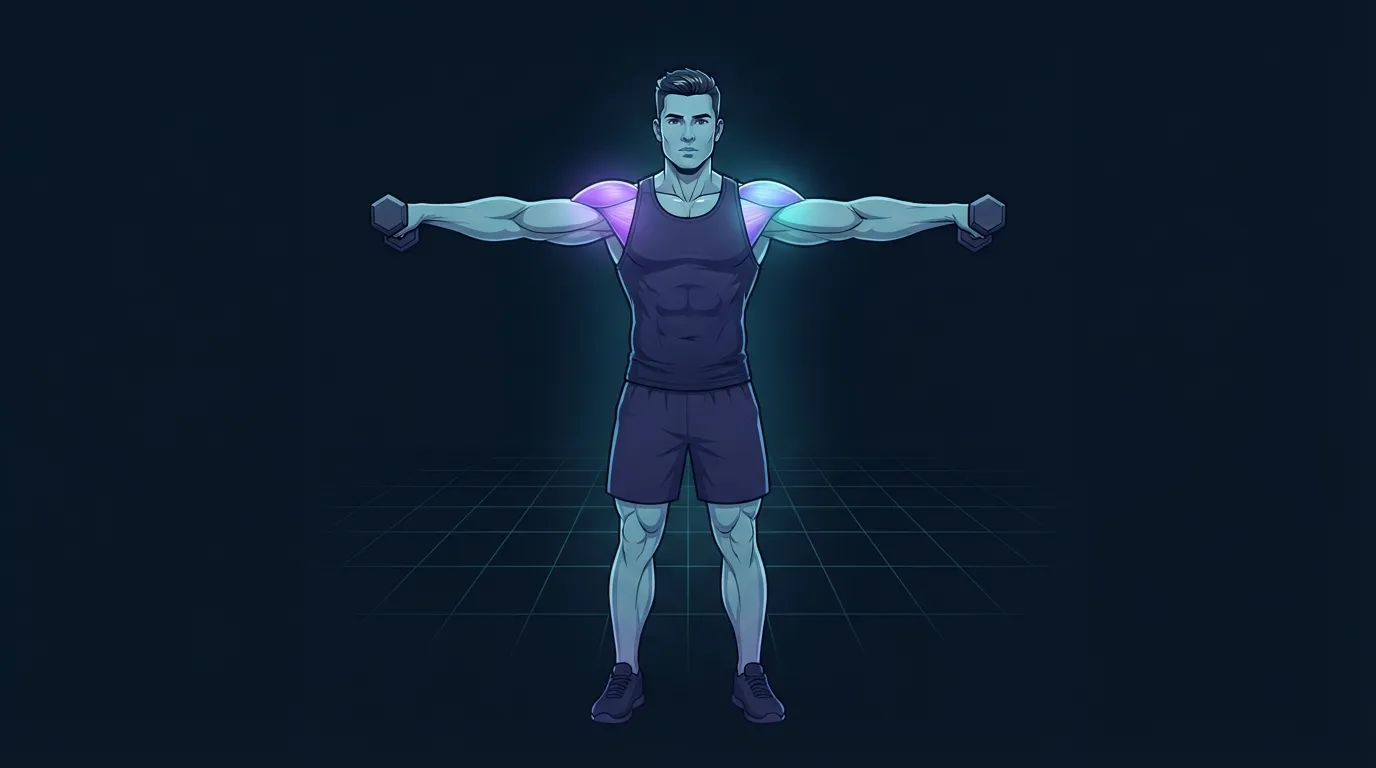
B) Standing Dumbbell Lateral Raise: 4 sets of 12 to 20 reps
Soft bend in the elbows, thumbs level with or very slightly above the little fingers, and lead with the elbow rather than the hand. Raise until the upper arms are level with the shoulders and stop there. Lower on a deliberate three-count, because the lowering is the part most people give away when the weight is too heavy. The rep range is high on purpose: the medial deltoid works through a long lever, so a load light enough to move strictly will land you in the teens for reps, and that is fine. Every second session, do one set leaning away from a rack upright to bias the bottom of the arc, as the Coratella comparison suggests. See our lateral raise exercise page for how to stop the trap from taking over.
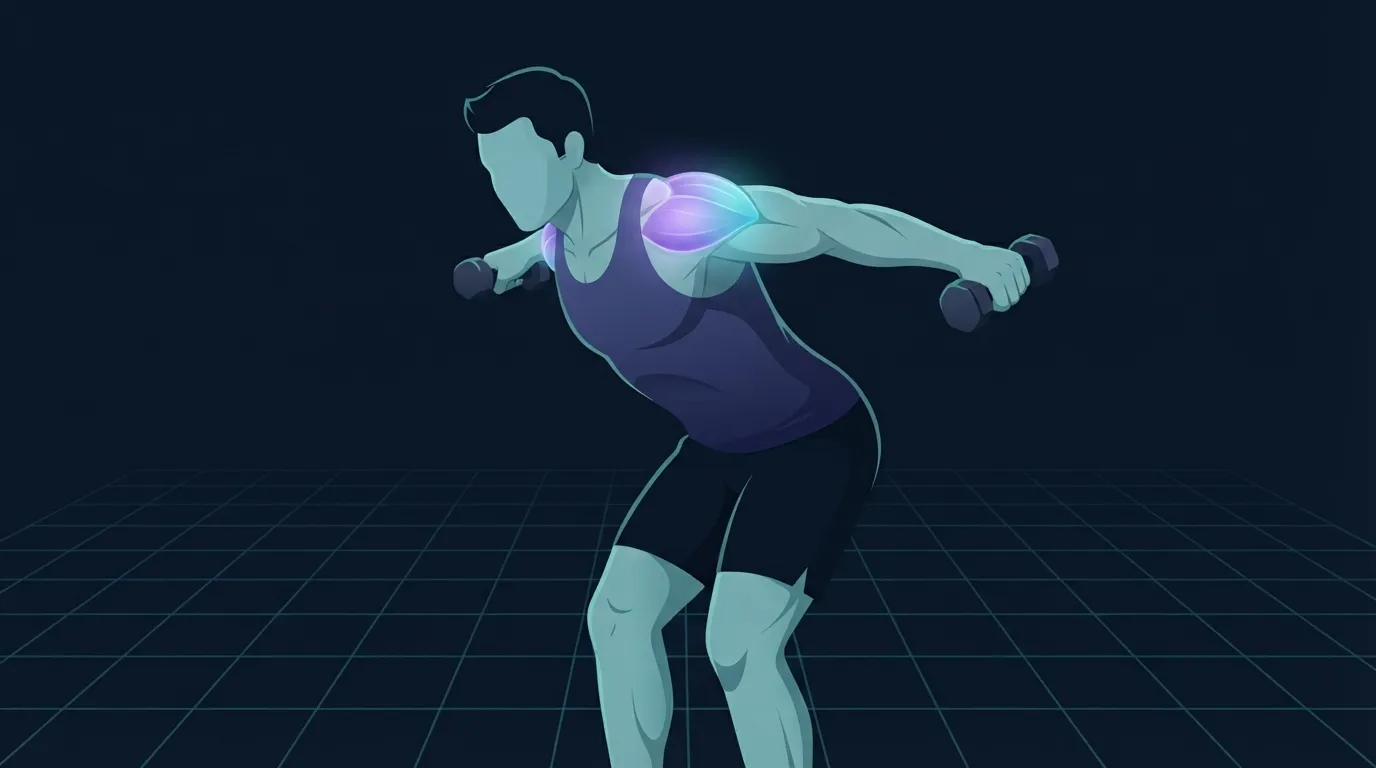
C) Chest-Supported or Bent-Over Rear Delt Fly: 3 sets of 12 to 20 reps
Set an incline bench to 30 to 45 degrees and lie face down on it if you have one, because that removes the low back from the equation entirely and makes the position repeatable. Arms hanging, palms facing each other, soft elbows. Pull the dumbbells out and slightly back until the upper arms are in line with the shoulders, pause, then lower slowly. The cue that matters: think about moving the upper arm, not squeezing the shoulder blades, because a hard scapular squeeze converts the movement into a mid-back exercise. See our rear delt raise exercise page for the chest-supported setup.
Find out what's really holding you back
FitCraft, our mobile fitness app, pairs you with an AI coach who builds you a personalized plan around your goals, schedule, and fitness level. Every FitCraft program is designed by Domenic Angelino, MPH (Brown University) and NSCA-CSCS, with research published in the Journal of Strength and Conditioning Research and Medicine & Science in Sports & Exercise.
Take the Free Assessment Free • 2 minutes • No credit cardD) Arnold Press: 3 sets of 8 to 12 reps
Seated, dumbbells at chest height with the palms facing you, elbows in front of the body. Press up while rotating the forearms outward, so the palms finish facing forward at lockout, then reverse the rotation on the way down. Because the rep starts with the arms in front of the torso and rotates through, the joint spends less time in the flat-out-to-the-side position that tends to be provocative, which makes this a useful second press on a day when strict pressing feels sticky. Expect 70 to 80 percent of your strict press load for the same reps. See our Arnold press exercise page for the elbow track.
Pressing Overhead Without Provoking the Shoulder
Shoulder pain is the most common reason a pressing program quietly stops. Ludewig and Braman (2011) reviewed the biomechanics behind subacromial symptoms and made a case that has aged well: impingement is not one structural fault waiting to be found on a scan, it's a label for a set of contributing factors, including how the shoulder blade rotates and tilts as the arm goes up, how the upper arm is rotated as it elevates, and how much load the tissue has been asked to handle lately. The useful consequence for a lifter is that the arm path and the loading history are things you control.
Three adjustments come out of that. Keep the elbows about 30 degrees forward of the frontal plane when you press, so the upper arm elevates in the plane the shoulder blade actually sits in rather than flat out to the sides. Avoid forcing a range that produces a pinch high in the shoulder; stopping an inch short of that costs you nothing in growth. And ramp overhead volume in small steps after a layoff instead of returning to your old numbers in week one.
If your shoulder already hurts, the instinct to stop everything is usually the wrong one. Holmgren and colleagues (2012) randomised patients with long-standing subacromial pain who were already on a waiting list for surgery to either a specific programme of rotator cuff and scapular exercises or a general exercise programme. Three months later the specific-exercise group had better shoulder scores, and far fewer of them still wanted the operation. That is a strong argument for targeted loading over rest, and a reason to work through our shoulder mobility exercises and the rotator cuff work on the rotator cuff stretch page rather than shelving the session. Persistent pain still deserves a clinician rather than a guide.
How Often to Train Shoulders
Schoenfeld, Grgic and Krieger (2019) pooled 25 studies and found twice-weekly training produced more hypertrophy than once-weekly when weekly sets were equated, with no further gain past three sessions. For the deltoid there's an extra wrinkle: the three heads don't need the same frequency. The front head is already being hit on every pressing day, so its frequency is whatever your pressing frequency is.
The medial and posterior heads are the ones to schedule deliberately, and they're unusually easy to spread out because raises and flies are light and create almost no systemic fatigue. Three sets of laterals and three sets of rear delt flies at the end of any session cost you six or seven minutes. A lot of people do better attaching those to two or three existing workouts than defending a standalone shoulder day in a busy week.
Rear Delt Work Has to Be Deliberate
The rear delt is the head most likely to be missing, and the reason is that people believe their back work covers it. It mostly does not. In a row, the upper arm travels backwards close to the ribs, which is a lat-dominant path. In a fly, the upper arm travels backwards at shoulder height, which is the posterior deltoid's job description. The Campos comparison found that reverse fly work led the other exercises for posterior activation, and no amount of heavy rowing substitutes for it.
Program it like a habit rather than an exercise. Six to ten hard sets a week, always chest-supported if your low back is at all cranky, always in a rep range high enough that you're not tempted to heave. It is also the head that pulls the shoulder into a more balanced resting position over months, so if your shoulders sit further forward than they used to, this movement plus the postural work in our guide to fixing rounded shoulders is the pairing that changes it.
What Carries Over From the Chest Session
Sets, reps and rest. Schoenfeld, Ogborn and Krieger (2017) found growth continuing up to at least 10 weekly hard sets per muscle, and Schoenfeld and colleagues (2017) found similar hypertrophy from 6 to 20 reps when sets end close to failure, which is what licenses the high-rep raises here. Grgic and colleagues (2018) found rest below 60 seconds costs strength, so take 90 seconds after press sets and 60 after raises. The full version of this discussion lives on the dumbbell chest workout page, which anchors this cluster.
Progression. Same two-reps-in-reserve rule, with one shoulder-specific caveat: on lateral raises and rear delt flies, progress by adding reps and slowing the lowering phase long before you add load, because the smallest dumbbell jump most people own is a 20 to 25 percent increase on a raise. The chest guide covers the general rule and when to take the jump.
Mistakes. The shoulder-specific ones are swinging the lateral raise until the traps do the lifting, flaring the elbows flat out to the sides on the press, and treating rows as rear delt work. General errors that apply to any dumbbell session, like training every set to grinding failure or skipping the week's second session, are covered on the chest page.
Two Shoulder Days, Three Deltoid Heads
The point of the split below is the set counts in the last column, not the exercise names: the two heads nothing else trains get the volume, and the front head gets what is left over because your pressing days already fed it.
| Day | What it's for | Structure |
|---|---|---|
| Shoulder day 1 (press led) | Load the anterior and medial heads together | Overhead press 4×6-8 · Lateral raise 4×12-15 · Rear delt fly 3×12-20 · Arnold press 2×8-12 |
| Shoulder day 2 (raise led) | Medial and posterior volume with no heavy pressing | Lateral raise 4×15-20 · Rear delt fly 4×15-20 · Leaning lateral raise 2×12-15 · Arnold press 3×10-12 |
Weekly totals: 10 direct sets on the medial head, 7 on the posterior head, and 5 direct sets on the anterior head plus everything it picks up from your chest and pressing days. If you don't run a separate chest session, add two sets to the overhead press on day 1 so the front head is not short.
What Actually Builds Shoulders
Stop counting shoulders as one muscle. Give the medial and posterior heads their own weekly set targets, pick the movement that actually reaches each one, and accept that the front head is already fed. Keep the raises light enough to move strictly and high enough in reps that the last three are honest work. Press with the elbows forward of the frontal plane and stop short of anything that pinches, because the joint is the part of this session with the least room for error.
Then do it for three months, which is the part nobody puts in a training video. If turning up twice a week is the bit that slips, that is an adherence problem rather than a shoulder problem, and our comparison of the best dumbbell workout apps covers how the leading options handle programming and consistency for people training at home.
Frequently Asked Questions About Shoulder Training
Can you build big shoulders with just dumbbells?
Yes, because the deltoid is three separate regions that each need a different arm path, and one pair of dumbbells reaches all three. Campos and colleagues (2020) measured all three deltoid portions across a range of common shoulder exercises and found no single movement led for every portion: pressing and front-raising topped the anterior region, raising the arm out to the side topped the medial region, and reverse fly work topped the posterior region. A press, a lateral raise and a rear delt fly cover that map. The only real concession you make without cables is losing constant tension at the bottom of a raise, which you can partly buy back by leaning away from a support.
How many sets per week do shoulders need?
Count the three heads separately rather than counting shoulders as one muscle. Roughly 6 to 10 weekly hard sets each for the medial and posterior deltoid, and as few as 4 to 6 direct sets for the anterior deltoid, because the front head already gets loaded on every push-up, bench press and overhead press in your week. Schoenfeld, Ogborn and Krieger (2017) found growth continuing up to at least 10 weekly sets per muscle, and that is the number worth aiming at for the two heads that get no accidental work. Most people who feel like their shoulders will not grow are running 20 sets of front-delt work and four of everything else.
How often should I train shoulders with dumbbells?
Twice a week for the medial and posterior heads, and the anterior head can usually ride along on whatever pressing you already do. Schoenfeld, Grgic and Krieger (2019) pooled 25 studies and found two sessions a week beat one when weekly sets were matched. Lateral raises and rear delt flies are light, low-fatigue movements, so they're easy to spread out: some people do best putting three sets of each at the end of two or three different sessions rather than saving them all for one shoulder day.
What are the best dumbbell exercises for shoulders?
One movement per deltoid head, plus a rotation-friendly press if your shoulders like it. The seated overhead press loads the anterior and medial heads together under the heaviest load of the session. The lateral raise is the movement that reaches the medial head most directly, and Coratella and colleagues (2020) found lateral raise variations produced greater middle-deltoid activation than the front raise, which is the movement most people substitute for it. A bent-over or chest-supported rear delt fly is the only common exercise whose whole job is pulling the arm backwards at shoulder height. The Arnold press adds a rotation through the pattern and works well as a lighter second press.
Should I do lateral raises heavy or light?
Light and clean beats heavy and swung, for a mechanical reason rather than a moral one. The middle deltoid raises the arm through a long lever, so every pound at the hand creates a large torque demand at the shoulder, and the load that a strict raise can handle is genuinely small. If the traps are lifting toward the ears or the torso is rocking backwards to start the rep, the weight has stopped being a medial deltoid weight. Most home lifters do their best work on this movement with 10 to 25 pound dumbbells for years, and progress by adding reps and slowing the lowering rather than by adding plates.
Is overhead pressing bad for your shoulders?
Overhead pressing is not inherently harmful, but the path the arm takes matters. Ludewig and Braman (2011) reviewed the biomechanics behind shoulder impingement and described it as a set of contributing factors rather than one structural fault, with how the shoulder blade rotates during elevation and how the upper arm is rotated among them. In practice that means pressing with the elbows about 30 degrees forward of the frontal plane instead of flat out to the sides, and stopping short of a range that pinches. If overhead work already hurts, the exercise answer is usually not rest: Holmgren and colleagues (2012) randomised patients with long-standing subacromial pain to a specific rotator cuff and scapular exercise programme or a general one, and the specific group improved more and requested surgery far less often.