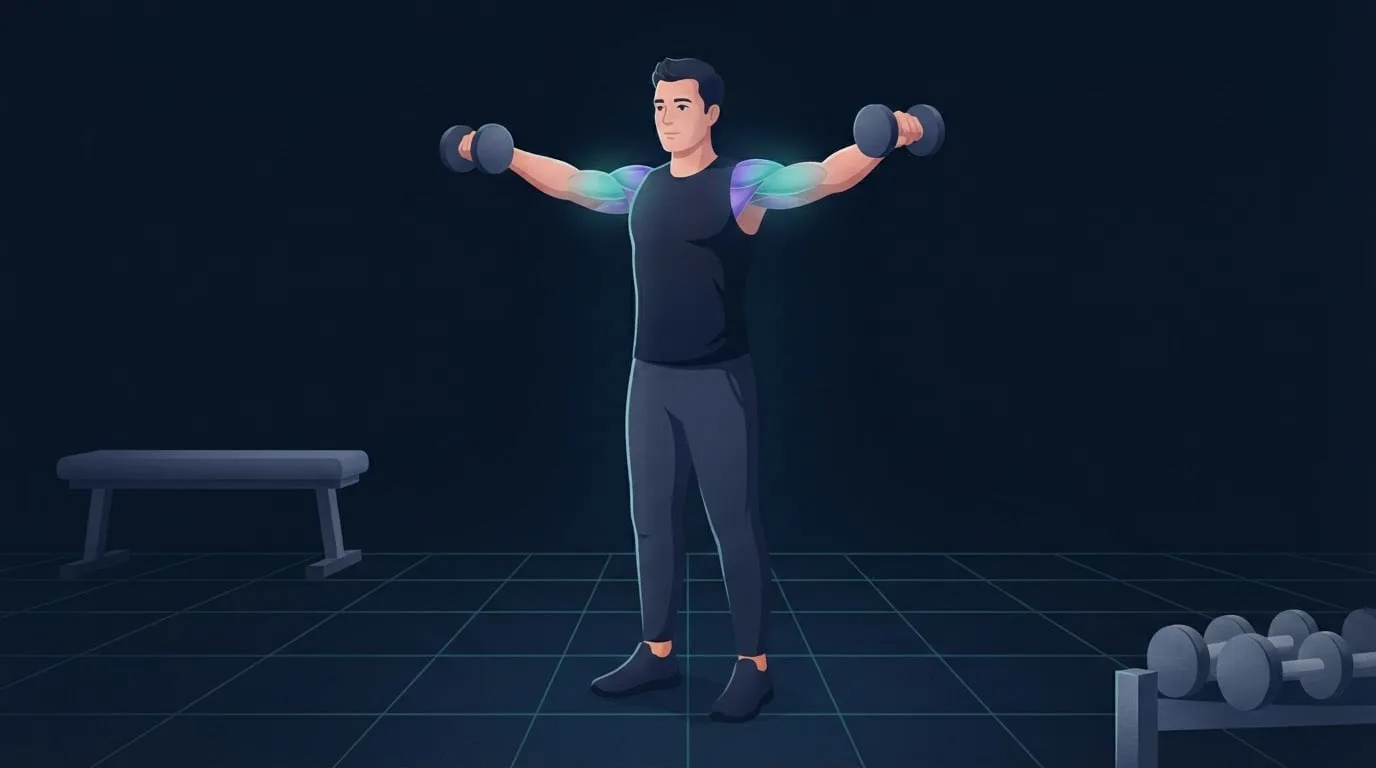
Maybe it's a shirt that hangs off you instead of sitting square, or a photo where your head looks big for your frame. You've done push-ups and the odd shoulder press for months, and the mirror hasn't moved.
That's frustrating, and it's easy to decide you just have narrow shoulders. Part of that is true: the bones that set your frame are fixed now. The muscles that sit on them aren't, and most workout plans barely train the one that adds the most width.
What works is a plan aimed at the right muscles, done consistently for long enough to show. Below you'll find what sets shoulder width, the exercises that change it, how many sets to do and what to expect month by month.
What Causes Broad Shoulders?
Shoulder width has two layers: a bony frame you inherited and a layer of muscle you can build. The frame is your biacromial breadth, the distance between the two bony points at the tops of your shoulders, called the acromions. Your collarbones and shoulder blades set it.
That frame mostly widens at puberty. Zivicnjak and colleagues (2008), in Collegium Antropologicum, measured 5,260 children and teenagers aged 2 to 18 in Zagreb, Croatia. Body widths kept increasing until about 14 to 15 in girls and about 16 in boys. The difference between the sexes in shoulder breadth appeared with the pubertal growth spurt, and from about 13 onward boys had clearly wider shoulders while girls gained more hip width. So testosterone in your teens helped set your frame, but adult testosterone can't lengthen bones that have finished growing.
On top of that frame sit three muscle groups you can train:
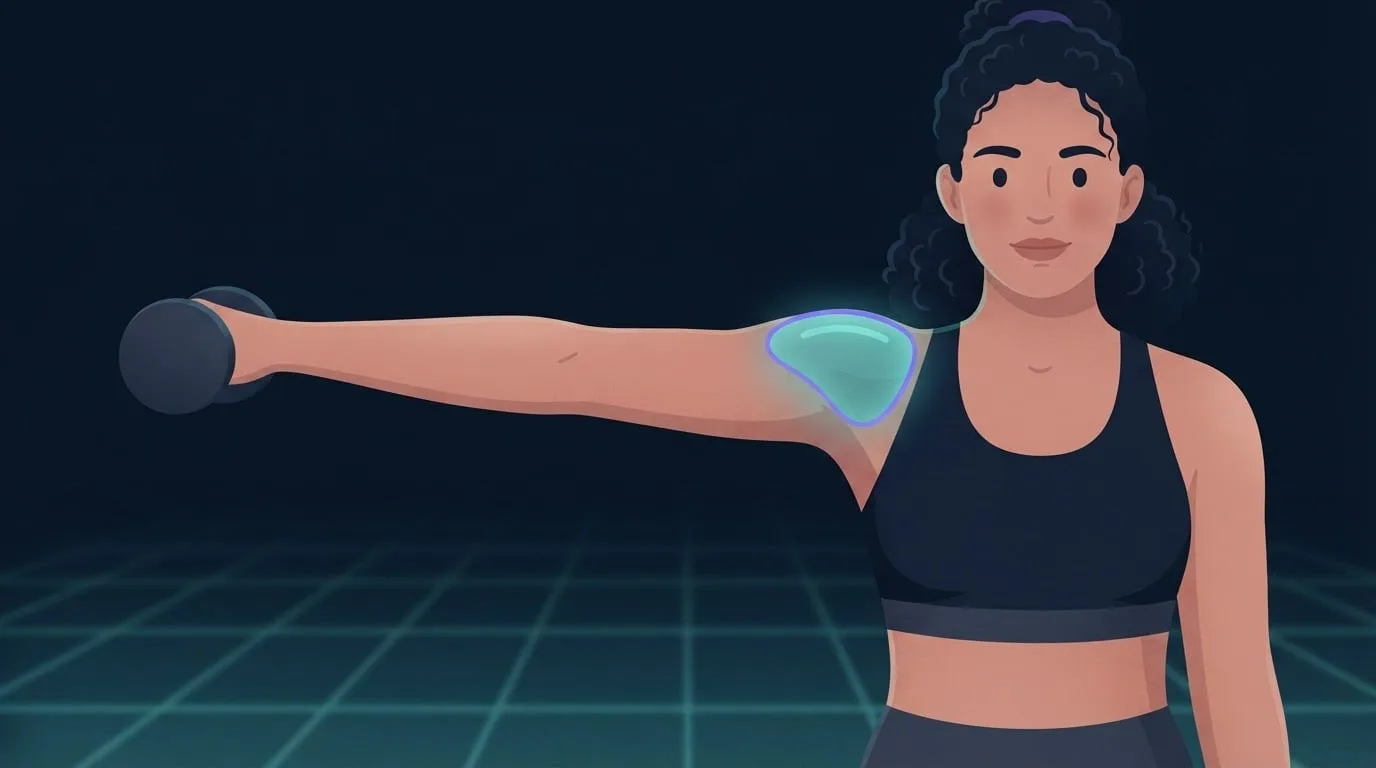
- Side deltoids. The middle part of the deltoid starts on the acromion and caps the outside of the shoulder. It's the biggest single lever on how wide you look from the front, and almost nothing in a typical workout trains it hard except a lateral raise.
- Upper trapezius. The upper traps run from the neck to the collarbone and shoulder blade and fill the slope between them. They add thickness and make the upper body look bigger, but they don't push the point of the shoulder outward.
- Latissimus dorsi. The lats wrap from the lower back up to the upper arm, just below the armpit. Bigger lats widen the upper back under the shoulders, which is what creates the V-taper.
Two more things change how wide you look without changing your shoulders at all: how your shoulders sit and how wide your waist is. Both get their own section below.
The 7 Best Exercises for Broader Shoulders
Three exercises train the side deltoids directly, two are presses that load the whole shoulder, and two train the lats. All of them need only a pair of dumbbells, a bench or your body weight. The sets and reps here are starting points, and the plan further down puts them in order.
- Standing dumbbell lateral raise. Hold the dumbbells at your sides with a slight bend in the elbows, then raise them out to the sides, leading with the elbows, until your upper arms reach shoulder height. Lower slower than you lift. Pick a weight you can lift for 12 to 20 clean reps, which for most people is much lighter than they expect. Our lateral raise exercise guide walks through the setup step by step.
- Lean-away lateral raise. Hold a door frame or sturdy post with one hand, let your body lean away from it and raise a dumbbell with the free arm. The lean puts tension on the side deltoid at the bottom of the lift, the part a standing raise makes easy. Do 10 to 15 reps per arm.
- Seated or chest-supported lateral raise. Sitting on a bench, or lying face down on an incline bench, takes away the hip swing that turns a heavy raise into a shrug. Use it once your standing raises start to rock. Do 12 to 20 reps.
- Dumbbell overhead press. Pressing overhead loads the front and side deltoids together with the heaviest weights of the session. Sit or stand tall, start with the dumbbells at ear height and your elbows slightly in front of your body, and press up until your arms are straight. Do 6 to 12 reps.
- Pike push-up. Put your hands on the floor, walk your feet in until your hips are high, and lower the top of your head toward the floor just in front of your hands. It's the no-equipment version of the overhead press, and putting your feet on a step makes it harder. Do 6 to 12 reps.
- One-arm dumbbell row. Rest one hand and knee on a bench, pull the dumbbell toward your hip with the elbow brushing your ribs, then lower it until your arm is straight. This trains the lats, the muscles that widen your back under the shoulders. Do 8 to 12 reps per arm.
- Dumbbell pullover. Lie on a bench, hold one dumbbell over your chest with both hands, lower it back behind your head with slightly bent elbows until you feel a stretch, then pull it back over your chest. It works the chest and lats together through a long range. Do 10 to 15 reps.
Rear delt flies and upright rows are useful extras. The rear delt fly trains the back of the shoulder, which keeps the joint balanced and adds fullness when you're seen from the side, so it's in the plan below. Upright rows train the side deltoids and traps, but skip them if lifting your elbows high pinches the front of your shoulder.
How Many Sets Do Side Delts Need Each Week?
The general rules of shoulder training, including which deltoid head each exercise reaches and why the front deltoid rarely needs extra work, are set out in our dumbbell shoulder workout, along with a full session for all three heads. For width, one point matters most: the side deltoid only gets the work you schedule for it on purpose.
Larsen and colleagues (2025), in Frontiers in Physiology, gave 24 trained men and women two sessions a week of five lateral raise sets taken to failure, which is 10 hard sets a week, for eight weeks. Each person trained one arm with a dumbbell and the other with a cable. The side deltoid grew 3.3 to 4.6 percent in thickness, and the dumbbell arm grew as much as the cable arm. You don't need a cable machine, and 10 hard sets a week is a tested starting dose.
Presses count too, but only partly. A 2026 meta-analysis in Sports Medicine by Pelland and colleagues pooled 67 studies and 2,058 people and found that growth was predicted best when an exercise that only partly trains a muscle was counted as half a set. More weekly sets led to more growth, with smaller returns at the top end. For the side deltoids, count each lateral raise set as one set and each overhead press or pike push-up set as half.
| Where you are | Lateral raise sets a week | Press sets a week (count as half) |
|---|---|---|
| New to lifting | 6 to 8 | 3 to 6 |
| Six months or more of steady training | 10 to 14 | 4 to 8 |
| No visible change after three months | Add 2 to 4 | Keep the same |
A set only counts if it ends within one or two reps of failure. Twenty easy reps with a weight you could have lifted 35 times is a warm-up, not a hard set.
How to Get a Wider Upper Body: Lats and the V-Taper
Wide shoulders over a narrow back look top-heavy. Broad lats fill the space under the shoulders and give the upper body its V shape, so a plan for a wider upper body needs pulling work as well as raises.
Grip width matters less than gym advice suggests. A 2026 review of 23 EMG studies by Di Fonza and colleagues, in the Journal of Functional Morphology and Kinesiology, found that grip width had inconsistent effects on lat activity in the pulldown. In the seated row, a narrower grip and keeping the upper arm closer to the body were each linked to more lat activity. That's the shape of a one-arm dumbbell row with the elbow brushing your ribs. The review also noted that the inverted row, a bodyweight row under a bar or sturdy table, produced the highest lat activity among the rowing variations, though only in one small study.
The pullover is the honest exception. Marchetti and Uchida (2011), in the Journal of Applied Biomechanics, recorded muscle activity in eight men during the pullover and found it worked the chest more than the lats. Keep it for the long range it trains both muscles through, and let rows carry most of the lat work.
For a home plan, two days of rows at 3 to 4 sets each plus one day of pullovers covers the lats. If you have a pull-up bar, pull-ups and chin-ups do the same job with your body weight.
Upper Traps: Do They Help or Hurt Shoulder Width?
Big upper traps make the upper body look powerful, but they fill the slope from the neck down rather than pushing the shoulder point out. Very large traps on small side deltoids can make the shoulders look more sloped, not wider.
You also train them more than you think. Andersen and colleagues (2008), in Physical Therapy, measured muscle activity in 12 women with chronic neck pain during five exercises. The lateral raise drove the upper trapezius to 97 percent of a maximal contraction, close to the 102 percent of a shrug, with a fraction of the load. These were women in rehab rather than lifters, but the point carries over: lateral raises and upright rows already work the traps hard.
So for width, shrugs are optional. The bigger win is stopping the traps from taking over your raises. If your shoulders creep toward your ears, the weight is too heavy. Drop to a lighter dumbbell, set your shoulders down before each rep and lift with the elbows.
Find out what's really holding you back
FitCraft, our mobile fitness app, pairs you with an AI coach who builds you a personalized plan around your goals, schedule, and fitness level. Every FitCraft program is designed by Domenic Angelino, MPH (Brown University) and NSCA-CSCS, with research published in the Journal of Strength and Conditioning Research and Medicine & Science in Sports & Exercise.
Take the Free Assessment Free • 2 minutes • No credit cardThe 8-Week Dumbbell Plan for Broader Shoulders
This plan uses three sessions a week built around the side deltoids and lats. Days A and B are full sessions of 30 to 40 minutes. Day C is a 15-minute top-up you can add to the end of another workout. Rest 60 to 90 seconds between sets, and leave one or two reps in reserve except on the last set of each raise.
| Day | Exercises (sets x reps) |
|---|---|
| Day A | Dumbbell overhead press 3 x 8-12 · Standing lateral raise 4 x 12-20 · One-arm dumbbell row 3 x 8-12 per arm · Rear delt fly 2 x 15-20 |
| Day B | Pike push-up 3 x 6-12 · Lean-away lateral raise 3 x 10-15 per arm · Dumbbell pullover 3 x 10-15 · One-arm dumbbell row 2 x 10-12 per arm |
| Day C | Seated lateral raise 3 x 15-20 · Rear delt fly 2 x 15-20 |
That's 10 direct side-delt sets a week, plus six press sets that count as three more. Run it in three blocks:
- Weeks 1 and 2: do two sets of each exercise instead of the full number and stop every set about three reps short of failure. You're learning the movements and letting your joints adjust.
- Weeks 3 to 5: do the full sets in the table. Add a rep or two each week where you can.
- Weeks 6 to 8: add one set to each lateral raise, which brings you to 13 direct sets, and take the last set of each raise to failure.
Move up a dumbbell when you hit the top of the rep range on every set. On raises, the next dumbbell is often a 20 to 25 percent jump, so stay with the lighter weight until the top of the range feels easy. At the end of week 8, retake your measurements and photos, then start a new block with two more lateral raise sets if the change is smaller than you hoped.
If you'd rather not plan the sets yourself, a dumbbell workout app can schedule them for you. FitCraft builds programs from dumbbell and bodyweight exercises, an AI coach demonstrates each exercise on an interactive 3D model, and the workouts adjust as you progress. Streaks reward the three sessions a week that this plan depends on.
How to Make Shoulders Look Broader: Posture and Waist
Two changes make your shoulders look broader within a week or two, before any muscle grows.
Let your shoulders sit back
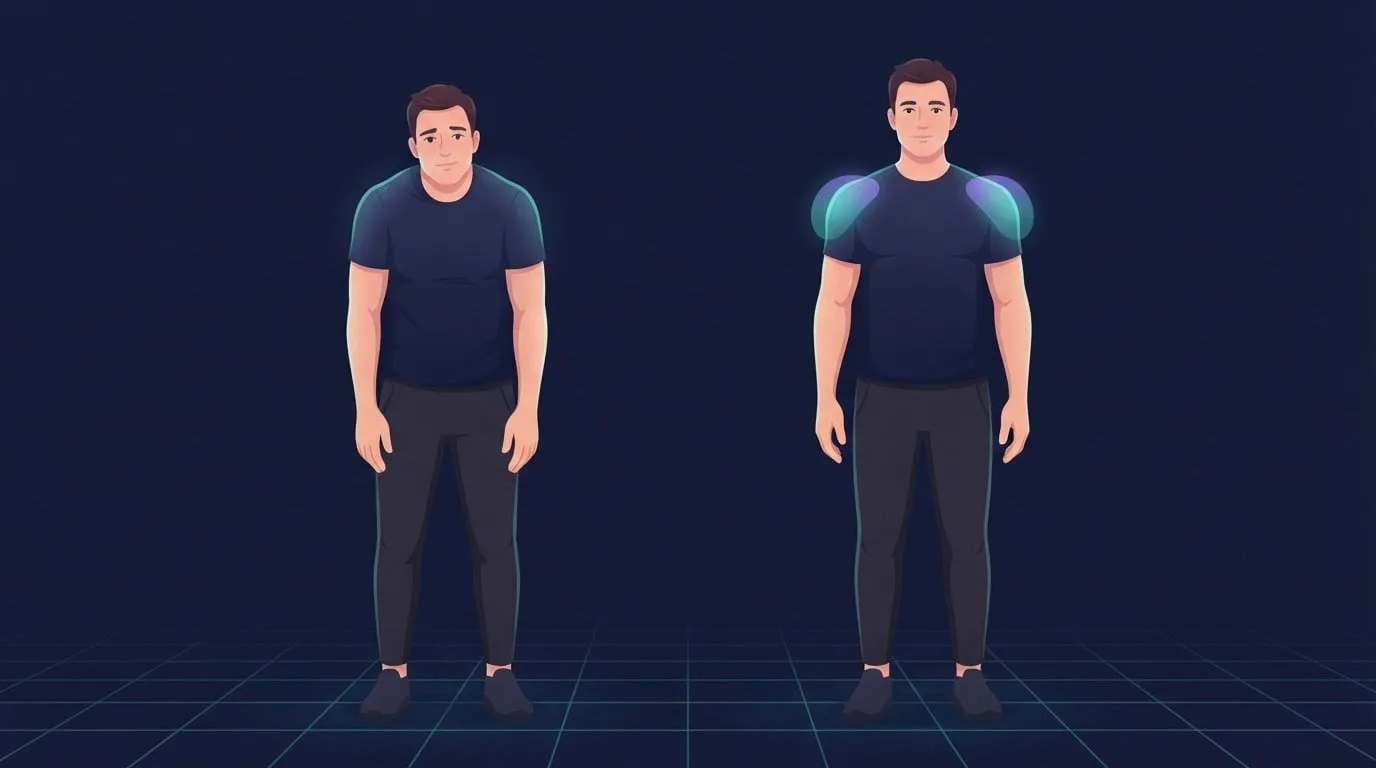
Rounded shoulders pull the points of your shoulders forward and inward, which narrows your outline from the front. Strengthening your upper back and loosening your chest lets them sit wider. Our guide to fixing rounded shoulders has a four-week plan. If tight shoulders stop you from pressing overhead with straight arms, start with these shoulder mobility exercises and a floor test that shows what is limiting you.
Shrink the waist side of the ratio
People judge shoulder width against the hips and waist below it. Pazhoohi and colleagues (2023), in the Archives of Sexual Behavior, showed 659 women male figures between 160 and 190 centimeters tall with three different shoulder-to-hip ratios. Women rated the figures with a larger ratio as more attractive, more masculine and better able to fight. Sell and colleagues (2017), in Proceedings of the Royal Society B, found that how strong a man's body looked explained more than 70 percent of how attractive raters found it, with height and leanness adding to that.
Losing fat around your waist raises that ratio from the bottom without changing your shoulders at all. If you're carrying extra weight around the middle, a modest calorie deficit alongside this plan may change your outline faster than the training alone.
How to Get Broader Shoulders at Home Without Equipment
No dumbbells yet? The side deltoids need so little load that they're the easiest muscle in this guide to train at home.
- Press: pike push-ups, with your feet raised on a step or couch once 12 reps feel easy.
- Side deltoids: lateral raises holding a loaded backpack, two water jugs or full bottles, or a resistance band anchored under your feet.
- Lats and upper back: inverted rows under a sturdy table or a bar at hip height, and one-arm rows with a loaded backpack.
- Rear deltoids: bent-over reverse flies with water bottles, or band pull-aparts.
Load is the limit at home, so lean on higher reps, slow lowering and short rests. Take sets close to failure, and the same weekly set counts from the table above apply.
How to Get Broader Shoulders as a Woman
Women use the same exercises and the same plan. The frame difference set at puberty stays, but muscle responds to training in a similar way in both sexes. In one of the largest training studies done, Hubal and colleagues (2005), in Medicine & Science in Sports & Exercise, trained one arm of 585 adults (342 women and 243 men) for 12 weeks. Men gained only 2.5 percent more muscle size than women, and women gained more strength in relative terms.
Rounder side deltoids and a defined upper back give the capped, athletic shoulders many women train for, and they won't appear by accident or overnight. In the Larsen trial, 10 hard sets of raises a week added a few percent of side-delt thickness over eight weeks, which is a steady change you control.
How Long Does It Take to Get Broader Shoulders?
It takes longer than social media suggests and about as long as any muscle takes. Early on, most of the change is in strength and coordination rather than muscle size. Damas and colleagues (2016), in the Journal of Physiology, took repeated thigh muscle biopsies from 10 young men over a training program. Their muscle fibers had grown measurably only by week 10, and in the first weeks the protein their muscles built went mostly to repairing damage.
People also vary a lot. In the Hubal study, muscle size changes after 12 weeks ranged from a 2 percent loss to a 59 percent gain on the same program. Use the timeline below as a guide from coaching practice, not a promise:
| When | What usually changes |
|---|---|
| Weeks 1 to 3 | Your raises get smoother and stronger. Muscle size has barely changed yet. |
| Weeks 6 to 10 | The first real muscle growth. Trained lifters in the Larsen trial added 3.3 to 4.6 percent side-delt thickness by week 8. |
| Months 3 to 6 | Shirts fit differently across the shoulders, and side-by-side photos show it. |
| Months 6 to 12 | A change in width that other people notice. |
Measure it the same way every time. Wrap a tape around the widest part of your shoulders with your arms relaxed, and take front photos in the same spot and light every four weeks. Your memory of last month's mirror isn't a measurement.
The Bottom Line
Your collarbones set the frame, and that part is done. The side deltoids, lats and upper traps on top of it are still yours to build. Train the side deltoids directly with about 10 hard sets a week, row for your lats, stand tall, keep your waist in check and give it at least three months.
The hard part is turning up three times a week for long enough to see it. As one FitCraft user, Mike, 23, put it: "The streak system got me hooked. I didn't want to break my chain."
Frequently Asked Questions
Are broad shoulders attractive?
Broad shoulders are consistently rated as attractive in men, mostly because they signal strength. Sell and colleagues (2017) found that how strong a man's body looked explained more than 70 percent of how attractive raters found it, and Pazhoohi and colleagues (2023) found that 659 women rated male figures with a larger shoulder-to-hip ratio as more attractive. Research on women's bodies has focused on waist and hip shape rather than shoulders, so there's less evidence either way for women.
Does testosterone widen shoulders?
Testosterone widened your shoulders during puberty, when the growth spurt made boys' shoulders broader than girls' from about age 13. In one growth study of 5,260 children, body widths stopped increasing at about 16 in boys and 14 to 15 in girls, and adult testosterone can't lengthen bones that have finished growing. As an adult, testosterone affects shoulder width only through muscle, and training builds that muscle in men and women.
What causes skinny shoulders?
Skinny shoulders usually come from a narrow bony frame, small side deltoids, or both. The frame is set by the end of puberty, but most people have never trained their side deltoids directly, because push-ups and presses load mainly the front of the shoulder. Rounded posture and extra fat around the waist make shoulders look narrower still.
Can I hit shoulders 3x a week?
Yes. Lateral raises and rear delt flies are light and cause little fatigue, so three shoulder sessions a week is fine for most people. Pelland and colleagues (2026) found that at the same weekly number of sets, training a muscle more often added little extra growth, so three days helps mainly by splitting 10 to 14 weekly sets into fresher, cleaner ones. Keep heavy overhead pressing to two of those days if your shoulders feel beaten up.
How to loosen very tight shoulders?
Tight shoulders usually loosen with a few minutes of movement most days rather than one long stretch. Spend 5 to 10 minutes on upper-back extensions over a rolled towel, doorway chest stretches, lat stretches and wall slides, and keep training through a full range that doesn't hurt. Sharp pain, numbness or stiffness that keeps getting worse needs a clinician.
How do I get big shoulders?
Train all three parts of the deltoid: an overhead press for the front and side, lateral raises for the side and rear delt flies for the back. Aim for about 10 hard sets a week each for the side and rear deltoids, eat enough protein, and judge the result after three months rather than three weeks. Big shoulders and broad shoulders overlap, but width depends most on the side deltoids and the lats.