Your shoulders keep a record of your day. Hours at a keyboard pull them forward, your phone pulls your head down, and a week of push-ups or dumbbell presses leaves the front of your chest feeling short. So you look up a shoulder stretch, find a list of fifteen, and do three of them for ten seconds each.
It's frustrating when that changes nothing. Usually the problem is the match: the stretch you picked pulls on a different tissue from the one that's tight, or it isn't held long enough or often enough to add range. Shoulder stretching exercises work when you aim them, hold them for about 30 seconds and repeat them for weeks. They're also a sensible first step among exercises for a sore shoulder from desk work or training, and the wrong tool for a few specific problems that this guide spells out.
Below are nine stretches, each labelled with the tissue it targets. After them come dynamic stretches for before training, a 5-minute routine, desk and post-workout versions, and the signs that point you to a physical therapist instead.
The 9 Best Shoulder Stretches and What Each One Targets
Shoulder tightness usually sits in one of five places: the back of the joint (the posterior capsule and the rotator cuff muscles behind it), the chest (pec major and pec minor), the lats, the upper traps and neck, or the front of the rotator cuff. Pick the stretches for where you feel it. Hold each one for about 30 seconds and repeat two to four times per side unless the stretch says otherwise. Ease in until you feel a clear pull, never pain.
| Stretch | What it targets | Hold |
|---|---|---|
| 1. Cross-body stretch | Back of the shoulder: rear deltoid, posterior capsule | 30 sec, 3 to 5 times |
| 2. Doorway chest stretch | Pec major and pec minor | 30 sec, 2 to 3 times |
| 3. Upper trap stretch | Upper trapezius | 30 sec, 2 to 3 times |
| 4. Levator scapulae stretch | Levator scapulae (neck to shoulder blade) | 30 sec, 2 to 3 times |
| 5. Kneeling lat stretch | Lats and teres major | 30 to 45 sec, 2 to 3 times |
| 6. Modified sleeper stretch | Back of the rotator cuff, posterior capsule | 30 sec, 3 times |
| 7. Doorway external rotation stretch | Front of the rotator cuff (subscapularis) | 30 sec, 2 to 3 times |
| 8. Overhead triceps stretch | Triceps long head and lats | 30 sec, 2 times |
| 9. Behind-the-back chest opener | Front deltoids, pec major, biceps | 20 to 30 sec, 2 to 3 times |
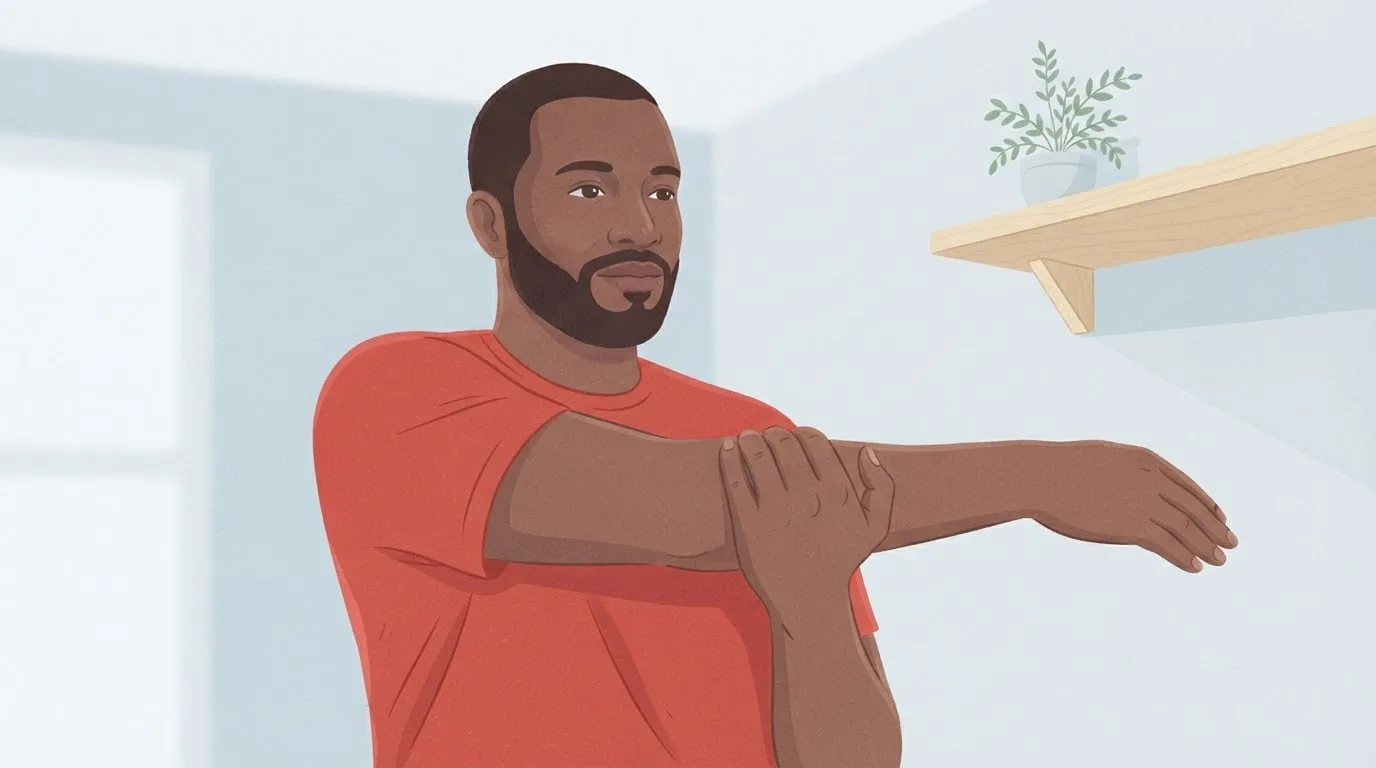
1. Cross-body shoulder stretch
- Stand or sit tall and raise one arm straight in front of you to shoulder height.
- Bring it across your chest and hold the upper arm just above the elbow with your other hand.
- Draw the arm toward your chest until you feel a stretch at the back of the shoulder.
- Keep the shoulder down and back. If it shrugs up or rolls forward, the shoulder blade slides instead of the joint stretching.
This is the shoulder stretch with the best trial behind it. In a 2007 randomized trial by McClure and colleagues in the Journal of Orthopaedic and Sports Physical Therapy, people with a tight back of the shoulder did five 30-second holds once a day for four weeks. The cross-body group gained 20.0 degrees of internal rotation, against 5.9 degrees in a control group. Lying on your back with the shoulder blade pinned to the floor makes the same stretch more precise, and the seated rear delt stretch is the chair version.
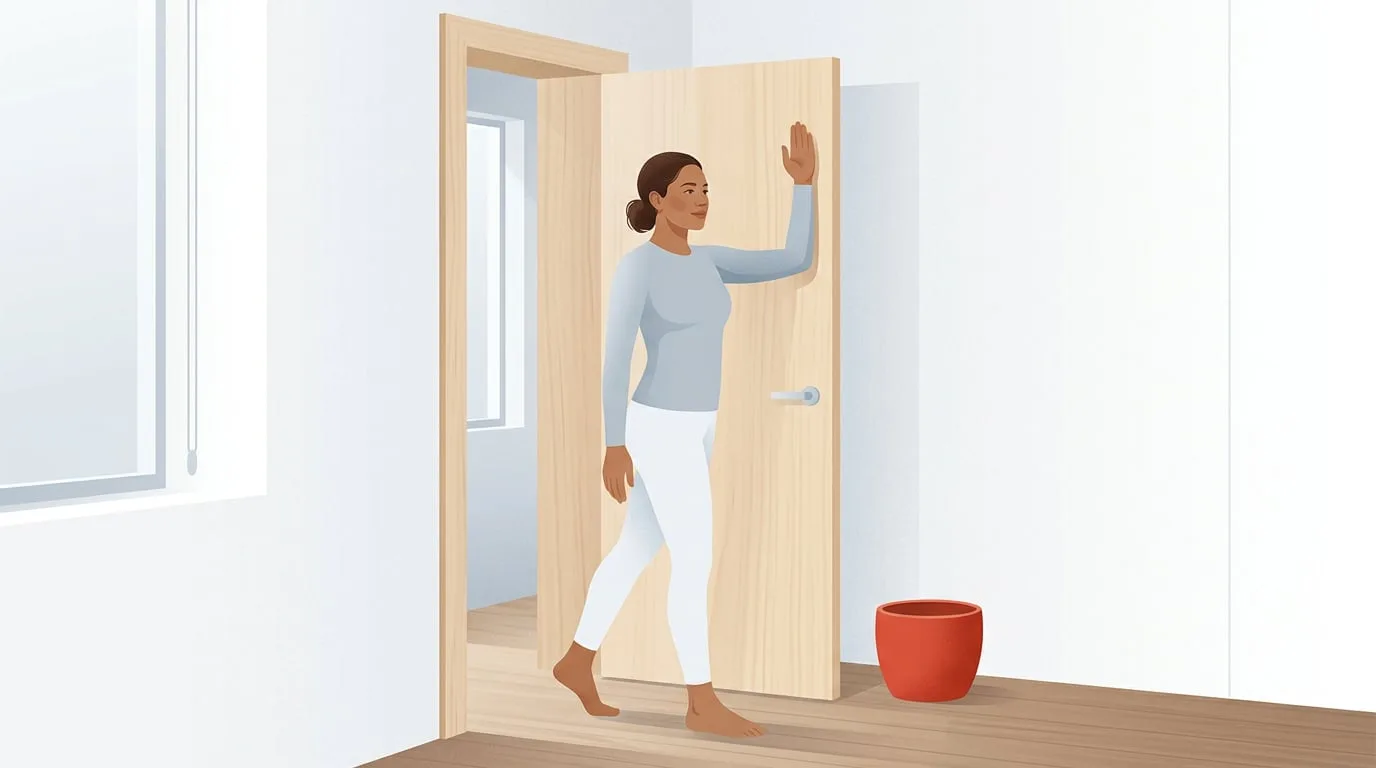
2. Doorway chest stretch
- Stand in a doorway or beside a wall corner. Bend one elbow to 90 degrees and place the forearm flat on the frame, with the elbow at about shoulder height.
- Step forward with the foot on the same side and slowly turn your chest away from the arm.
- Stop when you feel a stretch across the front of the chest and shoulder. Keep your ribs down so your lower back doesn't arch.
- Slide the elbow a little higher on the frame to shift the stretch toward the lower chest.
The pec minor runs from the ribs to the front of the shoulder blade, and when it's short it tips the shoulder blade forward. Borstad and Ludewig (2006), in the Journal of Shoulder and Elbow Surgery, used motion sensors in 50 people to measure how far three common pec minor stretches lengthened the muscle while it was held. A one-arm self-stretch against a corner lengthened it by 2.24 cm, more than a lying stretch done by a partner (1.69 cm) or a seated partner stretch (0.77 cm). The version you can do alone in a doorway is also the one that worked best.
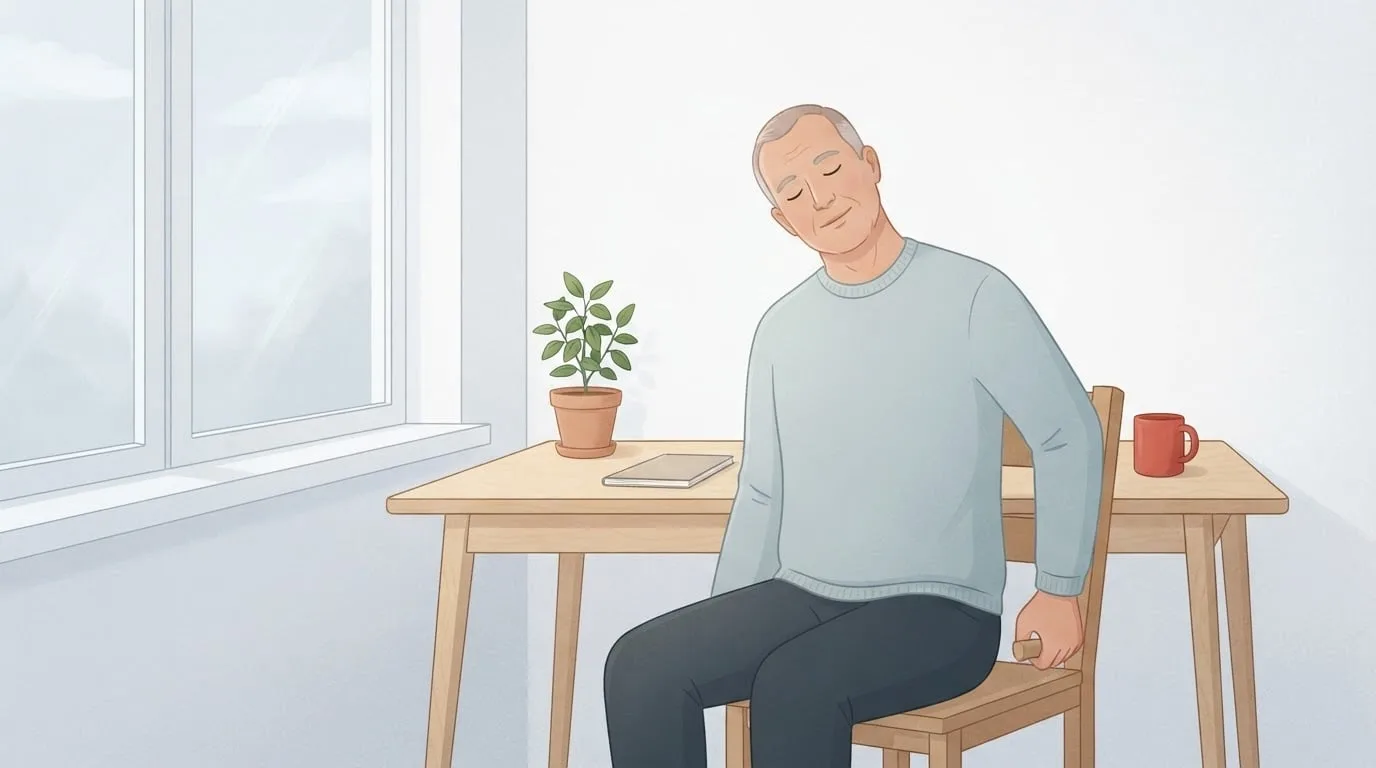
3. Upper trap stretch
- Sit tall and hold the edge of your seat with your right hand. This anchors the right shoulder down.
- Tilt your left ear toward your left shoulder without turning your head.
- If you need more, rest your left hand on the side of your head for light extra pressure.
- Breathe slowly and let the right shoulder sink a little further each time you breathe out. Then switch sides.
4. Levator scapulae stretch
- Sit tall and hold the seat with your right hand.
- Turn your head about 45 degrees to the left, then tip your chin down as if looking into your left pocket.
- Place your left hand on the back of your head and let its weight add a gentle pull.
- You should feel it behind the right side of your neck, down toward the shoulder blade. Then switch sides.
5. Kneeling lat stretch
- Kneel facing a chair, couch or low bench and rest your elbows on the seat, shoulder-width apart, palms together.
- Sit your hips back toward your heels and let your chest sink toward the floor between your arms.
- Keep your ribs tucked in so the stretch stays in the lats instead of arching your lower back.
- To work one side at a time, kneel in child's pose on the floor and walk both hands to the left. You'll feel the right lat.
6. Modified sleeper stretch
- Lie on the side you want to stretch, then roll back about a third of the way toward lying flat. Rest your head on a pillow.
- Put the bottom arm out in front at shoulder height with the elbow bent to 90 degrees and the fingers pointing at the ceiling.
- With your top hand, gently press the bottom forearm down toward the floor in front of you.
- Stop at a stretch in the back of the shoulder. A pinch at the front means you've gone too far, so ease off or roll further onto your back.
Baseball players love the sleeper stretch, but its numbers are modest. In Laudner, Sipes and Wilson (2008), in the Journal of Athletic Training, three 30-second sleeper stretches raised internal rotation in 33 college baseball players from 43.8 to 46.9 degrees. The authors noted that a change of about 3 degrees may not be clinically meaningful. In the McClure trial, the sleeper group's 12.4-degree gain wasn't significantly better than the control group's. Start with the cross-body stretch and keep this one as an option.
7. Doorway external rotation stretch
- Stand side-on to a doorway. Bend your elbow to 90 degrees and keep it tucked against your side.
- Put your palm flat against the door frame.
- Keep the elbow at your side and slowly turn your body away from the frame until you feel a stretch at the front of the shoulder.
- A rolled towel between your elbow and your ribs stops the elbow drifting out.
Skip this one if your shoulder has ever dislocated or slipped out of place. The front of the capsule is the structure that holds the joint in, and after a dislocation it needs strength work rather than more stretch.
8. Overhead triceps stretch
- Raise one arm overhead, then bend the elbow so your hand drops behind your head toward your upper back.
- With the other hand, gently press the elbow back and toward your head.
- Lean your upper body slightly away from the raised arm to add the lat.
- Keep your ribs down and your chin level instead of pushing your head forward.
The tricep-n-lat stretch page covers easier and harder versions of the same position.
9. Behind-the-back chest opener
- Stand tall and clasp your hands behind your back. If they don't meet, hold a towel between them.
- Straighten your elbows and gently draw your shoulder blades together.
- Lift your hands a few centimeters away from your back and lift your chest.
- Keep your chin tucked so your head doesn't drift forward.
What Are Dynamic Shoulder Stretches?
Dynamic shoulder stretches move the joint through its range with control instead of holding the end position. They warm the tissue and rehearse the positions you're about to use, so they're the better choice before push-ups, presses, rows, swimming or throwing. Do about 10 slow reps of each:
- Arm circles: start small and grow to full circles, 10 forward and 10 back.
- Hug-and-open swings: swing your arms wide at shoulder height, then across your chest into a hug, switching which arm is on top.
- Overhead swings: swing both arms forward and up overhead, then down and back behind you.
- Shoulder rolls: big, slow shoulder rolls up, back and down, then in reverse.
- Reach and rotate: hold your arms out to the sides and turn your upper body left and right, letting the arms follow.
Long static holds before a hard upper-body session are the habit to drop. Kay and Blazevich (2012) reviewed 106 studies in Medicine & Science in Sports & Exercise. Holds under 30 seconds had no meaningful effect on strength, a pooled change of minus 1.1%, and holds of 30 to 45 seconds cost about 1.9%. Holds of 60 seconds or longer were the ones likely to reduce force. A quick 20-second doorway stretch before push-ups is fine. Save the long holds for later.
Shoulder Stretches or Shoulder Mobility Drills?
Stretches hold a muscle at the end of its range and ease it further. Mobility drills train you to use the range under control. If your problem is reaching overhead, such as a dumbbell press that drifts forward or ribs that flare when you lift your arms, the upper back and lats are often part of it. Our guide to shoulder mobility exercises covers a floor test for which link is limiting you, plus active drills such as cat cow, thread the needle and light pullovers. This page sticks to static and dynamic stretches.
Find out what's really holding you back
FitCraft, our mobile fitness app, pairs you with an AI coach who builds you a personalized plan around your goals, schedule, and fitness level. Every FitCraft program is designed by Domenic Angelino, MPH (Brown University) and NSCA-CSCS, with research published in the Journal of Strength and Conditioning Research and Medicine & Science in Sports & Exercise.
Take the Free Assessment Free • 2 minutes • No credit cardA 5-Minute Shoulder Stretching Routine
This sequence covers the back of the shoulder, the chest, the upper traps, the lats and the triceps in five minutes. Do it in the evening, on rest days or after training. All you need is a doorway and a chair.
- 0:00 to 0:30: shoulder rolls, slow, in both directions.
- 0:30 to 1:30: cross-body stretch, 30 seconds per side.
- 1:30 to 2:30: doorway chest stretch, 30 seconds per side.
- 2:30 to 3:30: upper trap stretch, 30 seconds per side.
- 3:30 to 4:15: kneeling lat stretch, one 45-second hold.
- 4:15 to 5:00: overhead triceps stretch, about 20 seconds per side.
One pass gives most stretches 30 seconds a side. The American College of Sports Medicine's position stand on exercise (Garber and colleagues, 2011) recommends a total of 60 seconds per stretch on at least two days a week. So run the routine twice through, or once a day on most days. For a stiff back of the shoulder, copy the McClure trial and add five 30-second cross-body holds on the tighter side.
If you'd rather follow along than watch a clock, FitCraft's yoga and mobility workouts are led by a 3D AI coach who talks you through the session, and the moves come with interactive 3D demos you can pinch and zoom. Streaks reward you for showing up on the days you'd otherwise skip. It's part of a bodyweight workout app for home that also covers strength and cardio.
Shoulder Stretches at Your Desk
Desk shoulders are mostly neck and upper-trap shoulders. This 2-minute set works in your chair, every hour or two:
- Shoulder rolls, 10 back and 10 forward.
- Upper trap stretch while holding the seat, 30 seconds per side.
- Levator scapulae stretch, 30 seconds per side.
- Seated cross-body stretch, 20 seconds per side.
- Behind-the-back chest opener, holding the back of the chair or clasping your hands, 20 seconds.
Office workers have a trial behind this. Tunwattanapong and colleagues (2016), in Clinical Rehabilitation, randomized 96 office workers who'd had moderate to severe neck pain for at least three months. Everyone got an ergonomics brochure, and half also did neck and shoulder stretches twice a day, five days a week, for four weeks. Pain in the stretching group fell 1.4 points more on a 10-point scale, and their neck function and quality of life improved more as well. Workers who stretched at least three times a week gained more function than those who did it less often.
Stretching helps, and getting up still matters. Stand, walk to refill your water and check your chair and screen height. Shoulders that sit rounded forward also need a stronger upper back, which our guide on how to fix rounded shoulders lays out as a 4-week plan.
Shoulder Stretches After a Workout
After training, your muscles are warm and the short-term strength cost of long holds no longer matters, so this is the time for 30-second holds. Pick by what you trained:
- After pushing, such as push-ups and dumbbell presses: doorway chest stretch, overhead triceps stretch and behind-the-back chest opener.
- After pulling, such as rows and pullovers: kneeling lat stretch and cross-body stretch.
- After a full-body session: the 5-minute routine above.
Two or three 30-second holds per stretch is plenty. Don't expect them to prevent next-day soreness. A Cochrane review by Herbert, de Noronha and Kamper (2011) found that stretching after exercise reduced soreness the next day by about 1 point on a 100-point scale. Stretch after training for range and to wind down. The same matching rule works below the waist too: our guide to the best stretches for hamstrings pairs each leg stretch with the tissue it reaches.
What Shoulder Stretches Can and Can't Fix
A short chest muscle does change how your shoulder moves. Borstad and Ludewig (2005), in the Journal of Orthopaedic and Sports Physical Therapy, split 50 pain-free volunteers by pec minor length and tracked their shoulder blades as they raised their arms. In the short group, the shoulder blade stayed tipped forward at higher arm angles, the same pattern seen in people with shoulder impingement. That's a sound reason to stretch your chest if you spend the day hunched forward.
What daily stretching changes is less obvious. Rosa and colleagues (2017), in the Journal of Hand Therapy, had 25 people with shoulder pain and 25 without stretch the pec minor every day for six weeks. Pain and arm function improved in the group with pain, yet the muscle's resting length didn't change in either group. Stretching seems to help how the shoulder feels and works more than it remodels the muscle.
Stretching has limits, too. It won't build the upper-back strength that holds your shoulders back, and range you gain fades if you stop. Think of stretches as one half of the job and strength work as the other half.
When Stretching Is the Wrong Tool
Most stiff shoulders are simply underused. Stop stretching and see a doctor or physical therapist if any of these apply:
- Sharp pain during a stretch, or pain that's worse an hour afterwards.
- A shoulder that slips, clunks or has dislocated. An unstable shoulder already moves too much. Stretching the front of it can make that worse, and it needs a strengthening plan.
- A recent injury, fall or surgery. Healing tissue has its own timeline, so follow the plan from your surgeon or physical therapist.
- Weakness, such as struggling to lift your arm out to the side or hold it up, which can mean a rotator cuff tear.
- Night pain that wakes you, or stiffness that gets worse over weeks, especially losing the ability to turn your arm outward. That pattern is typical of frozen shoulder.
- Numbness, tingling or pain running down the arm, which often starts in the neck.
- Shoulder or arm pain with chest pressure, shortness of breath, sweating or nausea. Call emergency services, because this can be a heart problem.
Frozen shoulder (adhesive capsulitis) shows why pushing harder backfires. Diercks and Stevens (2004) followed 77 people with frozen shoulder for two years, reporting in the Journal of Shoulder and Elbow Surgery. Of those given supportive therapy and exercises kept within their pain limits, 89% reached normal or near-normal painless function. Only 63% of those given intensive physical therapy with passive stretching got there. Forcing a painful, inflamed shoulder into long stretches led to worse results.
Exercises for a Sore Shoulder: Stretch or Strengthen?
For a shoulder that's sore after a long week at a desk or a hard workout, gentle stretches and easy movement are a reasonable first step. Pain that has lasted more than a few weeks is different. Exercise therapy for it usually means strengthening the rotator cuff and the muscles around the shoulder blade, prescribed by a physical therapist who has examined you. Our guide to rotator cuff exercises shows what that strength work looks like.
The Bottom Line
Shoulder stretches work best when you aim them: the cross-body stretch for the back of the shoulder, a doorway stretch for the chest, chair-anchored neck stretches for the upper traps and a kneeling stretch for the lats. Hold about 30 seconds, build to 60 seconds per stretch, and repeat on most days for a few weeks. Move your shoulders before training and hold the stretches after it.
Tight shoulders are common, and most respond to five minutes a day. When they don't, or when stretching hurts, that's the moment to have a professional take a look.
Frequently Asked Questions
How can I relax my shoulder muscles?
To relax your shoulder muscles, pair slow breathing with gentle movement and short holds. Do 10 slow shoulder rolls, then an upper trap stretch and a levator scapulae stretch for 30 seconds a side, letting the shoulder sink a little further on each breath out. If your shoulders tense up at a desk, repeat the set every hour or two and get up to walk around.
How do you loosen extremely tight shoulders?
Find where the tightness sits first, then stretch that tissue with 30-second holds repeated two to four times, on most days for at least four weeks. Use the cross-body stretch for the back of the shoulder, a doorway stretch for the chest and a kneeling lat stretch if your arms won't go fully overhead. Shoulders that are very tight and also painful, or that lose range week by week, should be checked by a doctor or physical therapist, because frozen shoulder and other joint problems can feel like ordinary tightness.
What are dynamic shoulder stretches?
Dynamic shoulder stretches move the shoulder through its range with control instead of holding one position. Examples are arm circles, hug-and-open arm swings, overhead arm swings, shoulder rolls and reach-and-rotate twists, about 10 slow reps each. They're the better choice before a workout, because static holds of 60 seconds or longer can briefly reduce strength.
What are some good exercises for mobility in the rotator cuff?
For the back of the rotator cuff, the cross-body stretch and a gentle modified sleeper stretch improve internal rotation. In one randomized trial, daily cross-body stretching added 20 degrees of internal rotation in four weeks. For the front of the cuff, a doorway external rotation stretch with the elbow at your side works, unless your shoulder has ever dislocated. Pair the stretches with rotator cuff strengthening so you can control the range you gain.
Are there exercises for adhesive capsulitis in the shoulder?
Yes, but adhesive capsulitis (frozen shoulder) needs a diagnosis and a plan from a doctor or physical therapist rather than a generic handout or PDF. Programs usually start with gentle range-of-motion work kept within pain limits, such as pendulum swings and table slides. In a two-year study of 77 people with frozen shoulder, exercising within pain limits led to normal or near-normal function in 89%, against 63% with intensive stretching and mobilization.
How long should you hold a shoulder stretch?
Hold a shoulder stretch for about 30 seconds and repeat it two to four times, for around 60 seconds in total per stretch, which matches the American College of Sports Medicine's recommendation. Stretch at least two days a week, or daily for a tight spot. Before a workout, keep holds short or use dynamic stretches instead.
Should you stretch a sore shoulder?
Gentle stretching is fine for a shoulder that feels stiff or achy after desk work or training, as long as it doesn't cause sharp pain or leave you worse an hour later. Don't stretch through pain after a fall or injury, or a shoulder that has slipped out of place or comes with weakness, numbness or night pain. Those need a professional assessment first.