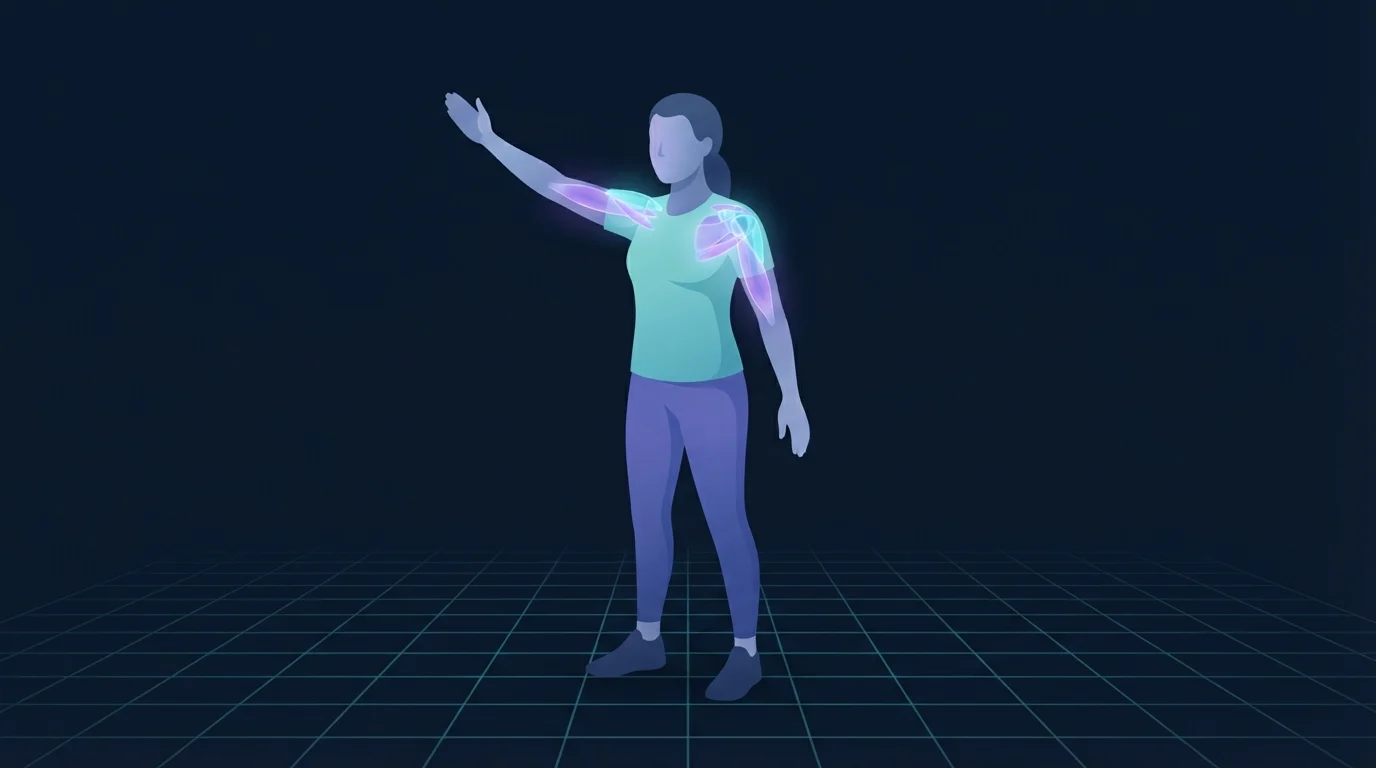
Your shoulder has been annoying for four months. It's fine most of the day, and then you reach behind the passenger seat, or lift a pan onto the top shelf, and there's a catch on the outside of the joint that makes you suck air through your teeth. You looked it up. Every result said rotator cuff, and every result showed the same photo of someone holding a thin band at their waist.
So you did that. Three sets of twenty, most mornings, for a few weeks. Nothing much changed. The part that stings isn't the shoulder, it's the quiet conclusion you drew: that this is just how your shoulder is now, and the exercises are a box you tick on the way to accepting it.
The exercises weren't wrong. The dose was. Cuff work got packaged as a gentle pre-workout ritual somewhere in the 1990s and it never got unpackaged, so people do a movement that should be genuinely hard by the last rep at a load that couldn't fatigue a forearm. Here's what these muscles do, the five exercises that load them properly, and what happened in the trials where the load was right.
What the Rotator Cuff Actually Does
Four muscles start on the shoulder blade and wrap around to attach on the top of the upper arm bone. Supraspinatus runs over the top. Infraspinatus and teres minor come from behind and rotate the arm outward. Subscapularis sits on the front surface of the shoulder blade, sandwiched between it and the ribs, and rotates the arm inward.
Together they do something the big muscles can't. The socket of the shoulder is shallow, roughly a third of the size of the ball that sits in it, which is why the joint has more range than any other in your body and why it's the one that dislocates. The cuff compresses the ball into that shallow dish so the deltoid can pull the arm overhead without the head of the bone riding upward into the roof of the joint. The review by Escamilla and colleagues (2009) in Sports Medicine puts numbers on the partnership: the middle deltoid contributes 35 to 65 percent of the force during abduction, and subscapularis alone supplies about 30 percent. The cuff is not a small accessory to the movement. It's half of it.
That's also why cuff problems present as vague rather than dramatic. Nothing tears in a moment. The shoulder just stops tolerating the reach behind you, then the overhead press, then sleeping on that side, and each step feels small enough to work around.
What a scan does and doesn't tell you
One thing worth knowing before you go looking for a diagnosis. Teunis and colleagues (2014) pooled 30 studies covering 6,112 shoulders and found cuff abnormalities on imaging in 9.7 percent of people aged 20 and under, rising to 62 percent of people aged 80 and over. The rate climbed with age whether or not the shoulder hurt. Imaging findings are common, they accumulate quietly, and on their own they're a poor explanation for the pain you woke up with. What you can change is how much load the tissue tolerates.
The Five Rotator Cuff Exercises Worth Doing
These five are chosen on two criteria: electromyography showing they actually recruit the target muscle without the deltoid taking over, and appearance in the programs that produced results in controlled trials. Everything else is a variation on one of them.
| Exercise | What it loads | Why it's here |
|---|---|---|
| Side-lying external rotation | Infraspinatus, teres minor | Highest EMG of the common ER exercises (Reinold 2004) |
| Prone external rotation at 90° | Supraspinatus, infraspinatus | Better supraspinatus-to-deltoid ratio than "can" lifts (Boettcher 2009) |
| Standing band external rotation | Infraspinatus, teres minor | Easiest position to add load week after week |
| Side-lying internal rotation | Subscapularis | The half of the cuff most programs skip entirely |
| Prone Y raise or row | Lower and mid trapezius, serratus | Every successful trial program included scapular work |
1. Side-lying external rotation
Lie on your side with the working arm on top, elbow bent to 90 degrees and tucked against your ribs, forearm across your stomach. Roll a small towel under the elbow so the upper arm sits slightly away from your body. Rotate the forearm up toward the ceiling without letting the elbow drift off the towel, then lower slowly over about three seconds.
This is the highest-yield position for the back of the cuff. Reinold and colleagues (2004) measured EMG in the infraspinatus, teres minor, supraspinatus and both heads of the deltoid across the common external rotation exercises and found side-lying external rotation produced the greatest activity in the infraspinatus, at 62 percent of maximum voluntary contraction, and the teres minor, at 67 percent. Standing versions with the arm at the side came in meaningfully lower.
Start with 2 to 5 pounds. That number looks absurd written down. It won't feel absurd on rep 13 with a slow lowering phase.
2. Prone external rotation at 90 degrees
Lie face down on a bench or bed with the working arm hanging off the edge, then raise the upper arm until it's level with your shoulder and supported by the surface, elbow bent to 90 degrees and forearm hanging straight down. Rotate the forearm up and back until it's level with the floor. Lower slowly.
This one earns its place because of what it doesn't recruit. Boettcher, Ginn and Cathers (2009), writing in Medicine and Science in Sports and Exercise, compared five exercises commonly prescribed to strengthen supraspinatus and concluded that pendant and prone external rotation are more valid choices than the "full can" and "empty can" lifts, because they achieve supraspinatus activity while keeping deltoid activity down. The can exercises light up the deltoid so much that you can't tell what you're actually training.
3. Standing external rotation with a band or cable
Anchor a band at elbow height, stand side-on, elbow tucked and bent to 90 degrees, and rotate the forearm outward away from your body. Keep the elbow pinned. If your torso rotates, the band is too heavy or you're too close to the anchor.
EMG on this one is lower than side-lying. It stays on the list for a practical reason: it's the easiest version to progress. A band gives you a continuous ladder of resistance instead of a jump from 5 pounds to 8, and it travels. If you're only going to do one external rotation exercise for the next three months, this is the one you'll still be doing in month three.
Find out what's really holding you back
FitCraft, our mobile fitness app, pairs you with an AI coach who builds you a personalized plan around your goals, schedule, and fitness level. Every FitCraft program is designed by Domenic Angelino, MPH (Brown University) and NSCA-CSCS, with research published in the Journal of Strength and Conditioning Research and Medicine & Science in Sports & Exercise.
Take the Free Assessment Free • 2 minutes • No credit card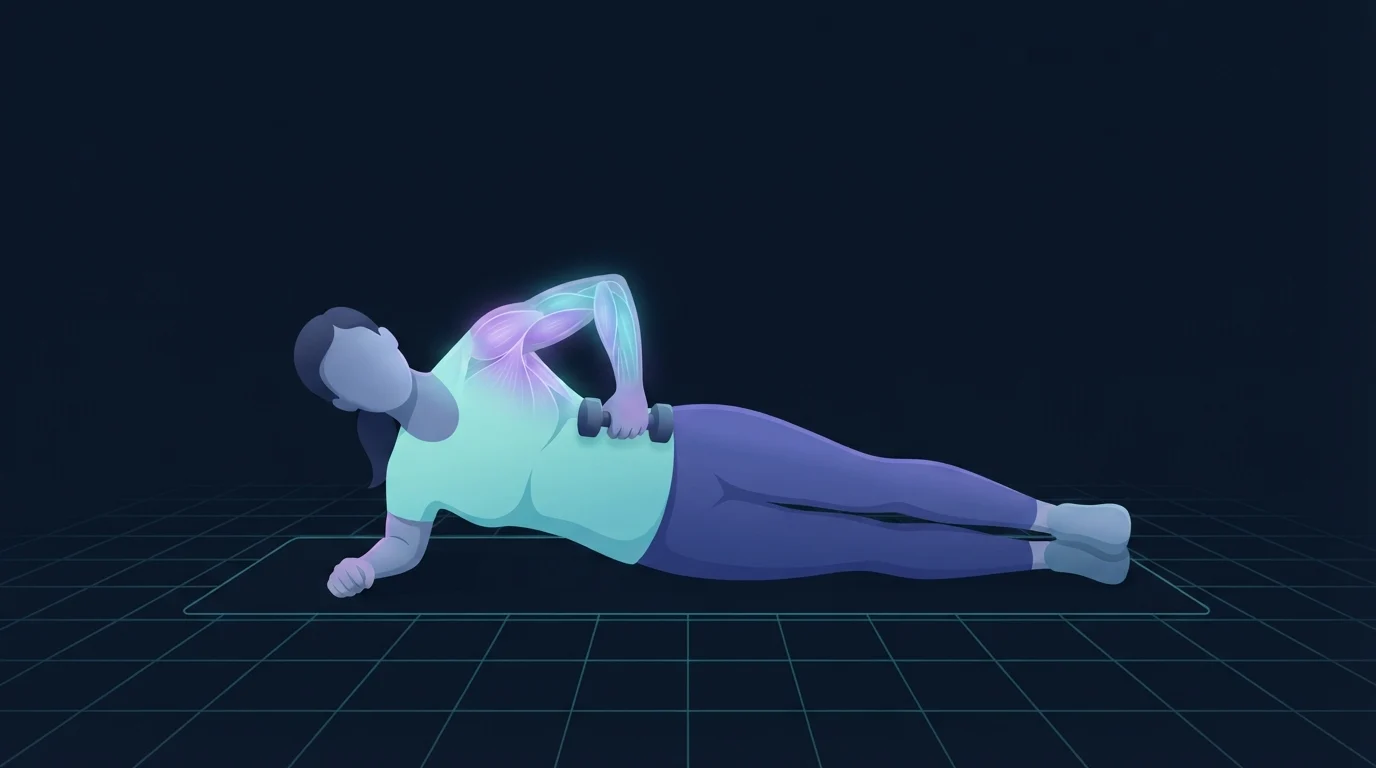
4. Side-lying internal rotation for the subscapularis
Lie on the side you want to train, working arm underneath, elbow bent to 90 degrees and held against your ribs, forearm out in front of you on the floor. Rotate the forearm up across your body. Lower slowly.
Most cuff routines are three external rotation variations and nothing else, which trains half the cuff and ignores the muscle that supplies roughly 30 percent of abduction force. Subscapularis is also the muscle doing the work when you reach behind your back, tuck in a shirt, or put on a jacket, which is why people who only train external rotation keep finding those exact movements still catch.
5. One scapular exercise
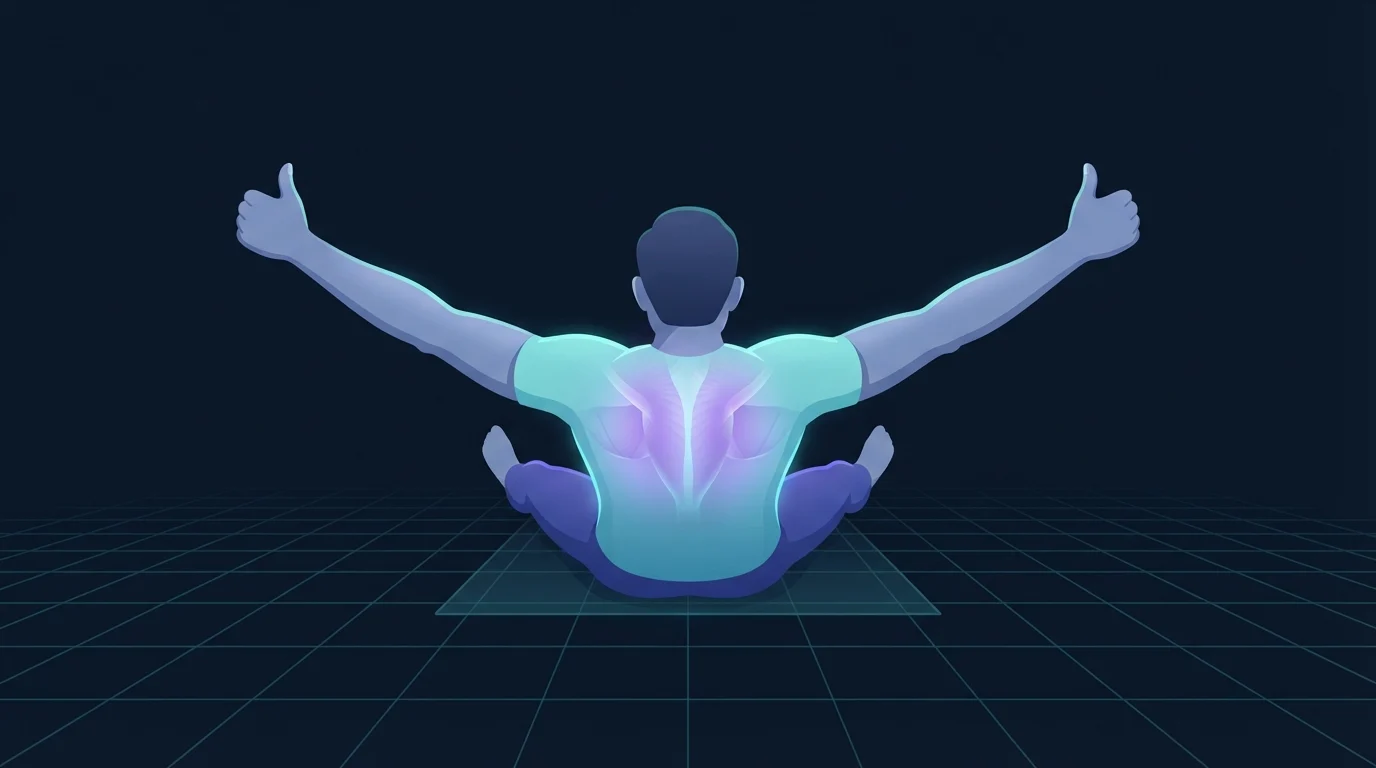
A prone Y raise, a wall slide, or a row. Lie face down with arms overhead in a Y shape and lift them an inch off the floor with the thumbs up, or stand with forearms on a wall and slide them upward without shrugging, or row a dumbbell to your ribs and hold for a second at the top.
The shoulder blade is the platform the whole joint sits on. Every trial program that produced a large effect included scapular work alongside the cuff work, and the biggest of them used three separate scapular exercises. If you're already doing rows and pull-ups, you may have this covered. Our guide to fixing rounded shoulders goes deeper on the upper-back side of the problem.
Rotator Cuff Strengthening: How Heavy and How Often
Here's the part the photo of the thin band never covers.
| Variable | Starting point | Progression |
|---|---|---|
| Frequency | 2 to 3 sessions a week | Daily if the shoulder has been sore for months |
| Sets and reps | 3 sets of 8 to 15 | Add reps first, then weight |
| Effort | Last 2 to 3 reps genuinely hard | RPE 7 to 8, not 4 |
| Tempo | Lower over 3 seconds | Keep the slow lowering as load rises |
| Load change | 2 to 5 lb to start | Increase every 1 to 2 weeks |
| Pain allowed | Up to about 4 out of 10 | Must settle by the next morning |
Effort is the variable people get wrong, and it's worth being honest about how confident the evidence is here. Naunton and colleagues (2020), in a Clinical Rehabilitation meta-analysis of randomised trials in rotator cuff related shoulder pain, found uncertain clinical benefit for progressive resisted exercise over comparison conditions, and no clear benefit for non-progressive, non-resisted exercise. Read carefully, that isn't a licence to keep the band light. It's a warning that loading alone isn't magic, and that the strongest single programs in the literature were the specific, progressed ones.
The practical rule: the set has to get hard. If you finish 15 reps and could obviously do 15 more, you did a warm-up. Use RPE 7 to 8 as the target and add weight the week it starts feeling like a 5.
Shoulder Impingement Exercises: What the Trials Actually Tested
"Shoulder impingement" is the label most people arrive with, and the shoulder impingement exercises that have the best evidence behind them are, unsurprisingly, the five above done properly.
The trial worth knowing is Holmgren and colleagues (2012) in the BMJ. They took 102 patients aged 30 to 65 with subacromial impingement of at least six months, all of them already on a waiting list for surgery, and randomised them to either a specific exercise strategy or a control exercise program. The specific program was two eccentric exercises for the cuff plus three concentric and eccentric exercises for the scapular stabilisers, 3 sets of 15 reps twice a day for eight weeks, then once a day through week 12, with load added by weights and bands as they progressed.
At three months the specific group had improved 24 points on the Constant-Murley shoulder score against 9 points in the control group. More striking: 20 percent of the specific-exercise group still chose to have the surgery they were queued for, compared with 63 percent of the control group.
That result doesn't stand alone. Steuri and colleagues (2017), reviewing conservative interventions in the British Journal of Sports Medicine, found exercise superior to non-exercise controls for pain, and specific exercises superior to generic ones. Ludewig and Borstad (2003) randomised 67 construction workers with shoulder pain, mean age 49, to a home exercise program or a control group and found reduced symptoms and improved function from home work alone, no clinic required.
And the surgical comparison is less flattering than you'd expect. Beard and colleagues (2018) ran a placebo-controlled surgical trial across 32 UK hospitals, comparing arthroscopic subacromial decompression against arthroscopy alone and against no treatment. Both surgical groups beat no treatment, but not by a clinically important margin, and the actual decompression added nothing over looking inside the joint and doing nothing. For most people this isn't a shoulder that needs an operation. It's a shoulder that needs a load it hasn't met yet.
Five Ways Cuff Work Goes Wrong
The load never changes. The most common failure by a distance. You picked the yellow band in month one and you're still on the yellow band in month four. Nothing about that is training. Add resistance every week or two or accept that the routine is a habit, not a stimulus.
Only external rotation. Three ER variations and no internal rotation trains half the cuff. Subscapularis is the front half, it's the biggest of the four, and it's the one that matters for reaching behind your back.
Doing it as a warm-up and nothing else. Two minutes of band work before bench press is fine as a warm-up and useless as rehab. Rehab is its own session, or at minimum its own block of sets with real effort, done when you're fresh enough to push.
Chasing full range through sharp pain. Mild discomfort is allowed. A catch that makes you flinch means that range, that day, is too much. Shorten the range, keep the load, and let the range come back as the tissue tolerates more.
Stopping at week three. The trials ran 8 to 12 weeks. Week three is roughly where the initial enthusiasm dies and nothing visible has happened yet, which is exactly where most people conclude it isn't working. Our guide to the week 3 motivation dip covers why that point is so predictable.
What to Expect
Weeks 1 and 2 are calibration. You'll get the load wrong, probably too light, and you'll discover which of the five positions your shoulder dislikes. That's useful information rather than a setback.
Weeks 4 to 6 are usually where the first honest change shows up, and it rarely arrives as a dramatic improvement. It arrives as a reduction in the number of daily movements that catch. The car reach stops being a problem before the overhead press does.
Weeks 8 to 12 are where the trial results were measured. If you've been consistent and progressive and nothing has moved at all by week 8, that's the point to get the shoulder assessed in person rather than to try a different set of exercises. If it has moved, keep going. Mobility work pairs well with the strength work at this stage, and our rotator cuff stretch and shoulder mobility exercises cover that side. Loading small muscles consistently also pays off well beyond the shoulder, which the research on strength training and injury prevention lays out in detail.
If the barrier is remembering to do a five-exercise block three times a week for three months, that's a scheduling problem rather than a shoulder problem, and it's the one an app is genuinely good at solving. A dumbbell workout app that already programs your week can slot cuff work in where you'll actually see it.
The Bottom Line
Five exercises, three sessions a week, 3 sets of 8 to 15 reps at a weight that makes the last few hard, progressed every week or two, for 8 to 12 weeks. That's the whole prescription, and it's the one that took a group of patients off a surgical waiting list in a randomised trial.
Your shoulder isn't fragile and you didn't fail at the exercises. You were handed a photo of a thin band and no instructions about effort, which is the one variable that decides whether any of this does anything.
Frequently Asked Questions
What are the best rotator cuff exercises?
Five cover the job: side-lying external rotation, prone external rotation at 90 degrees of abduction, standing external rotation with a band or cable, side-lying internal rotation for the subscapularis, and one scapular exercise such as a prone Y raise or a row. Side-lying external rotation produced the highest recorded activity of the common external rotation exercises, 62 percent MVIC in the infraspinatus and 67 percent in the teres minor (Reinold et al., 2004). Do them with a load you could not lift twice more with clean form, not with the lightest band in the drawer.
How often should you do rotator cuff exercises?
Two or three sessions a week is the usual prescription and it's enough for most people. The trial that moved the needle hardest was more demanding than that: Holmgren and colleagues had patients do 3 sets of 15 repetitions twice a day for eight weeks, then once a day for four more. If your shoulder has been sore for months rather than days, treat daily work as the honest starting point and scale back once it settles.
How much weight should you use for rotator cuff exercises?
Enough that the last two or three repetitions are genuinely hard. For most people starting side-lying external rotation that's somewhere between 2 and 8 pounds, which feels insultingly light until you do 15 reps with a slow lowering phase. The cuff muscles are small, so the absolute number stays small, but the effort shouldn't. Add load roughly every one to two weeks, and if you never add load, the program stops being training and becomes a ritual.
Do rotator cuff exercises help shoulder impingement?
Yes, and the effect can be large. In a randomised controlled trial of 97 patients already on a surgical waiting list, a specific program of loaded eccentric cuff work plus scapular exercises improved Constant-Murley scores by 24 points against 9 in the control exercise group, and at three months only 20 percent of the specific-exercise group still wanted surgery compared with 63 percent of controls (Holmgren et al., 2012). A meta-analysis of conservative care also found specific exercises beat generic exercises for pain (Steuri et al., 2017).
Is it normal for rotator cuff exercises to hurt?
Mild discomfort during the set is acceptable in most rehab protocols as long as it stays around 4 out of 10 or below, settles within a few minutes of finishing, and doesn't leave the shoulder worse the next morning. Sharp pain, pain that climbs set to set, or a shoulder that's angrier 24 hours later means the load or the range was too much that day. Reduce one variable, usually the weight, and keep going rather than stopping entirely.
How long do rotator cuff exercises take to work?
Plan on 8 to 12 weeks before you judge the program, because that's how long the successful trials ran. Most people notice the first change between weeks 4 and 6, usually as a reduction in the number of daily movements that catch rather than as a single dramatic improvement. If nothing at all has shifted by week 8 of consistent, progressed loading, that's the point to get the shoulder assessed in person.