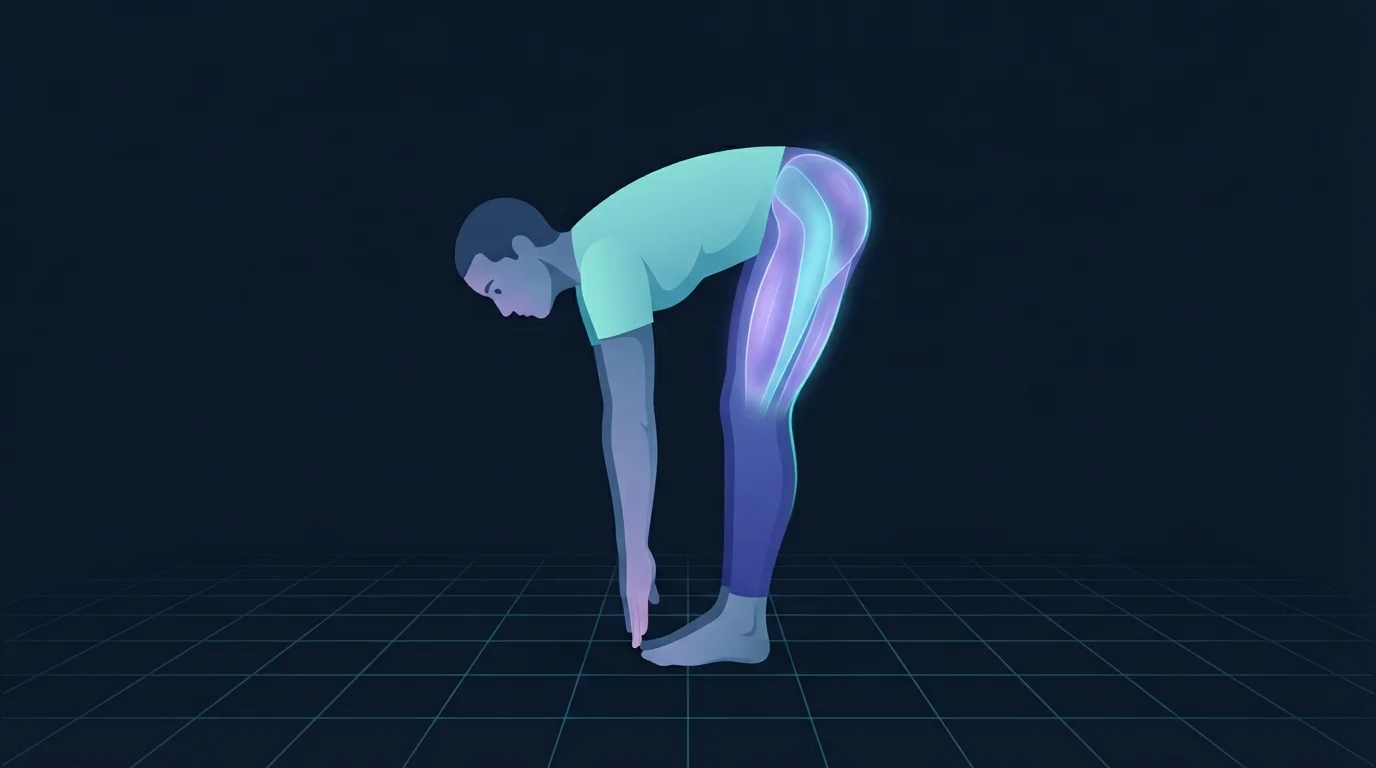
Stand up, feet together, knees locked straight, and fold forward. Wherever your fingertips land is a number you've probably carried since a gym class in middle school, and most people assume it's fixed. It isn't. It's one of the most trainable measurements in the body, and the reason it hasn't moved is usually that nobody told you the dose.
The frustrating part is that toe-touch advice is everywhere and almost all of it is the same advice: hold a hamstring stretch for 20 seconds, do it a few times a week, wait. That prescription is roughly a tenth of what the research says produces change. So people do it for a fortnight, measure no difference, and file themselves under "not flexible" for another decade.
Here's what actually limits the reach, how to test which part is yours, and a four-week plan you can run on a carpet with a towel.
Why You Can't Touch Your Toes
Three structures decide the answer, and they're worth separating because the fix for each one is different.
Your hamstrings, mostly
The hamstrings cross both the knee and the hip. With the knee locked straight and the hip flexing forward, they're being lengthened at both ends at once, which is why the standing toe touch is the single most demanding position most people put them in all week. If you sit for most of the day, they spend that day short and unloaded, and both the tissue and the nervous system adapt to the range you actually use.
This is the part of the problem most stretching programs correctly target. It's also the part that responds fastest.
Your hips, not your spine
A proper toe touch is a hip movement. The pelvis rotates forward over the femurs while the spine stays long, and the spine contributes a modest, normal amount of flexion on top. When the pelvis stops rotating, most people compensate by curling the upper back, which drops the fingertips a few inches without lengthening anything useful.
Two things commonly block the pelvis. One is hamstring tension pulling down on the back of it. The other is the hip joint's own available flexion, which is influenced by capsule stiffness and by hip flexors that have been held short all day. If deep hip flexion pinches at the front of your hip rather than pulling behind your thigh, start with our guides on tight hip flexors and hip mobility exercises, because more hamstring stretching won't touch that.
What is not the cause: a long torso, a short spine, short arms, or "bad genetics". Limb proportions shift the toe touch by a small amount, and they're the same proportions you had when you could do it as a child.
Your nervous system decides when to stop
This is the finding that changes how the whole thing should be trained. Ben and Harvey (2010), in the Scandinavian Journal of Medicine and Science in Sports, randomised 60 healthy adults to stretch one hamstring for 30 minutes a day, five days a week, for six weeks. Joint range of motion went up. Measured muscle extensibility did not. What changed was the participants' tolerance of the stretch sensation.
Weppler and Magnusson (2010) laid out the mechanism in Physical Therapy: over weeks, the reliable change from stretching is a modified sensory response rather than a permanently longer muscle. Your body holds a protective limit on how far it will let a lengthened muscle go, and training gradually raises that limit.
Practically, this means the stretch that works is calm, warm, unhurried and repeated. A hard, gritted, bouncing stretch triggers the exact protective response you're trying to turn down.
Test Yourself First: The Sit-and-Reach
Before you train it, measure it. The sit-and-reach is the standard test and you can run it with a box and a ruler.
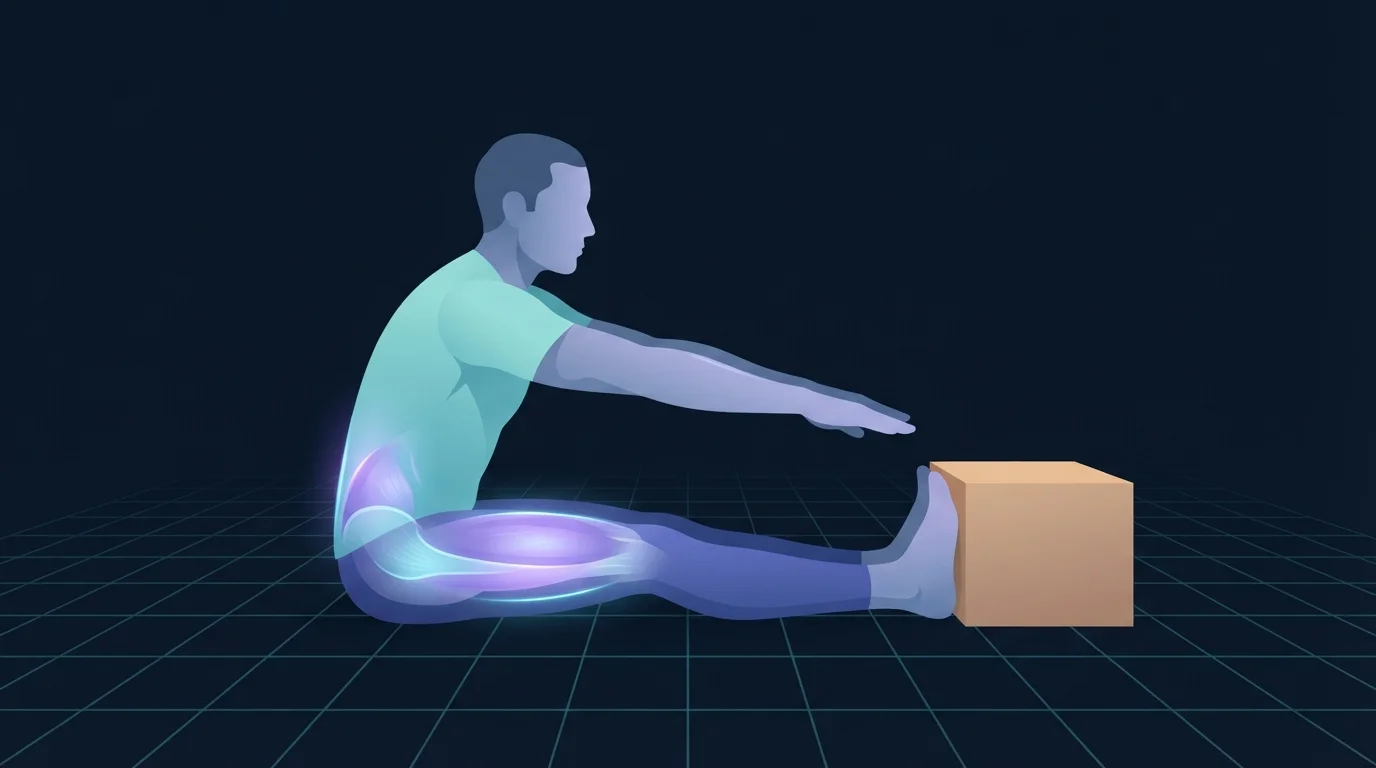
Sit on the floor with your legs straight and the soles of both feet flat against a box or a wall. Keep your knees pressed down, exhale, and reach both hands forward along the top of the box as far as you can without bouncing. Hold the end position for two seconds. Mark where your fingertips reach relative to the front of the box: level with your toes is zero, past them is positive, short of them is negative. Take the best of three, measured at the same time of day, because range is meaningfully better in the afternoon than first thing in the morning.
Be honest about what the score means. Mayorga-Vega, Merino-Marban and Viciana (2014) pooled 34 studies in the Journal of Sports Science and Medicine and found sit-and-reach variants had only moderate criterion validity for hamstring extensibility (r = 0.46 to 0.67) and low validity for lumbar extensibility (r = 0.16 to 0.35). It's a decent hamstring proxy and a poor low-back one. Its real value is that it's repeatable, so it tracks your own change well even though it estimates any one tissue imperfectly.
The two-minute test that tells you which problem is yours
- Bend your knees 20 degrees and fold again. If your hands suddenly reach the floor, hamstring length is your limiter. This is the most common result by a wide margin.
- Sit on a chair and hinge forward with a flat back. If the pull is behind your thighs, hamstrings again. If it's a hard pinch at the front crease of the hip, the hip joint and its flexors are involved.
- Lie on your back, keep one leg flat, and raise the other straight leg. Under about 70 degrees before the knee wants to bend is a clear hamstring restriction. Above 80 degrees with a poor standing fold points at the hips and the pelvis.
- Fold with your heels raised on a book. A noticeable improvement means calf and ankle tension is contributing, in which case a few minutes of ankle mobility work belongs in the plan too.
How Much Stretching Actually Changes Range
This is where most toe-touch plans fall apart, so it's worth spelling out the numbers.
The most complete answer comes from Ingram and colleagues (2025) in Sports Medicine, a meta-analysis and multivariate meta-regression of 189 studies covering 6,654 adults. Chronic static stretching produced a large improvement in flexibility (Hedges' g = 0.96, 95% CI 0.84 to 1.09). More importantly for programming, the regression found gains were maximised at roughly 4 minutes per session and 10 minutes per week for a muscle group, with no further benefit past that. Stretching intensity, age, sex, training status and weekly session count did not moderate the effect. Baseline flexibility did: the people who started the least flexible improved the most.
Read that dose again. Ten minutes a week for the hamstrings is the ceiling, not the entry fee, and it's roughly ten times what the average person actually does.
Thomas and colleagues (2018), in the International Journal of Sports Medicine, reached a compatible conclusion from 23 studies: static protocols beat ballistic and PNF ones over the long term, a minimum of about 5 minutes per week per muscle group is needed, and weekly frequency was positively associated with range gains.
On the length of each hold, the classic trial still stands. Bandy, Irion and Briggler (1997) randomised 93 adults with limited hamstring flexibility into five groups who stretched five days a week for six weeks. A single 30-second hold produced the same knee-extension range gain as 60 seconds, and performing a second or third 30-second bout in the same day added nothing. One good hold, most days, is the shape of the answer.
And you don't have to get all of it from stretching. Afonso and colleagues (2021) pooled 11 randomised trials covering 452 participants in Healthcare and found no significant difference between strength training and stretching for range of motion (ES = -0.22, 95% CI -0.55 to 0.12, p = 0.206). O'Sullivan, McAuliffe and DeBurca (2012), in the British Journal of Sports Medicine, reviewed six high-quality studies of eccentric training and found every one produced increases in range of motion or muscle fascicle length. Our review of the Nordic hamstring curl research covers the same mechanism from the injury-prevention side.
That's why the plan below is half stretching and half loaded hinging. Two routes to the same adaptation, and the second one leaves you stronger.
Find out what's really holding you back
FitCraft, our mobile fitness app, pairs you with an AI coach who builds you a personalized plan around your goals, schedule, and fitness level. Every FitCraft program is designed by Domenic Angelino, MPH (Brown University) and NSCA-CSCS, with research published in the Journal of Strength and Conditioning Research and Medicine & Science in Sports & Exercise.
Take the Free Assessment Free • 2 minutes • No credit cardSix Progressions That Move the Toe Touch
Everything here works on a floor with a towel and, for the fifth one, a pair of dumbbells or a loaded bag. Nothing needs a gym. If you want the strength side of the week to run on the same equipment-free footing, our bodyweight workout app for home page covers how a no-equipment program is structured.
1. Supported hip hinge
Stand a forearm's length from a wall, feet hip width, knees soft. Push your hips back until your backside taps the wall, keeping your chest long and your spine neutral. Come back up. This teaches the pelvis to rotate forward over the hips, which is the movement a toe touch is actually made of. Two sets of 8, daily, as a warm-up for everything else.
2. Supine hamstring stretch with a towel
Lie on your back, loop a towel around the arch of one foot, and raise that leg with the knee straight until you feel a firm but breathable pull behind the thigh. Not a 9 out of 10. About a 6. Keep the other leg flat on the floor. Hold 60 seconds, breathe slowly, and let the leg drift a little further as the sensation fades. Two holds per leg. This is your highest-value minute of the day, because the floor supports your back and removes the balance problem.
3. Standing fold with a soft knee
Fold forward with a 20-degree knee bend and let your head and arms hang heavy for 60 seconds. Over the four weeks, straighten the knees a few degrees each week. Starting bent is not cheating. It lets the pelvis rotate before the hamstrings clamp, which is exactly the sequence you're trying to train.
4. Half-kneeling hip flexor stretch
Kneel on one knee, tuck your tailbone under to flatten the lower back, and shift forward a couple of inches until you feel a stretch at the front of the kneeling hip. Squeeze that glute. Hold 45 seconds per side. If the pinch-at-the-front test flagged your hips, this one matters more than the hamstring work does.
5. Loaded hinge: the Romanian deadlift
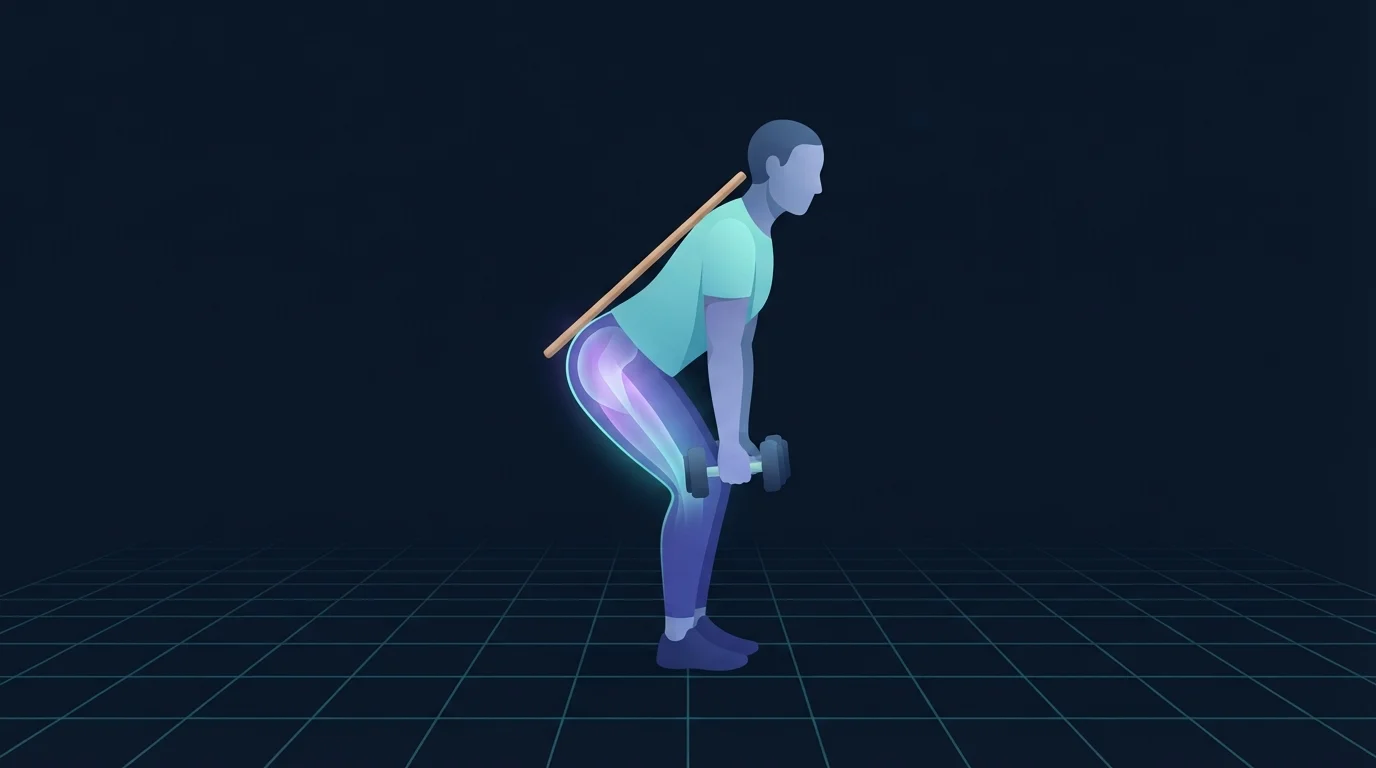
Hold a dumbbell in each hand, knees softly bent, and push your hips back while lowering the weights along your thighs to just below the knee, stopping when your back would otherwise round. Pause at the bottom for two seconds, then stand. Three sets of 8, twice a week. The Romanian deadlift trains the hamstrings under tension at long muscle lengths, which is the mechanism behind the eccentric range gains above.
6. Warm first, stretch after
Five minutes of brisk walking, leg swings or any easy movement before you stretch is worth more than most people assume. Order matters in the other direction too: static stretching immediately before heavy or explosive work temporarily blunts force production. Our review of static versus dynamic stretching covers the timing in full. Dynamic before, static after.
| Drill | Dose | Days per week |
|---|---|---|
| Supported hip hinge | 2 x 8 reps | 7 |
| Supine hamstring stretch | 2 x 60 s per leg | 5 to 7 |
| Standing fold, soft knee | 2 x 60 s | 5 to 7 |
| Half-kneeling hip flexor stretch | 2 x 45 s per side | 5 |
| Romanian deadlift | 3 x 8, 2 s pause | 2 |
| Warm-up before stretching | 5 min easy movement | Every session |
Add the hamstring holds up and you land at roughly 8 to 14 minutes a week for that muscle group, which is where Ingram's regression says the gains top out.
The 4-Week Plan
Two blocks a day, roughly seven minutes each, plus two short hinge sessions a week. Retest on day 1, day 14 and day 28 only.
| Week | Daily block | Twice a week | Target |
|---|---|---|---|
| 1 | Hinge 2 x 8, supine stretch 2 x 60 s per leg, standing fold 2 x 60 s with a clear knee bend | Romanian deadlift 3 x 8, light | Learn the hinge. Do not chase the floor. |
| 2 | Same, plus half-kneeling hip flexor stretch 2 x 45 s per side | Romanian deadlift 3 x 8, add a little load | Straighten the knee a few degrees in the fold |
| 3 | Supine stretch 2 x 60 s per leg, standing fold 2 x 60 s nearly straight, hip flexor stretch | Romanian deadlift 3 x 8 with a 2 s pause at the bottom | Fingertips reach the top of the foot |
| 4 | Same, knees fully straight in the fold, holds out to 75 s if they stay comfortable | Romanian deadlift 3 x 8 at the deepest pain-free range | Retest. Most people close a hand's width. |
If you land the toe touch before week 4, keep going anyway. Range you stop training regresses, and the maintenance dose after the first block is small: two or three sessions a week holds what four weeks of daily work bought you.
Mistakes That Keep You Two Inches Short
Rounding the upper back to reach. It moves your fingertips and trains nothing. If your lower back is doing the bending, your hamstrings never got the message. Keep the chest long and accept a shorter reach until the hips catch up.
Bouncing. Ballistic reaching triggers the protective response that stretch training exists to turn down, and Thomas and colleagues found ballistic protocols underperformed static ones for long-term range anyway.
Stretching cold, right before lifting. Wrong order and the wrong time. Warm up first, and save the long holds for after training or for a separate session.
Three sessions a week of 20-second holds. That's about a minute of hamstring stretching a week against a target of five to ten. This is the single most common reason a toe-touch plan produces nothing.
Measuring every day. Range swings with time of day, temperature and how you slept. Daily testing produces noise that reads like failure. Every two weeks is enough.
Quitting on day 10. The trials that moved range ran four to six weeks. Day 10 is the point where the novelty has worn off and the number has barely moved, which is exactly what the curve looks like right before it turns.
The Bottom Line
Touching your toes is a dosing problem, not a talent problem. Hamstring extensibility, hip flexion and stretch tolerance are what stop you, and all three respond to roughly 10 minutes a week of unhurried 30 to 60 second holds plus a full-range loaded hinge twice a week.
Practical rule: bend the knees enough to hinge properly, hold long enough to stop fighting the sensation, do it most days for four weeks, and retest twice rather than daily.
You aren't built wrong. You've been asked to reach into a range you never visit, with a protocol that delivers a tenth of the effective dose, and then quietly told the result says something about you. It doesn't. It says something about the dose.
Frequently Asked Questions
How long does it take to learn to touch your toes?
Most adults who are within a hand's width of the floor get there in three to six weeks of daily work, and people starting mid-shin usually need eight to twelve. The trials that produced reliable range gains ran four to six weeks at five or more sessions a week, so the calendar matters more than any single session does. Ingram and colleagues also found the largest improvements in the people who started out the least flexible, which is the opposite of how most beginners expect it to go.
Why can't I touch my toes even though I stretch every day?
Usually because the dose is too small or the position is wrong. Ingram and colleagues pooled 189 studies and found range gains kept climbing up to about four minutes per session and ten minutes per week for a muscle group, and a single 20-second reach is a fraction of that. The other common cause is rounding the upper back to chase the floor, which moves your fingertips without ever loading the hamstrings.
Is it bad if you can't touch your toes?
No. The toe touch is a convenient measure of hamstring and hip extensibility, not a health grade. What it does predict is how comfortable hinging, lifting from the floor, and getting in and out of low seats will feel. If those movements feel restricted, the toe touch is a useful thing to train. If they don't, there's no independent reason to chase the floor.
How long should you hold a hamstring stretch?
Thirty to sixty seconds per hold is the well-supported range. Bandy, Irion and Briggler randomised 93 adults across six weeks and found a single 30-second hold produced the same hamstring range gain as 60 seconds, and that adding a second or third daily bout added nothing. Accumulating roughly 5 to 10 minutes a week for the hamstrings is a better target than perfecting any one hold.
Does stretching actually make the muscle longer?
Mostly not in the short term. Ben and Harvey had 60 adults stretch one hamstring for 30 minutes a day, five days a week, for six weeks, and found range of motion increased while measured muscle extensibility did not. What changed was tolerance to the stretch sensation. Weppler and Magnusson had already argued this in their review of the mechanisms, and it's why a warm, calm, unhurried stretch outperforms a tense one.
Can strength training improve your toe touch?
Yes, and about as well as stretching does. Afonso and colleagues pooled 11 randomised trials covering 452 participants and found no significant difference between strength training and stretching for range of motion. O'Sullivan and colleagues reviewed six high-quality studies of eccentric training and found every one increased range of motion or fascicle length. Full-range hinge work such as a Romanian deadlift is doing flexibility work while it builds the hamstrings.