Somebody in a gym has told you to keep your back flat. Probably several somebodies, probably in a tone that suggested the alternative was a wheelchair.
Then you saw a gymnast stand on a box, hold a dumbbell, and slowly curl their spine into the exact shape you were warned about. Nothing happened to them. They did it again the next week with more weight.
That contradiction is worth resolving properly, because the answer is not "the rule was a lie" and it is not "gymnasts are built differently". It's that a spine, like every other tissue in your body, adapts to what you ask of it, and the argument has always been about dose rather than direction.
What Is a Jefferson Curl?
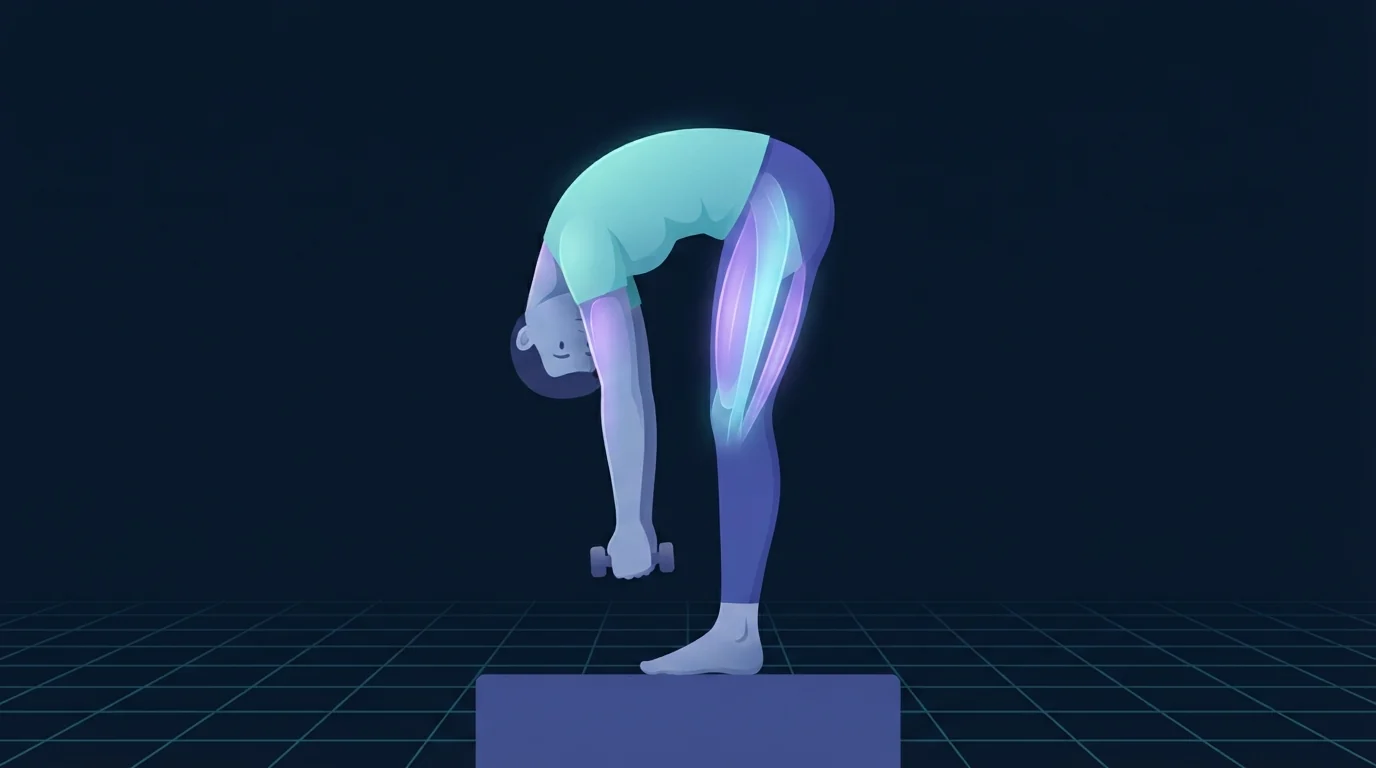
A jefferson curl is a slow, deliberately segmental forward roll-down performed with the legs straight, usually while standing on a raised surface so a weight held in both hands can travel below the level of your feet.
Three features separate it from every other forward bend:
- The spine is the joint that moves. A deadlift or a Romanian deadlift rotates around the hips with the back rigid. Here the hips stay roughly stacked over the heels and the vertebrae articulate one after another.
- It is sequenced, not dropped. The chin leads, then the upper back, then the mid back, then the lower back. Coming up runs in the opposite order, pelvis first, head last. That sequencing is the skill.
- The load is small and the tempo is long. A typical working weight is a fraction of what the same person deadlifts, and a single rep can take fifteen seconds.
It reached mainstream training through gymnastics strength work, where athletes need end-range positions they can actively control rather than passively fall into. The name is commonly attributed to strength coach Charles Poliquin, though the movement pattern itself is much older than any of the labels attached to it.
Is Loaded Spinal Flexion Actually Dangerous?
This is the question underneath every jefferson curl argument, so here's the evidence rather than the vibe.
Saraceni and colleagues (2020), in the Journal of Orthopaedic and Sports Physical Therapy, ran a systematic review with meta-analysis specifically on whether lumbar flexion during lifting predicts back pain. Their conclusion, based on low-quality evidence, was that greater lumbar spine flexion during lifting was neither a risk factor for the onset or persistence of low back pain nor a way to tell people with and without back pain apart.
Swain and colleagues (2020), in the Journal of Biomechanics, went a level higher and reviewed the systematic reviews themselves. Across that literature they found no consensus on causality between spine postures or physical exposure and low back pain. Association, yes, in places. Causation, not established.
Nolan and colleagues (2020), in the Scandinavian Journal of Pain, asked the narrower version: do people with back pain actually lift differently? Across the studies they pooled, the differences in lifting kinematics between painful and pain-free groups were inconsistent and small.
Now the other side, because it deserves an honest hearing. Callaghan and McGill (2001), in Clinical Biomechanics, took pig spine segments and cycled them through repeated flexion and extension under a modest compressive load. Disc herniation was produced consistently. That study is the backbone of the flat-back orthodoxy, and it's real work. It's also an isolated non-living spine, cycled tens of thousands of times with no muscular protection, no blood supply, no recovery, no adaptation. It tells you something about repetitive occupational bending over years. It says very little about three controlled reps twice a week in a body that repairs itself.
So the honest summary is this. Flexion is not the villain it was sold as, and it is also not free. What decides the outcome is the same thing that decides it everywhere else in training: how much, how fast, and how far ahead of your current capacity.
What the Research Says a Jefferson Curl Buys You
Nobody has run a trial on the jefferson curl in isolation. What we do have is close enough to be useful.
Rosenfeldt and colleagues (2024), in BMC Sports Science, Medicine and Rehabilitation, randomised physically active young adults into three groups for eight weeks. One did static stretching of the hip and lower back extensors. One did full-range resistance training built from two straight-legged deadlift variants performed standing on an elevated box, the second of which the authors describe as a modified jefferson curl with a kettlebell. The third was a control. Both training groups ran three sessions a week, four to eight sets of eight reps, with a three-second lowering phase.
| Outcome after 8 weeks | Full-range resistance training | Static stretching | Control |
|---|---|---|---|
| Sit-and-reach | +6.6 cm | +6.1 cm | +0.8 cm |
| Isometric straight-leg deadlift force at 95% of range | +145 N | -16 N | +49 N |
| Isometric force at 50% of range | +139 N | +17 N | +23 N |
Read the two rows together and you have the entire case for loading a stretch instead of only holding one. Flexibility improved about the same either way. Strength at the far end of that new range only improved in the group that put a weight in their hands. A range you can reach but cannot control is not much use to you when a suitcase is involved.
That result is not a fluke of one trial. O'Sullivan, McAuliffe and De Burca (2012), in the British Journal of Sports Medicine, reviewed six high-quality studies on eccentric training and lower limb flexibility, and every one of them showed range-of-motion gains from loaded lengthening. And the hypertrophy literature points the same direction: Kassiano and colleagues (2023) found that training at longer muscle lengths produced better growth than training in the shortened part of the range across a set of muscles.
What the research does not support is the bigger claims people make for this movement. There is no trial showing that jefferson curls prevent back injury, fix disc problems, or "decompress" anything. Treat it as a way to own the end of your range, not as therapy. If back pain is the actual problem you're solving, start with our review of what the research says about exercise for lower back pain.
Find out what's really holding you back
FitCraft, our mobile fitness app, pairs you with an AI coach who builds you a personalized plan around your goals, schedule, and fitness level. Every FitCraft program is designed by Domenic Angelino, MPH (Brown University) and NSCA-CSCS, with research published in the Journal of Strength and Conditioning Research and Medicine & Science in Sports & Exercise.
Take the Free Assessment Free • 2 minutes • No credit card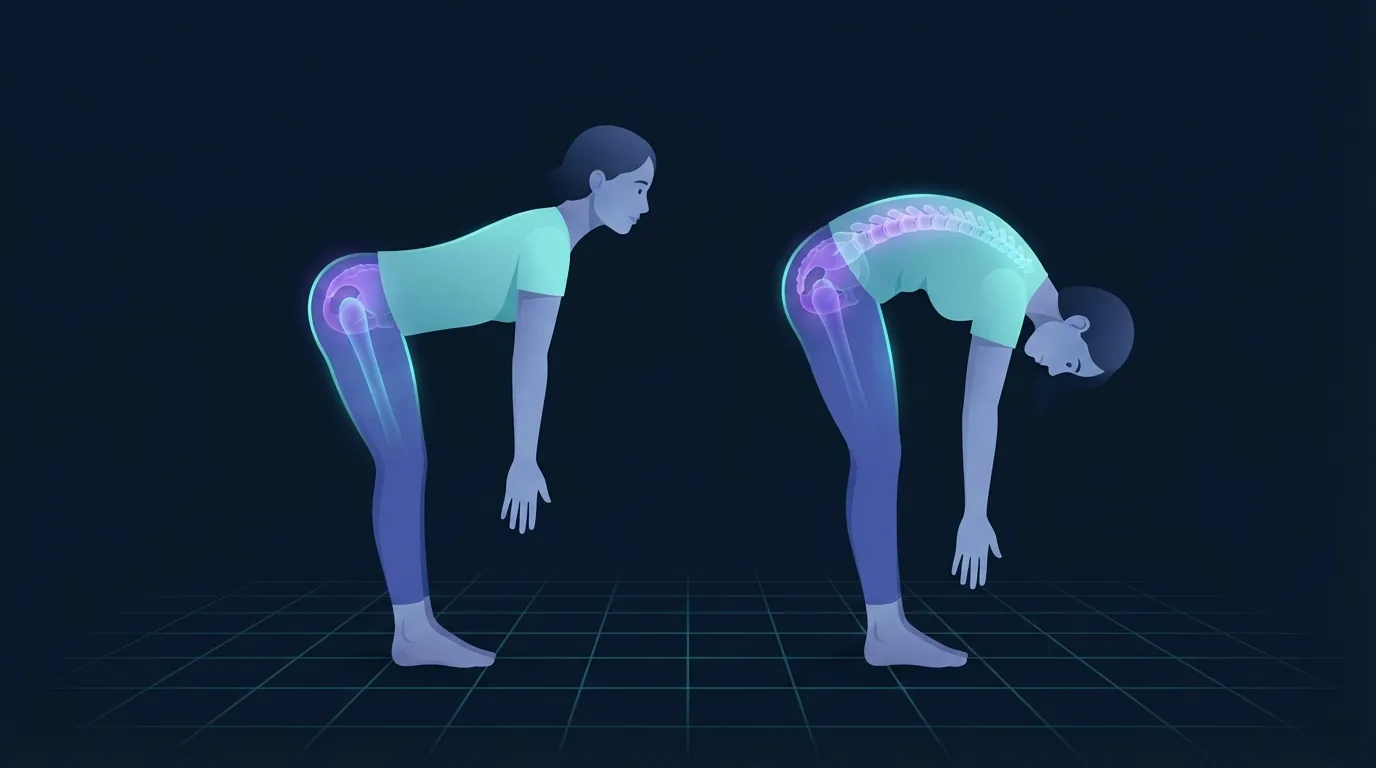
How to Do a Jefferson Curl, Step by Step
Six cues, in order. Read them all before your first rep, because the mistakes happen at the start and at the bottom.
- Set up on the edge. Stand on a step or low box, feet hip width, toes just short of the edge. Legs straight, knees soft rather than jammed back. Hold the weight in both hands in front of your thighs.
- Tuck the chin first. The movement starts at the top, not the hips. Drop your chin toward your chest and let your head pull the upper back over.
- Peel down segment by segment. Upper back, then mid back, then lower back. Imagine unrolling a carpet rather than folding a hinge. Five seconds down is a minimum, and slower is better.
- Let the weight hang close. The dumbbell travels near the shins, not out in front of them. Out in front is where the lever gets long and the load on the lower back multiplies.
- Stop where control ends. The bottom of your rep is the deepest point you can hold still and take a full breath in. That may be mid-shin in week one. Depth is an outcome, not a target.
- Restack from the pelvis. Tilt the pelvis under first, then rebuild the lower back, mid back, upper back, and raise the head last. Coming up should take at least as long as going down.
Three faults account for almost everything that goes wrong. Bending the knees to reach further, which converts the exercise into a squat and removes the hamstring stretch entirely. Bouncing at the bottom, which is the one thing the pig-spine research genuinely warns about. And holding your breath through the whole rep, which usually means the load is too heavy for the position.
If the segmental feel is not there at all, spend a week on cat cow on all fours. Same articulation skill, no load, no balance demand.
How Much Weight Should You Use?
Less than you think, for longer than you want.
| Phase | Setup | Load | Stay here until |
|---|---|---|---|
| 1. Floor roll-down | Flat floor, empty hands | None | You can reach mid-shin, hold, and breathe for 2 weeks |
| 2. Elevated bodyweight | Low step, empty hands | None | Fingertips pass below toe level with a smooth restack |
| 3. First load | Low step | 5 to 10 lb dumbbell | 3 sets of 5 look identical to the bodyweight version |
| 4. Slow build | Step or box | Add 2 to 5 lb every 2 to 3 weeks | Indefinitely. There is no finish line here |
Two rules govern the whole table. The weight only rises when the current weight looks boring on video, and the depth only rises when the restack still runs bottom to top. Break either rule and you're loading a position you cannot hold, which is the actual mechanism behind most bad outcomes with this movement.
For context on where the ceiling sits: advanced gymnasts work with loads around a quarter to a third of body weight after years of practice. That's a destination, not a benchmark, and nobody needs to get there. A light dumbbell used well beats a heavy one used badly by a wide margin, which is the same progressive overload logic that governs every other lift, just with a smaller step size.
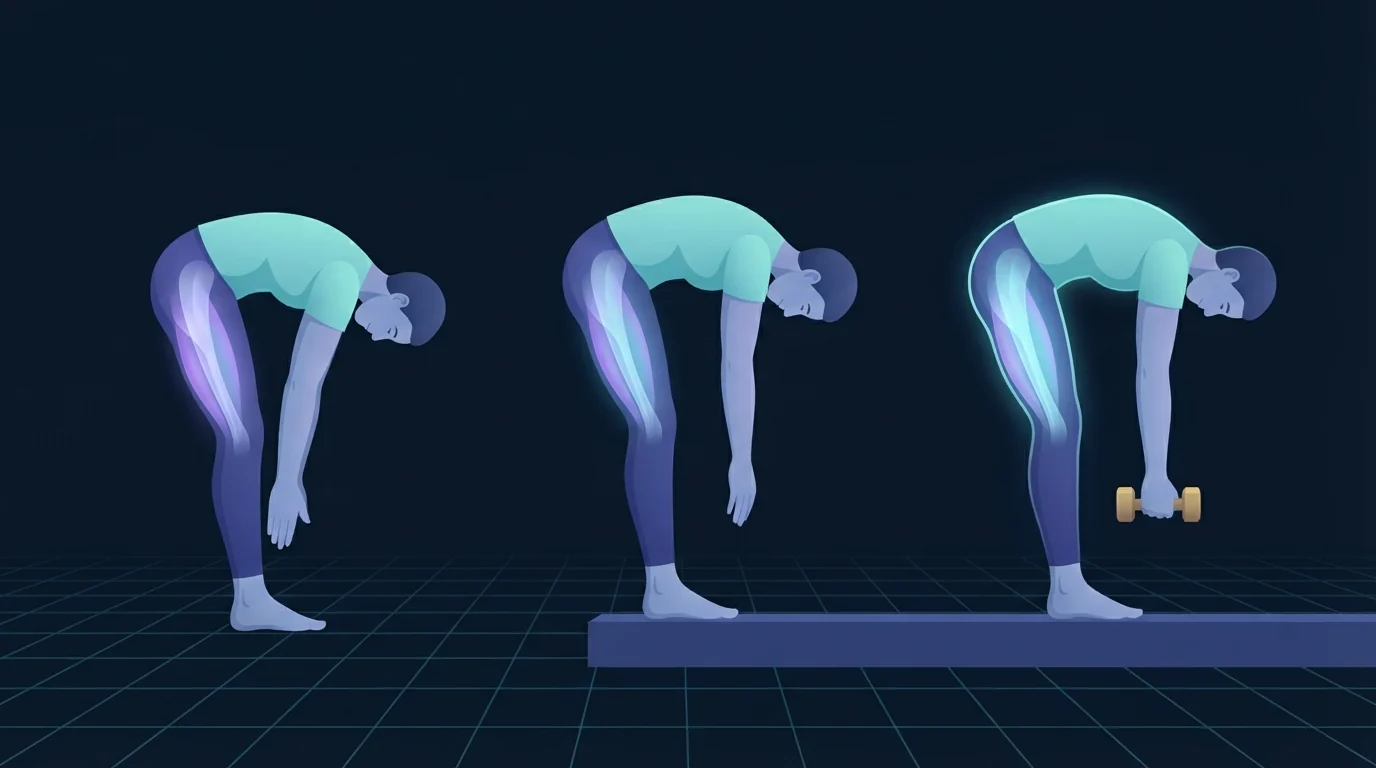
Jefferson Curl, Static Stretching and the Worlds Greatest Stretch
These three get compared constantly and they do genuinely different jobs, so it's worth being precise.
| What it trains | When to use it | |
|---|---|---|
| Jefferson curl | Strength and control at the end of spinal flexion and hamstring range | End of a session, 2-3 times a week |
| Static hamstring stretch | Passive range, tolerance to the stretch sensation | Any time, including daily |
| Worlds greatest stretch | Multi-joint dynamic mobility: hips, thoracic spine, ankles | Warm-up, before training |
The worlds greatest stretch is a warm-up sequence that moves several joints through a range quickly. The jefferson curl is a training set that loads one range slowly. Using either in the other's slot is the most common mistake: doing loaded roll-downs as a warm-up puts your spinal erectors under a long eccentric before you squat, and doing a dynamic lunge sequence as your only hamstring work will not build anything.
And if what you actually want is to reach your toes, the jefferson curl is one tool among several. Our guide to how to touch your toes tests which structure is limiting you first, because for a lot of people the answer is nervous-system tolerance rather than tissue length.
Who Should Skip the Jefferson Curl
Most exercises have soft contraindications. This one has some hard ones, and they matter more than the technique section.
- An acute back pain flare. Not forever, just not now. Load the position when the pain has settled, not while it is deciding.
- A symptomatic disc injury where bending forward reproduces leg symptoms. Numbness, pins and needles or pain travelling below the knee when you flex is a signal to stop and get assessed, not to push through.
- Diagnosed osteoporosis or a previous vertebral fracture. Loaded forward flexion is specifically discouraged for reduced bone density, and this is the clearest exclusion on the list.
- Recent spinal surgery. Your surgeon sets the timeline here, and it is usually measured in months.
- Pregnancy and early postpartum. Ligament laxity and abdominal wall changes make end-range loaded flexion a poor bet during this window.
If you're in one of those categories and still want the hamstring work, the Romanian deadlift and good mornings get you a long-length hamstring load with a neutral spine, and our guide to the best exercises for lower back pain covers the rest.
How to Program It
The jefferson curl is a small movement that gets ruined by enthusiasm. Keep it small.
- Frequency: two or three sessions a week. A fourth adds nothing.
- Volume: one or two sets of three to five reps. That's it. Reps six through ten are where form degrades.
- Placement: at the end of a session, never before squats or deadlifts. You want fresh erectors controlling the descent, and you don't want tired ones controlling your next heavy lift.
- Tempo: five seconds down, a pause, five seconds up. If that feels easy, the answer is a longer pause before more weight.
- Regression: full back curls from the floor with no weight cover the same pattern when you need a lighter day.
Track it the way you track any lift, because the whole point is that it's a lift. Weight, reps, and where your fingertips reached. The progression on this movement is slow enough that memory alone will lie to you about it.
The Bottom Line
The jefferson curl is a strength exercise for a range most people only ever stretch. That's its whole value, and the Rosenfeldt trial is the cleanest demonstration: the same flexibility gain as stretching, plus strength at the far end that stretching never delivered.
The fear attached to it has not held up well. Two 2020 reviews found neither a causal link between spine posture and back pain nor a consistent difference in how people with and without pain bend. What is left is an ordinary training principle. Start with nothing in your hands, add a pound at a time, stop where control stops, and skip it entirely if your bone density or a recent injury says so.
If you'd rather follow a plan than assemble one, that's what an app is for. FitCraft runs mobility, yoga and strength programs with an AI coach as a 3D character and interactive 3D exercise demos you can rotate and zoom to check a position from any angle, with calendar tracking to keep the twice-a-week rhythm honest. The dumbbell side of that is covered on our dumbbell workout app page.
Frequently Asked Questions
What is a jefferson curl?
A jefferson curl is a slow, deliberately rounded roll-down performed with straight legs, usually from a raised surface so a light weight can travel below foot level. You tuck the chin, peel the spine down one segment at a time, pause at the end of your controllable range, then restack from the pelvis upward. It comes out of gymnastics strength training, and its purpose is to train and load the end of your spinal flexion and hamstring range rather than to move heavy weight.
Are jefferson curls safe?
For a healthy back with sensible loading, the evidence does not support the fear. Saraceni and colleagues meta-analysed the question in 2020 and found low-quality evidence that greater lumbar flexion during lifting was neither a risk factor for low back pain onset nor a differentiator between people with and without it. Swain and colleagues reviewed 23 systematic reviews the same year and found no consensus that spine posture causes back pain. The real risk is dose: starting too heavy, too deep, or too soon after a back injury.
How much weight should you use for a jefferson curl?
Start with none. Spend two to four weeks doing the movement with empty hands from the floor, then from a low step, before you pick anything up. When you do load it, a 5 to 10 pound dumbbell is a normal first weight for most adults, and progress by 2 to 5 pounds every couple of weeks only when the current weight lets you pause at the bottom and restack smoothly. Loads beyond about a quarter of body weight belong to people who have been doing this for years.
Do jefferson curls actually improve flexibility?
Yes, and about as much as stretching does. Rosenfeldt and colleagues randomised physically active adults to eight weeks of either static stretching or full-range resistance training that included a modified jefferson curl with a kettlebell, three sessions a week. Sit-and-reach improved by 6.6 cm in the resistance group and 6.1 cm in the stretching group, against 0.8 cm in controls. The difference was strength: the resistance group gained about 145 N of isometric straight-legged deadlift force at the long end of the range, while the stretching group gained none.
Who should not do jefferson curls?
Anyone in an acute flare of back pain, anyone with a recent or symptomatic disc injury where bending forward reproduces leg symptoms, anyone diagnosed with osteoporosis or a prior vertebral fracture, and anyone in the first months after spinal surgery. If forward bending is the exact movement that hurts, the jefferson curl is the wrong first exercise even though loaded flexion may be a reasonable destination later with a clinician guiding the progression.
Is a jefferson curl the same as a Romanian deadlift?
No. A Romanian deadlift keeps the spine rigid and moves the hips backward, so the load is carried by the hamstrings and glutes through a hip hinge. A jefferson curl deliberately does the opposite: the hips stay roughly over the heels and the spine itself moves, segment by segment. They train different things and neither replaces the other. Most people should own a competent hip hinge before they start loading spinal flexion.
How often should you do jefferson curls?
Two or three times a week, three to five reps, one or two sets, at the end of a session rather than the start. It is a low-volume movement by design. A fatigued spinal erector cannot control a slow descent well, so putting it after your heavy lifting is safer than putting it first, and doing it daily adds nothing that a third weekly session does not.