Most people bend forward by hinging at the hips and letting their back come along for the ride. That's fine for picking up a dumbbell. It's not spinal mobility. Spinal mobility means each vertebral segment moves independently, and for most adults (especially those who sit all day) those segments are stuck together like a single stiff rod. The full back curl fixes that by forcing you to articulate one vertebra at a time through standing spinal flexion.
Think of your spine as a chain with 24 movable links. When you do a full back curl properly, each link peels away from the one below it on the way down, then stacks back on top on the way up. It's the same movement pattern as the Jefferson curl, the popular loaded spinal flexion exercise used in gymnastics, CrossFit, and physical therapy, performed with bodyweight only. That makes it accessible for intermediate-level exercisers who want the mobility benefits without the loading risks. A 1991 study in Spine confirmed that both spinal flexion and extension exercises significantly reduce low back pain and improve spinal mobility in patients with chronic mechanical back issues (Elnaggar et al., 1991).
Quick Facts: Full Back Curl
- Equipment needed: None (bodyweight only; optional chair for seated regression or raised platform plus light weight for the Jefferson curl progression)
- Difficulty: Intermediate (seated regression for beginners; loaded Jefferson curl for advanced)
- Modality: Spinal flexion mobility, posterior chain stretch
- Body region: Full spine (cervical, thoracic, lumbar), posterior chain (hamstrings, glutes)
- FitCraft quest category: Mobility / Warm-up / Cool-down
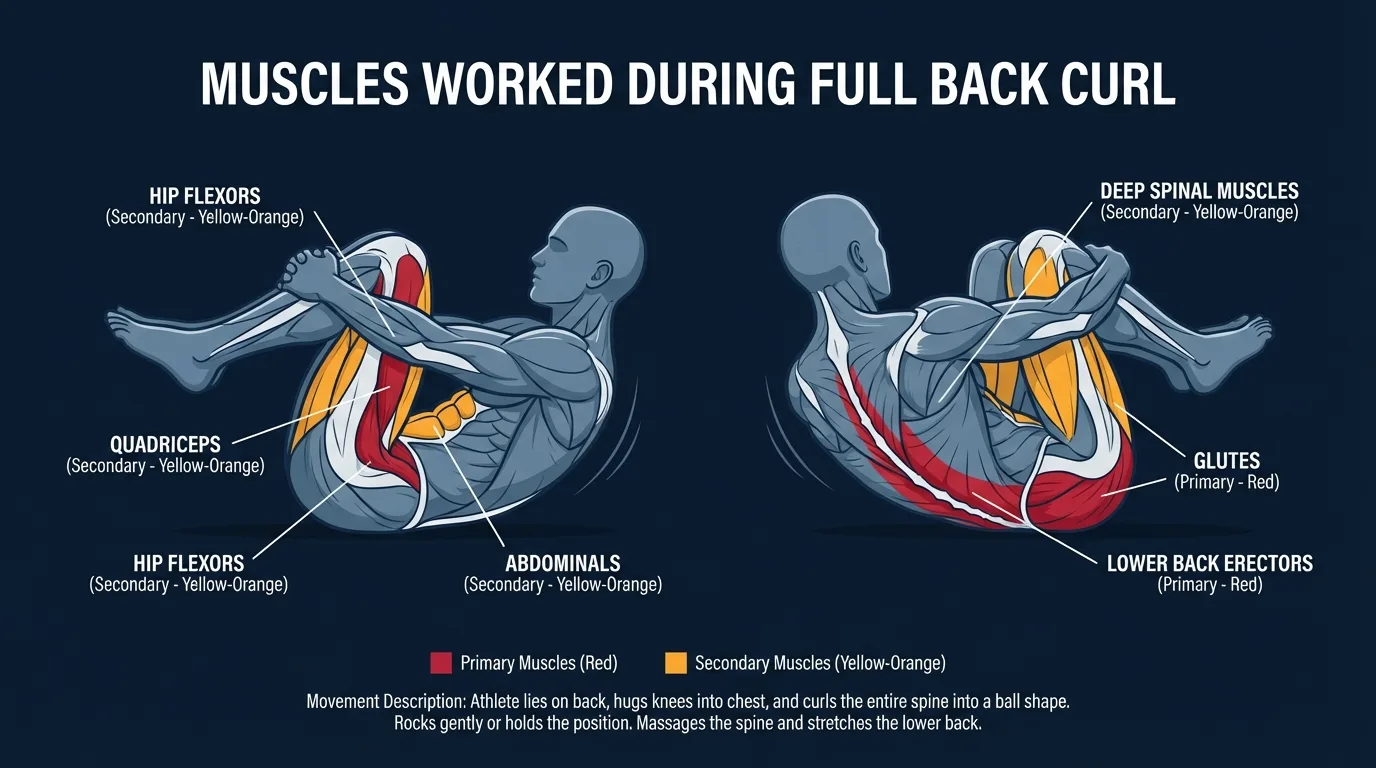
Areas Stretched & Mobilized
Primary stretch targets: the erector spinae group (spinalis, longissimus, iliocostalis) along the full length of the spine, the hamstrings (biceps femoris, semitendinosus, semimembranosus), and the gluteus maximus. These all lengthen progressively as you roll down. The erector spinae stretches segmentally vertebra by vertebra. The hamstrings and glutes load eccentrically through hip flexion as the pelvis tilts forward.
Secondary stretch targets: the multifidus and quadratus lumborum (deep spinal stabilizers that often hold chronic tension in desk-bound adults), the deep cervical flexors at the top of the roll, and the thoracolumbar fascia. The calves also receive a mild stretch at the bottom of the position when the hips fold forward over the knees.
What works isometrically: the deep core (transverse abdominis, internal obliques) engages lightly to control the descent. The quadriceps stabilize the slightly bent knees. Active mobility means you're not just collapsing forward under gravity. You're controlling the rate of segmentation, which is what makes the difference between a useful spinal mobility drill and a sloppy toe-touch.
Why segmental movement matters: Murata et al. (2023) measured spinal flexibility outcomes after segmental versus non-segmental flexion training and found that the segmental approach (rolling one vertebra at a time) produced significantly greater improvements in spinal range of motion than total-body bending. The mechanism is straightforward. Segmental control trains each motion segment to move independently, which restores the inter-vertebral mobility that gets lost with prolonged sitting and habitual hip-hinge bending.
How to Do the Full Back Curl (Step-by-Step)
- Stand tall. Feet hip-width apart, arms relaxed at your sides. Soften your knees slightly. They stay slightly bent throughout the entire movement. Take a breath in and think about growing as tall as possible through the top of your head.
Coach Ty's cue: "Locked knees shift the entire stretch to your hamstrings and take the spine out of the equation. Soft knees let your pelvis move."
- Tuck your chin and begin rolling down. Exhale and drop your chin toward your chest. This starts the curl from the top of your cervical spine. Let the weight of your head pull you forward. Your arms hang loose like ropes. Do not reach for the floor.
Ty's cue: "The movement starts at your chin, not your hips. If you're bending at the waist first, you're doing a toe-touch instead."
- Roll through your mid-back. Keep curling down through your thoracic spine, feeling each vertebra peel away from the one below it. Your shoulders round forward naturally. Your core stays lightly engaged (not braced hard, just enough to control the descent). Gravity does the heavy lifting here.
Ty's cue: "It should look like a slow wave traveling down your spine. Each segment curls before the next one begins."
- Continue through your lower back. As you pass through the lumbar spine, this is where most people feel the first real stretch. Keep the motion smooth and continuous. Do not speed up. At the bottom, your hands will hang somewhere between your knees and past your toes depending on hamstring and spinal flexibility. Pause for 2 to 3 seconds.
Ty's cue: "Where your hands end up doesn't matter. The quality of the spinal roll does."
- Reverse the curl back to standing. Inhale and reverse the entire sequence from the bottom up. Start by tilting your pelvis back to neutral, then stack your lumbar vertebrae one on top of the next, then thoracic, then cervical. Your head comes up last. You should arrive back at the tall standing position you started in. That is one rep.
Ty's cue: "Rebuild your spine from the bottom up. Don't pop back to standing in one motion. The return phase is where you build the motor control that transfers to better posture."
Get this exercise in a personalized workout
FitCraft, our mobile fitness app, uses its AI coach Ty to program mobility work like this into your plan at the right volume and intensity, based on your level, goals, and equipment. Ty was designed and trained by Domenic Angelino, MPH (Brown University) and NSCA-CSCS, with research published in the Journal of Strength and Conditioning Research and Medicine & Science in Sports & Exercise.
Take the Free Assessment Free · 2 minutes · No credit card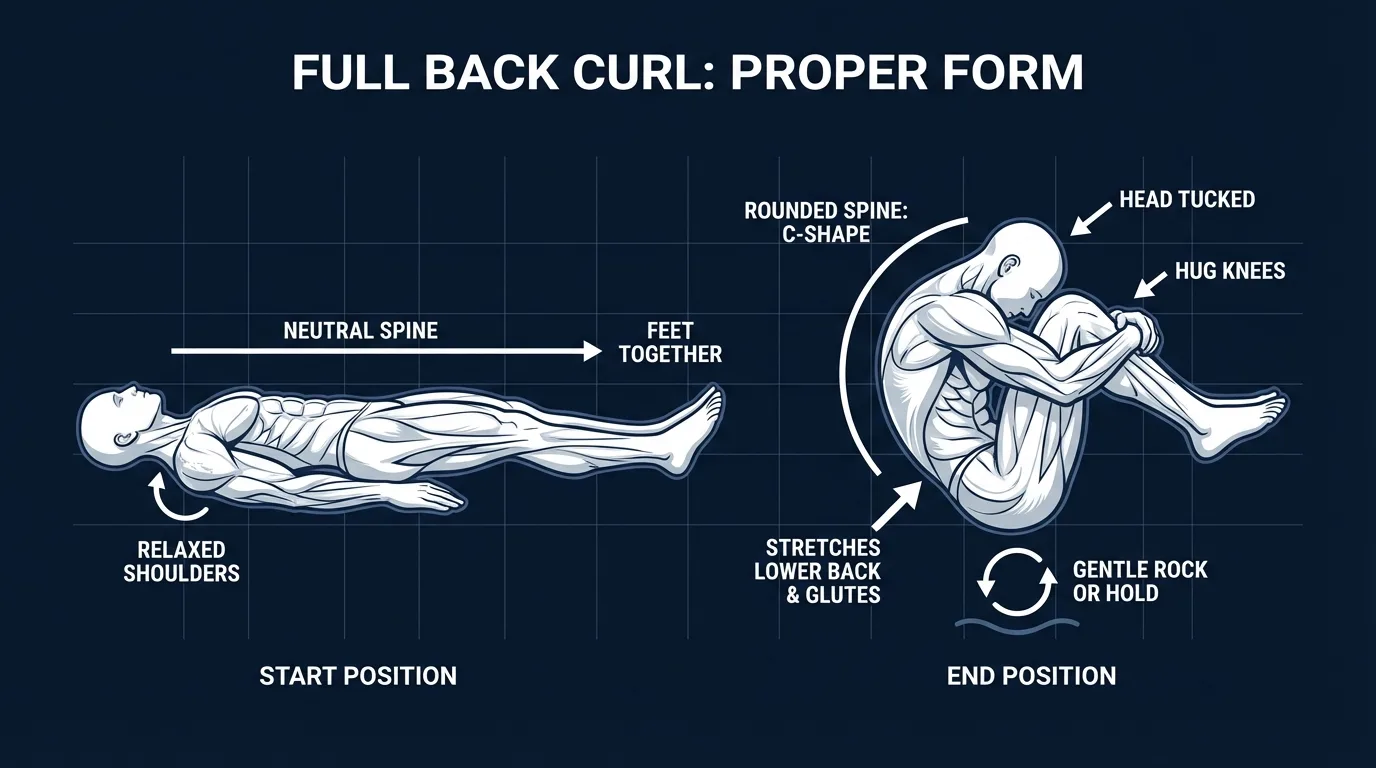
Common Mistakes to Avoid
The full back curl has a low injury risk when done at bodyweight, but poor technique wastes the exercise. Here are the patterns that turn a spinal mobility drill into meaningless bending:
- Hinging at the hips instead of curling the spine. This is the most common mistake. If your back stays flat and you fold at the hip crease, you're doing a Romanian deadlift pattern, not a full back curl. The spine must round. That is the entire point. Think about curling your spine like you are rolling over a large ball in front of you.
- Going too fast. Each rep should take 8 to 10 seconds. If you're knocking out reps in 3 seconds, you're not moving segmentally. You're flopping forward and bouncing back. Slow down until you can feel each spinal section move independently.
- Holding your breath. Exhale on the way down, inhale on the way up. That coordination matters because the exhale naturally facilitates spinal flexion (your abs engage and your ribs draw in), while the inhale facilitates extension (your rib cage expands and your back straightens). Fighting that pattern makes the movement harder and less effective.
- Reaching for the floor. Your hands should hang. They should not reach. The moment you stretch your fingers toward your toes, you recruit your hip flexors and shoulder muscles instead of letting gravity pull you through spinal flexion. Where your hands end up depends on your flexibility. It doesn't matter. The quality of the spinal roll is what matters.
- Loading too soon. Some people see the loaded Jefferson curl and jump straight to a barbell. Bad idea. Loaded flexion is for after you've built bodyweight segmental control and built up the connective tissue tolerance over weeks. Skipping the bodyweight version and adding load is a fast way to aggravate the lower back.
Full Back Curl Variations: Regressions and Progressions
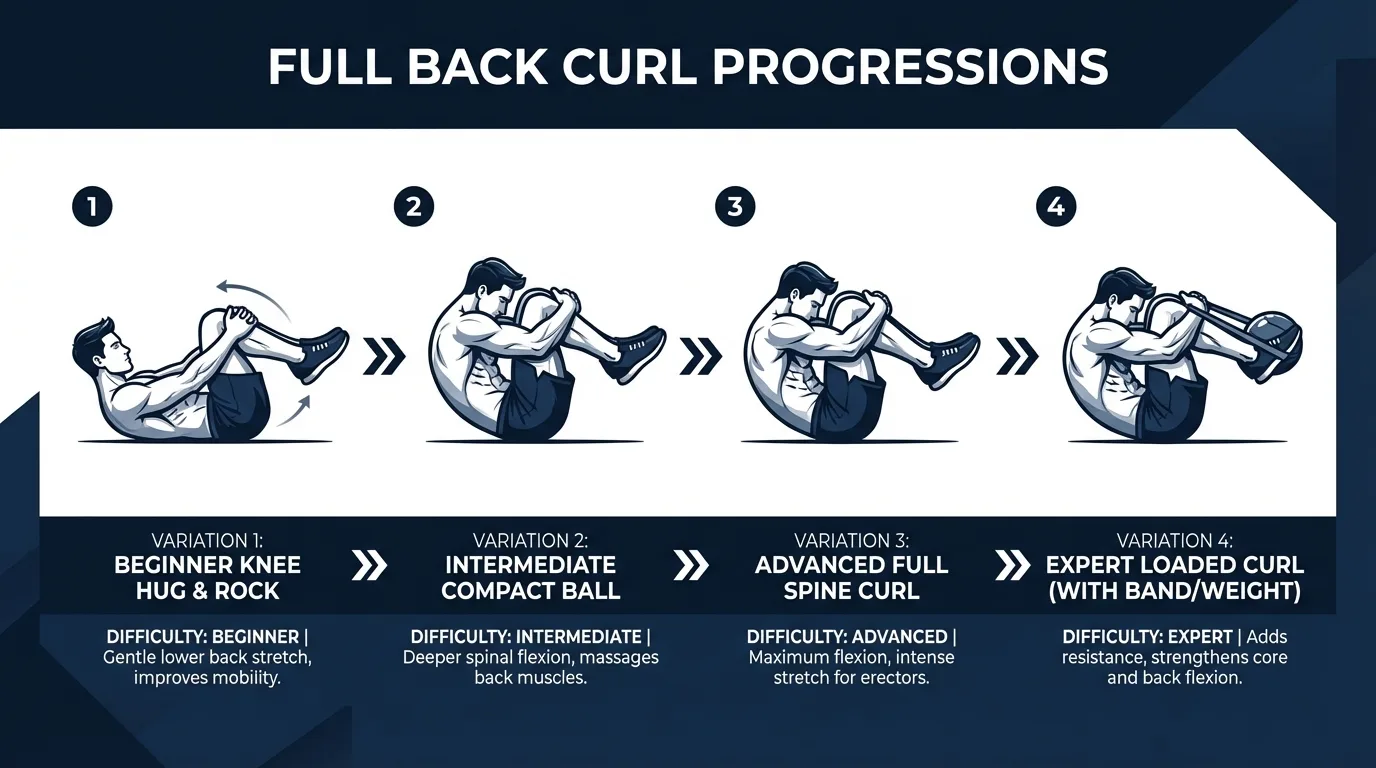
Seated Full Back Curl (Beginner Regression)
Sit at the edge of a chair with feet flat on the floor. Perform the same segmental roll-down starting from your chin, curling your spine forward until your chest is near your thighs. Reverse back up the same way. This removes the hamstring demand and balance challenge, making it accessible for beginners or anyone who wants a spinal mobility break at their desk. Same movement quality, lower barrier to entry.
Standing Full Back Curl (Standard)
The version described in the step-by-step above. Bodyweight only, standing on the floor. Once you can move through each spinal segment cleanly without hip-hinging, you're getting the full benefit of the exercise.
Loaded Full Back Curl / Jefferson Curl (Advanced Progression)
Stand on a raised surface (a sturdy box or step, 6 to 12 inches high) holding a very light dumbbell or barbell. Perform the same segmental roll-down, allowing the weight to travel below foot level at the bottom. This is the classic Jefferson curl. The load increases the stretch on the posterior chain and builds end-range strength. Start extremely light (5 to 10 lbs maximum) and add weight in small increments over weeks. This is not an exercise to ego-lift. Control is everything.
When to Avoid or Modify Full Back Curls
The full back curl is generally safe for healthy adults when performed at bodyweight with controlled segmental movement, but several conditions warrant modification or substitution. None of these are permanent restrictions. They're starting points. Always consult your physician or physical therapist for personalized guidance, especially for any back pain or spinal condition.
- Diagnosed disc pathology or active sciatica. Loaded spinal flexion is contraindicated for most disc-related back issues (herniation, bulge, degenerative disc disease) because flexion increases intradiscal pressure anteriorly. Even bodyweight forward flexion can aggravate symptoms. If you have a known disc issue, skip this exercise until cleared by a spine specialist. Spinal extension work like cobra pose or gentle back extensions is often the safer mobility starting point.
- Acute lower back pain or recent back injury. Wait until the acute phase resolves before adding any spinal flexion work. Re-introduce with the seated regression first and progress to standing only when pain-free.
- Hypermobility or connective tissue disorders (Ehlers-Danlos, Marfan syndrome). Hypermobile spines benefit from controlled active mobility rather than passive end-range stretching. Stop well short of full flexion and emphasize the segmental control rather than chasing depth. Consult a PT with hypermobility expertise.
- Pregnancy (second and third trimesters). Relaxin loosens ligaments, increasing the risk of overstretching, and forward folding becomes mechanically awkward and uncomfortable. Substitute with seated cat-cow or other upright mobility work that doesn't require deep forward flexion.
- Osteoporosis or low bone density. Vertebral compression risk increases with spinal flexion under load. Bodyweight flexion is typically safer than loaded, but anyone with diagnosed osteoporosis should consult their physician before performing any flexion-based exercise. Many clinicians recommend extension-biased mobility instead.
- Recent abdominal or lower back surgery. Get clearance from your surgeon before any spinal flexion work. Most protocols start with neutral-spine core work like deadbugs and bird-dogs before progressing to flexion-based mobility.
Related Exercises
If the full back curl is part of your mobility routine, these movements complement it or work the opposite spinal direction:
- Active spinal mobility pairing: Cat-cow alternates between spinal flexion and extension from a tabletop position. Lower demand than the full back curl and includes extension work that the full back curl does not. Pairs well as a warm-up before the standing version.
- Opposite direction (spinal extension): Cobra pose and back extensions work the opposite plane. Spinal extension balances out the flexion bias of the full back curl and counteracts seated posture.
- Thoracic rotation: Spinal twist mobilizes the third plane of spinal motion (rotation), filling in what flexion-only work misses.
- Core foundation for spinal control: Deadbugs and bird-dogs build the neutral-spine stability that complements segmental mobility work. Useful if your full back curl tends to collapse rather than articulate.
- Hip and posterior chain mobility: Hip abductor stretch and butterfly pose address the hip and inner-thigh restrictions that often limit how deep you can fold during the full back curl.
How to Program Full Back Curls
Mobility programming follows different rules than resistance training. Frequency can be daily, hold quality matters more than load, and consistency over weeks produces the adaptation. The general American College of Sports Medicine programming framework still applies for the loaded Jefferson curl progression (Ratamess et al., 2009), but for the bodyweight version, treat it as daily mobility work.
| Level | Sets × Reps | Tempo / Rest | Frequency |
|---|---|---|---|
| Beginner (seated regression) | 1–2 × 5–8 | 8–10 seconds per rep · 30 sec rest | 5–7 sessions/week |
| Intermediate (standing bodyweight) | 2–3 × 5–8 | 8–10 seconds per rep · 30–60 sec rest | 5–7 sessions/week |
| Advanced (loaded Jefferson curl) | 2–3 × 5–6 | 10–12 seconds per rep · 90 sec rest | 2–3 sessions/week |
Where in your workout: use the bodyweight version as part of a warm-up before squats, deadlifts, or any lower body training. It also works as a cool-down after training or as a standalone mobility session in the morning or during a desk break. The loaded Jefferson curl belongs in its own dedicated mobility block, not bolted onto a heavy training day. Long static holds before strength or power work can transiently reduce force output, so keep the warm-up version dynamic and short.
Quality of segmentation over rep count: if you cannot feel each spinal section move independently, slow down or regress to the seated version. Knocking out 8 sloppy reps in 30 seconds builds nothing. 5 clean segmental reps in 60 seconds builds real spinal mobility. The whole exercise rewards control, not volume.
How FitCraft Programs This Exercise
Knowing how to do a full back curl is step one. Knowing when to do it, how to scale it, and how to fit it into a balanced mobility plan is where most people get stuck.
FitCraft's AI coach Ty handles that. During your personalized diagnostic assessment, Ty maps your fitness level, mobility needs, and goals. Then Ty builds a plan that slots the full back curl into your warm-up, cool-down, or mobility blocks at the right variation for your level.
As your spinal mobility improves, Ty adjusts the variation. Seated becomes standing. Standing eventually pairs with extension and rotation work for a complete spinal mobility menu. Every program is designed by an Ivy League-trained exercise scientist and NSCA-certified strength coach using evidence-based mobility principles, then adapted to you by the AI.
Frequently Asked Questions
Can I do full back curls if I have lower back pain or a disc injury?
Anyone with a diagnosed disc injury, acute back pain, or active sciatica should consult a healthcare provider before performing spinal flexion exercises. Loaded flexion is contraindicated for most disc pathology. The bodyweight version is lower risk when performed with slow, controlled segmental movement, but it still loads the spine in flexion. For mild general stiffness without diagnosed pathology, the bodyweight full back curl is generally safe and well-tolerated.
What muscles does the full back curl stretch work?
The full back curl targets the entire posterior chain. The primary areas stretched are the erector spinae group along the full length of the spine, the hamstrings, and the glutes. Secondary areas include the multifidus, quadratus lumborum, deep cervical flexors, and rectus abdominis. It's primarily a mobility and flexibility exercise, not a strength builder.
How many full back curls should I do?
5 to 8 slow repetitions per set is the standard recommendation. Each rep should take 8 to 10 seconds total. Two sets of 5 to 8 reps works well as a warm-up or cool-down. Rushing through more reps defeats the purpose. The value is in the controlled, segmental movement, not the volume.
What is the difference between a full back curl and a Jefferson curl?
They're the same movement pattern. The Jefferson curl typically refers to the loaded version performed while standing on a raised surface with a barbell or dumbbell, allowing the hands to travel below foot level. The full back curl is the bodyweight version focused on controlled spinal segmentation without external load. Both emphasize rolling down one vertebra at a time.
Can I do full back curls every day?
Yes. The bodyweight full back curl is a low-intensity mobility exercise with virtually zero recovery demand. Daily practice is one of the fastest ways to improve spinal segmentation and posterior chain flexibility. It works well first thing in the morning, before training, or as a desk break during the workday.