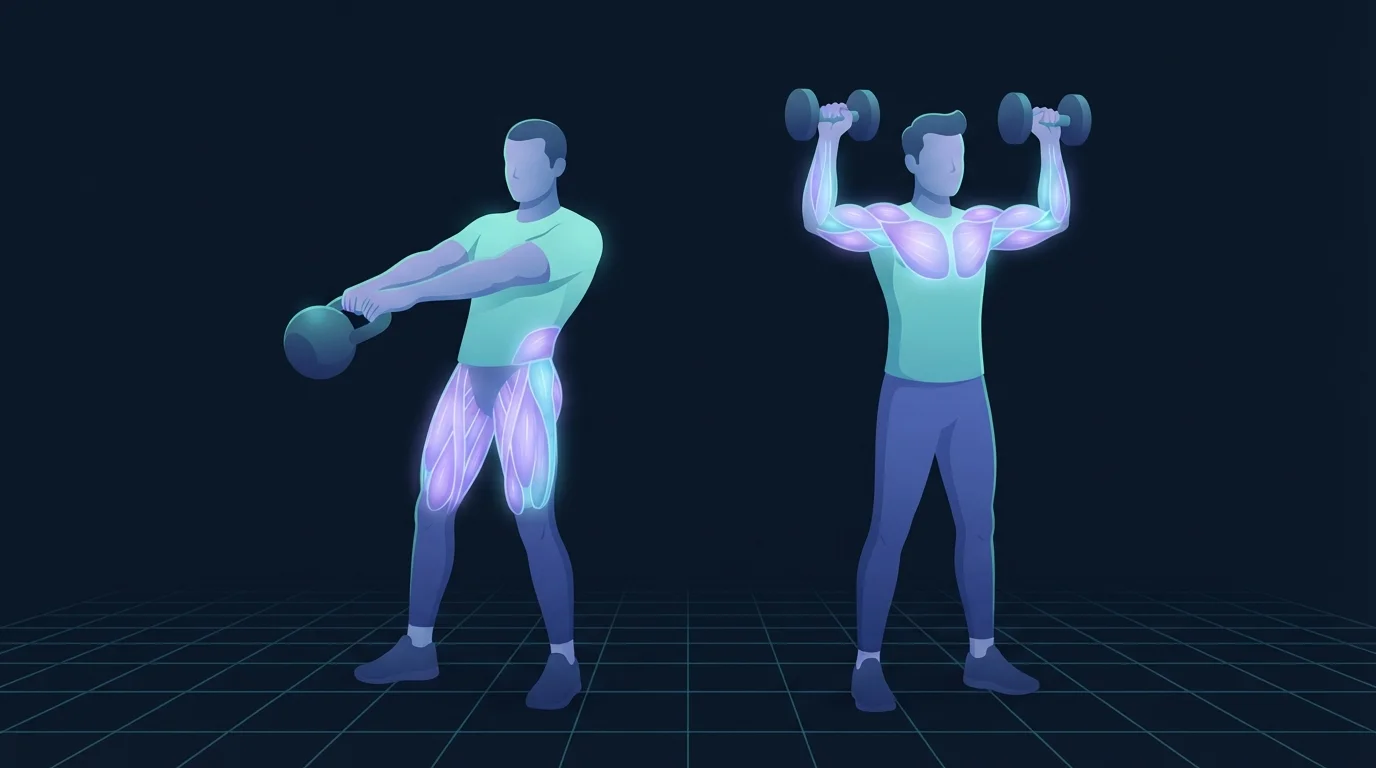
Buy dumbbells if the goal is muscle, strength or a first home setup that covers everything. Buy a kettlebell if the goal is conditioning, hip power or a way to get your heart rate high in a small room without jumping. Both claims survive contact with the evidence, which is why the argument never ends. What almost nobody says out loud is that the two implements are barely competing. They ask your body for different things.
Here is the part that gets skipped. You've probably already bought fitness equipment that's currently under a bed or behind a door. That is not a gear problem. Buying the wrong shape of metal costs you a little money. Buying anything at all and then not touching it after week three costs you the entire result, which is the pattern most home setups die of.
What Is the Real Difference Between a Kettlebell and a Dumbbell?
A dumbbell is balanced. The load sits on both sides of your hand, so the center of mass is roughly where you're gripping. That makes it stable, predictable and easy to hold in any position, which is exactly what you want when the goal is to move a weight slowly through a full range and then move slightly more of it next week.
A kettlebell is deliberately unbalanced. The mass hangs several inches below and behind the handle, so the bell wants to rotate around your grip. That offset is not a flaw. It's the whole feature. It lets the bell travel in an arc, pulls your hips into the movement, and loads the end of a swing or a snatch the way no balanced weight can. It also means the bell fights you in every hold, which is why a kettlebell rack position and a dumbbell rack position feel nothing alike.
| Kettlebell | Dumbbell | |
|---|---|---|
| Where the mass sits | Below and behind the handle, offset | In line with the hand, balanced |
| Signature movement | The swing, the clean, the snatch, the get-up | The press, the row, the curl, the lunge |
| Speed it rewards | Fast and ballistic, driven by the hips | Slow and controlled, driven by the working muscle |
| How you add load | Buy the next bell, usually 4 kg heavier | Add a plate or a couple of pounds per hand |
| How many you need | One does a lot, two unlock more | Always a pair, ideally a range |
| Learning curve | Steep, the hinge has to be taught first | Shallow, most people can press and row on day one |
| Strongest evidence | Explosive strength, VO2 max, grip, back and neck pain | Maximal strength, muscle size, graded overload |
| Weakest claim | That swings replace lifting or replace cardio | That dumbbells train power as well as a bell does |
What Kettlebells Do Better
Ballistic hip power, with no barbell in the room
The swing is the only common home movement that trains a fast, forceful hip extension against real load. That matters because power fades faster with age than strength does, and because almost nothing else you can do in a bedroom trains it. Lake and Lauder (2012), writing in the Journal of Strength and Conditioning Research, trained 21 healthy men twice a week for six weeks using nothing but swings: twelve-minute sessions of 30 seconds of work and 30 seconds of rest, with a 12 kg bell for lighter participants and 16 kg for heavier ones. Half squat one-rep max rose 12 percent and vertical jump height rose 15 percent. Under half an hour of training a week, with a bell most people would call light.
A hard conditioning session in twelve minutes
Farrar et al. (2010) measured what continuous swinging actually costs. Twelve minutes of two-handed swings with a 16 kg bell drove heart rate to 87 percent of maximum and oxygen uptake to 65 percent of maximum, which is squarely inside the intensity band that improves aerobic fitness. Falatic et al. (2015) tested whether that translates into adaptation, adding a 20-minute kettlebell snatch interval protocol three days a week for four weeks to the off-season program of 17 NCAA Division I women's soccer players. VO2 max rose by 2.3 ml/kg/min, roughly 6 percent, while the circuit weight training control group showed no change. Our review of the kettlebell swing research goes through the energy-cost numbers in more detail.
Grip, carries and awkward loads
The thick handle and offset mass make everything harder to hold, which turns out to be useful. The BELL trial, Meigh et al. (2022) in BMC Geriatrics, ran 32 insufficiently active adults averaging about 68 years old through three months of supervised hardstyle kettlebell training after a three-month control period. Grip strength rose 7.1 kg in the right hand and 6.3 kg in the left, both past the threshold considered clinically meaningful. Thirty-second sit-to-stand repetitions improved by 3.3, a 23 percent gain. Appendicular skeletal muscle mass rose 0.65 kg with no change in fat mass. Attendance was 91.5 percent, which is its own finding.
There's a pain story too, and it's more mixed than the marketing suggests. Jay et al. (2011) randomized 40 adults from jobs with high rates of musculoskeletal pain to eight weeks of ballistic kettlebell work three times a week or to a control group. Neck and shoulder pain intensity fell 2.1 points on a 0 to 10 scale, and trunk extensor strength improved. Shoulder strength did not improve. Aerobic fitness did not change. That is an honest picture of a tool that is very good at a few specific things and unremarkable at the rest.
What Dumbbells Do Better
Load you can actually grade
Muscle growth and maximal strength both run on progressive overload, and overload needs small, frequent steps. A dumbbell gives you those: two pounds a hand, then two more, then two more. A kettlebell usually gives you a 4 kg jump to the next bell, which for a beginner pressing an 8 kg bell is a 50 percent increase. You cannot ladder that.
The clearest head-to-head data on where that leads comes from Otto et al. (2012), who randomized 30 healthy men to six weeks of either weightlifting plus traditional heavy resistance work or kettlebell training, twice a week. Back squat one-rep max rose 13.6 percent in the lifting group and 4.5 percent in the kettlebell group. Vertical jump improved in both with no difference between them, and neither group changed body composition in six weeks. Kettlebells held their own on power. They lost badly on maximal strength.
Volume is the other lever, and dumbbells make it countable. Schoenfeld, Ogborn and Krieger (2017) pooled 15 studies in the Journal of Sports Sciences and found a graded dose-response between weekly sets per muscle group and muscle growth. Sets per muscle is a number you can track with dumbbells because each exercise targets an obvious muscle. In a ballistic circuit it's genuinely hard to say how many sets your chest just did.
Every pattern, and both sides of your body
A pair of dumbbells covers press, row, curl, extension, squat, lunge, hinge, carry and raise, on both sides independently. That independence exposes and then fixes side-to-side differences, which a two-handed swing hides. A single bell can do many of these, but it does them one arm at a time, which doubles session length for the same volume.
A much shorter learning curve
Most people can perform a competent dumbbell row, press or goblet squat within a session or two. A swing is different. It's a hip hinge done at speed, and a hinge done wrong is a squat done with a rounded back. McGill and Marshall (2012) measured around 3,200 N of L4-L5 compression during a two-handed swing with a 16 kg bell, well under what a heavy deadlift produces but not trivial, and the pattern loads the spine in posterior shear. That is fine with a neutral spine. It is not fine at speed with a rounded one. Learn the hinge unloaded before the bell moves fast.
Find out what's really holding you back
FitCraft, our mobile fitness app, pairs you with an AI coach who builds you a personalized plan around your goals, schedule, and fitness level. Every FitCraft program is designed by Domenic Angelino, MPH (Brown University) and NSCA-CSCS, with research published in the Journal of Strength and Conditioning Research and Medicine & Science in Sports & Exercise.
Take the Free Assessment Free • 2 minutes • No credit card
Cost and Space in a Real Home Gym
On money, a single mid-weight kettlebell is the cheapest useful thing you can buy. One bell, one purchase, done. Fixed dumbbells look cheap per pair and then get expensive fast, because you need several pairs to have anything to progress into. Adjustable dumbbells cost more than one bell up front and less than three or four fixed pairs, and they are the option most home lifters end up at.
On space, neither one is a problem. A bell occupies roughly the footprint of a shoebox. One adjustable pair with its tray takes maybe twice that. The floor you need to move is the bigger constraint: a swing needs clear space in front of you and a ceiling you won't clip on a snatch, while dumbbell work needs little more than room to lie down.
Two practical notes that rarely make the buying guides. A dropped bell is a serious floor event, so if you train upstairs or on tile you want a mat, and swings on a thin rug will slide. And second hand is a genuinely good market for both, because cast iron doesn't wear out.
| Practical factor | Kettlebell | Dumbbells |
|---|---|---|
| Cheapest useful setup | One bell | One adjustable pair |
| Cost to progress | A new bell each jump | Nothing, up to the pair's top weight |
| Storage footprint | About a shoebox, per bell | About two shoeboxes, fixed |
| Floor space to train | Clear arc in front, high ceiling | Room to lie down |
| Downstairs neighbour risk | Higher, drops are heavy and sudden | Lower, but use a mat |
| Resale and second hand | Excellent, cast iron lasts | Good, adjustables hold value |

Which One Should You Buy First?
For most people reading this, the answer is an adjustable dumbbell pair, and the reason is coverage rather than superiority. Dumbbells do a competent version of almost every movement a home trainee needs. A kettlebell does a handful of movements brilliantly and the rest awkwardly. When you own one tool, coverage wins.
The exception is real, though. If you already lift in some form and what you're missing is conditioning and hip power, one bell in the 12 to 20 kg range will do more for your week than another pair of dumbbells. Start with the goblet squat to learn the rack position, then the two-handed swing, which you can practice with either implement while you build the hinge.
| If this is you | Buy first | Why |
|---|---|---|
| New to training, want to look stronger | Dumbbells | Small load steps and every pattern covered from day one |
| Already lift, short on conditioning | Kettlebell | Twelve minutes of swings hits 87 percent of max heart rate |
| Small apartment, upstairs neighbour | Dumbbells | Quieter, and no swinging arc to clear |
| Over 60, worried about frailty | Either, supervised | The BELL trial moved grip, muscle mass and sit-to-stand in 3 months |
| History of low back pain | Dumbbells | Learn the hinge unloaded before loading it at speed |
| Bored senseless by sets and reps | Kettlebell | Flows and intervals feel like a sport, not a checklist |
| Training for a sport with sprinting or jumping | Kettlebell | Swings raised vertical jump 15 percent in six weeks |
A Week That Uses Both
If you end up owning both, and plenty of people do within a year, the split is simple. Dumbbells build the muscle. The bell builds the engine and the hips. Don't try to make either one do the other's job.
| Goal | Dumbbell work | Kettlebell work |
|---|---|---|
| Build muscle | 3 sessions, 10 to 20 sets per muscle group a week | 1 short swing finisher, optional |
| Lose fat, keep muscle | 3 full-body strength sessions | 2 swing intervals, 10 to 12 minutes each |
| General fitness on 3 days | 2 strength sessions | 1 swing and carry session |
| Power for sport | 2 strength sessions, heavier and slower | 2 sessions of swings, cleans and snatches |
| Time-starved week | 1 full-body session | 2 twelve-minute swing sessions |
If you're starting from an empty room and want the dumbbell side mapped out first, our beginner dumbbell exercise list covers the movements worth learning in the first month, and the FitCraft dumbbell workout plan turns them into a structured program instead of a list you have to sequence yourself. If you're still deciding whether to buy anything at all, calisthenics vs weights is the argument one level up from this one.
The Bottom Line
Kettlebell vs dumbbell comes down to what you want the load to do. Fast and hip-driven, buy the bell. Slow, controlled and gradually heavier, buy the dumbbells. The strongest kettlebell evidence is for explosive strength, VO2 max and grip. The strongest dumbbell case is that overload in small steps is what builds muscle, and only a dumbbell gives you small steps.
Practical rule: if you own nothing, buy one adjustable dumbbell pair. If you own dumbbells and your cardio is the gap, add one bell between 12 and 20 kg. If you own a bell and your muscle is the gap, add dumbbells instead of a heavier bell.
The honest closing note is that this decision matters far less than the one you make afterward. Otto's lifting group and kettlebell group both improved. The BELL participants improved with 91.5 percent attendance. Every number quoted on this page came from people who kept showing up for four to twelve weeks. Nobody has ever published a trial on equipment that sat in a closet.
Frequently Asked Questions
Is a kettlebell better than a dumbbell?
Neither is better in general, because they are built for different jobs. A kettlebell's mass sits behind and below the handle, which is what makes swinging movements possible and what makes the bell harder to hold still. A dumbbell's mass sits in line with your hand, which makes it easier to load a press, a row or a curl precisely. Kettlebells win on ballistic hip work and conditioning. Dumbbells win on building muscle.
Should I buy a kettlebell or dumbbells first?
Buy dumbbells first if you want to build muscle, and a kettlebell first if your conditioning is the weak link and you already do some form of strength work. An adjustable pair of dumbbells covers every movement pattern at a load you can raise a couple of pounds at a time, which is what progressive overload needs. A single kettlebell covers swings, goblet squats, carries and presses but jumps in big steps between sizes.
Can you build muscle with only kettlebells?
Yes, especially if you are new to training, but the ceiling arrives sooner. The BELL trial (Meigh et al. 2022) put 32 previously inactive adults around age 68 through three months of hardstyle kettlebell work and measured a 0.65 kg increase in appendicular skeletal muscle mass alongside a 7.1 kg grip strength gain. The limit is load steps: bells are usually sold 4 kg apart, so once you outgrow one size the next one is a large jump.
Are kettlebell swings better cardio than running?
They are comparable, not superior. Farrar et al. (2010) found that 12 minutes of continuous two-handed swings drove heart rate to 87 percent of maximum and oxygen uptake to 65 percent of maximum, which is a genuine aerobic stimulus. Falatic et al. (2015) then added four weeks of kettlebell snatch intervals to collegiate soccer players and measured a 6 percent rise in VO2 max. Swings are useful because they are low-impact and need no floor space, not because they beat running.
What weight kettlebell should a beginner start with?
Most untrained adults start swinging somewhere between 8 and 16 kg, and the research protocols cluster in that range. The BELL trial progressed previously inactive adults over 60 to 12 to 16 kg bells over three months. Pick the weight that lets your hips drive the bell without your arms lifting it, and remember that a bell too light to challenge the hinge teaches the wrong pattern just as surely as one that is too heavy.
Do I need both a kettlebell and dumbbells?
No, but the pair covers more than either alone and takes up almost no extra room. One mid-weight kettlebell plus one adjustable dumbbell pair fits in the corner of a bedroom and handles swings, carries, presses, rows, squats and hinges. If you own only one of them, you are not missing much. If you own neither and can only buy one now, dumbbells are the safer first purchase for most goals.