The swing is one of the most efficient movements you can own. In a single rep it trains hip power, glute and hamstring strength, and conditioning, and you can run high-rep sets that leave you breathing hard in a few minutes. Most people just assume it requires a kettlebell.
It doesn't. A dumbbell swings the same way once you know how to hold it, and it delivers the same explosive hip-hinge stimulus. The one thing that trips people up is the pattern itself. The swing hinges at the hips, and the power comes from snapping them forward, never from squatting down or heaving with the arms. Get those two things right and everything else falls into place.
This guide covers how to grip the dumbbell safely, the hinge-and-snap pattern that powers every rep, the mistakes that quietly turn the swing into a front raise or a squat, and how to program it for power and conditioning.
Quick Facts: Dumbbell Swing
- Equipment needed: One dumbbell
- Difficulty: Advanced (two-handed swing) to Expert (single-arm swing)
- Modality: Strength and Conditioning
- Body region: Posterior chain (glutes, hamstrings and erector spinae)
- FitCraft quest category: Strength
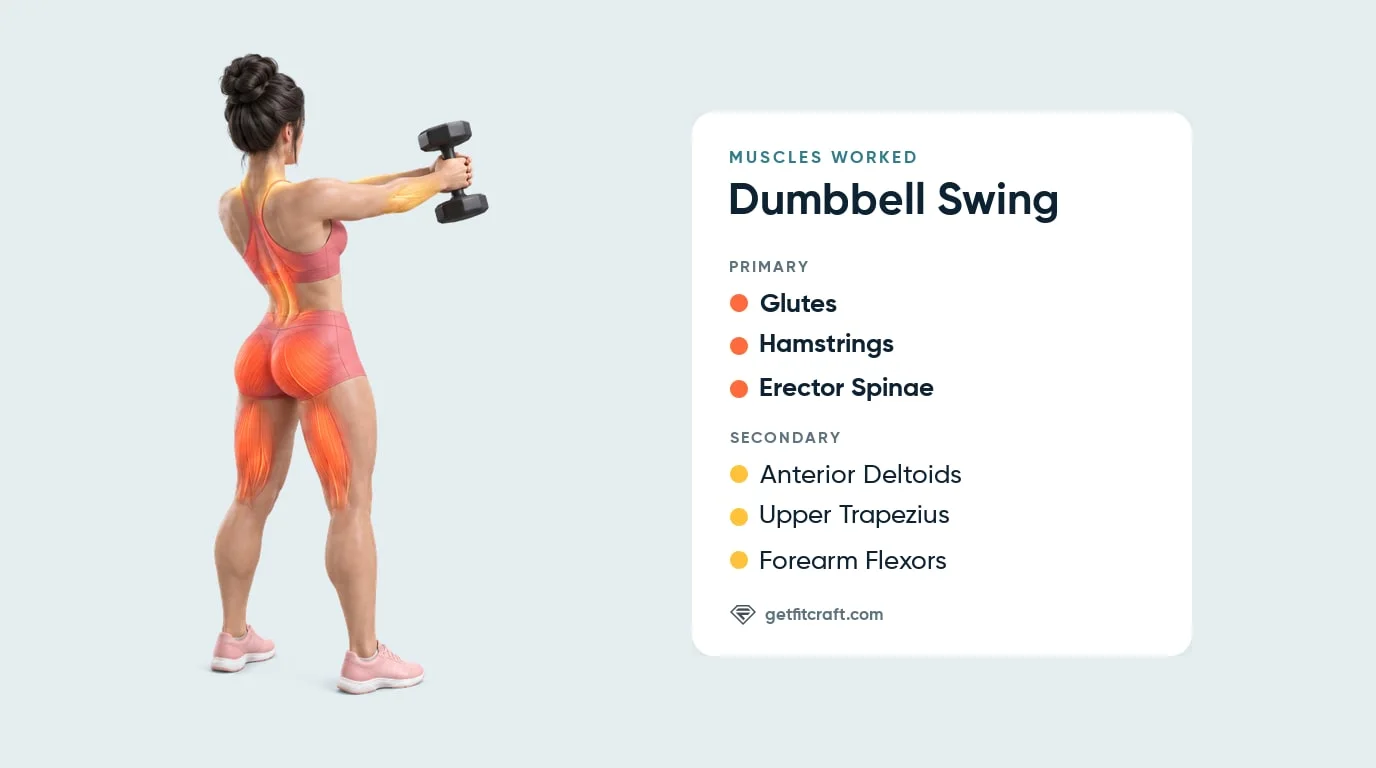
Muscles Worked
Primary muscles: the glutes, the hamstrings and the erector spinae. The glutes and hamstrings produce the explosive hip extension that is the entire engine of the swing. They lengthen and load as you hinge back (eccentric phase), then contract hard and fast to snap the hips forward and float the dumbbell upward (concentric phase). The glutes in particular reach high activation as the hips snap forward. The erector spinae, the muscles that run along your spine, work the whole time to hold your back flat as your torso hinges forward and the swinging dumbbell pulls on it, and keep you tall and stacked at the top.
Secondary muscles: the front delts (anterior deltoids) carry your straight arms forward as the hips float the dumbbell up and control it on the way back down. The upper trapezius supports your shoulders against the pull of the swinging dumbbell, and the forearm flexors keep a firm grip on the handle through every rep. The power comes from the hip snap, so your arms guide the weight instead of lifting it.
Mechanism and movement-pattern evidence: the swing is a ballistic hip hinge, the same pattern trained by the kettlebell swing. Research on the swing pattern documents high gluteal and hamstring activation and a meaningful cardiovascular response, which is why it works as both a power builder and a conditioning tool. Our breakdown of the swing research covers the hip-power and heart-rate findings in detail; the dumbbell version trains the same pattern with a different grip.
Step-by-Step: How to Perform a Dumbbell Swing
Before you swing anything, you need a clean hip hinge. If you can't hinge with a flat back and feel it in your hamstrings, spend a week on the hinge itself before adding speed.
Step 1: Set Your Stance and Grip
Feet slightly wider than shoulder-width, toes turned out a touch. Hold one dumbbell by its handle with both hands wrapped around it, one hand above the other, so it hangs upright. Let it hang at arm's length in front of your hips.
Form tip: keep a firm grip on the handle and your shoulders pulled back and down.
Step 2: Hinge and Hike
Push your hips back and hinge forward with a flat back, letting the dumbbell swing back between your thighs like you're hiking a football behind you. Shins stay nearly vertical, with a soft to moderate bend in your knees. The movement happens at the hips.
Form tip: keep your back flat through the whole arc, from the backswing to the top.
Step 3: Snap the Hips Forward
Drive your hips forward fast and squeeze your glutes hard to stand tall. That hip snap is the whole exercise. Your arms stay relaxed and just ride along as the momentum floats the dumbbell up to about shoulder height.
Form tip: breathe out each time you drive your hips forward.
Step 4: Stand Tall at the Top
At the top you're a vertical plank: glutes squeezed, core braced, dumbbell floating at shoulder height. Don't lean back or crank your lower back into an arch. The tall, stacked standing position is the finish.
Step 5: Absorb and Repeat
Let the dumbbell fall as you hinge back again, catching the weight by loading your glutes and hamstrings. Time it so the dumbbell reaches your hips exactly as your torso folds. Keep a smooth, continuous rhythm for the whole set.
Form tip: do not let the dumbbell drop to knee height. Let it swing back between your legs and under your hips.
Get this exercise in a personalized workout
FitCraft, our mobile fitness app, uses an AI coach to program compound strength exercises like this into your plan at the right volume and intensity, based on your level, goals, and equipment. Every FitCraft program is designed by Domenic Angelino, MPH (Brown University) and NSCA-CSCS, with research published in the Journal of Strength and Conditioning Research and Medicine & Science in Sports & Exercise.
Take the Free Assessment Free · 2 minutes · No credit card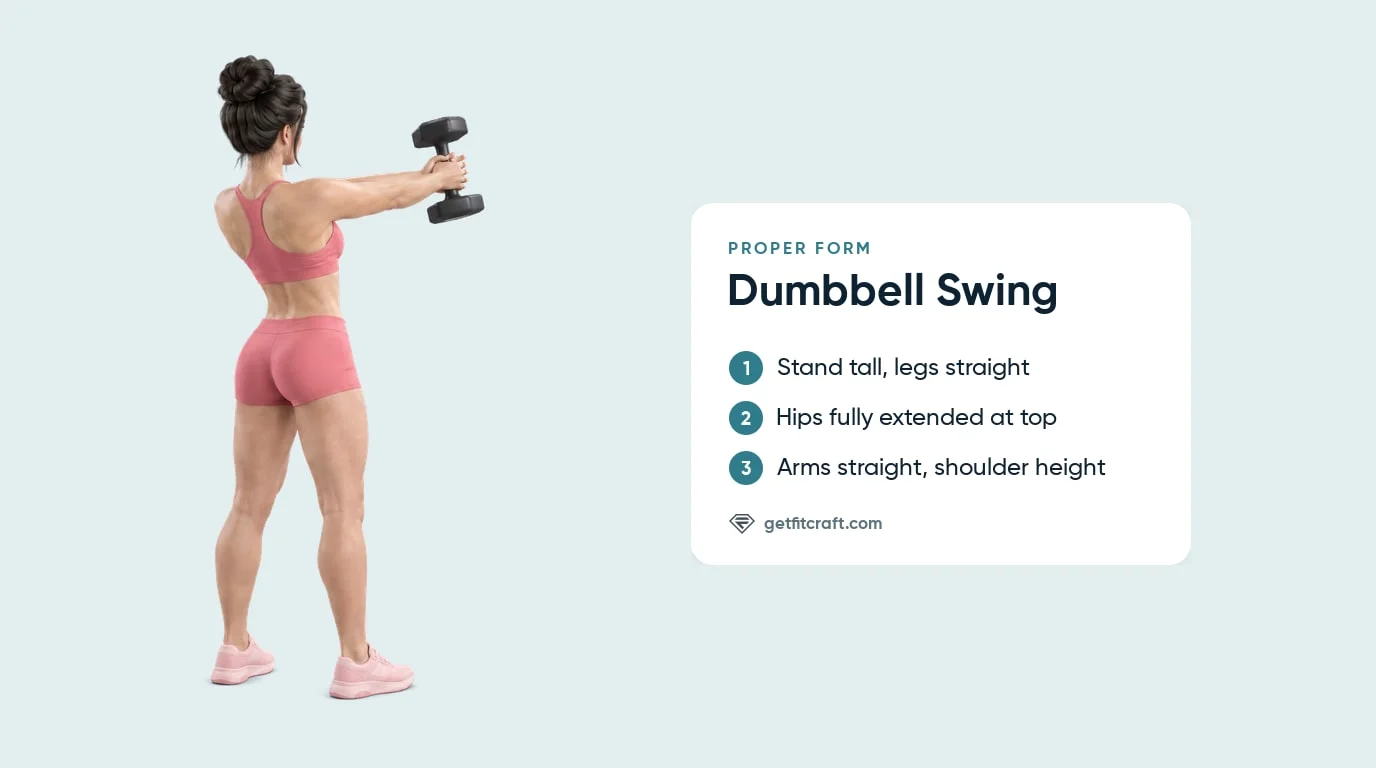
Common Mistakes (and How to Fix Them)
These are the errors that turn a powerful swing into a risky or ineffective one, and how to fix each.
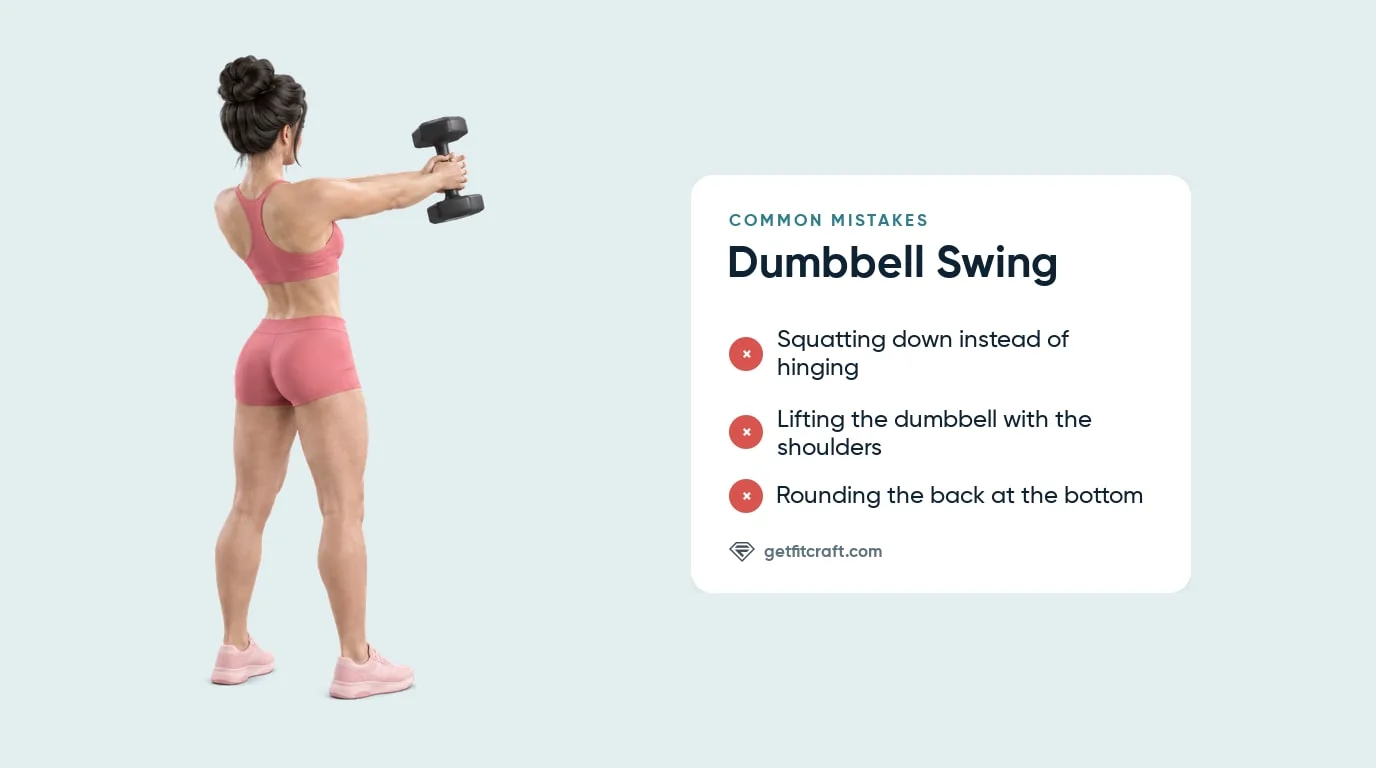
- Squatting instead of hinging. Bending the knees deeply and dipping down turns the swing into an awkward front squat and kills the hip drive. Fix: push your hips back, keep your shins near vertical, and think "hinge" not "squat." The knees soften, they don't bend deeply.
- Lifting with the arms. Muscling the dumbbell up with the shoulders and arms means your hips aren't doing their job, and it usually stalls the dumbbell at waist height. Fix: keep the arms loose like ropes and let the hip snap float the weight. If your shoulders are burning, your hips are underperforming.
- Rounding the lower back. Letting the spine curve as you hinge, especially at the bottom, loads the lumbar discs at speed and is the main injury risk of the swing. Fix: keep a flat, braced back through the whole arc. If you can't, drop to a lighter weight or rebuild the pattern with Romanian deadlifts first.
- Overextending at the top. Leaning back and cranking the lower back into an arch at the top trades hip extension for spinal extension. Fix: finish in a tall vertical plank with glutes and abs braced. Head, hips, and heels stack in one line.
- Swinging too high. Heaving the dumbbell overhead adds shoulder strain without adding hip work. Fix: let the dumbbell float to about shoulder height. Anywhere from chest to head height is fine, but never overhead. The swing is a hip exercise, not a shoulder raise.
- Losing the rhythm. Pausing at the bottom or muscling each rep from a dead stop breaks the ballistic quality that makes the swing effective. Fix: absorb the falling dumbbell with your hips and let it rebound into the next rep in a smooth, continuous cadence.
Dumbbell Swing Variations: Regressions and Progressions
The swing is a skill before it's a conditioning tool. Build the pattern first, then add speed and load.
Bodyweight Hip Hinge (Beginner Regression)
Practice the hinge with no weight, hands sliding down your thighs, pushing the hips back until you feel a hamstring stretch, then snapping tall and squeezing the glutes. This grooves the exact pattern the swing needs before any load is involved.
Dumbbell Romanian Deadlift (Strength Prerequisite)
Hold a dumbbell in each hand and perform a slow, controlled hip hinge, lowering the weights along your shins and driving the hips back to stand. This builds the posterior-chain strength and hinge control the swing then expresses at speed. Master this before swinging.
Two-Handed Dumbbell Swing (Standard)
The version this guide covers: one dumbbell held in both hands, swung to shoulder height with an explosive hip snap. The go-to for power and conditioning at home.
Single-Arm Dumbbell Swing (Expert Progression)
Swing the dumbbell with one hand, holding the middle of the handle with an overhand grip. Let your free arm swing back as you hinge and come forward with the hip drive. Because the weight sits on one side, your trunk has to resist being pulled toward it, and the set exposes any left-right imbalance. Only progress here once your two-handed swing is powerful and consistent, and keep the load lighter than you'd use with both hands.
When to Avoid or Modify Dumbbell Swings
The dumbbell swing is a ballistic, loaded movement, so it demands a solid hinge and a healthy lower back before you add speed. A few situations call for caution or modification. Always consult your physician or physical therapist for personalized guidance.
- Acute lower-back pain or known disc pathology. A loaded hinge at speed is high on the list of movements to avoid during a back flare-up. Rebuild trunk stability with deadbugs, bird-dogs, and forearm planks, then reintroduce the hinge slowly with Romanian deadlifts before returning to swings, with clearance from a professional.
- You can't yet hinge with a flat back. If your lower back rounds the moment you hinge, swinging a weight at speed will only load that rounded position. Master the bodyweight hinge and the dumbbell Romanian deadlift first. The swing is a progression, not a starting point.
- Shoulder impingement or limited overhead range. Even chest-height swings ask the shoulders to guide and decelerate a moving weight. Keep the swing low, let the hips do all the work, and stop if the shoulder pinches or hurts. Do not swing overhead.
- Uncontrolled hypertension or cardiovascular disease. The ballistic, high-effort nature of swing intervals spikes heart rate and blood pressure quickly. Use lighter loads with longer rest, avoid all-out sets, and follow your cardiologist's exercise guidance.
- Pregnancy or first 6-8 weeks postpartum, or active diastasis recti. The high intra-abdominal pressure and ballistic loading are best replaced with slower, controlled hinge work such as glute bridges and light Romanian deadlifts. Restore deep-core function first and follow your provider's guidance.
- Grip or wrist concerns. A dumbbell is harder to hold securely than a kettlebell during a swing. If your grip is a limiter, wrap both hands firmly around the handle, use a lighter dumbbell, and never swing a weight you don't fully control.
Related Exercises
If dumbbell swings are in your routine, these movements build the strength behind them or train the same posterior chain:
- The strength prerequisite: Romanian Deadlifts build the slow-strength version of the same hinge, and mastering them is the fastest way to a safe, powerful swing.
- Same hinge pattern, unilateral: Single-Leg Deadlifts train the hinge one side at a time, building the hip stability that carries over to the swing.
- Hinge accessory: Good Mornings load the hip hinge from a different angle and reinforce the flat-back position the swing demands.
- Glute strength companion: Glute Bridges build the same hip-extension strength from a supported position, a great low-back-friendly pairing with the swing.
- Lower-body power partner: Jump Squats train explosive triple extension in the squat pattern, complementing the hinge power of the swing for full lower-body athleticism.
- Core foundation for the hinge: Deadbugs, Bird-Dogs, and Forearm Planks build the spinal bracing that keeps the swing safe under speed.
How to Program Dumbbell Swings
The dumbbell swing is a power and conditioning exercise, so it's programmed differently from a grinding strength lift. The American College of Sports Medicine Position Stand on resistance training recommends prioritizing quality and speed for power work, with adequate rest between efforts (Ratamess et al., 2009). For swings, that means crisp, explosive sets and stopping well before form degrades.
| Level | Sets × Reps | Rest between sets | Frequency |
|---|---|---|---|
| Beginner (light dumbbell, learning the pattern) | 3-4 × 10-12 | 60-90 seconds | 2-3 sessions/week |
| Intermediate (moderate dumbbell, conditioning focus) | 4-5 × 12-20 | 45-75 seconds | 2-3 sessions/week |
| Advanced (heavier dumbbell, power intervals) | 5-8 × 8-15 (power-focused) | 60-120 seconds | 2-4 sessions/week |
Where in your workout: for power development, do swings early in the session while you're fresh, after your warm-up and before heavy strength work, so each rep is fast and crisp. For conditioning, they work well toward the end of a session or as timed intervals (for example, 30 seconds on, 30 seconds off). Just don't chase power and fatigue at the same time.
Speed and quality over grind: the swing trains power, which only develops when every rep is explosive. The moment your hip snap slows or your form softens, the set is done, even if you had more reps planned. A crisp set of 10 beats a sloppy set of 25.
Form floor over rep targets: because the swing is loaded and ballistic, a rounded back or a stalled rep is your signal to stop immediately. Never push extra reps on a swing when the pattern is breaking down. The risk-to-reward flips fast.
How FitCraft Programs This Exercise
Knowing how to swing a dumbbell is step one. Knowing whether to use it for power or conditioning, how heavy to go, and how to fit it around your other lower-body work is where most people get stuck.
FitCraft's AI coach handles that. During your personalized diagnostic assessment, your coach maps your fitness level, goals, and available equipment, then decides whether the swing belongs in your plan and slots it in at the right load and rep scheme for your goal.
As you get stronger, your coach adjusts the variation and volume to match, moving you from the hinge pattern to loaded Romanian deadlifts to full-speed swings, and eventually to single-arm work. Every program is designed by an Ivy League-trained exercise scientist and NSCA-certified strength coach using evidence-based periodization, then adapted to you by the AI.
Frequently Asked Questions
How many dumbbell swings should a beginner do?
Once your hip hinge is solid, start with 3 to 5 sets of 10 to 15 swings using a light dumbbell, resting 60 to 90 seconds between sets. The swing is a power and conditioning exercise, so short, crisp sets beat long grinding ones. Stop the set the moment your form or hip snap starts to fade.
What muscles do dumbbell swings work?
The primary muscles are the glutes and hamstrings, which drive the explosive hip extension that powers every swing, and the erector spinae, which hold your back flat through the hinge. The front delts, upper traps and forearm flexors assist as secondary muscles while your arms grip and guide the dumbbell. It is a full posterior-chain power exercise disguised as a simple movement.
Are dumbbell swings as good as kettlebell swings?
For the same hip-hinge power and conditioning stimulus, yes, and a dumbbell is what most people have at home. The main difference is the grip: a kettlebell has a single horizontal handle built for swinging, while a dumbbell is held by its handle with both hands so it hangs vertically. The movement pattern is the same, and the one study that compared them found similar shoulder muscle activity in two-handed dumbbell and kettlebell swings. Lower-body muscle activity has not been compared directly. See our review of the swing research for the underlying evidence.
Do dumbbell swings build the glutes?
Yes. The explosive hip extension at the top of every swing is a direct, powerful contraction of the glutes, which makes the dumbbell swing one of the better home exercises for building glute strength and power. Pair it with a slower strength movement like the Romanian deadlift or glute bridge for balanced posterior-chain development.
Can I do dumbbell swings with lower-back pain?
Not during an acute flare-up. A loaded hinge at speed is one of the movements most likely to aggravate an irritated lower back. Rebuild trunk stability with deadbugs, bird-dogs, and planks, reintroduce the hinge slowly with Romanian deadlifts, and return to swings only once you're pain-free and can hinge with a flat back. If back pain persists, see a physical therapist before loading the pattern.