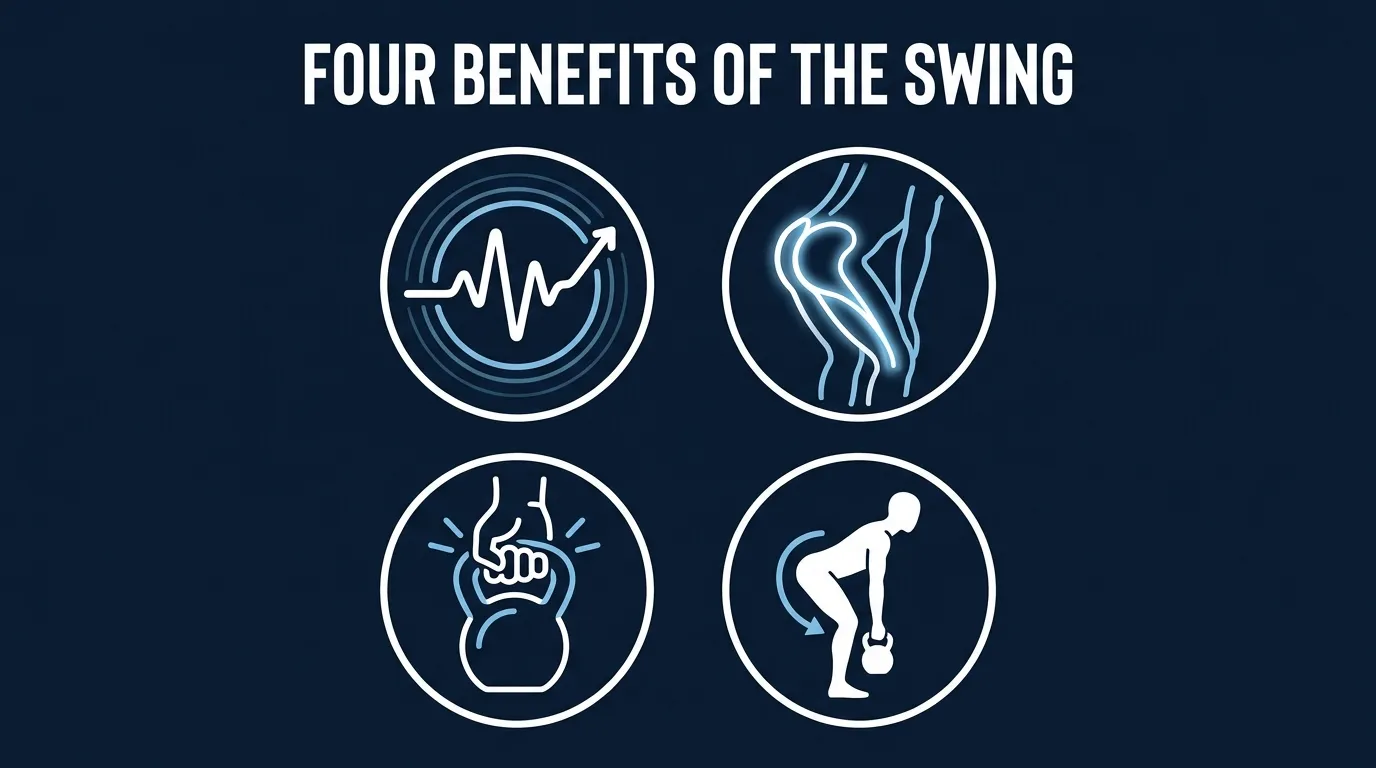
- Swings drive a real cardio stimulus. Farrar et al. (2010) recorded 87% of max heart rate and 65% of VO2max during 12 minutes of continuous swings, inside the loading window that drives aerobic adaptation.
- They also improve VO2max in trained athletes. Falatic et al. (2015) found a 6% VO2max gain in NCAA soccer players after four weeks of kettlebell snatch intervals, three days per week.
- The spine load is modest with good form. McGill and Marshall (2012) measured L4-L5 compression around 3,200 N in a 16 kg two-handed swing, well under the loads seen in a heavy deadlift.
- They work for previously untrained older adults. The BELL trial (Meigh et al., 2022, 32 adults over 60) showed clinically meaningful gains in grip, 6-minute walk, sit-to-stand, and estimated 1RM deadlift after 12 weeks of hardstyle training.
- Programming that works: 8 to 12 minutes total swing volume, two to three days per week, with a bell you can hip-drive cleanly. Start lighter than your ego wants.
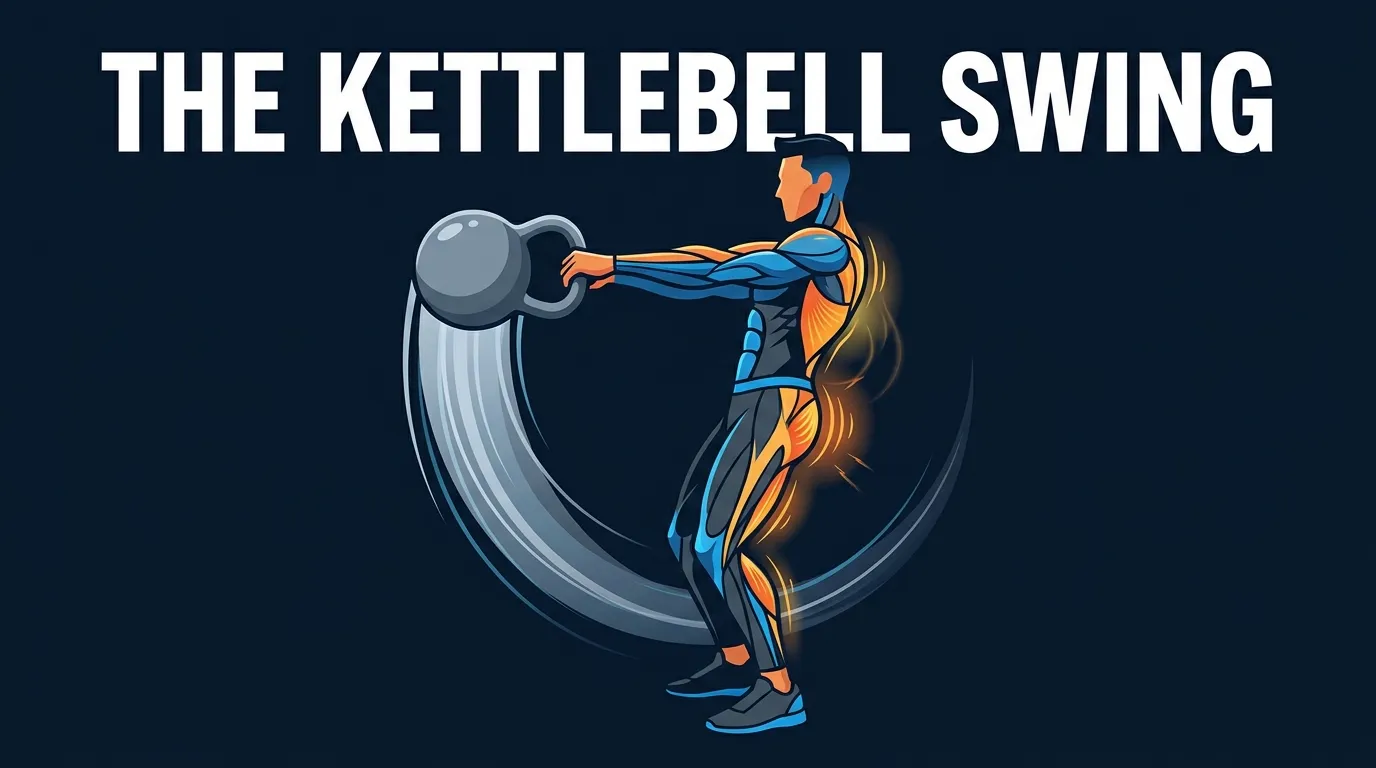
Kettlebells refuse to die. Every few years someone declares them a fad. Every few years the research says otherwise. The swing keeps showing up in peer-reviewed journals as one of the very few movements that reliably builds cardiorespiratory fitness and posterior-chain strength in the same session. That's a rare combination, and it holds up under study.
But the swing also gets sold with a lot of Instagram hype. Muscle-and-cardio-in-15-minutes. Fat burning turbocharger. Best exercise on earth. That's where the research and the marketing part ways. Swings are excellent at the things they're excellent at, and mediocre at everything else. This piece walks through the evidence honestly.
The short version: with a well-sized bell and a real hip hinge, 8 to 12 minutes of swing volume, two or three times per week, produces measurable gains in VO2max, grip endurance, and posterior-chain strength. It won't replace running, and it won't replace a heavy lower-body lifting program. It sits between them.
The Research: What Studies Show
The Cardio Stimulus Is Real
The foundational study is Farrar et al. (2010) in the Journal of Strength and Conditioning Research. Ten male subjects performed continuous two-handed swings with a 16 kg bell for as long as possible, up to 12 minutes. Average heart rate hit 87% of predicted max, and average VO2 landed at 65% of VO2max. That intensity range is inside the classic aerobic-adaptation window that programs like Zone 3 and threshold work target.
The reason this matters: most resistance exercises push heart rate up briefly, then drop it during rest. Swings sustain the elevated heart rate because there's no natural pause. You either keep swinging or you set the bell down. That continuity is what turns a strength implement into a cardio tool.
Actual VO2max Gains From Training
Acute intensity is one thing. Chronic adaptation is another. Falatic et al. (2015) assigned 17 NCAA Division I collegiate soccer players to either a kettlebell snatch protocol (20 minutes of 15-seconds-on, 15-seconds-off intervals) or a matched circuit weight training control. Both groups trained three days per week for four weeks. The kettlebell group gained 2.3 mL/kg/min in estimated VO2max, roughly a 6% improvement. The circuit group saw no significant change.
That's a fast gain in already-fit athletes. In untrained populations, VO2max responses to any well-dosed cardio program tend to be larger, so the ceiling is likely higher. The important nuance: this study used snatches, which are the swing's higher-intensity cousin. Two-handed swings sit in the same family and drive similar loading patterns.
Muscle Activation and Spine Load
The classic biomechanics paper is McGill and Marshall (2012), published in the Journal of Strength and Conditioning Research. Seven trained subjects performed two-handed swings, snatches, and bottoms-up carries with a 16 kg bell while researchers recorded EMG, ground reaction forces, and 3D kinematics.
For the two-handed swing, gluteal muscle activity averaged around 80% of maximum voluntary contraction and low back extensors averaged around 50% MVC through the movement. That's genuinely high muscle recruitment for a single dynamic exercise. Meanwhile L4-L5 spine compression landed at about 3,200 N, well under a heavy deadlift's peak values. The swing is a moderate spinal load paired with high posterior-chain recruitment, an efficient tradeoff for most trainees. If you are still deciding whether the bell deserves the floor space at all, our guide to kettlebell vs dumbbell lays out which job each implement is actually built for.
Older Adults Respond Well
The largest recent trial in a general population is Meigh et al. (2022), the BELL pragmatic controlled trial, published in BMC Geriatrics. Thirty-two insufficiently active adults aged 59 to 79 completed a supervised hardstyle kettlebell program (three supervised group classes and two home sessions per week) for 12 weeks after a three-month control period. Attendance hit 91.5%. Grip strength jumped 7.1 kg on the right hand and 6.3 kg on the left, a magnitude the authors called "large and clinically important." Six-minute walk distance improved by nearly 42 meters. Sit-to-stand repetitions climbed by 3.3. Predicted 1RM deadlift rose by more than 16 kg. Only four minor adverse events, no serious ones.
That's a wide sweep of fitness markers moving in the right direction in a population where movement gains are usually hard to earn. Grip strength alone is a well-established mortality predictor (see our companion piece on grip strength and longevity), so the transfer to a longevity-relevant marker is real.
Cardiorespiratory Fitness Rises, Sport Transfer Is Trickier
A 2023 study in PLOS ONE by Melo et al. added a kettlebell swing block (three sessions per week of 12 sets of 30 seconds at roughly a quarter of body weight) to the regular training of 18 young female artistic gymnasts for four weeks, and compared it against gymnastics-only controls. VO2max improved in the swing group, extending the aerobic-fitness signal from Falatic et al. into a younger athletic population. Interestingly, the improved VO2max did not translate into better performance during simulated competition routines: the cardio gain was real but sport-specific transfer was limited. That's a useful reminder that a fitness marker moving in the right direction and a real-world performance win are not the same thing.
Why This Matters for Your Fitness
Most people don't have unlimited training time. The realistic question is how much fitness you can buy with 30 to 45 minutes a few times per week. The swing is one of a very short list of exercises where the answer is "surprisingly a lot."
If your training week has room for one dedicated cardio session and one dedicated strength session, a swing block does both jobs at partial credit. It won't fully replace either, but it means a missed session in either bucket doesn't leave you at zero. That's the practical value: consistency insurance.
The swing also solves a real programming problem for people who dislike running. Zone 2 cardio, threshold intervals, and even light jogging all require a running-tolerant body. Bad knees, plantar fasciitis, and a treadmill you hate all remove that option. Swings deliver a similar aerobic stimulus with a hip-hinge pattern instead of an impact pattern.
How Kettlebell Swings Work in Practice
The form basics: feet slightly wider than shoulders, bell about a foot in front of you. Hinge at the hips (not squat) and grab the handle with both hands. Hike the bell back between your legs like a football snap. Then snap your hips forward, letting the bell float up to about chest height on the momentum. The arms guide. The hips drive. Reverse and repeat.
Two common mistakes wreck the movement. First: lifting with the arms instead of the hips. That turns the swing into a shoulder exercise and misses the whole point. Second: squatting instead of hinging. That loads the knees and puts the bell in the wrong plane. The cleanest cue is to keep the shins nearly vertical and drive your hips backward as if you were bumping a door closed with your butt.
Getting Started: A Realistic Progression
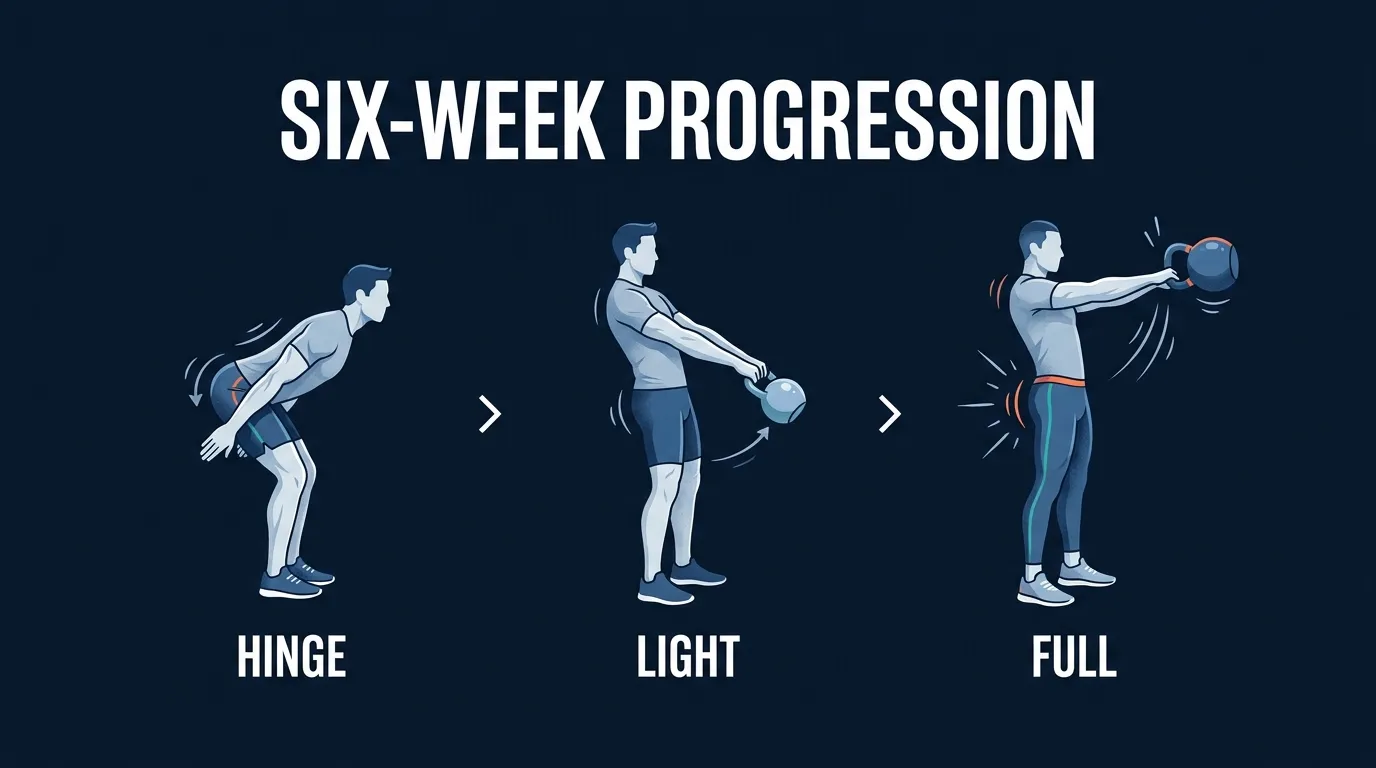
Weeks one and two, practice the hip hinge without a bell. Then swing a light kettlebell (8 kg for most women, 12 kg for most men) for sets of 10 with generous rest. The goal is nailing the pattern, not conditioning. If your lower back is doing the work, drop weight and slow down.
Weeks three through six, work up to a training bell (12 to 16 kg for women, 16 to 24 kg for men) and start putting swings into intervals. A useful entry protocol: 10 rounds of 20 seconds on, 40 seconds off. That's about 200 swings across 10 minutes, which lands most people in the 75 to 85% max heart rate zone by round five.
Weeks seven and beyond, you can shorten rests and add heavier bells for strength-biased blocks, or lengthen work intervals for cardio-biased blocks. Rotating between the two prevents plateau.
Get an evidence-based plan built for you
FitCraft, our mobile fitness app, pairs you with an AI coach who builds you a personalized plan around your goals, schedule, and fitness level. Every FitCraft program is designed by Domenic Angelino, MPH (Brown University) and NSCA-CSCS, with research published in the Journal of Strength and Conditioning Research and Medicine & Science in Sports & Exercise.
Take the Free Assessment Free • 2 minutes • No credit cardCommon Misconceptions
"Swings replace running."
They don't. Swings and running drive overlapping but distinct adaptations. Running builds tendon stiffness, running economy, and ventricular remodeling in ways swings can't fully replicate. Swings build hip-hinge strength and grip endurance running can't touch. If you love running and can tolerate it, keep running. If you can't or won't, swings are the best partial substitute in the literature.
"Higher bells are always better."
Past the point where you can drive the bell cleanly with your hips, more weight just means more compensation with the arms and back. In the Meigh et al. BELL trial, previously untrained adults over 60 progressed to 12 to 16 kg bells and hit clinically meaningful strength gains. The bell doesn't need to be heavy for the swing to work. It needs to be heavy enough to make your hips do the job.
"Swings burn a ton of calories."
They burn what a moderate-intensity cardio session burns, which is real but not miraculous. Farrar et al. measured about 20 calories per minute during continuous swings with a 16 kg bell in men, which lines up with a brisk run for the same duration. Twelve minutes of hard swings does not equal an hour of jogging in energy expenditure, even if it feels like it does.
What the Research Suggests Going Forward
The evidence base for kettlebell swings is smaller than for running or barbell lifting, but it's consistent. Where studies exist, swings improve VO2max, muscle activation, grip strength, functional capacity in older adults, and vertical jump. Where studies are missing, the mechanistic case (sustained heart rate, high posterior-chain recruitment, moderate spine load) matches what an exercise scientist would predict from first principles.
The realistic use case: swings are a high-return time-efficient movement for general fitness, home workouts, and people who need one implement that covers two bases. They're not the only exercise anyone needs. Pairing swings with a walking or running habit and some upper-body work gives you a broader base than any single tool alone. For a walking-based cardio partner, see our companion piece on rucking research, and for hinging technique breakdowns see the exercise pages for the deadlift and the glute bridge.
If you can hinge cleanly with a light bell, the on-ramp is short. If you can't yet, spend two weeks on the pattern before adding load. That's the honest answer the research supports.
References
- Farrar RE, Mayhew JL, Koch AJ. Oxygen cost of kettlebell swings. Journal of Strength and Conditioning Research. 2010;24(4):1034–1036. PMID: 20300022.
- Falatic JA, Plato PA, Holder C, Finch D, Han K, Cisar CJ. Effects of kettlebell training on aerobic capacity. Journal of Strength and Conditioning Research. 2015;29(7):1943–1947. DOI: 10.1519/JSC.0000000000000845.
- McGill SM, Marshall LW. Kettlebell swing, snatch, and bottoms-up carry: back and hip muscle activation, motion, and low back loads. Journal of Strength and Conditioning Research. 2012;26(1):16–27. PMID: 21997449.
- Meigh NJ, Keogh JWL, Schram B, Hing W, Rathbone EN. Effects of supervised high-intensity hardstyle kettlebell training on grip strength and health-related physical fitness in insufficiently active older adults: the BELL pragmatic controlled trial. BMC Geriatrics. 2022;22(1):354. PMC9026020.
- Melo X, Arrais I, Marôco JL, et al. Effects of kettlebell swing training on cardiorespiratory and metabolic demand to a simulated competition in young female artistic gymnasts. PLOS ONE. 2023;18(3):e0283228. DOI: 10.1371/journal.pone.0283228.
Frequently Asked Questions
Do kettlebell swings really build cardio?
Yes, within limits. Farrar et al. (2010) showed that 12 minutes of continuous swings drove heart rate to 87% of max and VO2 to 65% of max, enough loading to drive aerobic adaptation. Falatic et al. (2015) then trained NCAA soccer players three days per week for four weeks with kettlebell snatches and found a 6% VO2max improvement. Swings work as a cardio stimulus when programmed continuously or with short rest intervals.
How heavy should a kettlebell be for swings?
Most published research used 16 kg (35 lb) for men and 8 to 12 kg (18 to 26 lb) for women as a starting point. A well-programmed swing feels heavy at the top position, not heavy on the hands. If you have to muscle the bell up with your arms, drop weight until your hips can drive it. As form matures, most men progress toward 24 kg and women toward 16 kg for training sets.
Are kettlebell swings safe for the lower back?
For most people with a neutral spine and a proper hip hinge, yes. McGill and Marshall (2012) measured L4-L5 compression at about 3,200 N during a two-handed swing with 16 kg, well under the loads seen in a heavy deadlift. Swings load the spine in a posterior-shear pattern that some clinicians consider useful for reintroducing loaded hip flexion after low-back rehab. Always work with a qualified professional if you have a history of disc pathology or acute low back pain.
How many kettlebell swings should I do per session?
The research protocols cluster around 10 minutes of total swing volume, broken into intervals. A common structure: 10 sets of 30 seconds work and 30 seconds rest, or 5 rounds of 20 swings with a minute of rest. Beginners can start at half that volume and add a set per week. The Meigh et al. (2022) BELL trial used a mixed hardstyle protocol (swings alongside cleans, presses, goblet squats, and Turkish get-ups) with three supervised group classes and two home sessions per week in previously untrained older adults.
Are kettlebell swings better than running for cardio?
They aren't strictly better, but they add something running doesn't: hip-driven strength under load. If your only cardio training is swings, you'll build cardio and posterior-chain strength together, but you'll miss the tendon and running-economy adaptations that come from actual running. If your goal is health markers like VO2max, blood pressure, and body composition, swings can carry a large share of the cardio load in a time-efficient way.