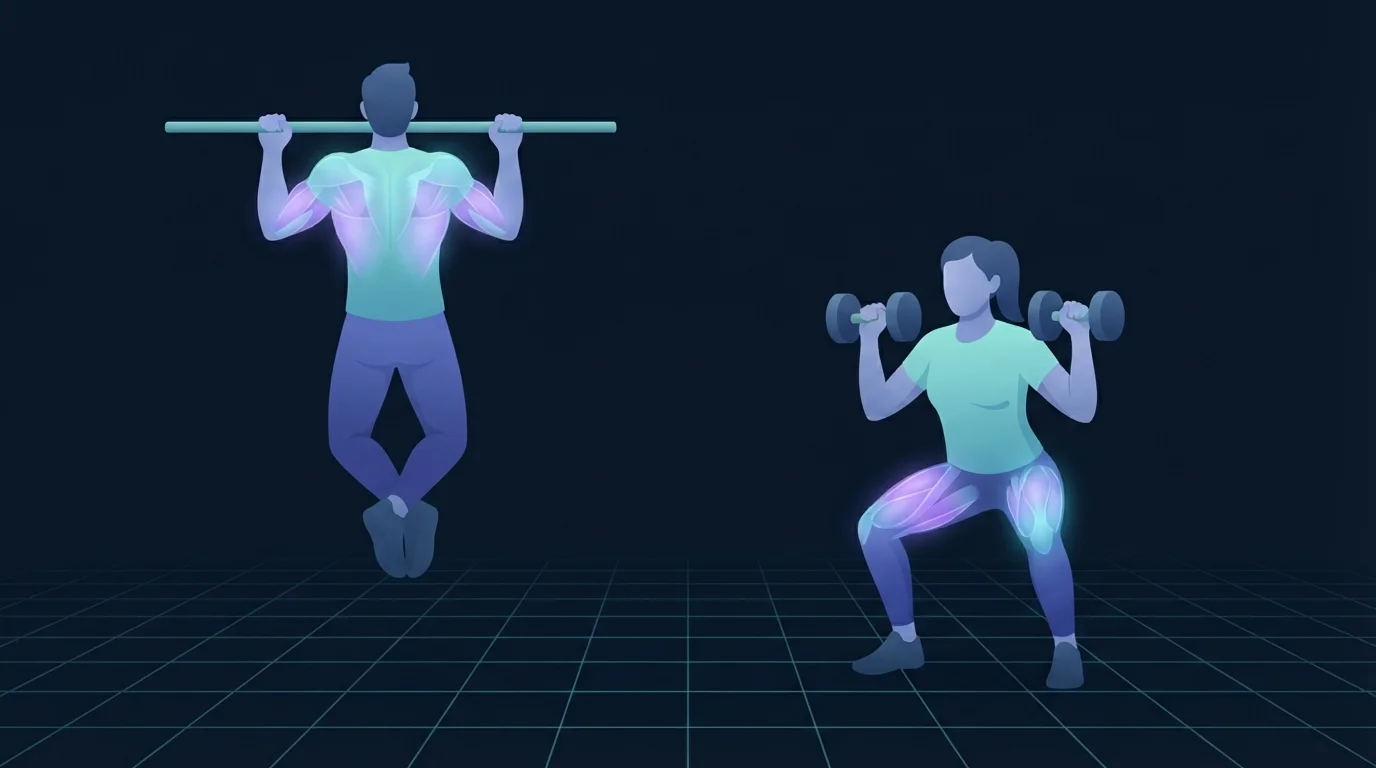
Choose calisthenics if you're starting out, training at home, short on space, or you want a body that can control itself through hard positions. Choose weights if your goal is maximum size or maximum strength, if your legs have outgrown bodyweight squats, or if you want the simplest possible way to add a little more load every week. For most people the honest answer is both, and the ratio changes as you get stronger.
The argument gets heated because each side is describing a different phase of training. Beginners genuinely do grow on push-ups. Advanced lifters genuinely do stall without external load. Both groups then go online and tell everyone their experience is the universal one.
What Calisthenics and Weights Actually Have in Common
Muscle doesn't know what's loading it. It responds to mechanical tension, to how close a set gets to failure, and to whether that stimulus rises over time. A push-up and a dumbbell press are two delivery systems for the same signal.
| Calisthenics | Weights | |
|---|---|---|
| Source of resistance | Your own bodyweight and leverage | External load you choose |
| How it gets harder | Harder variations, longer levers, slower tempo, less support | Add a little weight or another rep |
| Increment size | Large and uneven between variations | Small and predictable |
| Upper body ceiling | High, one-arm and lever work is genuinely hard | Effectively unlimited |
| Lower body ceiling | Low, legs outgrow bodyweight fast | Effectively unlimited |
| Equipment and space | A floor, and a bar if you want to pull | Dumbbells or kettlebells and somewhere to keep them |
| Skill demand | High, the movement itself is the challenge | Moderate, technique is learnable in weeks |
| Weakest claim made for it | "Builds a different, more functional kind of muscle" | "Bodyweight training can't build anything" |
Both of those weak claims fall apart on contact with the trials.
Does Calisthenics Build as Much Muscle as Weights?
In untrained and moderately trained people, yes, and this has been tested directly twice.
Kotarsky et al. (2018), in the Journal of Strength and Conditioning Research, randomised 23 moderately trained men into progressive calisthenic push-up training (14 men) or traditional bench press training (9 men), three days a week for four weeks. Both groups significantly increased their bench press one-rep max and their muscle thickness. The push-up group improved more on push-up progression, which is what specificity predicts. The authors' conclusion was that push-up progression training produced increases in strength and muscle thickness comparable to bench press training over that period.
Kikuchi and Nakazato (2017) ran it longer. Writing in the Journal of Exercise Science and Fitness, they assigned 18 men to eight weeks of either bench pressing at 40 percent of 1RM or push-ups adjusted (kneeling, for example) to that same load, twice a week. Bench press 1RM rose in both groups, from 60.0 to 65.0 kg in the bench group and 61.1 to 64.2 kg in the push-up group. Triceps thickness rose in both. The one difference: biceps thickness increased only in the bench press group.
The mechanism behind that is the load-versus-failure finding. Schoenfeld et al. (2017) pooled 21 studies comparing low-load training (60 percent of 1RM or less) against high-load training, with every set taken to momentary muscular failure. Changes in muscle size were similar between conditions. Gains in 1RM strength were significantly greater with heavy loads. Isometric strength showed no significant difference. Their summary: maximal strength comes from heavy loads, and hypertrophy can be achieved across a spectrum of loading ranges.
That's the scientific case for calisthenics, and it's a real one. We pulled the wider evidence together in our review of what bodyweight workouts actually produce, and the same logic runs through our look at whether light weights build muscle. The catch is hiding in the phrase "taken to failure".
Where Calisthenics Runs Out of Road
Every one of those studies used a load that was still meaningful for the people in it. Push-ups are a serious stimulus when your best bench press is 60 kg. They're a warm-up when it's 110 kg. The intervention didn't change. Your relationship to your own bodyweight did.
Lasevicius et al. (2018) put a number on the floor. In the European Journal of Sport Science, 30 men trained twice a week for 12 weeks in a within-subject design: one limb at 20 percent of 1RM, the contralateral limb at 40, 60 or 80 percent, with total volume load equated. Vastus lateralis cross-sectional area rose 8.9 percent at 20 percent of 1RM against 19.5 percent at 80 percent. Elbow flexors rose 11.4 percent against 25 percent. Every intensity worked. Twenty percent of 1RM worked distinctly less well.
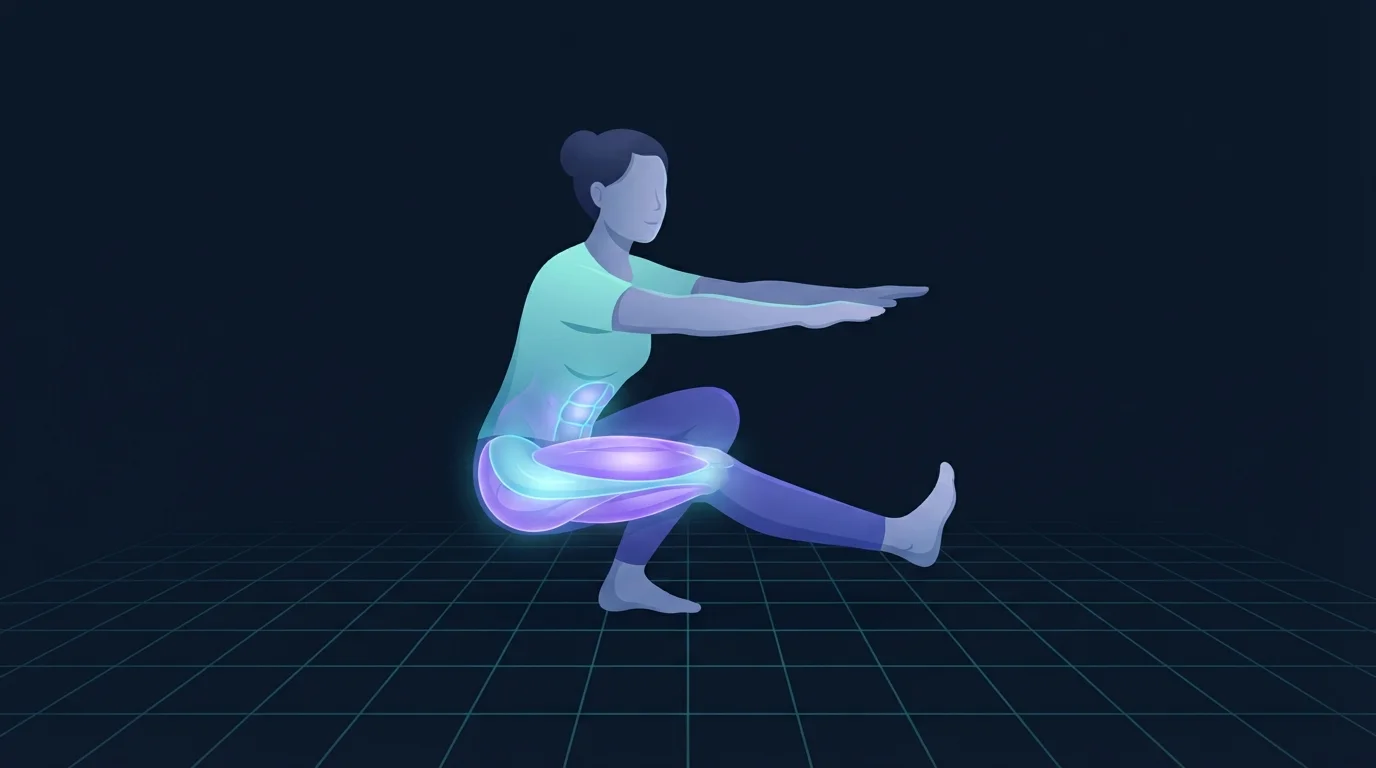
Bodyweight lower body work sits uncomfortably close to that floor for most adults. A bodyweight squat loads maybe 25 to 30 percent of what a trained person's legs can handle. Calisthenics answers this with leverage: single leg work, deeper ranges, slower tempo, longer pauses. Those are real tools, and Bulgarian split squats will genuinely challenge most people for a while. The problem is that the increments are enormous. Going from a two-leg squat to a full pistol squat is not a 5 percent jump, it's a cliff, and there's very little between the two.
Upper body has more room. The distance between an incline push-up and a one-arm push-up covers years of training, which our push-up progression guide maps rung by rung, and the same is true from inverted rows up through weighted chin-ups. That asymmetry is why so many long-term calisthenics athletes have impressive upper bodies and unremarkable legs.
Find out what's really holding you back
FitCraft, our mobile fitness app, pairs you with an AI coach who builds you a personalized plan around your goals, schedule, and fitness level. Every FitCraft program is designed by Domenic Angelino, MPH (Brown University) and NSCA-CSCS, with research published in the Journal of Strength and Conditioning Research and Medicine & Science in Sports & Exercise.
Take the Free Assessment Free • 2 minutes • No credit cardWhat Calisthenics Gives You That Weights Don't
Three things, and none of them are about muscle size.
Body control and position
Thomas et al. (2017), in Isokinetics and Exercise Science, split 28 men into a calisthenics group and a control group and tested posture, handgrip, push-up and pull-up performance and body composition after eight weeks. The calisthenics group improved on posture, strength and body composition. The control group, which carried on with its normal routine, did not. The authors called calisthenics a feasible and effective way to improve posture, strength and body composition without any major equipment.
Holding a hollow body position, keeping a plank rigid under load, controlling a slow descent on a chin-up bar: those demand trunk and shoulder coordination that a seated machine never asks for. That's a genuine advantage, not a marketing line.
Zero friction to start
Nothing to buy, nothing to assemble, nowhere to drive. The session starts the moment you decide to do it. For a lot of people that difference is worth more than any comparison of hypertrophy effect sizes, because the plan they follow imperfectly beats the plan they abandon. If training at home is the reason you're reading this, our home workout app with no equipment page walks through how to structure a week around nothing but the floor.
Joints get a vote
In a push-up your hands are fixed and your shoulder blades move freely, so the shoulder can find a path that suits it. Bodyweight work also caps the load at what you weigh, which makes it hard to overload a joint by accident on a day you feel strong. Neither point makes calisthenics injury-proof. Advanced skills load tendons hard at long muscle lengths, and rushed progressions produce elbow and shoulder complaints in exactly the way rushed lifting produces back complaints.
Who Should Choose Which
| If this is you | Start with | Why |
|---|---|---|
| New to training entirely | Calisthenics | No purchase, no setup, and bodyweight is plenty of load at first |
| Chasing maximum size | Weights | Only external load keeps rising once bodyweight feels light |
| Legs already strong, upper body behind | Calisthenics | Push and pull progressions have years of headroom |
| Upper body fine, legs untrained | Weights | Bodyweight squats sit near the load floor for most adults |
| Training in a small flat or a hotel | Calisthenics | The floor is the only equipment the plan needs |
| Coming back after a long gap | Calisthenics, then dumbbells | Rebuild control first, add load once the pattern is clean |
| Motivated by skills and milestones | Calisthenics | A first pull-up is a better goal than a slightly heavier row |
| You want the simplest possible progress | Weights | Add a small increment, repeat, no leverage puzzles |
If you land on the weights side and you're training at home, the next question is usually which implement to buy. Our kettlebell vs dumbbell comparison works through where each one has the edge, since they cover most of the same ground with different strengths in the details.
A Hybrid Week That Uses Both
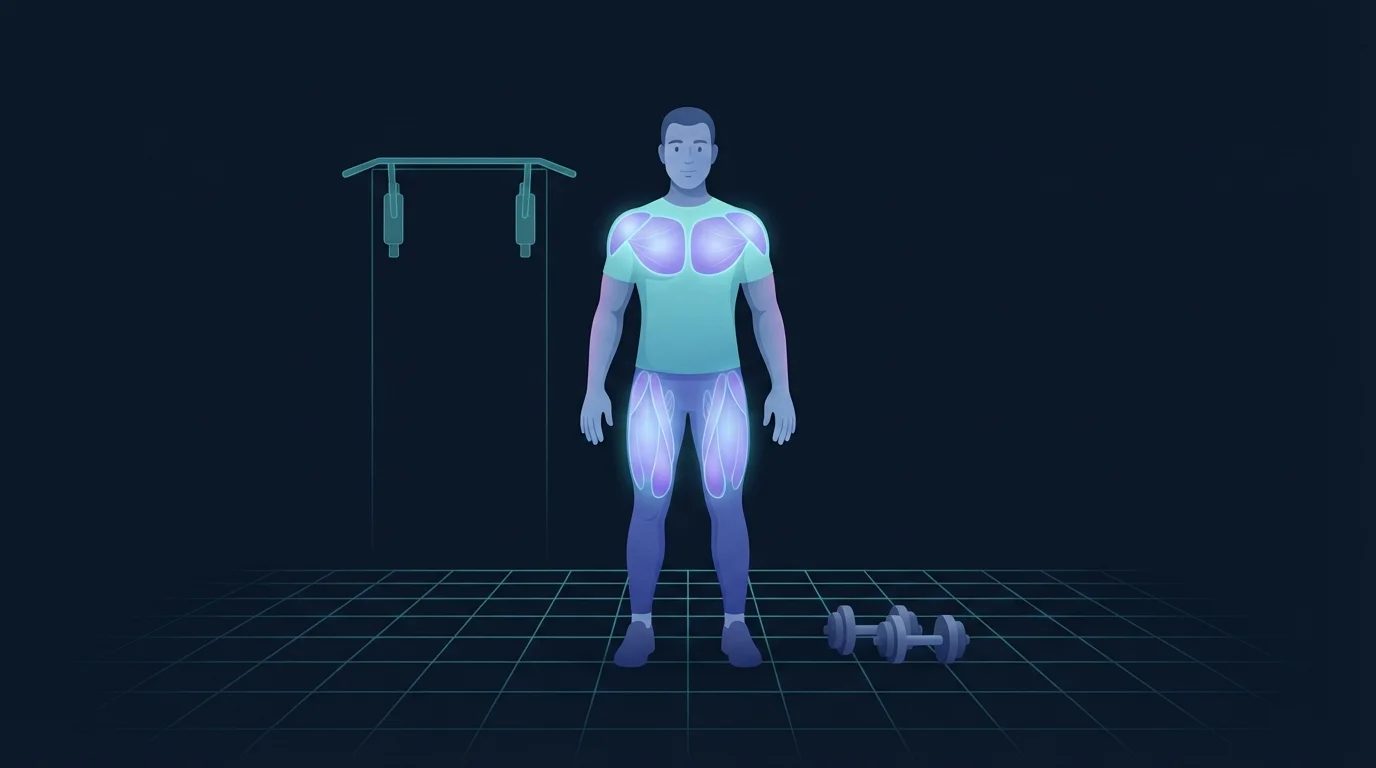
The split that works for most people is simple: bodyweight for pushing and pulling, load for the legs and hips. That plays to each method's headroom instead of arguing about which one is purer.
| Day | Bodyweight | Loaded |
|---|---|---|
| Day 1, push focus | Push-ups or a harder variation, 4 sets near failure | Dumbbell shoulder press, 3 sets of 8 to 12 |
| Day 2, legs and hips | Split squats or step-ups, 3 sets | Goblet squats and Romanian deadlifts, 3 sets of 6 to 10 |
| Day 3, pull focus | Chin-ups or inverted rows, 4 sets near failure | Dumbbell rows, 3 sets of 8 to 12 |
| Optional day 4 | Core and hollow holds, skill practice | Carries, 4 sets of 30 to 40 seconds |
Two rules make that week work. First, apply progressive overload to one variable at a time: this week add a rep, next week slow the lowering phase, the week after move to the harder variation. Changing three things at once means you can't tell what worked. Second, take the last set of each exercise close to failure, within about two reps. That's what made light loads competitive in the Schoenfeld pooling, and it's the single most common thing missing from home bodyweight training. A set of 20 comfortable push-ups is not the same stimulus as a set of 12 hard ones.
The Bottom Line
Calisthenics vs weights is a question about where you are, not about which is better. For the first year or two of training they build muscle at similar rates, and two head-to-head trials of push-ups against bench pressing found comparable gains. After that, the method that can keep adding load wins, because progressive overload is the actual mechanism and bodyweight stops providing it.
Practical rule: use calisthenics for pushing and pulling as far as it will take you, which is further than most people think. Add load for legs and hips early, because that's where bodyweight runs out first. If you have to pick one for the next six months, pick the one you'll actually do three times a week.
Mike, 23, put four months into it and came out visibly stronger. His account of why is not about programming at all: "The streak system got me hooked. I didn't want to break my chain." The method he used mattered less than the fact that he kept using it, which is the finding hiding underneath every study quoted on this page.
Frequently Asked Questions
Can you build muscle with calisthenics alone?
Yes, especially in the first year or two. Kikuchi and Nakazato (2017) trained 18 men for 8 weeks and found push-ups produced similar muscle thickness and bench press strength gains to low-load bench pressing. The limit is not the method, it is the load. Once a set of a given exercise stops being hard at 15 or 20 reps, you need a harder variation or external resistance to keep growing.
Is calisthenics or weights better for strength?
Weights, if you mean maximal strength. Schoenfeld et al. (2017) pooled 21 studies and found 1RM strength gains were significantly greater with heavy loads than with light loads, even though muscle growth was similar across the loading spectrum. Calisthenics builds impressive strength relative to your own bodyweight, which is a different and equally useful thing.
Why do calisthenics athletes look so muscular?
Because hard bodyweight skills demand high relative strength, which selects for people who are lean and carry most of their muscle in the upper body. Pull-ups, dips and handstand work load the back, chest, shoulders and arms heavily. Legs and hips are the usual gap, which is why most experienced calisthenics athletes add loaded squats, lunges or hinges at some point.
How do you progress calisthenics without adding weight?
You change leverage instead of load. Elevate your feet, slow the lowering phase, pause at the hardest point, reduce the base of support, or move to a harder variation of the same pattern. A knee push-up becomes a full push-up, then a decline push-up, then a one-arm progression. Each step raises the effective load on the same muscles without a dumbbell.
Should beginners start with calisthenics or weights?
Calisthenics is the easier entry point for most beginners because there's nothing to buy, nothing to set up and no technique bottleneck before you can train hard. Add dumbbells once bodyweight lower body work stops being challenging, which usually happens sooner for legs than for upper body. A mixed week is better than either extreme.
Is calisthenics safer than lifting weights?
Both are safe when the load is matched to what you can currently control. Calisthenics keeps the load capped at your own bodyweight and lets the joints find their own path, which suits many people. The trade-off is that advanced bodyweight skills load tendons hard at long muscle lengths, and elbow and shoulder complaints are common in people who progress those too quickly.