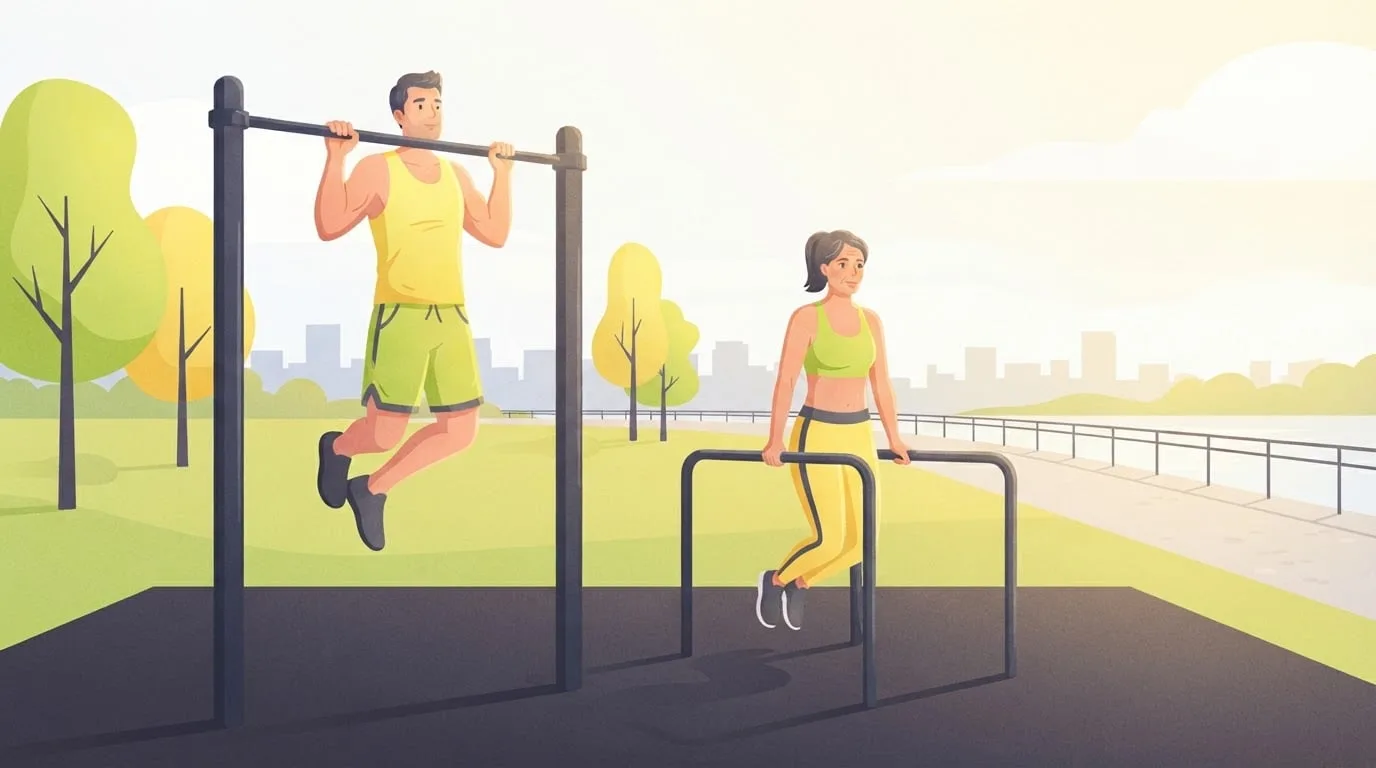
Calisthenics is exercise that uses your own body weight as the load. If you've ever done push-ups in gym class, squats in your living room or a pull-up on a playground bar, you've done calisthenics, even if nobody called it that.
The word sounds technical, and social media makes it look like a sport for people who can hold their body sideways off a lamppost. That picture puts a lot of people off before they start. You don't need a gym, a barbell or special talent, and the research on plain bodyweight training is more encouraging than most people expect.
Below you'll find the calisthenics definition and where the word comes from, a short history, whether it counts as a sport, what studies show it does for your body, the five moves most programs are built on, a simple way to start, and the downsides worth knowing before you commit.
Calisthenics Definition and Meaning
Calisthenics is a form of strength training in which your body weight provides the resistance. You move that weight against gravity by pushing, pulling, squatting, lunging and bracing your trunk. The definition most coaches use has three parts:
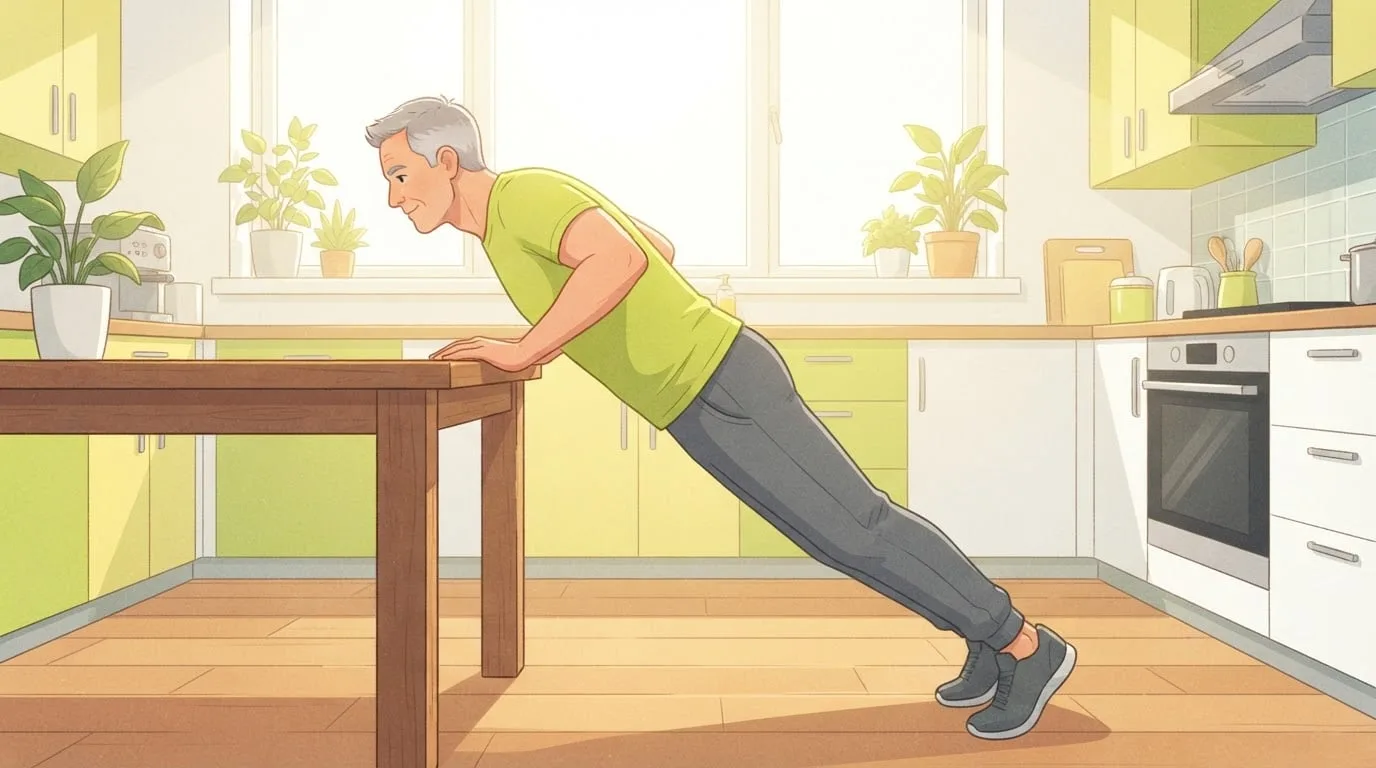
- Your body is the resistance. You change the difficulty by changing leverage and position. A push-up with your hands on a kitchen counter is easier than one on the floor, and one with your feet on a chair is harder.
- Equipment is minimal. A floor is enough for most moves. A pull-up bar, parallel bars or gymnastic rings extend the menu, but they hold your body up rather than add weight to it.
- The moves are mostly compound exercises. Push-ups, squats and pull-ups each train several muscle groups at once, which is why a short calisthenics session can cover the whole body.
Where the word comes from
The word joins two Greek roots: kallos, meaning beauty, and sthenos, meaning strength. So calisthenics means, roughly, beautiful strength. It was in English print by the late 1830s, mostly for exercise classes in girls' schools, and Catharine Beecher's 1856 book Physiology and Calisthenics for Schools and Families, now held by the National Library of Medicine, helped spread it to classrooms and homes across the United States.
Calisthenics in a sentence
In everyday use the word names a style of training: "She does calisthenics in the park before work, mostly push-ups, dips and pull-ups." The adjective is calisthenic, as in "a calisthenic exercise." British and Australian writers often spell it callisthenics.
Calisthenics, bodyweight training and gymnastics
Most coaches and researchers use calisthenics and bodyweight training to mean the same thing. Gymnastics shares many of the skills, such as the handstand and the L-sit, but it's a judged sport with its own apparatus and routines. Modern calisthenics borrows those skills and trains them on simple bars and on the floor.
A Short History of Calisthenics
No one person invented calisthenics. People have trained with their own body weight for as long as there have been soldiers and athletes. The modern version grew out of a handful of movements:
- Germany, 1811. Friedrich Ludwig Jahn opened an open-air exercise ground in Berlin's Hasenheide park, where young men trained on bars, beams and ropes. His Turnen movement popularized the horizontal bar and the parallel bars that calisthenics parks still use.
- United States, 1850s. Beecher argued that girls and women needed daily exercise at a time when few people thought so, and her calisthenics were light, rhythmic movements that families could do at home.
- Canada, 1960s. The Royal Canadian Air Force published 5BX, short for Five Basic Exercises, a short daily bodyweight plan first meant for service members at remote bases. It spread far beyond the military.
- City parks, 2000s. Street workout grew up on outdoor pull-up bars, and online videos turned strength skills like the muscle-up, the front lever and the human flag into something people trained for and filmed.
Is Calisthenics a Sport?
It can be. For most people calisthenics is a way to train, the way running is a way to get fit. It also has two competitive forms.
- Street workout competitions. Athletes are judged on freestyle routines of strength holds and dynamic moves on a bar, or compete in strength events such as weighted pull-ups and dips. The World Street Workout and Calisthenics Federation, based in Riga, Latvia, runs a world championship.
- Australian calisthenics. In Australia, calisthenics also names a team performing art that blends dance, gymnastics, ballet and theater on stage, competed by clubs since the late 1800s. That's why searches for "calisthenics dance meaning" turn up costumed troupes instead of pull-up bars.
What Does Calisthenics Do for Your Body?
Calisthenics builds strength, muscular endurance and, when you keep moving between exercises, aerobic fitness. Here's what controlled studies have measured.
It makes you stronger
Thomas and colleagues (2017) split 28 untrained men into a calisthenics group and a group that kept their usual routine. After 8 weeks of calisthenics, the training group's push-up score rose 16.4% and their pull-up score 39.2%, their fat mass fell and their posture improved. The other group didn't change.
Bodyweight moves can also match a barbell for strength when the effort matches. In a study of 30 university students with lifting experience, Calatayud and colleagues (2015) made push-ups as hard as a 6-rep bench press by adding elastic bands. After 5 weeks, both groups gained similar strength. In a 4-week trial with 23 moderately trained men, Kotarsky and colleagues (2018) found that push-up variations that got harder over time raised the one-rep bench press about as well as bench pressing did, although muscle thickness didn't change significantly in either group in that short window.
It trains your heart and lungs too
Bodyweight moves done briskly work as cardio. Archila and colleagues (2021) modelled a modern version of 5BX: 11-minute sessions of burpees, high knees, split squat jumps and squat jumps at a challenging pace, with walking in between, three times a week for 6 weeks. In 19 inactive young adults, peak oxygen uptake in the training group rose about 7% from the start and ended higher than in the control group. It's a small study, and leg endurance and grip strength didn't change, but it shows how little time a bodyweight session needs to move aerobic fitness.
It's linked with better long-term health
Calisthenics counts as muscle-strengthening activity, and that kind of activity tracks with living longer. Pooling 16 cohort studies, Momma and colleagues (2022) found it was linked with a 10 to 17% lower risk of death from any cause, heart disease, cancer and diabetes. The largest reduction showed up at about 30 to 60 minutes a week, and the authors say the effect of doing much more is unclear. These are observational studies, so they show a link rather than proof.
Push-ups have their own data point. In 1,104 male firefighters followed for 10 years, Yang and colleagues (2019) found that men who could do more than 40 push-ups had a 96% lower rate of heart disease events than men who managed fewer than 10. Our breakdown of the push-up test and heart health research explains why that cohort is too narrow to generalize from, and what the test still tells you.
Can Calisthenics Build Muscle?
Yes, as long as your sets are hard. Kikuchi and Nakazato (2017) had 18 young men train for 8 weeks with either a light bench press or push-ups adjusted to the same load, and both groups built similar chest and triceps thickness. A meta-analysis of 21 studies by Schoenfeld and colleagues (2017) explains why: light loads taken to failure built as much muscle as heavy ones, while heavy loads built more maximal strength. The catch is that a move you can do 40 times stops being a useful stimulus, so you keep moving to harder versions. Our guide to calisthenics vs weights compares the two approaches in detail.
What Are the Big 5 of Calisthenics?
There's no official list, but most calisthenics programs rest on five basic exercises, one for each major movement. Some coaches swap the dip for an inverted row or the leg raise for a lunge. Each one has an easier version you can do today.
- Push-up for the chest, shoulders and triceps. Start with your hands on a counter or sturdy table, and lower the surface as you get stronger until you reach the floor.
- Pull-up for the back and biceps. Start with inverted rows under a sturdy table, or jump to the top of a bar and lower yourself slowly.
- Dip for the triceps, chest and shoulders. Start with bench dips, hands on a stable chair and feet on the floor. Dips are the hardest of the five on the shoulders, so skip them if they hurt.
- Squat for the thighs and glutes. Start by standing up from a chair without using your hands, then progress to full squats, split squats and single-leg work.
- Hanging leg raise for the abs, hip flexors and grip. Start with lying leg raises or knee raises on the floor, and hang from a bar once you have one.
Our calisthenics workout plan builder turns these moves into step-by-step progression ladders, with sets and reps for 3, 4 or 5 days a week.
Knowing what to do is the easy part.
FitCraft, our mobile fitness app, pairs you with an AI coach who builds you a personalized plan around your goals, schedule, and fitness level. Every FitCraft program is designed by Domenic Angelino, MPH (Brown University) and NSCA-CSCS, with research published in the Journal of Strength and Conditioning Research and Medicine & Science in Sports & Exercise.
Take the Free Assessment Free • 2 minutes • No credit cardHow to Start Calisthenics as a Beginner
You need a few square meters of floor, a sturdy chair or table, and 20 to 30 minutes, two or three times a week. That covers the Physical Activity Guidelines for Americans, which ask adults for muscle-strengthening work on 2 or more days a week (Piercy and colleagues, 2018).
A first calisthenics workout
- Warm up for 3 minutes: march in place, circle your arms and do 10 slow squats to a chair.
- Incline push-up: 3 sets of 8 to 12, hands on a counter or table.
- Inverted row under a table, or a slow lowering from a bar: 3 sets of 6 to 10.
- Chair squat: 3 sets of 10 to 15, standing up without using your hands.
- Bench dip from a chair: 2 sets of 6 to 10, if your shoulders are comfortable.
- Lying knee raise: 2 sets of 10 to 15, lower back pressed into the floor.
Rest 60 to 90 seconds between sets, or run the moves as a circuit with less rest if you want more of a cardio effect. End each set when you could still do one to three more good reps. That's close enough to failure to build strength without letting your form fall apart.
How to progress without adding weight
Calisthenics uses progressive overload just like lifting, but you add difficulty instead of plates. When you can do the top of the rep range on every set with good form, move to a harder version: a lower surface for push-ups, a more horizontal body for rows, a split squat instead of a squat, or a slow 3-second lowering on every rep. Write down your reps each session so you know when it's time to move up. Our list of the best bodyweight exercises covers more moves for each movement pattern when you want variety.
Is 20 Minutes of Calisthenics Enough?
For health and steady strength gains, yes, if you do it two or three times a week and your sets are challenging. Two or three 20-minute sessions add up to 40 to 60 minutes a week, which is where Momma's meta-analysis saw the largest drop in risk. The 5BX-style trial above improved aerobic fitness with 11 minutes a session.
A 20-minute session works well with this shape: 3 minutes of warm-up, 15 minutes for three rounds of the five basic moves with short rests, and 2 minutes to cool down and stretch. What 20 minutes won't do is fit in long skill practice. If you're working toward a handstand or a muscle-up, add a few minutes of practice on separate days.
What Is the 80/20 Rule in Calisthenics?
It's a coaching rule of thumb, not a research finding, and people use it in two ways. The common one borrows the Pareto principle: about 80% of your results come from 20% of the exercises, meaning the basic push, pull, dip, squat and core moves, so those should fill most of your training. The second splits your time: about 80% on strength basics and 20% on skills you're learning, such as a handstand or an L-sit.
Both versions point the same way. Spend most of every session on the basics and treat the flashy skills as a small, fun extra. Some people also use 80/20 for food, eating mostly whole foods with room for treats, which is a separate idea.
Is There a Downside to Calisthenics?
Calisthenics has real limits, and knowing them early saves frustration.
- Your legs outgrow your body weight first. They already carry you all day, so plain squats get easy fast. Split squats, step-ups and single-leg squats extend the road, but many people eventually add dumbbells for legs.
- Pulling needs something to hang from. Without a bar, rings or a sturdy table for rows, your back gets less work than your chest.
- Maximal strength lags. Heavy loads build more one-rep max strength than light ones, as the Schoenfeld meta-analysis found. If your goal is a big barbell lift, you'll need the barbell.
- Progress comes in bigger jumps. You can't add a small plate to a push-up. Each harder variation is a step up in difficulty, so you'll spend some weeks building reps before the next level feels possible.
- Some joints carry a lot of load. Push-ups and handstands load the wrists, and dips load the front of the shoulders. Build volume gradually, and use fists or push-up handles if your wrists complain.
- Advanced skills take years. Moves like the planche put heavy strain on the wrists, elbows and shoulders. Chasing them before you have a solid base of push-ups, dips and rows is a common route to elbow and wrist pain.
None of these are reasons to skip calisthenics. They're reasons to pair it with a few dumbbells as you advance, or to add gym training later if your goals change.
What This Means for You
Calisthenics is the simplest way to start strength training: your body, a bit of floor and a plan. The exercises are rarely the hard part. Showing up on Wednesday after Monday's motivation is gone, and again in week four when the novelty has worn off, is where most people fall away. That's a design problem, and it has design fixes: a short session, a fixed schedule and a reason to come back.
If you'd like that structure built for you, FitCraft is one option. It plans bodyweight and dumbbell strength workouts, a 3D AI coach demonstrates every exercise and says your name during the workout, your workouts adjust as you progress, and streaks and leaderboards give you a reason to return. See how it works as a home workout app with no equipment. As Mike, 23, who got visibly stronger in 4 months, put it: "The streak system got me hooked. I didn't want to break my chain."
Whatever you use, start with the five basic moves this week, at whatever level you can do with good form today. A month from now you'll be doing harder versions than you can manage now, and that's what calisthenics is for.
Frequently Asked Questions
What is the meaning of calisthenics?
Calisthenics means exercise that uses your own body weight as the resistance, such as push-ups, squats, lunges, pull-ups and dips, with little or no equipment. The word comes from the Greek kallos (beauty) and sthenos (strength), so it means roughly beautiful strength.
Who invented calisthenics?
No single person invented calisthenics. Bodyweight training is ancient, and the modern form grew from several movements: Friedrich Ludwig Jahn's outdoor exercise grounds in Germany from 1811, Catharine Beecher's calisthenics for American schools and families in the 1850s, the Royal Canadian Air Force's 5BX plan in the 1960s and the street workout scene in city parks in the 2000s.
Can you do calisthenics every day?
You can move every day, but hard strength sessions for the same muscles work better with a rest day between them. Most beginners do best with full-body calisthenics on 2 or 3 non-consecutive days a week and a walk, mobility or yoga on the days between.
Does calisthenics burn fat?
It helps. A meta-analysis of 58 studies found that resistance training lowered body fat percentage by about 1.46 percentage points compared with no exercise, and calisthenics is a form of resistance training. Most fat loss still comes from eating a little less than you burn, and the training helps you keep muscle while you do.
Is calisthenics better than going to the gym?
Neither is better for everyone. Calisthenics builds strength and muscle for most people when sets are hard, costs nothing and works anywhere, while weights make it easier to load the legs and to build maximal strength. The better choice is the one you'll keep doing, and many people combine both.
Is calisthenics good for beginners?
Yes. Every calisthenics exercise has an easier version, such as push-ups with your hands on a counter or squats to a chair, so you can start at your current level and progress. Two or three 20 to 30 minute sessions a week are enough to get stronger.