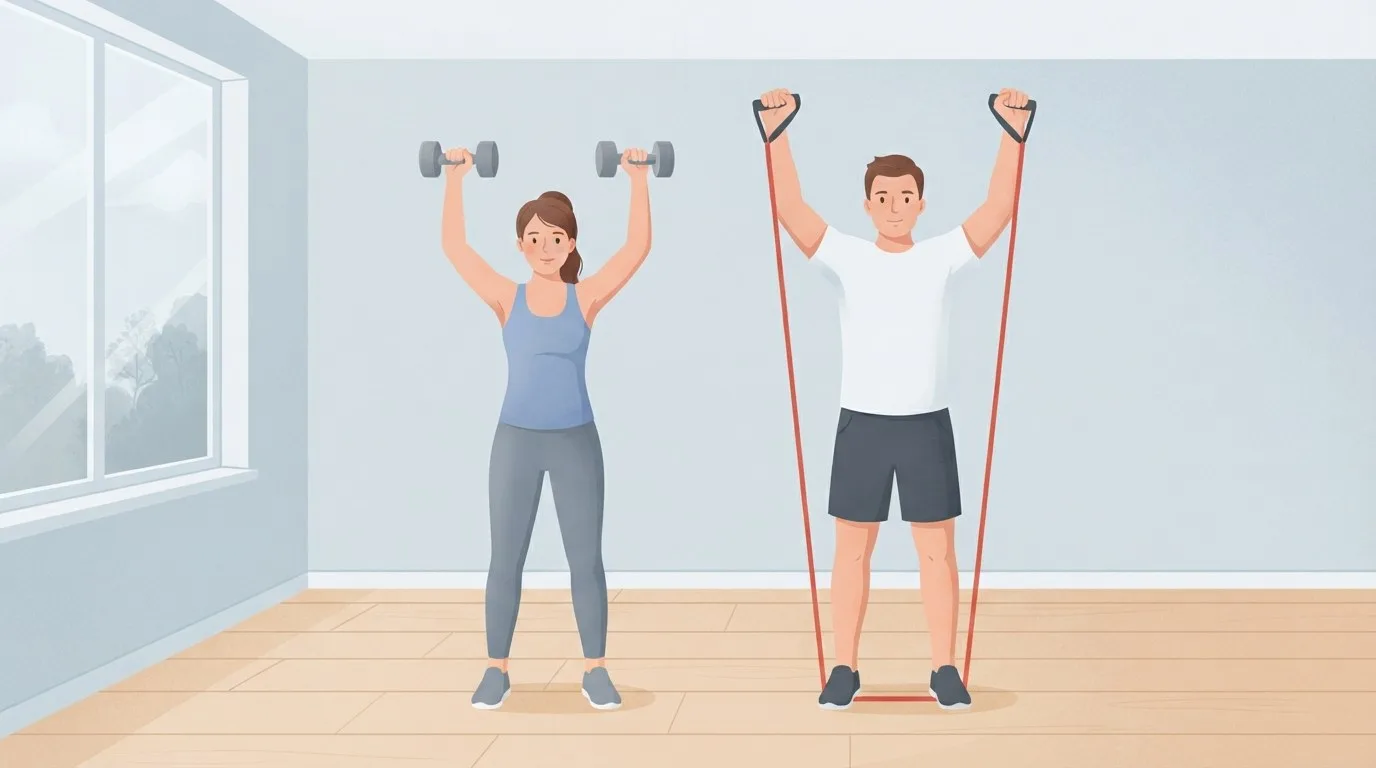
You've got a corner of the living room, a budget and two options: a bag of colored rubber bands or a pair of dumbbells. Maybe a trainer once told you bands are for rehab. Maybe a forum thread told you they're all you'll ever need. Underneath both is the question people search most: are resistance bands as effective as weights?
It matters more than it looks. Nobody wants to spend three months on the "lesser" option and find out later the work didn't count. That worry keeps a lot of people researching equipment instead of training, and every week spent deciding is a week of strength you didn't build.
The trials give a clearer answer than the forums do. Below are the studies that compared the two head to head, what actually differs in how each one loads a muscle, where bands run out of room, what each costs in money and space, and a straight call on who should choose which.
Resistance Bands vs Weights at a Glance
This table sums up the differences before the evidence. "Weights" here means free weights, mainly dumbbells, because that's the realistic alternative to bands in a home.
| Factor | Resistance bands | Free weights (dumbbells) |
|---|---|---|
| Where the load comes from | Elastic tension that rises as the band stretches | Gravity, the same weight through the whole rep |
| Hardest point of the rep | Near the end, where the band is longest | Where the weight sits furthest from the working joint, often mid-rep |
| Load at the stretched start of a rep | Light, because the band is close to slack | Full, as at the bottom of a fly or a Romanian deadlift |
| Strength gains in trials | Similar to weights across eight trials | Similar to bands at matched effort |
| Measuring progress | Rough: grade, stretch and stance all change the load | Exact: the number on the dumbbell |
| Heaviest practical load | Limited, especially for legs | Limited only by what you own |
| Space and noise | Fits in a drawer, silent | Needs a floor corner or rack |
| Travel | Fits in a carry-on | Stays home |
| Cost for a full range | Low | Higher, and it rises with every heavier pair |
| Lifespan | Latex wears out and can snap | Lasts for decades |
| Best for | Travel, small spaces, warm-ups, beginners, rehab with a clinician | Numbered progress, heavier leg work, a long-term home setup |
Are Resistance Bands as Effective as Weights?
For strength, yes, in the trials that have tested it. The broadest evidence is a meta-analysis by Lopes and colleagues (2019) in SAGE Open Medicine, which pooled eight randomized trials of elastic tubes and bands against dumbbells and weight machines and found no advantage for either method in upper- or lower-limb strength. Our resistance band training research review walks through that analysis and several other band trials one by one. The two studies below matter most for the decision in front of you, because they set bands directly against free weights.
Colado 2010: fit young women, eight weeks
Colado and colleagues (2010), writing in the International Journal of Sports Medicine, randomly split 42 physically fit women with an average age of about 22 into three groups: an elastic tubing station, weight machines and free weights, or no training. Both training groups followed the same periodized program for eight weeks, with two to four sessions a week and three or four sets of 8 to 15 reps stopped short of failure.
Both training groups got stronger and the control group didn't. Isometric rowing strength rose 19.9 percent with tubing and 19.8 percent with weights. Back extension strength rose 14.4 and 14.0 percent. The squat was the outlier, at 14.1 percent with tubing against 28.9 percent with free weights and machines. The authors judged the two approaches equivalent for a short program, but if stronger legs are your main goal, that squat result is worth remembering.
Calatayud 2015: experienced lifters, bench press vs band push-ups
The usual objection is that bands are fine for beginners and useless once you're strong. Calatayud and colleagues (2015) tested that in the Journal of Strength and Conditioning Research with 30 university students who had advanced resistance training experience. They first recorded muscle activity during a six-rep-max bench press and during push-ups loaded with elastic bands until six reps was also the limit, and found no difference between the two. Then they trained three groups for five weeks: bench press, band push-ups or no training.
Both training groups improved their one-rep max and six-rep max by similar amounts, with gains of roughly 14 to 22 percent, while the control group stayed the same. A band isn't magic. When it makes an exercise hard enough that six reps is all you can do, the muscle responds much as it does to a bar.
A meta-analysis of muscle activity studies by Aboodarda, Page and Behm (2016) points the same way. Across similar exercises, the main movers, the helper muscles and the stabilizers worked about equally hard under elastic and free-weight resistance.
Do Resistance Bands Build Muscle Like Weights?
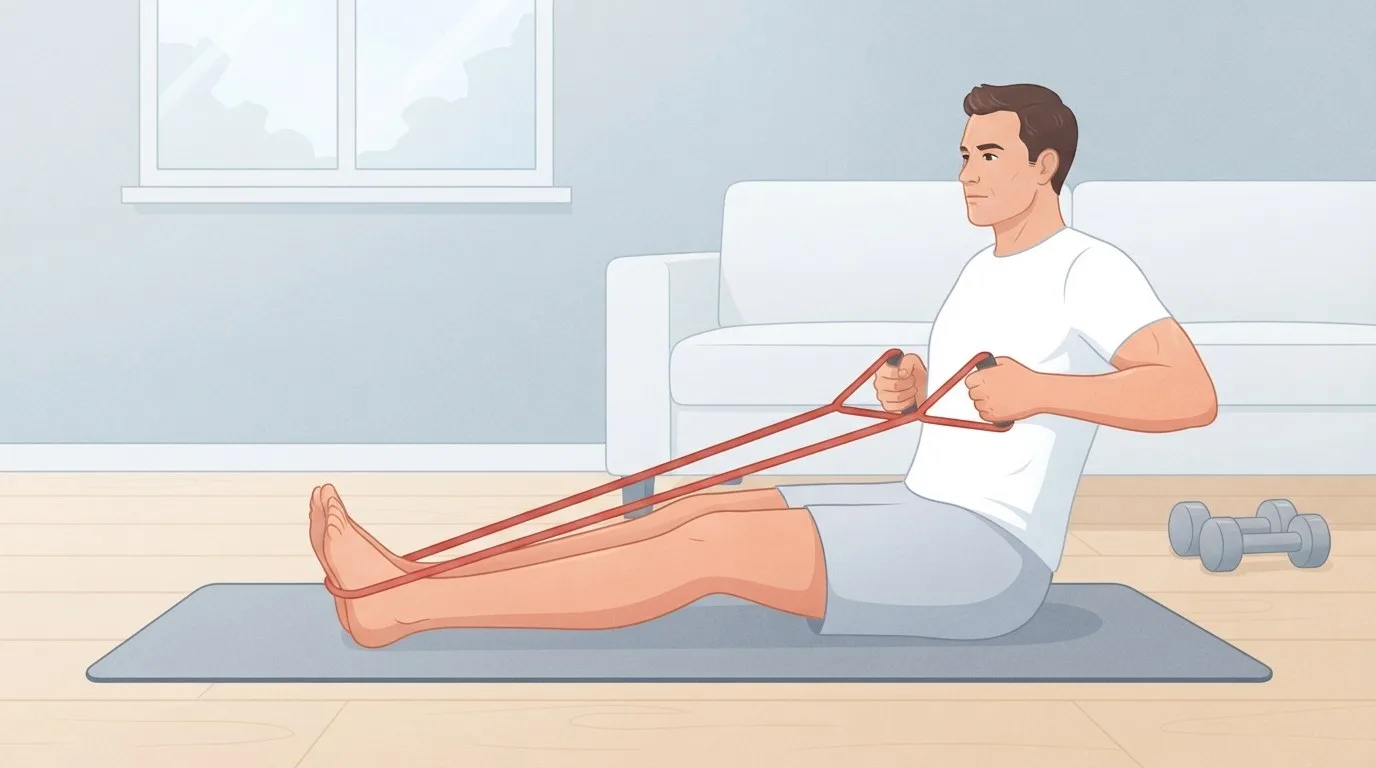
Probably, with one caveat about the evidence. Most band trials measured strength rather than muscle size, so direct band-versus-dumbbell data on muscle growth is thin. The indirect evidence is strong. Schoenfeld and colleagues (2017) pooled 21 studies and found that light and heavy loads built similar muscle when every set went to failure, while heavy loads built more one-rep-max strength. Muscle responds to effort more than to the source of the resistance, which is the argument our review of whether light weights build muscle lays out in detail.
So the useful question is whether your bands can take you close to failure in a sensible range of reps, say 8 to 20. For most upper-body exercises they can. For a strong lower body, a single band often can't, and that's the limit the next two sections explain.
Can you get ripped using resistance bands?
You can build visible muscle with bands if your sets are hard, but "ripped" is mostly a body-fat question. Training builds the muscle, and months of eating a little less than you burn reveal it. The same is true with dumbbells, which is why the equipment choice matters less here than the diet.
Loading Curves: Why Bands and Dumbbells Feel So Different
A dumbbell always weighs the same, but it doesn't always feel the same. How hard a rep feels depends on how far the weight sits horizontally from the joint that's moving. In a curl, that distance is greatest when your forearm is level with the floor, so the middle of the rep is the hardest part and the top is easy.
A band follows a different rule: its tension rises as it stretches. Uchida and colleagues (2016) measured eight grades of flat therapy band at set stretch lengths. The heaviest grade pulled with about 2.6 kilograms of force at a 25 percent stretch, 5.7 kilograms when stretched to double its resting length and 7.6 kilograms at triple its length. Every grade rose the same way. The team also found that the manufacturer's ratings overstated the tension of five of the eight grades, so the number on a band's packaging is a rough guide at best.
That rising curve has two consequences you'll feel in training:
- Bands load the finish. The top of a squat, a push-up, a press or a glute bridge is where most people are strongest, and it's exactly where a band pulls hardest. Those movements suit bands well.
- Bands go quiet at the stretch. A dumbbell keeps full load on your chest at the bottom of a fly and on your hamstrings at the bottom of a Romanian deadlift. A band is close to slack in those positions, so the stretched part of the rep gets very little work.
Neither curve is better in the abstract, and the trials suggest both make you stronger. If you own both, give them different jobs: bands for warm-ups, end-range work and travel weeks, and dumbbells for the movements where the stretched position matters.
Find out what's really holding you back
FitCraft, our mobile fitness app, pairs you with an AI coach who builds you a personalized plan around your goals, schedule, and fitness level. Every FitCraft program is designed by Domenic Angelino, MPH (Brown University) and NSCA-CSCS, with research published in the Journal of Strength and Conditioning Research and Medicine & Science in Sports & Exercise.
Take the Free Assessment Free • 2 minutes • No credit cardProgression Limits: Where Bands Run Out
Getting stronger means doing a bit more over time: more load, more reps or more sets. Dumbbells make the first one obvious. You did 12 reps with the 20s last week, so this week you try the 25s. Bands make progress harder to see in three ways.
- The load isn't a number. Band tension depends on the grade, how far you stretch it and where you stand. Step a few inches further from the anchor and the exercise gets harder, so "red band, 12 reps" last week doesn't tell you much this week.
- The jumps are uneven. Moving up one grade can be a big leap in tension, and doubling up two bands is a bigger one still.
- There's a ceiling. The heaviest flat band in Uchida's test pulled less than 8 kilograms even at triple its length. Thick loop bands go much higher, but a trained lower body outgrows most of them for squats and hip hinges.
You can work around all three. Mark your foot position on the floor, write down the band and the stance you used, lower each rep over three or four seconds, add a pause at the hardest point, or switch to single-leg versions. Those tricks can keep a band set useful for months. They don't replace being able to pick up the next dumbbell.
Is a 10kg resistance band good?
It depends on the exercise and on how far the band has to stretch to reach 10 kilograms. Ratings usually describe one stretch length, so the same band pulls less at the start of a rep and more at the end. Ten kilograms of peak tension is a solid load for rows, presses and curls for most beginners. For squats, hinges and glute bridges it's light, and you'll likely want a heavier band, two bands together or a dumbbell.
Cost, Space and Travel
Bands are the cheaper way to cover a full range of resistance. A set of five or six grades usually costs less than one pair of heavy dumbbells, and it covers rows, presses, squats and pull-aparts for a beginner. Dumbbells get more expensive as you get stronger, because every heavier pair is another purchase, and adjustable sets cost more up front.
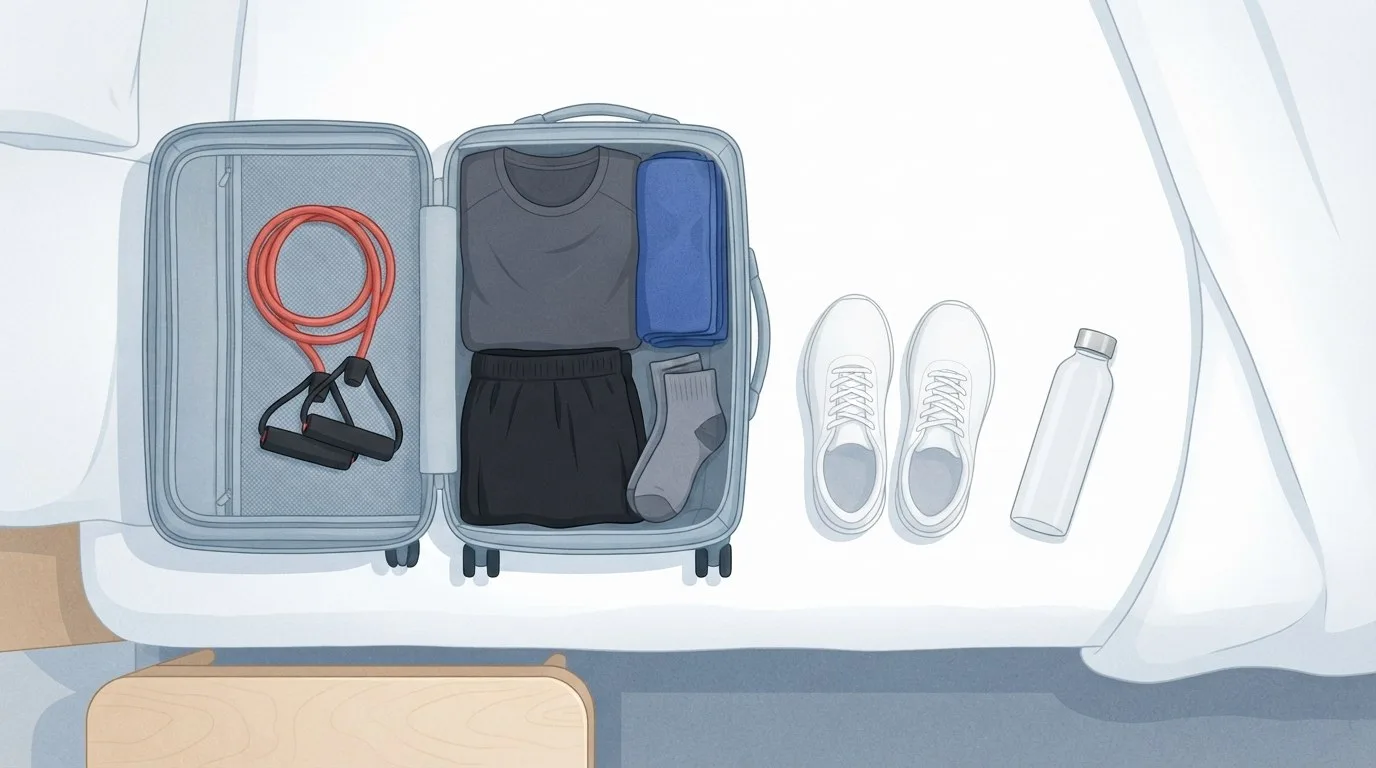
Space and travel are where bands are hardest to beat. A full set fits in a drawer or a carry-on side pocket, weighs almost nothing and makes no noise on an apartment floor. If you travel for work, a band means your training doesn't have to stop when you leave home, and missed weeks are what usually end a routine.
How long do resistance bands last?
Not as long as dumbbells, which last for decades. Latex wears from friction, sunlight, heat and sharp edges, and a band that's starting to fail can snap back hard. Check your bands for nicks, thin spots or sticky patches before each session, anchor them to something solid that can't slide, store them out of direct sun and throw away any band with a visible tear. Keep the band's path away from your face where you can.
What Do Resistance Bands Help With?
Beyond building general strength, bands are especially useful for four jobs.
- Starting from zero. A light band lets a complete beginner learn a row or a squat with a load that's easy to control and hard to drop.
- Older adults. Martins and colleagues (2013) pooled 11 trials with 834 people aged 60 to 79 and found large strength gains from elastic band training in healthy older adults and in those with some functional limitation, plus a moderate gain in people with a medical condition. Bands with handles are easier to grip, and they let an older beginner start lighter than most dumbbell sets allow.
- Warm-ups and shoulder work. Pull-aparts, face pulls and external rotations are quick to set up and load the small muscles around the shoulder blades at a comfortable intensity.
- Rehab, with a clinician. Physical therapists use bands because they can grade low tensions finely. If you're coming back from an injury, follow their plan rather than a general one.
Who Should Choose Bands and Who Should Choose Weights
Choose resistance bands if
- You travel often or train in hotel rooms.
- You live in a small or shared space where floor room and noise matter.
- You're starting from scratch and want the least expensive way to begin.
- You're an older adult starting strength work for the first time.
- You want a warm-up and shoulder tool to use alongside other training.
Choose weights if
- You want progress you can count in pounds or kilograms.
- Your legs are already strong, or stronger legs are your main goal.
- You want load in the stretched position of a fly, a lunge or a Romanian deadlift.
- Bone density is one of your goals.
- You're building a home setup you'll use for years.
The bone point deserves its evidence. In the LIFTMOR trial, Watson and colleagues (2018) had 101 postmenopausal women with low bone mass do eight months of twice-weekly, supervised heavy lifting and impact training at more than 85 percent of their one-rep max. Spine bone density rose 2.9 percent, while a low-intensity home exercise group lost 1.2 percent. No band trial has shown anything similar. That doesn't prove bands can't help bone, but the evidence for heavy loading is far stronger.
Choose both if you can
The most practical home setup for many people is a few pairs of dumbbells for the main lifts and a couple of bands for warm-ups, end-range work and trips. If you're also weighing which kind of free weight to buy, our barbell vs dumbbell guide covers that decision.
Where FitCraft Fits
FitCraft's strength programs use dumbbells and bodyweight, so if you choose weights, your plan is built around equipment you can grade and progress. Inside the app, an AI coach appears as a 3D character who demonstrates each exercise in interactive 3D demos you can pinch and zoom, says your name mid-workout and adapts your workouts as you progress. Streaks and leaderboards give you a reason to come back on the days motivation doesn't show up. If a band is all you have on a travel week, use it on your own for the same movement patterns and pick the dumbbells back up when you're home. Our roundup of the best dumbbell workout apps compares FitCraft with the other options built around dumbbells.
The Bottom Line
Resistance bands and weights both build strength, and in the trials that compared them head to head the gains were close. Bands win on cost, space, travel and gentle warm-ups. Weights win on measurable progression, heavier leg work and loading the stretched position. The better tool is the one you'll actually use three times a week, and for a lot of people that means owning some of each.
The equipment matters less than showing up. As Mike, 23, put it after four months of getting visibly stronger with FitCraft: "The streak system got me hooked. I didn't want to break my chain."
Frequently Asked Questions
Are resistance bands as good as weights?
For strength, mostly yes. A 2019 meta-analysis of eight randomized trials found no difference in strength gains between elastic bands and conventional weights, and a 2015 trial found band-loaded push-ups matched the bench press in trained lifters. Weights still win for measurable progression and for heavy leg training.
What are the downsides of using resistance bands?
Band tension is hard to measure because it changes with how far you stretch the band, and the jumps between grades are uneven. Bands give little load at the stretched start of many exercises, strong legs outgrow them quickly, and latex wears out and can snap. Most of these can be managed, but they're why dumbbells progress more easily.
How many times a week should you use resistance bands?
Two or three full-body sessions a week is enough for most people, the same dose that works with weights. The trials that compared bands with weights used two to four sessions a week. Leave a day between hard sessions for the same muscles.
Can I lose belly fat with resistance bands?
You can't choose where your body loses fat, so band exercises for your stomach won't target belly fat. Band workouts help fat loss the same way any strength training does: they build or keep muscle while a calorie deficit takes fat off over weeks and months.
Are resistance bands as good as weights for bone density?
The evidence favors heavier loads. In the LIFTMOR trial, eight months of supervised heavy lifting and impact training raised spine bone density by 2.9 percent in postmenopausal women with low bone mass, while a low-intensity home exercise group lost 1.2 percent. No band trial has shown a comparable effect.
Do resistance bands work for building muscle?
Yes, if each set is hard. Light and heavy loads build similar muscle when sets go close to failure, so a band that makes 10 to 20 reps genuinely difficult can build muscle. Once a band can no longer take you near failure, it stops driving growth and you need a heavier band or a dumbbell.