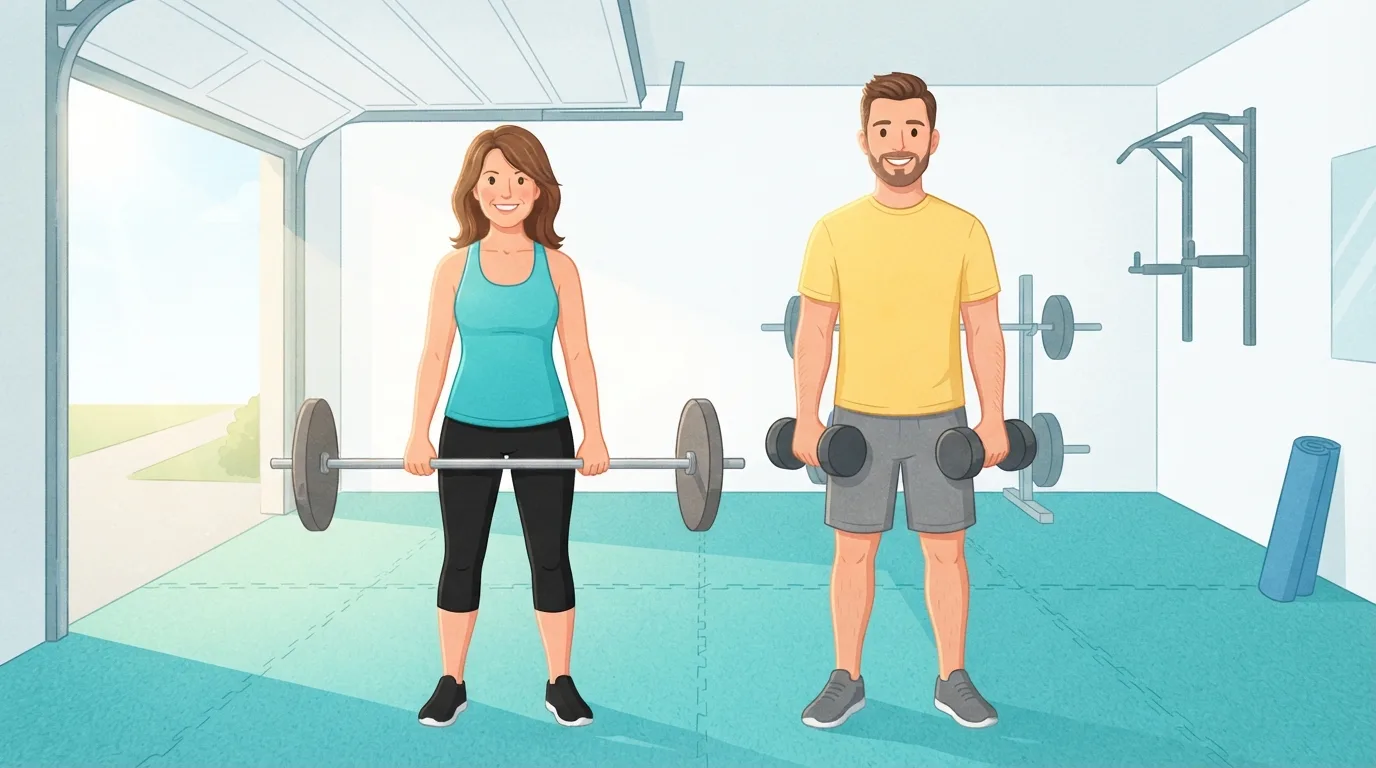
Maybe you're standing in a gym deciding which rack to walk to. Maybe you're about to buy equipment for home and every forum thread says something different. One camp calls barbells the only serious tool, and the other says dumbbells are safer and just as good.
It's easy to freeze here. You don't want to spend months, or a chunk of your savings, on the wrong setup, and you don't want to get hurt lifting alone.
The dumbbell vs barbell question has clearer answers than the arguments suggest. Researchers have measured how much weight people lift with each, which muscles work harder and what happens over weeks of training. The short version is that both tools work. The better one is the one that fits your goal, your space and your schedule, because the plan you keep following beats the perfect plan you drop in week three.
Barbell vs Dumbbell: Quick Comparison
| Barbell | Dumbbells | |
|---|---|---|
| How you hold it | Both hands on one long bar | One short handle in each hand |
| Most weight you can lift | Higher: dumbbell loads ran about 7 to 17 percent below barbell loads in pressing studies | Lower total load for the same exercise |
| Stability demand | Lower, the bar moves as one piece | Higher, each arm balances its own weight |
| Training each side alone | Not possible in two-handed lifts | Built in, and a stronger side can't take over |
| Joint freedom | Fixed hand position | Wrists can rotate and hands can travel inward |
| Smallest weight jumps | Very small with fractional plates | Larger, often a full dumbbell size per hand |
| Training alone safely | Needs a rack with safety arms for bench and squat | You can lower the weights to your sides or the floor |
| Space at home | A bar over 2 meters long, plates, a rack and a bench | A pair of dumbbells and a bench fit in a corner |
| Best for | Maximal strength, heavy squats and deadlifts, strength sports | Home training, beginners, training alone, single-side work |
What Is the Difference Between a Barbell and a Dumbbell?
A barbell is a long bar held with both hands, with weight plates loaded on each end. A standard Olympic bar is 2.2 meters (about 7 feet) long and weighs 20 kilograms (44 pounds) before you add any plates. Because both hands hold the same bar, your arms are locked together and the weight travels as one unit.
A dumbbell is a short handle with a weight on each side, held in one hand. Dumbbells come as fixed pairs or as adjustable pairs that change weight with a dial or pin. With one in each hand, every arm balances and steers its own load.
That single design difference explains almost everything else in this guide. A coupled load lets you lift more and needs less balancing. Two separate loads demand more control, allow more freedom at the joints and expose any difference between your left and right sides.
How Much More Can You Lift With a Barbell?
A barbell lets you lift more total weight, but the gap is smaller than many people assume and it depends on the lift. Two studies from the same Norwegian research group put numbers on it.
Saeterbakken, van den Tillaar and Fimland (2011), in the Journal of Sports Sciences, tested the one-rep max of 12 resistance-trained men on three chest presses. Their dumbbell load was 17 percent lower than their barbell load and 14 percent lower than on a Smith machine. In the shoulder press, Saeterbakken and Fimland (2013), in the Journal of Strength and Conditioning Research, found that 15 men's standing dumbbell one-rep max was about 7 percent lower than their standing barbell max.
The reason is stability. With a barbell, your two arms help steady each other. With dumbbells, each arm has to balance its own weight on every rep, and some of your effort goes into control rather than pure force.
The heaviest load isn't the whole story, though. Farias and colleagues (2017) had 19 trained men do four sets at their own 10-rep max on a barbell, dumbbell and Smith machine bench press. They completed more total reps with dumbbells, 31.2 against 27.8 on the barbell, across the four sets.
Muscle Activation: What Changes With Stability
The extra balancing work with dumbbells shifts which muscles do the most. It doesn't move the main muscle out of the lift.
- Chest press, 2011: chest and front-shoulder activity didn't differ between barbell, dumbbell and Smith machine. Biceps activity rose as stability demands rose, from Smith machine to barbell to dumbbells, while triceps activity was lower with dumbbells.
- Chest press, 2017: in the Farias study, the dumbbell bench produced more chest activity than the barbell bench, and the barbell bench produced more triceps activity.
- Shoulder press, 2013: front-deltoid activity was about 11 percent lower with a seated barbell than seated dumbbells and about 15 percent lower standing. Triceps activity was about 39 percent higher with the standing barbell.
So are dumbbells better than barbells for chest? For activity, they match or slightly beat the barbell in these studies. Barbells let the triceps push more of a heavier load. Neither result proves more muscle growth, because EMG measures activity in a single session, not growth over months.
Dumbbells Train Each Side on Its Own
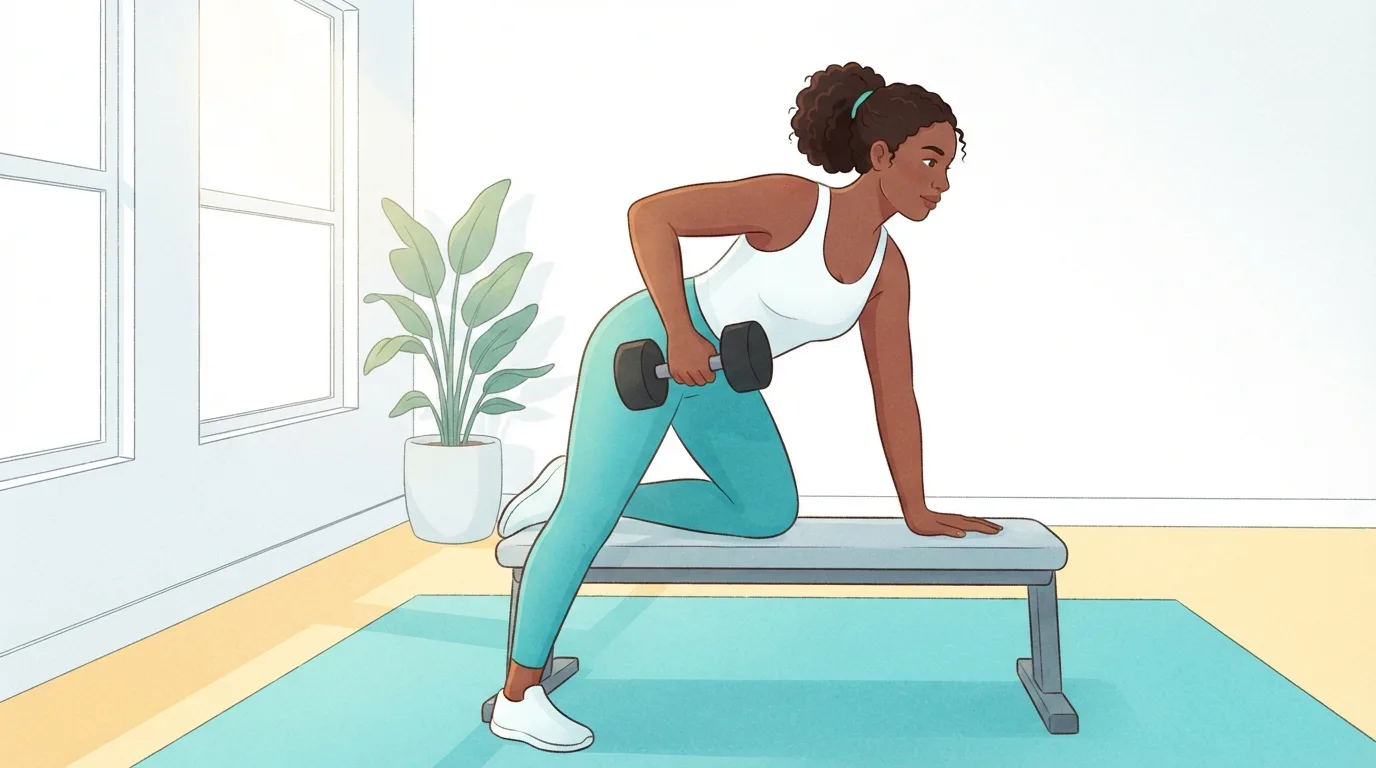
Single-side work is the clearest thing dumbbells do that a barbell can't. In a dumbbell press or row, each arm has to move its own load. Your stronger side can't quietly do more of the work, so a left-right difference shows up quickly and gets trained directly.
Does single-side training cost you strength? Not in the evidence we have. Speirs and colleagues (2016) split 18 academy rugby players into a group that squatted only on one leg, with the rear-foot-elevated split squat, and a group that did only back squats, for five weeks. Both groups improved their back squat, their split squat, their 40-meter sprint and their agility, with no difference between them.
You may also have read that two limbs working alone produce more total force than both together. That effect, called the bilateral deficit, is real but unreliable. Škarabot and colleagues' (2016) review in the European Journal of Applied Physiology found that its size varies widely between tasks and people, that practice changes it, and that some studies even show the opposite effect. It's a reason to include some single-side work, not a reason to drop two-handed lifts.
Dumbbells also give your joints more options. In a press, your wrists can turn and your hands can travel slightly inward. Many lifters with cranky shoulders find a dumbbell press more comfortable than a straight bar for that reason, which is a coaching observation rather than a trial result.
Barbell vs Dumbbell for Muscle Growth
Few trials have compared barbell-only and dumbbell-only training for muscle growth head to head. The closest evidence points the same way: the tool matters less than how hard and how often you train.
- Load doesn't decide growth. A 2017 meta-analysis of 21 studies by Schoenfeld and colleagues found that muscle growth was similar across light and heavy loads when sets were taken to failure. So the slightly lighter weights you use with dumbbells don't limit growth.
- Equipment type doesn't decide growth. Haugen and colleagues (2023) pooled 13 studies with 1,016 participants comparing free weights with machines. They found no difference in muscle growth. Strength gains tended to be largest on the type of equipment people trained with.
- Recovery looks similar. Ferreira and colleagues (2017) had 27 trained men do 8 sets of 10 on a Smith machine, barbell or dumbbell bench press. Chest recovery was the same in all three groups. Triceps soreness lasted until 72 hours after the barbell and Smith machine sessions, while the dumbbell group reported no triceps soreness.
Can you build muscle with only one of them? Yes, with either. A barbell covers squats, deadlifts, presses, rows and curls. Dumbbells cover the same patterns plus single-side work. What builds muscle is regular hard sets for each muscle, taken close to failure and repeated for months.
Find out what's really holding you back
FitCraft, our mobile fitness app, pairs you with an AI coach who builds you a personalized plan around your goals, schedule, and fitness level. Every FitCraft program is designed by Domenic Angelino, MPH (Brown University) and NSCA-CSCS, with research published in the Journal of Strength and Conditioning Research and Medicine & Science in Sports & Exercise.
Take the Free Assessment Free • 2 minutes • No credit cardBarbell vs Dumbbell for Strength: What Training Studies Show
Strength is more specific than muscle size. You get strongest at the lift you practice, in the form you practice it. Two training studies from the Saeterbakken group show how that plays out with dumbbells. Neither had a plain barbell training group, so they compare stability levels rather than barbells against dumbbells directly.
In the 2016 study, published in the European Journal of Applied Physiology, 36 resistance-trained men did a chest press twice a week for 10 weeks, 4 sets of 6, on a Swiss ball, a Smith machine or with dumbbells. The dumbbell and Swiss ball groups improved most in the exercise they trained, and that edge was already clear by the seventh session.
The 2020 follow-up in PLoS One tested how far that strength carries over. After 10 weeks, the dumbbell group's six-rep max rose 38.6 percent on the dumbbell press and 11.6 percent on the barbell bench press they hadn't trained. The Smith machine group rose 22.7 percent on its own lift and 17.0 percent on the barbell bench.
The practical rule is simple. If you want a bigger barbell bench press, bench with a barbell. If you want general strength for everyday life, either tool works, and dumbbell strength carries over partly to the bar.
What Are Barbells Good For?
Barbells earn their reputation. Here's where they're the better tool:
- The heaviest loads. You'll lift the most weight with a barbell, and heavy loads still win for one-rep-max strength in the Schoenfeld meta-analysis.
- Heavy squats and deadlifts. Once your legs outgrow the dumbbells you can hold, your grip and the awkwardness of getting heavy dumbbells into position become the limit. A barbell on your back or in your hands solves that.
- Tiny weight jumps. Fractional plates let you add 1 kilogram (about 2 pounds) or less to the bar at a time. Dumbbell jumps are bigger: going from a 10-kilogram to a 12.5-kilogram dumbbell is a 25 percent increase.
- Strength sports. Powerlifting and Olympic weightlifting are barbell sports. If you want to compete, train with the bar.
Safety Without a Spotter
Most weight-training injuries are accidents with the weight itself. Kerr, Collins and Comstock (2010), in the American Journal of Sports Medicine, analyzed US emergency department data from 1990 to 2007 and estimated 970,801 weight-training injuries nationwide. Free weights were involved in 90.4 percent, and the most common cause was a weight dropping on the person, at 65.5 percent. That study grouped barbells and dumbbells together, so it can't tell you which is riskier.
The difference shows up when a rep fails and you're alone. If you can't finish a barbell bench press, the bar comes down toward your chest or neck, and you need a spotter or a rack with safety arms set just below chest height. A failed barbell squat needs safety pins too. With dumbbells, you lower the weights to your sides or set them on the floor. Dumbbells carry their own risks, mainly dropping them on your feet and wrestling heavy ones into position, so clear the floor and wear shoes either way.
If you train alone, stop each set with one or two good reps left, especially on the barbell bench press and squat. Set your safeties every time, even on warm-up sets.
Cost and Space at Home
A barbell setup needs more room and more equipment. The bar alone is 2.2 meters long, so you need clear floor wider than that plus space to load plates at each end. Add a rack with safety arms, enough plates to grow into and a bench. That's a large footprint for a spare room, and it costs more than a basic dumbbell setup.
Dumbbells fit almost anywhere. One adjustable pair and a flat bench cover presses, rows, squats, lunges and hinges in a corner of a bedroom, and they slide under the bench when you're done. Fixed pairs work too, though a full set takes a rack of its own. If you're also weighing a kettlebell, our kettlebell vs dumbbell guide covers that choice.
Dumbbell or Barbell for Beginners: Which Should You Choose?
Use your goal, your space and how you train to decide:
- Choose dumbbells if you train at home or alone, you're a beginner, your space is small, your shoulders prefer a free path or you want to fix a left-right difference.
- Choose a barbell if you want maximal strength, plan to compete, have outgrown your heaviest dumbbells for squats and deadlifts, or train at a gym with racks and safeties.
- Use both if you can. A common gym approach is barbell squats, deadlifts and presses first, then dumbbell work for the rest of the session.
For beginners, dumbbells are usually the easier start at home. They come in light weights, need no rack and let you learn squats, hinges, presses and rows without a spotter. If you're starting from zero, our guide on how to start lifting weights covers the first month.
What about barbell vs dumbbell curls? A barbell curl lets you load a little more weight. Dumbbell curls let your wrists turn and make each arm do its own share. Both build the biceps, so choose the one that feels better on your wrists and elbows.
Here's a simple full-body week using only dumbbells. Do it two or three times a week with a rest day between sessions, 3 sets of 8 to 12 reps per exercise, and stop each set with one or two reps left:
- Goblet squat for the legs and trunk.
- Dumbbell bench press or floor press for the chest, shoulders and triceps.
- One-arm dumbbell row for the back and biceps, one side at a time.
- Dumbbell Romanian deadlift for the hamstrings and glutes.
- Seated dumbbell shoulder press for the shoulders.
- Reverse lunge for single-leg strength and balance.
Our list of the best dumbbell exercises for beginners explains each of these in more detail.
FitCraft sits on the dumbbell side of this choice. Its strength workouts use dumbbells and bodyweight only, so if you want barbell programming for powerlifting, a barbell-focused program or a coach is the better fit. If dumbbells suit your home and your goals, an AI coach demonstrates each exercise on an interactive 3D model, workouts adjust as you progress, and streaks and leaderboards help you keep showing up. Our comparison of the best dumbbell workout apps shows how FitCraft stacks up against the alternatives.
The Bottom Line
Barbells and dumbbells both build strength and muscle. Dumbbell loads ran about 7 to 17 percent below barbell loads in pressing studies, and a barbell moves in tiny weight jumps and suits heavy squats, deadlifts and strength sports. Dumbbells ask more of your stabilizers, train each side on its own, give your joints more freedom and are easier to use safely at home and alone.
The best tool is the one you'll keep using. As FitCraft user Katie put it, "I've tried everything. This is the first time I've stuck with something past two weeks." Pick the equipment that fits your space and your goal, then keep showing up for it.
Frequently Asked Questions
Which is best, a dumbbell or a barbell?
Neither is best for everyone. A barbell is better for lifting the heaviest possible loads and for maximal strength in the squat, bench press and deadlift. Dumbbells are better for training at home, training alone, working each side on its own and pressing in a joint-friendly path. Both build muscle well when your sets are hard.
Can I grow my chest with just dumbbells?
Yes. In trained men, the dumbbell bench press produced chest activity equal to the barbell bench press in a 2011 study and higher in a 2017 study, and muscle growth depends mostly on taking sets close to failure. A dumbbell bench press, an incline press and push-ups, done for hard sets two or three times a week, are enough to grow your chest.
Can you build muscle with barbell only?
Yes. A barbell covers squats, deadlifts, presses, rows and curls, which train every major muscle group, and it lets you add weight in very small steps. Many strength programs use nothing else. A few dumbbell exercises help with single-side work and shoulder-friendly pressing, but they aren't required to build muscle.
Is a 70 lbs dumbbell press good?
Yes, pressing a pair of 70-pound dumbbells for clean reps is strong for most lifters. A 2011 study found dumbbell loads ran about 17 percent below barbell loads in the chest press, so a pair of 70s suggests a barbell bench press somewhere around 165 to 170 pounds. Treat that as a rough estimate, because the gap varies from person to person.
Should beginners use dumbbells or barbells?
Beginners can start with either, and dumbbells are often the easier start at home. They come in light weights, need no rack or spotter, and let each arm find a comfortable path. Learn squats, hinges, presses and rows with controlled form first, then add a barbell later if you want heavier lower-body work.
Is a barbell or dumbbell better for weight loss?
Neither burns meaningfully more calories in a typical session. Weight loss comes mainly from your eating and your total weekly activity, and strength training helps you keep muscle while you lose fat. Pick the tool you'll use two or three times a week, because consistency matters far more than the equipment.