You've decided to start lifting weights. Then you open a search tab and find a five-day powerlifting program, a bodybuilding split, three people arguing about squat depth and someone deadlifting a truck tyre. None of it looks like something you could do on Tuesday.
Under that sits a quieter worry. You might get hurt, look clueless in front of other people, or pick the wrong weight and spend a week walking down stairs sideways.
Most of that disappears once you see what the first two weeks are for. They're skill practice with light weights, deliberately easy, and getting them right sets up months of steady progress. This guide is that two-week on-ramp, built around dumbbells, with the reasoning behind each choice so you can adjust it to your body.
What You Need Before Your First Session
Less than you'd think. Weight lifting for beginners works the same at home or in a gym, and the equipment list is short:
- Dumbbells. One adjustable pair, or two fixed pairs: a lighter pair for pressing and rowing and a heavier pair for squats and hinges. A gym's dumbbell rack does the same job.
- A bench or a sturdy chair. Useful for rows and seated presses, though the floor works for pressing in week one.
- About two metres by two metres of floor. Enough to lunge and lie down.
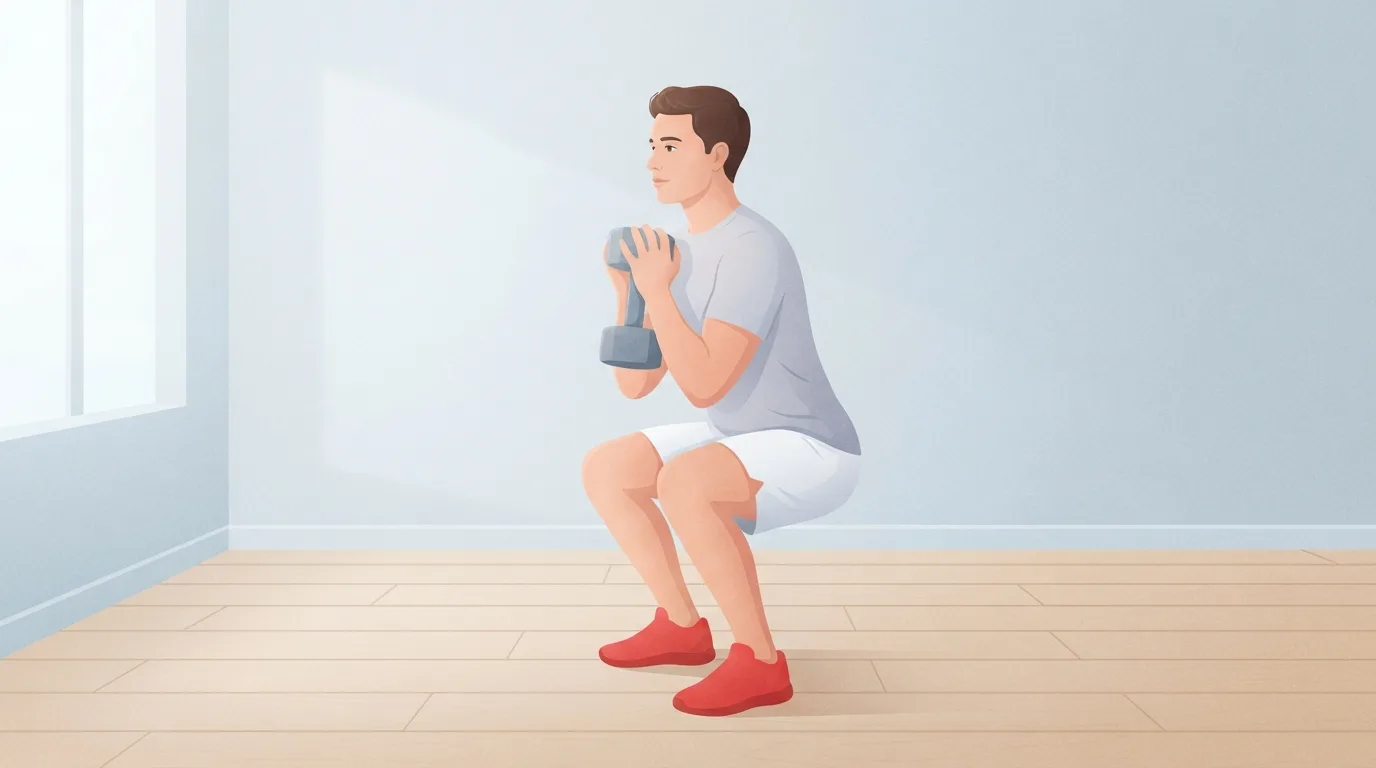
Five movements cover the whole body: a squat, a hip hinge, a push, a pull and a brace for your midsection. The plan below uses the goblet squat, the dumbbell Romanian deadlift, the floor or bench press, the one-arm row, the overhead press and a plank or dead bug. Our list of the best dumbbell exercises for beginners explains each movement and the order to learn them in, so this page uses them without re-teaching each one.
How to Choose Your Starting Weight in Session One
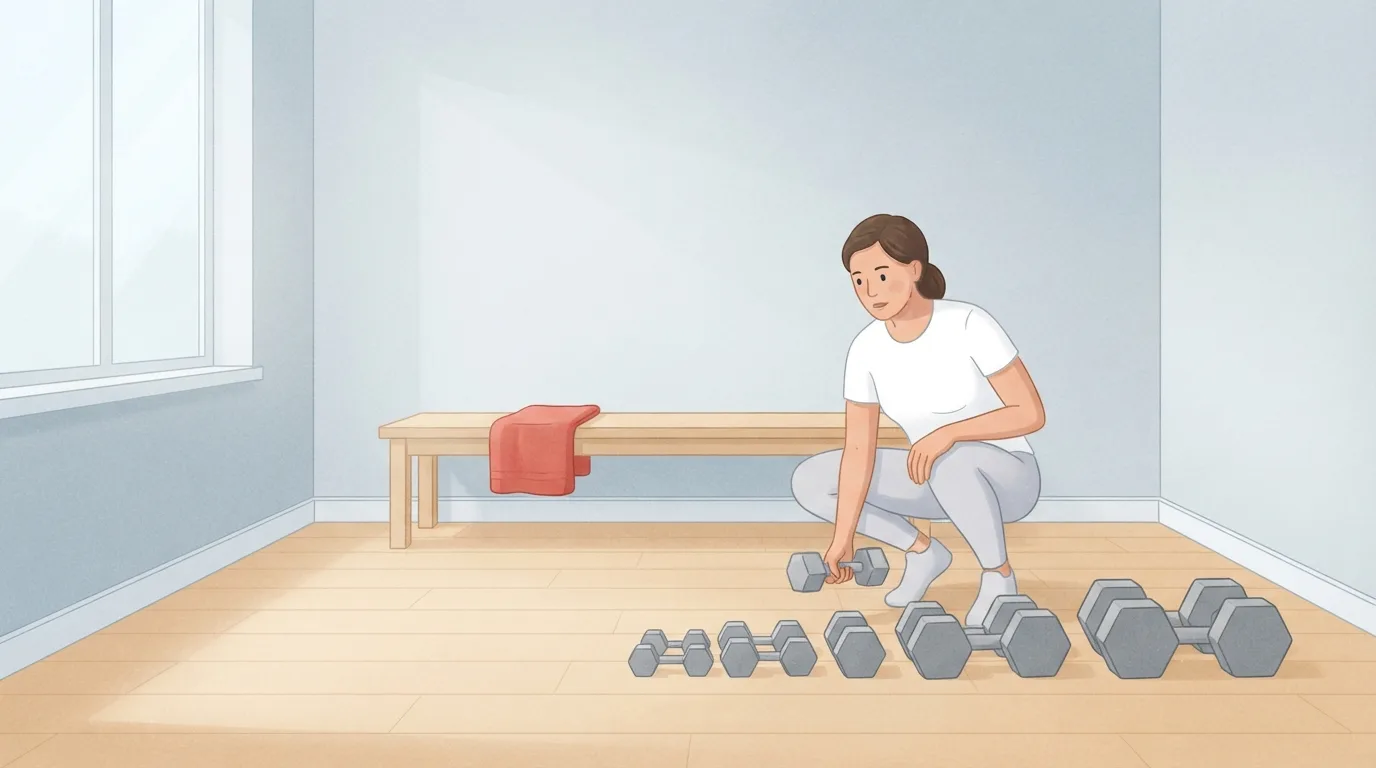
Choose your starting weight with a ramp test: work up through the dumbbells one size at a time until 10 reps start to slow down, then take one step back. It takes about five minutes per exercise in your first session and replaces guesswork with a number from your own body.
- Start with the lightest dumbbell you have and do 10 slow, controlled reps.
- If all 10 felt smooth and easy, rest 60 seconds and move up one size.
- Repeat until the tenth rep is noticeably slower than the first, while your form still looks the same.
- Your week-one weight is one size lighter than that.
- Write it down. Next session you start there and skip the test.
Why one size lighter? Because almost everyone misjudges how many reps they have left. Steele and colleagues (2017), in PeerJ, asked 141 people to predict how many reps they could do before failure on each exercise of a full-body session, then had them go to failure. People underpredicted, with a typical error of roughly three reps, and accuracy improved with training experience. When a beginner feels two reps away from failure, they're often five away. In weeks one and two that error works in your favour, because light is exactly where you want to be.
Light isn't wasted, either. Rhea and colleagues (2003) meta-analysed 140 studies in Medicine and Science in Sports and Exercise and found untrained people gained the most strength at a mean intensity of about 60 percent of their one-rep max, well below what feels heavy.
Your First Two Weeks of Lifting Weights, Session by Session
Five sessions over two weeks, alternating two full-body workouts. Every session opens with five minutes of brisk walking or marching on the spot, then one light set of the first exercise. Each one takes 30 to 40 minutes.
| Session | Exercises | Sets and effort |
|---|---|---|
| Week 1, session 1 (A) | Ramp test, then goblet squat, dumbbell floor press, one-arm row, plank | 2 sets of 10 (plank 20 sec), about 4 reps left in every set |
| Week 1, session 2 (B) | Dumbbell Romanian deadlift, seated overhead press, bodyweight split squat, dead bug | 2 sets of 10 (split squat 8 per side, dead bug 6 per side), about 4 reps left |
| Week 2, session 3 (A) | Same as session 1, no ramp test | 3 sets on squat, press and row, 3 to 4 reps left |
| Week 2, session 4 (B) | Same as session 2 | 3 sets on Romanian deadlift and overhead press, 3 to 4 reps left |
| Week 2, session 5 (A) | Same as session 3, same weights | Add 1 or 2 reps per set where form holds, about 3 reps left |
Week one has two sessions three days apart, Monday and Thursday for example. Week two has three, such as Monday, Wednesday and Friday, which lands you on the two-to-three-days-a-week frequency the American College of Sports Medicine position stand (2009) recommends for novices, along with loads you can lift for 8 to 12 reps. Moving from two sets to three in week two follows Krieger (2009), whose meta-regression of 14 studies in the Journal of Strength and Conditioning Research found 2 to 3 sets per exercise produced 46 percent greater strength gains than one set, in trained and untrained people alike.
The deliberately easy first week has a specific purpose. In Chen, Nosaka and Sacco (2007), published in the Journal of Applied Physiology, 52 men did a first bout of lowering exercise for the elbow flexors at 40, 60, 80 or 100 percent of their maximal strength, then an all-out bout two to three weeks later. After that all-out bout, every group, including the one whose first bout was at 40 percent, showed smaller changes in damage markers and soreness than the 100 percent group had shown after its first bout, though the lighter first bouts gave less protection. A light first exposure buys real protection, and it costs you almost nothing.
Find out what's really holding you back
FitCraft, our mobile fitness app, pairs you with an AI coach who builds you a personalized plan around your goals, schedule, and fitness level. Every FitCraft program is designed by Domenic Angelino, MPH (Brown University) and NSCA-CSCS, with research published in the Journal of Strength and Conditioning Research and Medicine & Science in Sports & Exercise.
Take the Free Assessment Free • 2 minutes • No credit cardForm Basics That Matter From Your First Rep
Good form for a beginner comes down to five habits, and none of them needs a mirror or a coach standing over you.
- Use the full range you can control. Pallarés and colleagues (2021) meta-analysed 16 studies in the Scandinavian Journal of Medicine and Science in Sports and found full range of motion training beat partial range for strength (effect size 0.56) and for lower-body muscle growth (0.88). Lower as far as you can while your back position and heel contact stay the same.
- Lower under control. Take about two seconds on the way down and stand or press up without a pause. You don't need slow motion: Schoenfeld, Ogborn and Krieger (2015) found muscle growth was similar for reps lasting anywhere from half a second to eight seconds, with very slow reps over ten seconds doing worse.
- Brace, then breathe. Take a breath into your belly, tighten your midsection as if someone were about to poke it, do the hard part of the rep, then breathe out. Avoid long, straining breath-holds.
- Hinge with a flat back. On Romanian deadlifts and rows, push your hips back and keep your back as flat as a table. Film one set from the side in your first week; it shows more than any amount of thinking about it.
- End the set when form changes. The rep count is a target. A rep where your knees cave in or your back rounds doesn't count, so the set is over.
How Many Sets and Reps a Beginner Needs, and How Long to Rest
For your first months, aim for 8 to 12 reps per set and two or three sets per exercise, which keeps you inside both the ACSM guidance and Krieger's findings above. Rhea and colleagues found untrained lifters made their biggest gains with about four sets per muscle group per session, three days a week, so the plan's week-two volume is already close to the target. More sets than that, this early, mostly add soreness.
Rest one to two minutes between sets: closer to two after goblet squats and Romanian deadlifts, closer to one after planks, rows and presses. Grgic and colleagues (2017) reviewed six trials in the European Journal of Sport Science and found both short rests (60 seconds or less) and longer rests built muscle, with a possible edge for longer rests in experienced lifters. For a beginner, the practical rule is to start the next set when your breathing has settled and you feel ready to do it well.
How to Progress After Your First Two Weeks
From week three, progress one variable at a time: add reps until you reach the top of your range, then move up to the next pair and drop back down. One catch is specific to light dumbbells. The jump between sizes is a big percentage early on, since going from 4 kg to 6 kg is a 50 percent increase, so expect your reps to fall to 6 or 7 on the new pair and rebuild from there. Our guide to progressive overload for beginners covers the other ways to progress when the next pair is too big a step, and once you're through these two weeks, the dumbbell routine in our full body workout routine is a natural next program.
Rest Days and Soreness in Your First Weeks
Expect some soreness after your first two or three sessions, usually peaking a day or two later, and expect it to fade fast. Cheung, Hume and Maxwell (2003), reviewing delayed onset muscle soreness in Sports Medicine, note it's most common when you're new to a type of exercise and that the lowering phase of a lift causes more of it than the lifting phase. McHugh (2003) describes the repeated bout effect: a single bout of that kind of exercise protects the muscle against damage from the next ones. That's why session three usually hurts far less than session one.
Soreness also isn't a sign that the session worked. Damas and colleagues (2016), in the Journal of Physiology, took muscle biopsies from ten young men at the start of a training program, at week three and at week ten. Muscle damage was highest after the first sessions, and the protein-building response at that stage didn't relate to later muscle growth. By week three the damage had dropped and the protein-building response tracked growth closely. Early soreness is the price of novelty, and it doesn't tell you how much muscle you're building.
Leave at least a day between full-body sessions, which the two-week plan already does. Walking on rest days is fine and often makes stiffness ease faster. Sharp pain in a joint, swelling, or soreness that gets worse after the third day is a reason to stop and get it checked.
Why Do I Struggle to Lift Weights?
Most beginners struggle to lift weights because the first weeks are a coordination problem more than a strength problem: your nervous system is still learning to recruit the muscle you already have. In a classic study, Moritani and deVries (1979) tracked 15 young men and women through eight weeks of strength training and found neural factors explained most of the early strength gain, with muscle growth becoming the dominant factor only after about three to five weeks. In the Damas study, measurable growth in muscle fibre size showed up at week ten, not week three.
That's good news with a delay built in. Your numbers on each exercise will climb quickly in the first month even though the mirror won't change much. Other common reasons beginners stall are starting too heavy, training too rarely to practise the movements, and short sleep. If the real obstacle is getting yourself to the sessions at all, our guide on how to motivate yourself to workout has ten tactics for the days you don't feel like it.
Lifting Weights for Women: Does the Plan Change?
No. Women can follow the same plan, and the research says they respond just as well. Roberts, Nuckols and Krieger (2020) meta-analysed studies that put men and women through identical programs and found no difference in muscle growth (10 studies) or lower-body strength gains (23 studies), and a larger relative increase in upper-body strength for women (17 studies). Start with the same ramp test, the same two weeks and the same progression rules. Your starting weights may be different, but the method is the same.
Is Lifting Weights Safe for Beginners?
Lifting weights carries a low risk of injury when you start light and progress gradually. Keogh and Winwood (2017) reviewed 20 studies of competitive weight-training sports in Sports Medicine. Bodybuilding, the sport closest to ordinary gym training, had the lowest injury rates, about 0.24 to 1 injury per 1,000 hours of training. Those were competitive athletes handling far heavier loads than a beginner ever will, and their most common problems were strains, tendon irritation and sprains in the shoulder, lower back and knee. The light first week, full-range control and stopping a set when form changes are exactly the habits that keep you at the low end of that range.
How FitCraft Fits Into Your First Months of Lifting
FitCraft's strength programs use dumbbells and bodyweight only, so everything on this page translates directly. Your AI coach is a 3D character who demonstrates each exercise on an interactive 3D model with pinch-and-zoom camera control, which helps when you're learning a hinge or a row for the first time and want a closer look. The multi-week programs adapt as you progress, and streaks and calendar tracking keep your two or three weekly sessions visible. If you'd rather follow a plan than build one, here's how FitCraft works as a dumbbell workout app. As Tim put it: "I didn't think an app could replace my trainer. My AI coach proved me wrong."
The Bottom Line
Start with two light full-body sessions in week one and three in week two. Find each weight with a ramp test, stop every set with three or four reps to spare, lift through a full range and rest until you're ready. Then add reps, move up a pair and keep going.
The people who get strong are the ones still lifting in month six, and an easy first two weeks makes that far more likely.
Frequently Asked Questions
What is the 3-3-3 rule for weightlifting?
The 3-3-3 rule for weightlifting usually means three exercises, three sets each, three days a week, though some lifters use the same name for three heavy sets of three reps. The first version is a reasonable beginner template: three sets per exercise sits inside the 2 to 3 sets Krieger (2009) found worked best for strength, and three days a week matches what Rhea and colleagues (2003) found produced the largest gains in untrained lifters. Choose a squat, a push and a pull, and swap a hinge in on alternate days. Save the heavy three-by-three version for later, once your form is consistent.
What is the 5-3-1 rule in gym?
5/3/1 is a barbell strength program by coach Jim Wendler. It runs in four-week waves where the top sets build from 5 reps to 3 reps to one heavy set of 1 or more, all calculated from a training max set at 90 percent of your one-rep max, followed by a lighter week. It's an intermediate program built around the squat, bench press, deadlift and overhead press. A beginner gets the same steady progress from simpler dumbbell rules and can move to a program like 5/3/1 once those stall.
How long should a beginner lift weights?
A beginner session should take about 30 to 45 minutes including a five-minute warm-up, two or three times a week, which fits the American College of Sports Medicine's recommendation of two to three days a week for novices. Longer sessions mostly add tired, sloppy sets. Expect to keep adding reps or weight most weeks for your first several months, which is the main advantage of starting as a beginner.
Will I lose belly fat if I just lift weights?
Lifting weights on its own does reduce body fat, including the deep visceral fat around your organs, but the change is modest. Wewege and colleagues (2022) pooled 58 randomised trials and found resistance training cut body fat percentage by about 1.5 points and fat mass by about half a kilogram compared with no exercise, with a reduction in visceral fat. You can't choose where fat comes off, and bigger changes need changes to how you eat as well.
What is the best time of day to lift weights?
The best time of day to lift weights is the one you can repeat, because morning and evening training produce similar results. Grgic and colleagues (2019) reviewed 11 studies and found strength gains and muscle growth were similar whichever time people trained. Most people are a little stronger in the evening, but morning training raised morning strength to the same level.
How much weight should I lift as a beginner in kg?
Use the ramp test rather than a fixed number, but most beginners settle around 4 to 9 kg per hand for presses and rows and 7 to 12 kg for a single goblet-squat dumbbell, which is roughly 10 to 20 lb and 15 to 25 lb. In your first two weeks, the right weight is one you can lift for 10 smooth reps with about four more left in the tank.
Should beginners start with dumbbells or a barbell?
Either works, and dumbbells are the easier place to start: they're affordable, fit at home, make each arm work independently and are simple to set down if a rep goes wrong. A barbell becomes useful later, when your squats and deadlifts outgrow the heaviest dumbbells you can hold, and at that point it's one good option rather than a requirement.