You've used the same pair of dumbbells for two months. The first few weeks felt great, the reps went up and the weight felt lighter every session. Now it doesn't. You try the next pair, get four ugly reps and put them back.
That's frustrating, and it's easy to decide you're just not built to be strong. You probably are. Most stalls come from a plan that stopped giving your body a reason to adapt, or from a jump between weights that's too big to make in one step.
This guide covers how to lift heavier in practical terms: why strength goes up, eight steps that keep it going up, how to bridge the gap between dumbbell sizes, a four-week plan, and what to check when you're struggling to lift heavier weights.
Why You Get Stronger: Skill First, Then Muscle
Strength has two parts. One is how well your nervous system coordinates a lift: which muscles fire, in what order and how hard. The other is how much muscle you have to do the work. Early on, the first part does most of the lifting.
A clear demonstration comes from Mattocks and colleagues (2017). They split 38 untrained adults into two groups for eight weeks. One did four hard sets of 8 to 12 reps on the chest press and knee extension. The other only practiced the one-rep max test: up to five attempts at a single heavy rep each session. The high-volume group built more muscle. Their one-rep max gains were no bigger. Practicing the heavy lift itself was enough to build the same maximal strength.
Strength is also specific to load. A meta-analysis of 21 studies by Schoenfeld and colleagues (2017) found that heavy loads produced bigger one-rep max gains than light loads, even though muscle growth was similar. A network meta-analysis of 28 studies and 747 adults by Lopez and colleagues (2021) agreed: sets of 8 reps or fewer and sets of 9 to 15 both beat sets of more than 15 for strength. If you want to lift heavier weights, you have to spend some of your training lifting heavy ones. Our review of whether light weights build muscle covers the muscle side of that trade.
How to Lift Heavier Weights: 8 Steps
These steps are in order of priority. The first three do most of the work for most people, and the rest remove the usual brakes.
- Pick a few main lifts and practice them two or three times a week.
- Keep most sets in a heavy-enough rep range.
- Add reps first, then weight.
- Do enough hard sets each week.
- Stop one to three reps short of failure.
- Rest 2 to 3 minutes between hard sets.
- Push every rep with full intent.
- Sleep and eat to recover.
1. Pick a few main lifts and practice them two or three times a week
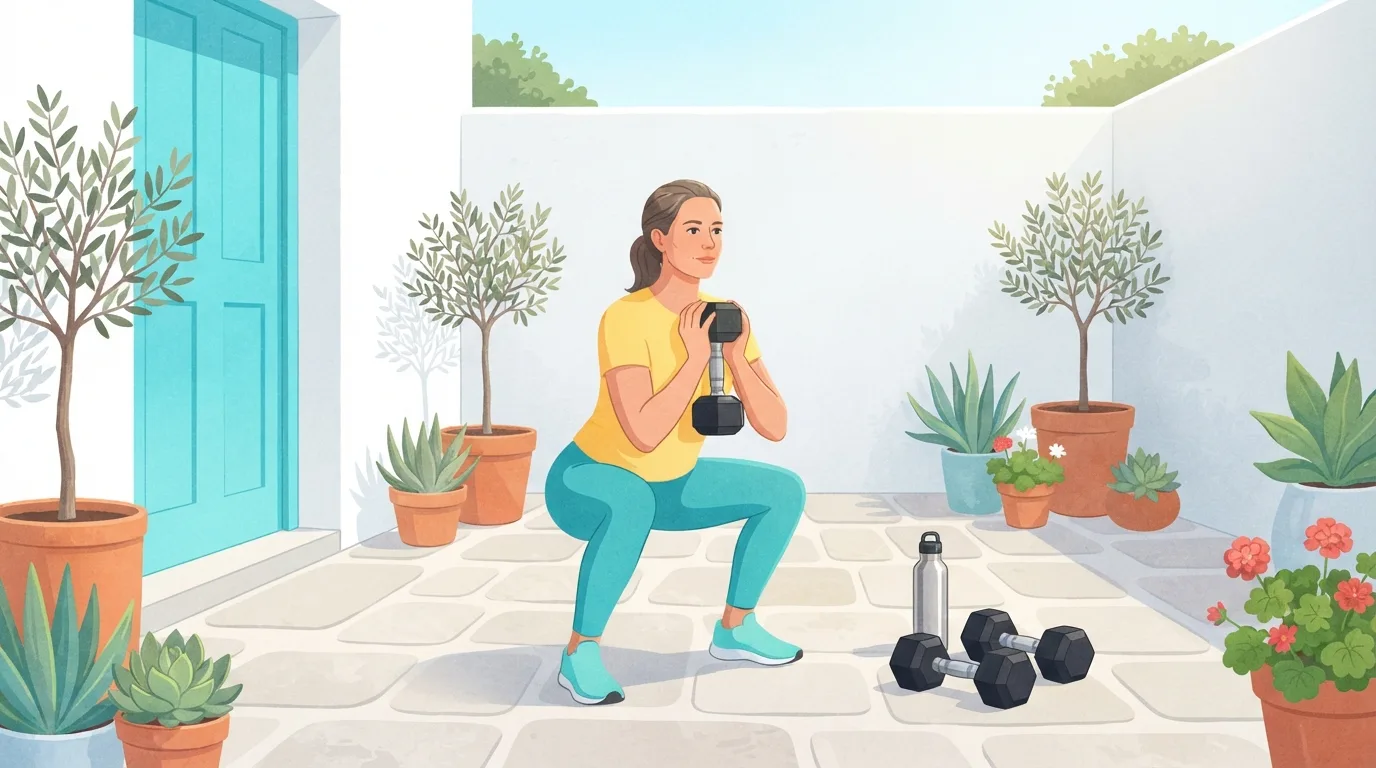
You get better at the lifts you repeat. Choose five or six compound lifts that cover the whole body and keep them for at least four to eight weeks. With dumbbells, a solid set is the goblet squat, the rear-foot-elevated split squat, the Romanian deadlift, the floor or bench press, the one-arm row and the overhead press, with push-ups as a bodyweight press.
Train each lift two or three times a week. A meta-analysis of 22 studies by Grgic and colleagues (2018) found strength gains grew with frequency, with effect sizes rising from 0.74 at once a week to 1.08 at four or more times. When total weekly volume was equal, frequency stopped mattering. So more sessions help mainly because they let you practice more and fit in more sets without making any one workout long.
2. Keep most sets in a heavy-enough rep range
For strength, most of your main-lift sets should be heavy enough that you can't do more than about 10 to 12 reps. Sets of about 6 to 12 are a practical sweet spot with dumbbells, because very low reps with heavy dumbbells are awkward to get into position. Lighter sets of 12 to 20 still build muscle and are fine for accessory work and for lifts where your dumbbells are too light.
3. Add reps first, then weight
This is called double progression, and it's the core of how to lift bigger weights with fixed dumbbells. Pick a rep range, say 6 to 12. Use a weight you can lift for 6 good reps on every set. Each session, try to add a rep to one or more sets. When you reach 12 reps on every set with a rep or two left in the tank, move to the next pair and start back near 6.
A rep range works because extra reps and extra load are two ways of showing the same strength. You don't need permission from the scale on the dumbbell to know you got stronger. If you went from 6 to 12 reps with the same weight, you did. Our guide to progressive overload for beginners covers the other ways to progress, such as more sets and shorter rest.
4. Do enough hard sets each week
More practice and more sets mean more strength, up to a point. A meta-analysis of nine studies by Ralston and colleagues (2017) found a graded relationship between weekly sets per exercise and strength gain: high weekly set volumes produced an effect size of 1.01 against 0.82 for low volumes. For most people, 6 to 12 hard sets per main lift each week, split over two or three sessions, is plenty. Add sets only when you've stopped progressing and you're recovering well.
5. Stop one to three reps short of failure
You don't need to grind every set to failure to get stronger. A series of meta-regressions by Robinson and colleagues (2024) found strength gains were similar across a wide range of reps left in reserve, while muscle growth improved as sets got closer to failure. For heavy main lifts, ending most sets with one to three good reps left keeps your form clean and your recovery manageable.
Counting the reps you have left is a skill. Zourdos and colleagues (2016) developed the RIR-based effort scale lifters now use, where a rating of 9 means one rep left and 10 means none. In their study, experienced squatters rated a true one-rep max closer to the top of the scale than novices did, so if you're new, test yourself now and then by finishing a safe exercise such as a push-up to failure and comparing the result with your guess.
6. Rest 2 to 3 minutes between hard sets
Short rest feels productive, but it costs you reps on the next set. Schoenfeld and colleagues (2016) randomized 21 resistance-trained men to rest 1 minute or 3 minutes between sets on the same eight-week program of three sets of 8 to 12 reps. The 3-minute group gained significantly more one-rep max strength on both the squat and the bench press, and more thigh muscle thickness. On your main lifts, rest 2 to 3 minutes. Save short rest for accessories.
7. Push every rep with full intent
Lower the weight under control, then drive it up as fast as you can, even when it moves slowly. González-Badillo and colleagues (2014) had two groups train the bench press three times a week for six weeks with identical loads. One lifted every rep at maximal intended speed and the other at deliberately half speed. The fast-intent group gained 18.2 percent on their one-rep max against 9.7 percent for the half-speed group. Intent is free, and most people leave it on the table.
8. Sleep and eat to recover
Strength gains happen between sessions. A systematic review of 17 studies by Knowles and colleagues (2018) found that one night without sleep had little effect on strength, but several nights in a row of short sleep reduced force in multi-joint lifts such as squats and presses. Aim for seven or more hours on most nights, especially before heavy sessions.
Protein supports the muscle side. A meta-analysis of 49 trials by Morton and colleagues (2018) found that gains in muscle mass from training stopped improving at about 1.6 grams of protein per kilogram of body weight a day. If you're also trying to add size, our guide to what a lean bulk is shows how to eat a small surplus without gaining much fat.
Find out what's really holding you back
FitCraft, our mobile fitness app, pairs you with an AI coach who builds you a personalized plan around your goals, schedule, and fitness level. Every FitCraft program is designed by Domenic Angelino, MPH (Brown University) and NSCA-CSCS, with research published in the Journal of Strength and Conditioning Research and Medicine & Science in Sports & Exercise.
Take the Free Assessment Free • 2 minutes • No credit cardWhy the Next Pair of Dumbbells Feels So Much Heavier
Dumbbells usually come in fixed jumps of 5 lb or 2 to 2.5 kg. That's a small step at the heavy end of the rack and a huge one at the light end. Going from 20 to 25 lb per hand is a 25 percent increase in load. Going from 10 to 15 lb is 50 percent. Adding 5 lb to a 200 lb barbell squat is 2.5 percent. That's why barbell lifters can add weight almost every week for months while dumbbell lifters hit a wall early.
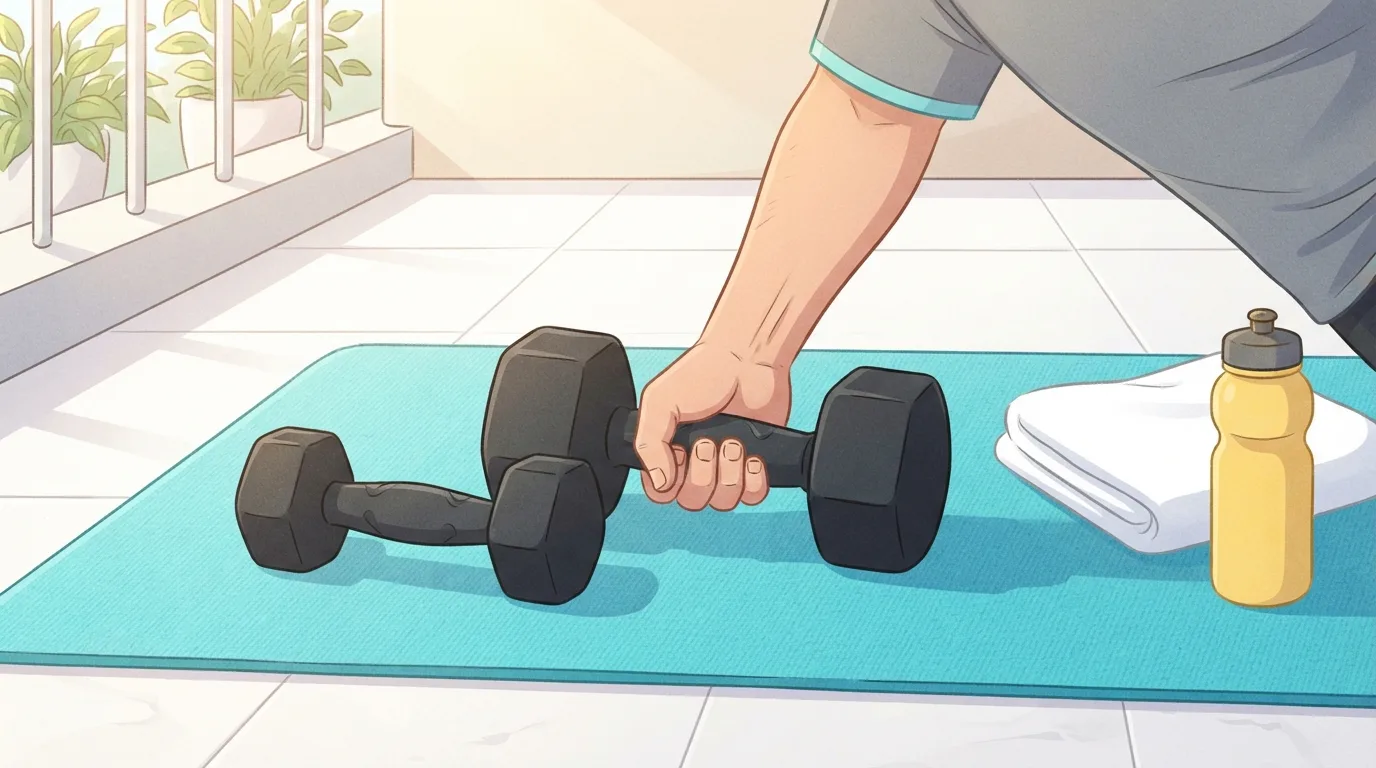
The fix is to make your rep range wide enough to absorb the jump. Using the common Epley estimate of one-rep max, 12 reps with a weight is roughly equal to 8 reps with one about 10 percent heavier, or 6 reps with one about 17 percent heavier. So a range of 6 to 12 can absorb a jump of about 15 percent, and a 25 percent jump needs a range closer to 6 to 15. If your next pair is a bigger jump than your range can cover, bridge it with one of these before you move up:
- Slow the lowering phase. Take three or four seconds to lower the weight. Our page on tempo training explains how to write and use tempos.
- Pause at the hardest point. Hold the bottom of a squat or press for two seconds before you drive up.
- Add 1.5 reps. Go down, come halfway up, go back down, then all the way up. That counts as one rep.
- Train one side at a time. A one-arm press or single-leg Romanian deadlift doubles the load on the working side.
- Use the heavier pair for fewer sets. Do your first set with the next pair for as many good reps as you can, then finish with the lighter pair.
How to Lift Heavier Weights at Home When Your Dumbbells Run Out
If you train at home, you'll eventually outgrow your heaviest pair on lower-body lifts. You don't need a new set straight away. Changing leverage makes the same load harder, and bodyweight moves count as real strength training.
The research backs this up. Kikuchi and Nakazato (2017) had 18 young men train twice a week for eight weeks with either a bench press at 40 percent of their one-rep max or push-ups adjusted, kneeling if needed, to match that load. Both groups gained similar strength and muscle. In trained lifters, Calatayud and colleagues (2015) found that push-ups made harder with an elastic band, heavy enough to allow only six reps, produced strength gains similar to a six-rep bench press over five weeks.
| Movement | Easier | Standard | Harder without heavier dumbbells |
|---|---|---|---|
| Squat | Goblet squat | Split squat | Rear-foot-elevated split squat, then add a 3-second lowering |
| Hinge | Two-dumbbell Romanian deadlift | Staggered-stance Romanian deadlift | Single-leg Romanian deadlift with a pause at the bottom |
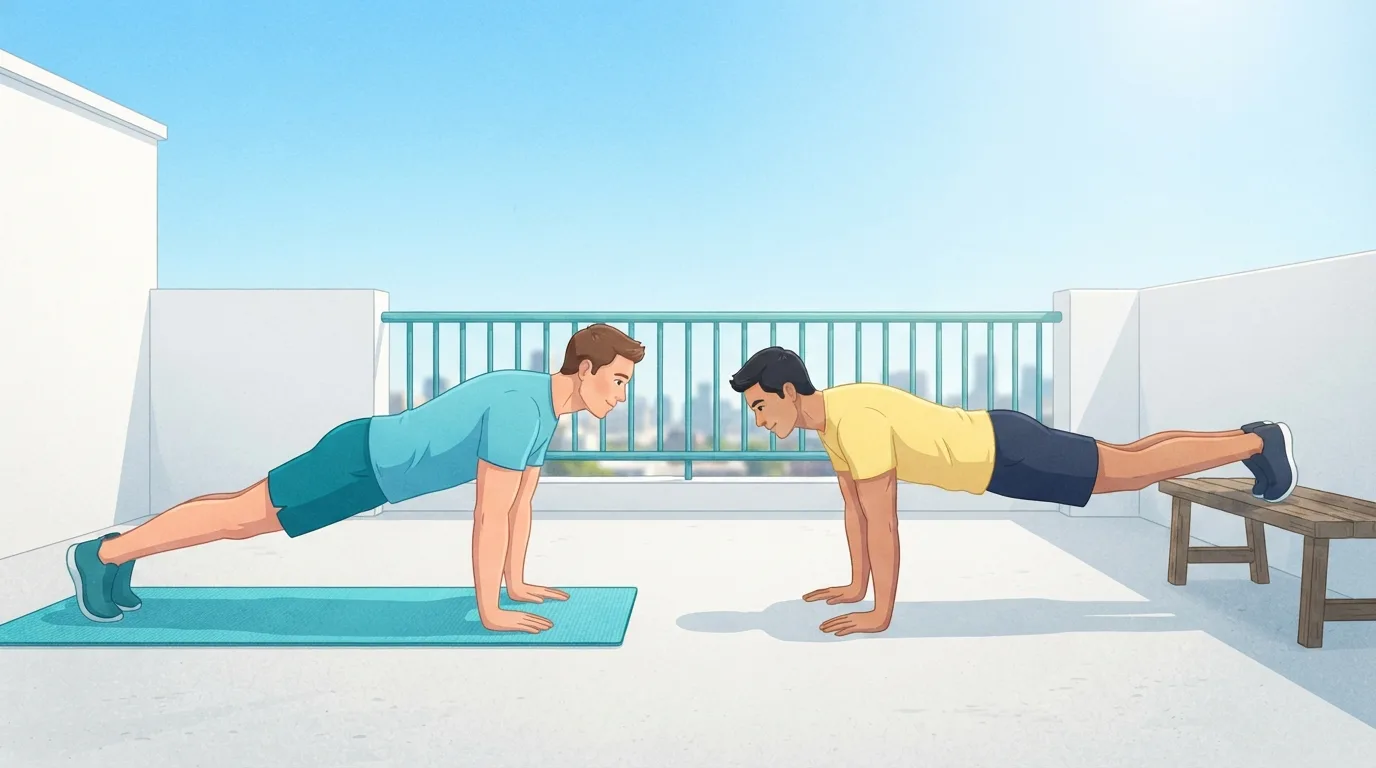
| Horizontal push | Incline push-up | Push-up | Feet-elevated push-up, then paused push-ups |
| Pull | Two-arm dumbbell row | One-arm dumbbell row | One-arm row with a 2-second hold at the top and a slow lowering |
| Overhead push | Seated dumbbell press | Standing dumbbell press | Single-arm standing press |
Move one column to the right when you can do the top of your rep range on every set with good form. When the hardest version stops challenging you, that's the time for heavier dumbbells or an adjustable set.
A 4-Week Dumbbell Plan to Lift Heavier
Run two full-body workouts, A and B, three days a week on non-consecutive days: A, B, A in weeks 1 and 3, and B, A, B in weeks 2 and 4. Warm up each main lift with two lighter sets of 5 before your working sets. Rest 2 to 3 minutes between working sets.
| Workout | Exercise | Sets x reps |
|---|---|---|
| A | Goblet squat | 3 x 6 to 12 |
| A | Dumbbell floor press or bench press | 3 x 6 to 12 |
| A | One-arm dumbbell row | 3 x 8 to 12 per side |
| A | Single-leg Romanian deadlift | 2 x 8 to 12 per side |
| B | Rear-foot-elevated split squat | 3 x 6 to 12 per side |
| B | Standing dumbbell overhead press | 3 x 6 to 12 |
| B | Dumbbell Romanian deadlift | 3 x 8 to 12 |
| B | Push-up, hardest version you can do for 6 to 12 reps | 3 x 6 to 12 |
Progress the effort across the four weeks:
- Week 1: Find your weights. End every set with about three reps left.
- Week 2: Add a rep to each set where you can. End sets with about two reps left.
- Week 3: Keep adding reps. End sets with one or two reps left. If you hit the top of the range on every set, move up a size or one column to the right in the table above.
- Week 4: Same as week 3. On the first lift of each workout, after your warm-up, do one heavier set of 3 to 5 reps with a rep left. That's your practice with heavy loads.
After week 4, take an easier week with half the sets, then start a new block from your new weights. If you're brand new to lifting, start with our guide on how to start lifting weights and come back to this plan after your first few weeks.
Why Am I Struggling to Lift Heavier Weights?
If you're not able to lift heavy in the gym or at home after a few months, one of these is usually the cause. Check them in order.
- You change exercises too often. Strength is partly skill, and you can't build skill on a lift you do once a month.
- Your jumps are too big. If the next weight is 25 percent heavier, you'll fail at it. Use a wider rep range or a bridge from the list above.
- Your rest is too short. One minute between heavy sets cuts the reps you can do on the next set.
- You never lift heavy. Sets of 20 build muscle but don't teach you to handle heavy loads.
- You always train to failure. Grinding every set leaves you too tired to add reps next session.
- You're short on sleep. Several short nights in a row reduce force on compound lifts.
- You've been dieting hard for months. In a meta-analysis by Murphy and Koehler (2022), strength gains held up during an energy deficit but lean mass gains didn't, and a deficit of about 500 calories a day was enough to prevent them. Over months, less new muscle means a lower ceiling for strength.
- You train each lift once a week. That's few chances to practice. Two or three sessions add practice and weekly sets.
Is It Better to Lift Heavy or Light Weights?
It depends on your goal. For maximal strength, heavy is better: the meta-analyses above found bigger one-rep max gains with heavier loads. For muscle, light and heavy both work if the sets are hard, so pick the load that suits the exercise and your joints. Most good programs use both, heavier sets on the main lifts and lighter sets on accessories.
How Much Weight Should I Be Lifting?
Enough that you finish each working set in your target rep range with one to three reps left. If you blow past the top of the range, it's too light; if you can't reach the bottom, it's too heavy. A one-rep max calculator can turn a set you just did into an estimate of your max and suggested weights for other rep ranges. Our one-rep max calculator does that from any set of up to about 10 reps. Treat its numbers as a starting point and let the reps you actually get decide.
How to Do Heavy Lifting Safely
Heavy lifting is safe for most people when the load climbs gradually and technique comes first. A few habits matter most:
- Warm up with ramp sets. Do two or three lighter sets of the first lift, building toward your working weight.
- Own the form before the load. Add weight only when the last rep looks like the first.
- Breathe out through the hardest part. Take a breath and brace your midsection before each rep, then exhale as you push. Don't hold your breath for a whole set.
- Set up so you can bail. At home without a spotter, a floor press is safer than a bench press, and dumbbells can be lowered to the sides if a rep fails.
- Stop on sharp pain. Muscle effort is normal. Sharp, pinching or joint pain means end the set.
How FitCraft Fits In
Most people don't stall because they lack information. They stall because they skip sessions, change programs every few weeks and lose the thread. Getting stronger takes months of practicing the same lifts, which is a consistency problem more than a knowledge problem.
If you want a plan built around the dumbbells you own, our page on the FitCraft dumbbell workout app explains how it works. FitCraft's strength programs use dumbbells and bodyweight, and the workouts adjust as you progress. An AI coach demonstrates every exercise as a 3D character you can pinch and zoom to see the movement up close, says your name mid-workout and keeps a streak going so skipping a session costs something.
The Bottom Line
Lifting heavier weights comes down to practice and patience. Pick a few main lifts, train them two or three times a week, add reps before weight, rest long enough, push every rep hard and recover well. With dumbbells, bridge the big jumps with wider rep ranges, tempo, pauses and leverage instead of forcing the next pair too soon.
Mike, 23, got visibly stronger over four months with FitCraft. His explanation was simple: "The streak system got me hooked. I didn't want to break my chain." Strength rewards the people who keep showing up.
Frequently Asked Questions
How can I increase weight in the gym?
Pick a rep range such as 6 to 12, add reps each session until you can do the top of the range on every set with a rep or two left, then move to the next weight and start again near the bottom of the range. Train each main lift two or three times a week, rest 2 to 3 minutes between hard sets and eat enough protein to recover.
How long does it take to lift heavier weights?
Beginners usually lift noticeably more within two to four weeks, mostly because their technique and coordination improve. After the first few months, progress slows to a rep or a small weight jump every week or two on each lift. Experienced lifters may take a month or more to move up a dumbbell size.
Can you get stronger without lifting heavier weights?
Yes. You can make the same weight harder by adding reps, slowing the lowering phase, pausing at the hardest point, training one arm or leg at a time or changing your leverage, such as raising your feet for push-ups. In Kikuchi and Nakazato (2017), push-ups adjusted to match 40 percent of a bench press one-rep max built similar strength and muscle to bench pressing that load.
How much weight should I add each week?
Add reps before you add weight. Most people can add a rep or two on a lift each week for a while, and move to the next dumbbell only when they hit the top of their rep range on every set. With barbells, small jumps of 1 to 2.5 kg (2.5 to 5 lb) are typical; with dumbbells, the next pair is often a much bigger percentage jump.
Does lifting heavier weights build muscle faster?
Not necessarily. A meta-analysis of 21 studies found that light and heavy loads built similar muscle when sets were taken to failure, while heavy loads built more maximal strength (Schoenfeld 2017). Lifting heavier mainly makes you stronger; effort and weekly volume drive muscle growth at any load.
Should I lift heavier or do more reps?
Do both, in that order. Add reps within your range first, then add weight once you reach the top of it. If your goal is maximal strength, keep most sets of your main lifts in roughly the 3 to 10 rep range; if it's muscle, anything from about 6 to 30 reps works when the sets are hard.