
You pick up a dumbbell, start your set, and somewhere in the third rep you realize you've stopped breathing. Your face is warm, your ears feel full, and you're not sure if you're doing it wrong. Questions about breathing and weight lifting are some of the first ones new lifters ask, from how to breathe while lifting weights in general to how to breathe when doing push-ups or squats.
The short answer is simple: breathe in on the easy half of the rep and out on the hard half. The longer answer matters too. Strong lifters sometimes hold their breath on purpose to brace for a heavy lift, and that same breath hold is what sends blood pressure soaring. Whether it's a useful tool or a risk depends on how heavy you lift and on your health.
Below you'll find step-by-step breathing for any lift, why you exhale when lifting, how to breathe when doing push-ups and squats, a breathing guide for common dumbbell exercises, when bracing makes sense and who should skip it, and how to breathe during exercise between sets.
How to Breathe While Lifting Weights, Step by Step
For most sets, follow these five steps:
- Set up with a breath. Take a normal breath in before the first rep and lightly tighten your midsection, as if someone were about to poke your stomach.
- Breathe in on the way down. Inhale as you lower the weight or move through the easier part of the rep. This is the lowering, or eccentric, phase.
- Breathe out on the effort. Exhale steadily as you lift, push or pull through the hard part. A slow, controlled breath out through pursed lips, or a soft "sss" sound, works well.
- Stay tight while you exhale. Keep your midsection firm. You don't need to empty your lungs.
- Reset every rep. Take a fresh breath at the top or bottom of the rep, then repeat. One breath per rep is a good rhythm for moderate weights.
On light sets of 15 reps or more, don't overthink it. Breathe naturally and just avoid holding your breath. The pattern matters most as the weight gets heavier and the reps get harder.
Should you breathe through your nose or your mouth? Either works. Many people breathe in through the nose and out through the mouth on lighter sets, then switch to the mouth as the effort climbs, because it moves more air.
Why Do You Exhale When Lifting Weights?
You exhale when lifting weights mainly to keep your blood pressure from spiking. Lifting heavy raises blood pressure on its own, because hard-working muscles squeeze their own blood vessels and the body pushes back. Holding your breath adds a big extra jump on top of that.
The classic measurements come from MacDougall and colleagues (1985), who placed a catheter in the arm artery of five experienced bodybuilders. During a double-leg press to failure, blood pressure averaged 320/250 mmHg at its peak, and one man went past 480/350. Even single-arm curls to failure reached an average of 255/190. Part of that rise came from the Valsalva maneuver, a breath hold against a closed throat that lifters often do without thinking. A normal resting reading is around 120/80.
Narloch and Brandstater (1995) then tested breathing directly. Ten male athletes did leg presses at 85% and 100% of their max, once holding their breath and once exhaling slowly through the lift. At 100%, blood pressure averaged 311/284 mmHg with the breath hold and 198/175 with slow exhaling. Exhaling lowered the spike at 85% too. The authors concluded that heavy lifting is safer when you keep breathing.
Exhaling doesn't cost you strength
A common worry is that you'll be weaker if you don't hold your breath. Ikeda and colleagues (2009) measured maximal force in 10 people under four breathing conditions. Forced exhaling produced more peak force than normal breathing in three of the six muscle actions they tested, including knee extension and elbow extension. The breath hold was no stronger than forced exhaling for any muscle group. The authors recommended forced exhaling over the Valsalva maneuver during maximal efforts.
It protects your eyes too
Breath holding raises the pressure inside your eyes as well. In a bench press study, eye pressure rose by an average of 4.3 mmHg when people held their breath on the last rep and by 2.2 mmHg when they breathed out normally. About 30% of the lifters had a rise of more than 5 mmHg with the breath hold (Vieira and colleagues, 2006). That matters most for people with glaucoma.
At moderate weights, the gap shrinks
Lepley and Hatzel (2010) had 30 young adults do a set of 10 on the chest press and leg press with each technique at a moderate load. Holding the breath produced slightly higher blood pressure and heart rate than controlled breathing, but the differences were small and not statistically significant. So a stray breath hold on a light set isn't dangerous for a healthy person. Steady breathing is still the habit to build, because the gap widens as the weight gets heavier.
How to Breathe When Doing Push-Ups
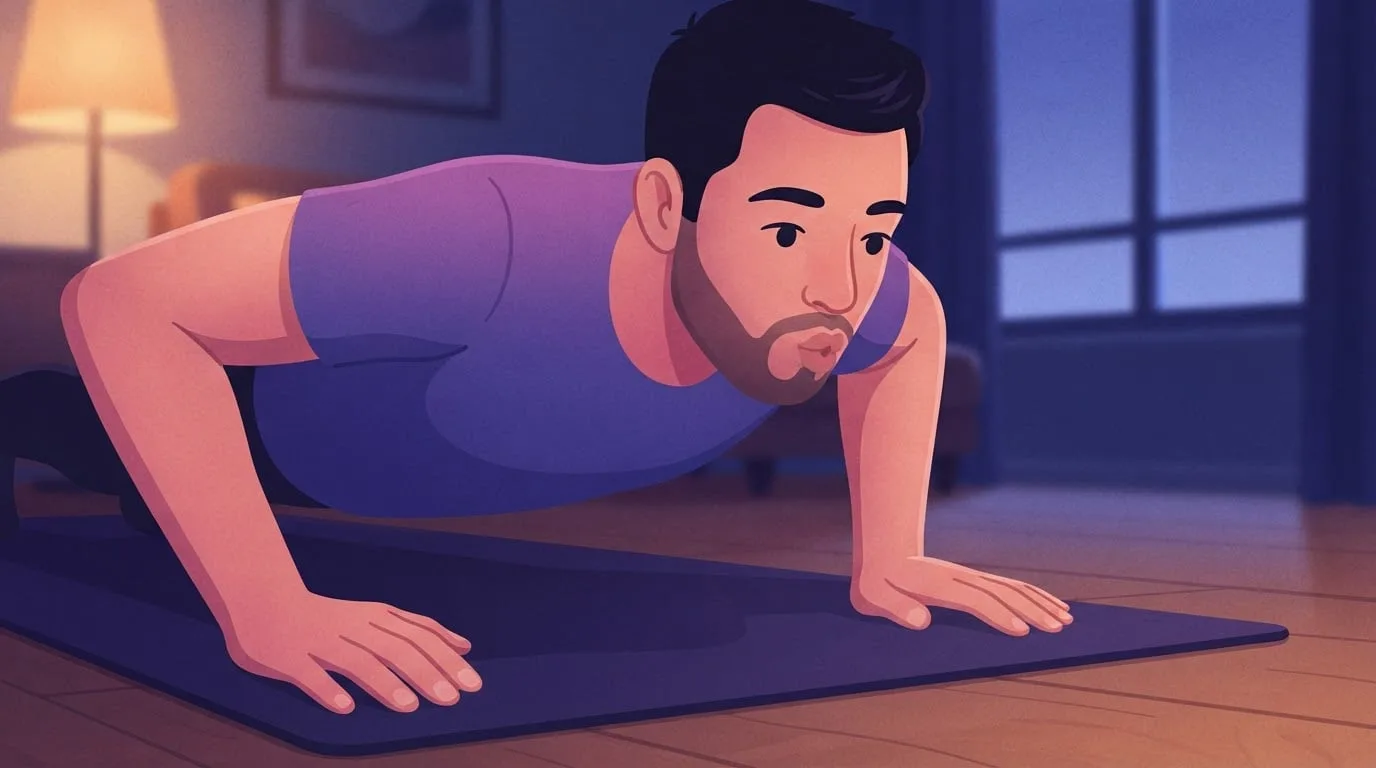
Breathe in as you lower your chest toward the floor, and breathe out as you press the floor away. That's the whole pattern for push-ups, and it's the same for any pressing exercise.
- At the top, set a straight line from your head to your heels and take a breath.
- Breathe in as you lower, which should take about two seconds.
- Breathe out as you push up, finishing the breath as your arms straighten.
- On fast or high-rep sets, keep one breath per rep. Near the end of a hard set is when most people stop breathing without noticing.
- If you can't keep the rhythm, the variation is too hard for now. Put your hands on a kitchen counter or a sturdy bench until you can.
Our push-up guide covers the form cues and the easier and harder variations.
Knowing what to do is the easy part.
FitCraft, our mobile fitness app, pairs you with an AI coach who builds you a personalized plan around your goals, schedule, and fitness level. Every FitCraft program is designed by Domenic Angelino, MPH (Brown University) and NSCA-CSCS, with research published in the Journal of Strength and Conditioning Research and Medicine & Science in Sports & Exercise.
Take the Free Assessment Free • 2 minutes • No credit cardHow Should You Breathe When Squatting?
Breathe in at the top, keep your midsection tight as you squat down, and breathe out as you stand back up, finishing the exhale near the top. With a dumbbell held at your chest in a goblet squat, one breath per rep is all you need.
Squats are where breathing matters most, because they load your trunk heavily. In a review of 16 studies, Blazek and colleagues (2019) found that squats produced the highest pressure inside the abdomen of any resistance exercise, over 200 mmHg, followed by the deadlift and leg press. The bench press produced the lowest. The authors suggested that beginners and people with high blood pressure favor exercises like the bench press and rows, and build up to heavy squats and deadlifts gradually.
A few squat-specific tips:
- Breathe into your belly and sides, not up into your shoulders.
- Don't blow all your air out at the bottom. You'd lose the tension that holds your back in position as you stand.
- Exhale through the hardest part of the way up, or just past it if the weight is heavy.
- Use the same pattern for lunges, split squats and dumbbell Romanian deadlifts.
Our goblet squat guide walks through the form step by step.
Bracing and the Valsalva Maneuver: When Holding Your Breath Makes Sense
Bracing means tightening the muscles all the way around your midsection, front, sides and back, so your trunk stays stiff under load. You can brace while you breathe. For a very heavy lift, many experienced lifters also take a big breath and hold it through the hardest part of the rep. That's a deliberate Valsalva maneuver.
It works for a reason. When you hold your breath against a closed throat, pressure inside your abdomen rises. In a lifting study by Hagins and colleagues (2004), breathing in and holding it produced higher abdominal pressure than any other breathing method, including natural breathing and breathing out during the lift. A spine model built by Cholewicki, Juluru and McGill (1999) showed how abdominal pressure, together with tight abdominal muscles, can stabilize the lower back, especially in lifting tasks.
A review by Hackett and Chow (2013) concluded that a brief Valsalva maneuver is unavoidable when lifting more than about 80% of your max, or when lighter sets go to failure. It raises abdominal pressure in a way that may help spine stability, and its health risks during resistance exercise remain unconfirmed. Unconfirmed isn't the same as zero, though, and the blood pressure numbers above are real.
There's one twist on the brain side. In seven people recovering from brain surgery, a breath hold on its own raised the pressure inside the skull more than a set of curls with normal breathing did. That meant the pressure across the walls of the brain's blood vessels was actually lower with the breath hold (Haykowsky and colleagues, 2003). It may soften some of the strain from a blood pressure spike. It doesn't make long breath holds a good idea.
If you use a breath hold, keep it short
- Save it for heavy sets of about 1 to 5 reps, not whole sets of 10 or more.
- Breathe in, brace, and hold only through the hardest part of a single rep, usually a second or two.
- Breathe out at the top, take a fresh breath and brace again for the next rep.
- Stop if you feel dizzy, see spots or get a headache, and get medical advice if it keeps happening.
Who should avoid holding their breath
Skip the breath hold and breathe out through every rep if you:
- have high blood pressure, heart disease, or a history of stroke or aneurysm
- have glaucoma or a problem with your retina
- are pregnant
- have a hernia or are recovering from surgery
- are new to lifting
High blood pressure doesn't rule out lifting. The American Heart Association's 2023 scientific statement says people with controlled high blood pressure can safely do low- to moderate-intensity resistance training with proper breathing techniques (Paluch and colleagues, 2024). Our review of isometric exercise and blood pressure covers a type of training studied for lowering resting blood pressure.
How to Breathe When Lifting Dumbbells: A Quick Guide by Exercise
Inhale or exhale when lifting? Use this table for the dumbbell and bodyweight exercises most people do at home. The rule is the same every time: breathe out on the part that works against gravity.
| Exercise | Breathe in | Breathe out |
|---|---|---|
| Push-up | Lowering your chest | Pressing back up |
| Dumbbell floor press | Lowering the dumbbells | Pressing them up |
| Dumbbell shoulder press | Lowering to shoulder height | Pressing overhead |
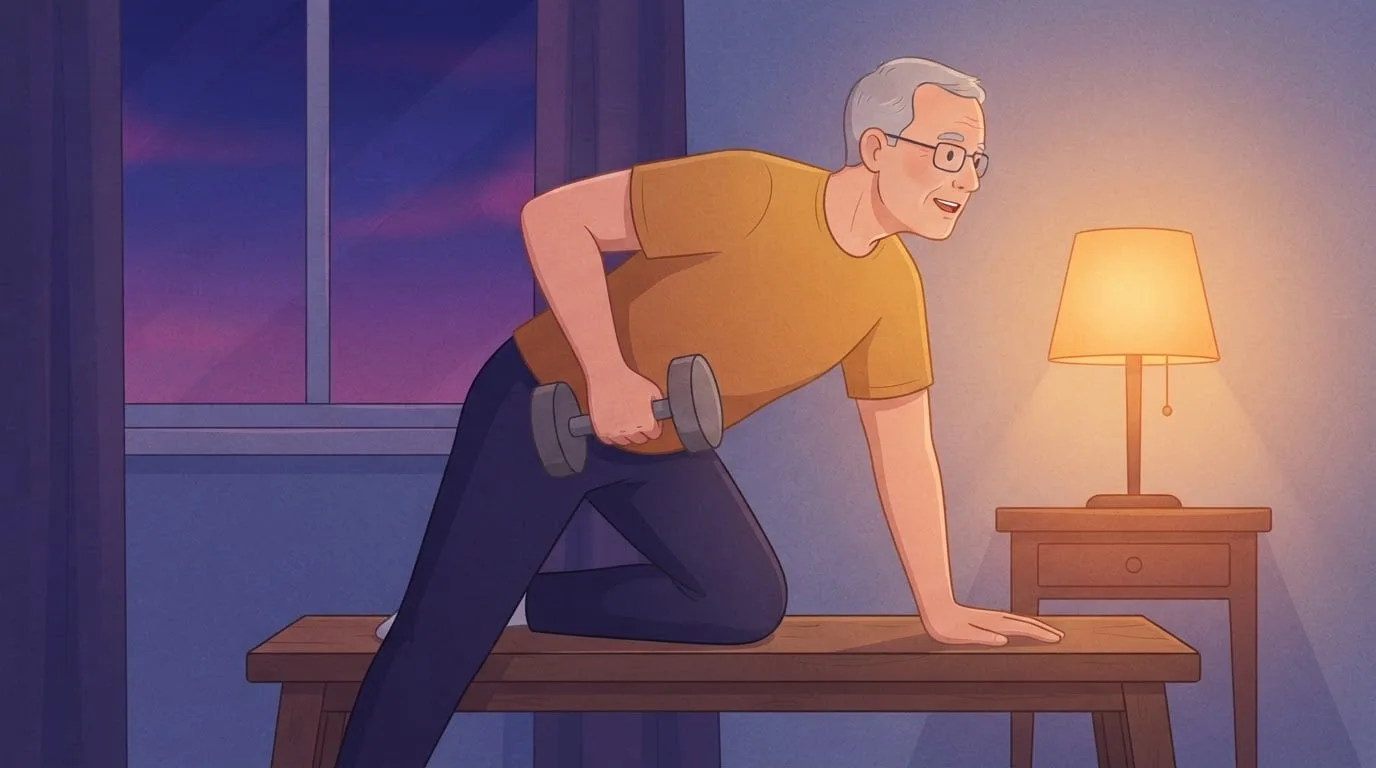
| One-arm dumbbell row | Lowering the dumbbell | Pulling it toward your hip |
| Biceps curl | Lowering the dumbbells | Curling them up |
| Goblet squat | Squatting down | Standing up |
| Dumbbell Romanian deadlift | Hinging forward | Standing tall |
| Reverse lunge | Stepping back and lowering | Driving back up |
| Glute bridge | Lowering your hips | Lifting your hips |
| Plank or side plank | Short, steady breaths | Short, steady breaths, keeping your midsection tight |
If you're ever unsure in the middle of a set, exhale on the effort. That one cue covers almost everything.
How to Breathe During Exercise Between Sets and in Circuits
How to breathe during exercise depends on the kind of exercise. Between strength sets, slow your breathing down: breathe in through your nose, let the breath fill your belly, and breathe out slowly. Start the next set when your breathing has settled and you feel ready, which takes one to three minutes for most people.
In circuits and cardio, you can't time a breath to every rep. Breathe in a steady rhythm that matches your pace, and slow down if you can't say a short sentence. Our guide on how to breathe while running covers breathing rhythms and side stitches, and our review of diaphragmatic breathing research explains belly breathing practice.
Common Breathing Mistakes at the Gym
- Holding your breath for the whole set. It's the most common one, and it gets worse near the end of a hard set when the reps slow down.
- Breathing high in your chest. If your shoulders rise on every breath, your diaphragm isn't doing the work and your trunk is softer than it should be.
- Blowing all your air out at the hardest point. A long, forceful exhale can make you lose tension. Let it out in a controlled stream.
- Breathing too fast between reps. Quick, shallow breaths can leave you lightheaded.
- Overthinking light sets. On a warm-up or a light set of 15, just breathe.
What This Means for You
You don't need a special breathing technique to start lifting. Breathe out when you lift, breathe in when you lower, and don't hold your breath through a whole set. That covers almost every dumbbell and bodyweight exercise you'll do at home, from rows to squats. Breath holds are a tool for heavy, low-rep lifting, and for most people they're optional.
Learning to lift can feel like a hundred things to get right at once: your feet, your back, the weight, and now your breathing. It gets easier fast. After a few sessions, breathing on the effort becomes automatic, and you can put your attention on getting stronger. Our guide on how to start lifting weights covers your first weeks. If you'd like to see each move before you try it, a dumbbell workout app like FitCraft shows every exercise as an interactive 3D demo you can pinch and zoom. As FitCraft user Tim put it: "I didn't think an app could replace my trainer. My AI coach proved me wrong."
Frequently Asked Questions
Do you inhale or exhale when pushing?
Exhale when pushing. Breathe out as you press a weight or your body away, as in a push-up or shoulder press, and breathe in as you lower it back. Exhaling through the hard part keeps blood pressure lower than holding your breath does.
Is it bad to hold your breath while lifting weights?
A brief breath hold on a heavy rep is common and helps brace your trunk, but it sends blood pressure much higher than breathing out does. Healthy, experienced lifters can use it for a second or two on heavy sets. People with high blood pressure, heart disease or glaucoma, and anyone who is pregnant, should breathe out through every rep instead.
Should you breathe through your nose or mouth when lifting?
Either is fine. Many people breathe in through the nose and out through the mouth on lighter sets, then switch to the mouth as the effort climbs because it moves more air. What matters more is breathing out through the hard part of the rep instead of holding your breath.
How do you breathe when lifting heavy weights?
Take a big breath into your belly before the rep, brace your midsection, and breathe out through or just after the hardest part of the lift. Experienced lifters sometimes hold the breath through one heavy rep, then breathe out at the top. Never hold it for a whole set.
Why do I get dizzy when lifting weights?
Holding your breath and straining raises the pressure in your chest and briefly reduces blood flow back to your heart, so you can feel lightheaded when you let go. Breathing too fast between sets, standing up quickly or training on an empty stomach can also cause it. Stop the set, sit down, and see a doctor if it keeps happening.
How to breathe during exercise?
Breathe in a steady rhythm that matches the effort. In strength training, breathe out on the hard part of each rep and in on the easy part. In cardio, let your breathing follow your pace, and slow down if you can't say a short sentence.