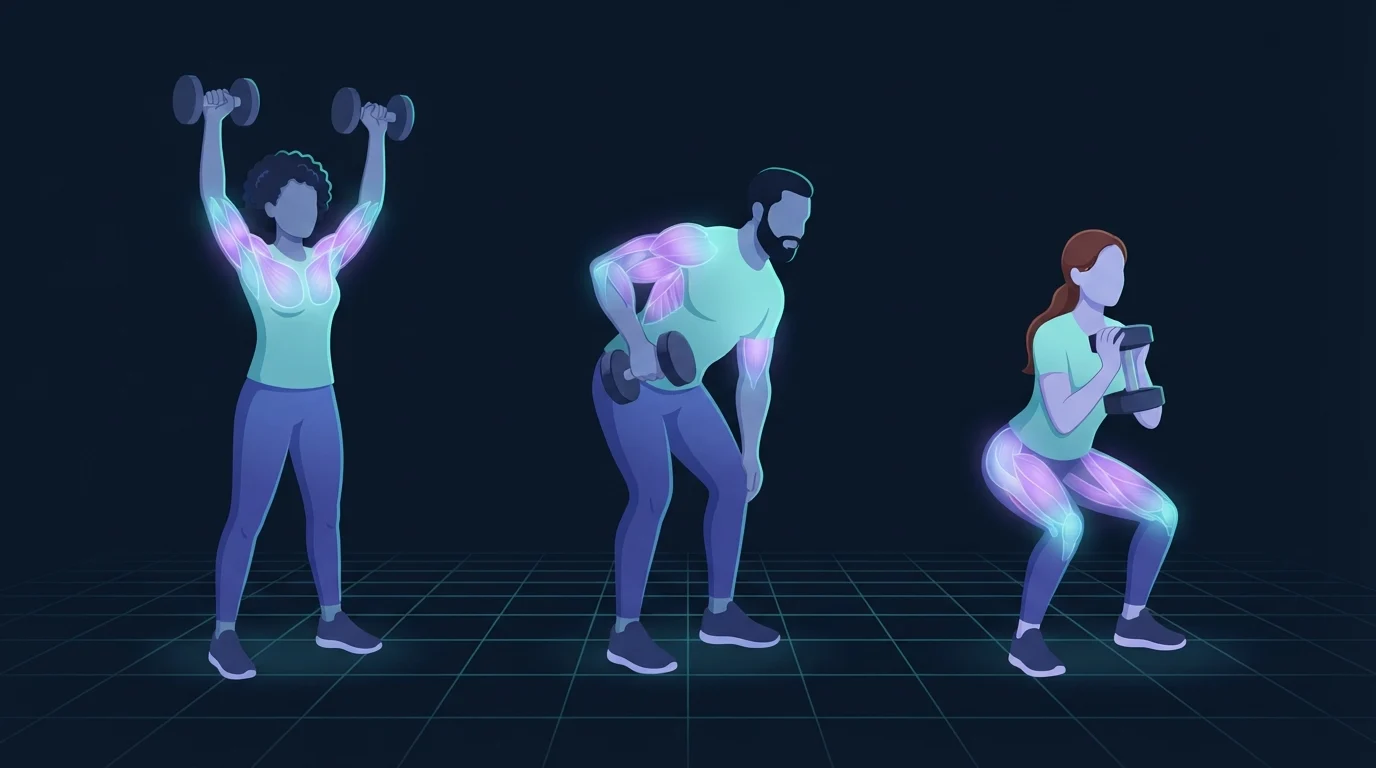
Push pull legs has a reputation problem. It's the split people graduate to when they want to feel serious, and it's the split that quietly falls apart in week three when a Thursday disappears and the whole rotation slides.
The layout itself is excellent. What gets people is running the six-day version on a four-day life, then blaming themselves when the results don't show up. That isn't a discipline failure. It's a container that was never sized for the week you actually have.
So here's the honest version: what push pull legs is good at, who it genuinely fits, two complete templates you can run at home, and the one arrangement of it that the research quietly rates worst.
What Push Pull Legs Actually Means
The split sorts exercises by the job the muscles do rather than by where they sit on your body. Three session types, three jobs.
- Push. Everything where the weight moves away from you: chest press, incline press, overhead press, lateral raises, triceps extensions, push-ups, dips.
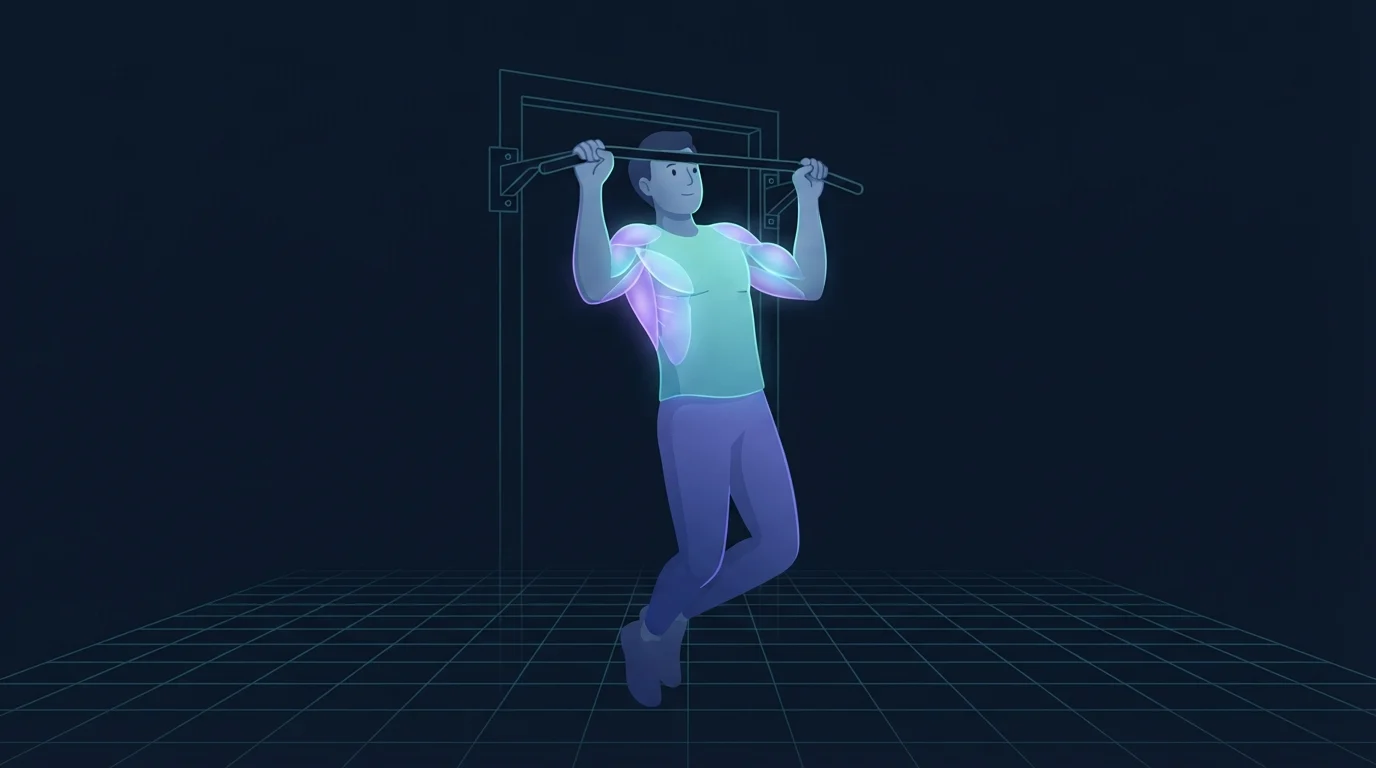
- Pull. Everything where the weight moves toward you: rows, chin-ups, inverted rows, rear delt raises, curls, face pulls.
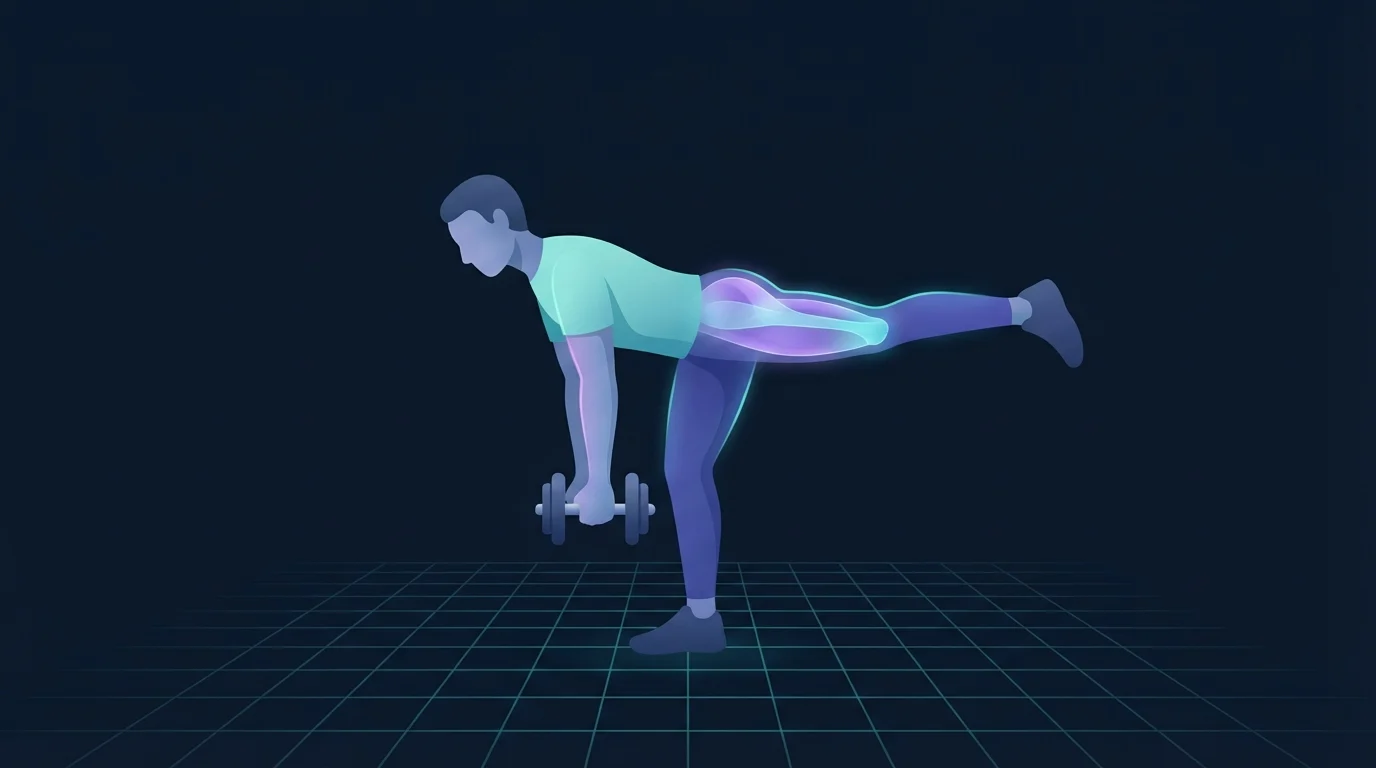
- Legs. Everything below the hips plus direct trunk work: goblet squats, Romanian deadlifts, split squats, glute bridges, calf raises, planks.
The elegance is that pushing muscles recover while you pull, and both recover while you train legs. You never ask the same tissue to work hard two days running, which is what lets the split stack six sessions into a week without the sessions colliding.
The cost is fragility. On a workout split this narrow, one missed pull day leaves your entire back with nothing that week. Full body training absorbs a missed day; push pull legs does not.
Who a Push Pull Legs Routine Suits
It fits you if you've been training consistently for a year or more, you can reliably hit five or six sessions, your weekly set target has climbed past roughly 15 sets per muscle, and you'd rather do six short sessions than four long ones. It also fits people who genuinely enjoy training and want to be in the gym or the garage most days.
It's the wrong pick if you're training three or four days a week, you're new to lifting, or your schedule shifts week to week. At three days you'd be giving every muscle one weekly exposure, which is the arrangement with the weakest evidence behind it. At four days an upper lower split delivers the same coverage more reliably.
| Days you can train | What push pull legs gives you | Better option, if any |
|---|---|---|
| 2 to 3 | One exposure per muscle per week | Full body, 3 days |
| 4 | Uneven coverage, or a rolling cycle that drifts | Upper lower, 4 days |
| 5 | A rolling cycle, roughly 1.7 exposures per muscle | Works well |
| 6 | Two exposures per muscle, short sessions | Its best fit |
The Frequency Evidence Behind the Six-Day Week
The case for running the cycle twice rests on a small, stable body of work, and it's worth knowing what it does and doesn't say.
Schoenfeld, Ogborn and Krieger (2016), in Sports Medicine, pooled 10 studies comparing training a muscle once a week against twice or more, and recommended at least two weekly sessions per muscle group. That recommendation held. The explanation people attached to it did not: three years later Schoenfeld, Grgic and Krieger (2019) restricted the analysis to 25 volume-equated studies and found no significant hypertrophy difference between low and high frequencies. Most of the earlier advantage came from higher-frequency groups doing more total sets.
The most direct test of a once-a-week split is Zaroni and colleagues (2019), in the Journal of Strength and Conditioning Research. Eighteen resistance-trained men ran either a split training each muscle group once a week or a whole-body routine training each muscle five days a week, with weekly volume equated, for eight weeks. Strength gains were similar. Muscle thickness of the forearm flexors and the vastus lateralis increased significantly more in the high-frequency group. That is the single most relevant finding on this page, because a three-day push pull legs routine is a once-a-week split.
At the other extreme, more is not better either. Saric and colleagues (2019) put 27 trained men through six weeks of either three or six weekly sessions with volume held equal and found similar strength and hypertrophy outcomes. And Pelland and colleagues (2026), in Sports Medicine, modelled 67 studies and 2,058 participants: weekly volume raised size and strength with near-certainty, while frequency was compatible with negligible effects for hypertrophy and a small, flattening benefit for strength. Grgic and colleagues (2018) found the same small strength edge across 22 studies.
Put it together and the six-day version earns its place for one reason: it's a comfortable container for a lot of weekly sets. Schoenfeld, Ogborn and Krieger (2017) found a graded dose-response between weekly set count and growth, and the 2026 ACSM position stand puts the practical floor at 10 hard sets per muscle per week. Fitting 18 to 22 sets for chest into two short push days is far easier than fitting it into one long upper day. Our training frequency research page covers where these meta-analyses disagree.
The 6-Day Push Pull Legs Routine
Six sessions, one rest day, dumbbells and bodyweight throughout. A doorway pull-up bar helps a lot on pull days but isn't required. The A and B versions of each day aren't different workouts so much as different emphases, which keeps the same muscles working twice a week without asking the same joints to repeat an identical session 72 hours later.
Three sets per exercise unless noted. Rest 2 to 3 minutes after the first two movements of each day, 60 to 90 seconds after the rest.
| Day | Exercises | Sets and reps |
|---|---|---|
| Push A (horizontal focus) |
Dumbbell bench or floor press Seated dumbbell overhead press Incline dumbbell press Lateral raise Overhead triceps extension Push-up, as many as possible |
4 x 6-10 3 x 8-12 3 x 8-12 3 x 12-20 3 x 10-15 1 set to finish |
| Pull A (vertical focus) |
Chin-up or band-assisted chin-up One-arm dumbbell row Chest-supported reverse fly Single-arm dumbbell pullover Hammer curl Dead hang |
4 x as many as possible 4 x 8-12 each side 3 x 12-15 3 x 10-15 3 x 10-15 2 x max time |
| Legs A (squat focus) |
Goblet squat Rear-foot-elevated split squat Dumbbell Romanian deadlift Standing calf raise Dead bug Side plank |
4 x 8-12 3 x 8-12 each side 3 x 10-12 3 x 12-20 3 x 8 each side 3 x 30 sec each side |
| Push B (vertical focus) |
Standing dumbbell overhead press Dumbbell floor press Pike push-up or decline push-up Arnold press Lateral raise, lighter Close-grip push-up |
4 x 6-10 3 x 8-12 3 x 6-12 3 x 10-15 3 x 15-20 2 x as many as possible |
| Pull B (horizontal focus) |
Inverted row, feet elevated Chest-supported dumbbell row Renegade row Band pull-apart Zottman or incline curl Rear delt raise |
4 x 8-15 4 x 8-12 3 x 8-12 each side 3 x 15-25 3 x 10-15 2 x 12-20 |
| Legs B (hinge focus) |
Dumbbell Romanian deadlift, heavier Single-leg Romanian deadlift Dumbbell hip thrust or glute bridge Walking or rear lunge Slider hamstring curl Hollow hold |
4 x 6-10 3 x 8-12 each side 3 x 10-15 3 x 10-12 each side 3 x 8-12 3 x 20-40 sec |
Run it Monday through Saturday with Sunday off, or push, pull, legs, rest, push, pull, legs on a rolling eight-day cycle if your week doesn't line up with the calendar. Weekly totals land around 16 to 20 hard sets for the main pushing and pulling muscles and 14 to 18 for the legs, which sits in the upper half of the productive range.
Find out what's really holding you back
FitCraft, our mobile fitness app, pairs you with an AI coach who builds you a personalized plan around your goals, schedule, and fitness level. Every FitCraft program is designed by Domenic Angelino, MPH (Brown University) and NSCA-CSCS, with research published in the Journal of Strength and Conditioning Research and Medicine & Science in Sports & Exercise.
Take the Free Assessment Free • 2 minutes • No credit cardThe 3-Day Push Pull Legs Routine, and Its One Real Weakness
Three days is the version most people search for, so it deserves straight talk before the template.
A three-day push pull legs routine gives every muscle exactly one training exposure per week. That's the arrangement Zaroni and colleagues tested against a high-frequency routine with weekly volume matched, and the higher-frequency group gained more muscle thickness. It's also the arrangement the 2016 frequency meta-analysis was written to argue against. None of that makes three-day push pull legs useless. It makes it the second-best use of three days.
Run it anyway if you specifically want longer, more focused sessions and you're happy trading a little growth rate for that. Here's the version that minimises the damage: each day gets more sets than its six-day counterpart, and each day borrows one movement from the adjacent pattern so nothing sits completely untouched.
| Day | Exercises | Sets and reps |
|---|---|---|
| Monday: Push | Dumbbell bench or floor press Seated dumbbell overhead press Incline dumbbell press Lateral raise Overhead triceps extension Close-grip push-up Face pull or band pull-apart |
4 x 6-10 4 x 8-12 3 x 8-12 3 x 12-20 3 x 10-15 2 x as many as possible 2 x 15-25 |
| Wednesday: Pull | Chin-up or band-assisted chin-up One-arm dumbbell row Chest-supported dumbbell row Reverse fly Dumbbell shrug Hammer curl Incline curl |
4 x as many as possible 4 x 8-12 each side 3 x 10-12 3 x 12-15 3 x 10-15 3 x 10-15 2 x 10-15 |
| Friday: Legs and trunk | Goblet squat Dumbbell Romanian deadlift Rear-foot-elevated split squat Dumbbell hip thrust Standing calf raise Dead bug Side plank |
4 x 8-12 4 x 8-12 3 x 8-12 each side 3 x 10-15 3 x 12-20 3 x 8 each side 3 x 30 sec each side |
Each session runs 60 to 70 minutes, which is the trade you're making. If that sounds worse than three 45-minute sessions that hit everything, it probably is for you, and our full body workout routine guide has three complete three-day templates at the same equipment tiers.
How to Pick Exercises for Each Day
Every day follows the same shape: two heavy compound movements, two moderate movements, two or three isolation movements. Fill the slots in that order and the session builds itself.
- Push days. One horizontal press and one vertical press as the anchors. Then a second press at a different angle, then side delts and triceps. Incline and flat are different enough to both earn a slot; flat and floor press are not.
- Pull days. One vertical pull and one horizontal pull as the anchors. Then a second row variation, then rear delts and biceps. Rear delt work is the most commonly skipped thing on this page and the most commonly needed.
- Leg days. One squat pattern and one hinge pattern as the anchors. Then a single-leg movement, then calves and trunk. Single-leg work is how home leg days stay hard once your dumbbells max out.
- Balance the ratio. Count your weekly pressing sets and your weekly pulling sets. If pressing is more than about 20 percent ahead, add a row, not a stretch.
Sets, Reps, Rest and Progression
The numbers in the templates only mean something if the effort behind them is real. Refalo and colleagues (2023), in Sports Medicine, found hypertrophy improved as sets were taken closer to failure, with the benefit flattening once you're within a few reps of it. Aim for one to three reps in reserve on working sets and save true failure for the last set of an isolation movement.
Progressive overload on a six-day schedule has one extra wrinkle: you have twice as many sessions to track, so the bookkeeping has to be simple.
- Add reps first. Climb from the bottom to the top of the prescribed range on every set, then add load next session and drop back down.
- Add load in the smallest increment you own. Two or five pounds is a big relative jump on a lateral raise.
- Add sets last, and only to the stalling lift. Not to the whole day.
- Deload every fifth or sixth week. On a six-day schedule this matters more than it does anywhere else. Cut sets roughly in half for a week and keep the loads. The easiest way to schedule it is to run four days that week instead of six.
- Write it down. Six sessions a week is 36 exercises. Nobody remembers that.
If you'd rather not run the bookkeeping yourself, our personalized training program page covers how FitCraft's multi-week programs get built around your goals, your schedule and your current fitness level.
Push Pull Legs vs Upper Lower vs Full Body
Three sensible structures, three different weeks, and the choice is almost entirely a calendar question.
| Push pull legs | Upper lower | Full body | |
|---|---|---|---|
| Days per week | 5 to 6 | 3 to 4 | 2 to 3 |
| Exposures per muscle | 2 at six days, 1 at three | 2 | 2 to 3 |
| Session length | 45 to 60 min | 45 to 60 min | 40 to 55 min |
| Sets per muscle per session | 6 to 10 | 5 to 8 | 2 to 4 |
| Ceiling on weekly volume | Highest | Middle | Lowest |
| Cost of a missed session | Highest: that muscle group gets nothing | High: half your body gets nothing | Low: the next session repeats it |
| Works with dumbbells only | Yes, with more pulling volume | Yes | Yes |
The honest ranking for most people is full body at two or three days, an upper lower split at three or four, and push pull legs at five or six. Pick by calendar, not by which one sounds most advanced. Our comparison of full body vs split workout programming works through the choice day count by day count.
Common Push Pull Legs Mistakes
- Running a six-day plan on a four-day life. The most expensive mistake here by a distance. Four days of a six-day rotation means most muscles get one exposure and the cycle drifts out of sync with your week. Pick the layout your calendar supports and add volume inside it.
- Making Push B a copy of Push A. If both days lead with a flat press, you've got a six-day schedule with four-day variety and twice the elbow mileage. Anchor one day horizontally and the other vertically.
- Pressing more than you pull. Push days are more fun and pressing loads more easily, so the ratio drifts. Count the sets. If pressing leads pulling by more than 20 percent over a week, add a row.
- Skipping leg day. It's the longest, hardest session and the easiest to move to tomorrow. Move it twice and the routine has quietly become push pull.
- Never deloading. Six sessions a week accumulates fatigue faster than three, and the schedule offers no natural gap. Put a light week in the calendar before you need it.
- Chasing frequency instead of sets. The research is clear that weekly volume drives growth and frequency mostly helps you deliver it. If you're at six days and 8 sets per muscle, more days isn't the fix.
The Bottom Line
A push pull legs routine is the best container anyone has built for a lot of weekly sets. Run twice through a week it gives every muscle two exposures in sessions that stay under an hour, and it lets pushing recover while you pull. Run once through a week it becomes a once-a-week split, which is the layout the frequency evidence rates lowest.
So the decision is simple and it isn't about how serious you are. If you can genuinely train five or six days, this is an excellent plan and you should run it. If you can train three or four, run something that reaches every muscle more than once, and spend the attention you saved on load, effort and showing up.
Frequently Asked Questions
What is a push pull legs routine?
A push pull legs routine divides training into three session types. Push days cover chest, front and side shoulders, and triceps. Pull days cover lats, mid back, rear shoulders, and biceps. Leg days cover quads, hamstrings, glutes, calves and the trunk. Run twice through in a week it becomes a six-day schedule that trains every muscle twice, which is the version the frequency research supports. Run once through it becomes a three-day schedule with one exposure per muscle.
How many days a week should you run push pull legs?
Six is the natural fit, five is the honest compromise, and four works on a rolling rotation. Six days means push, pull, legs, push, pull, legs with one rest day, so every muscle gets two weekly exposures. Five days runs the same three sessions on a rolling cycle so the week starts on a different day each time. Below four days a week, an upper lower split or a full body routine delivers the same weekly sets with better coverage.
Is a 3-day push pull legs routine effective?
It works, but it's the weakest version of the layout because each muscle gets only one training exposure per week. A 2019 trial in resistance-trained men compared a split hitting each muscle once a week against a whole-body routine hitting each muscle five times, with weekly volume matched, and found greater muscle thickness gains in the higher-frequency group. If you only have three days, a three-day full body routine usually beats a three-day push pull legs routine on coverage.
Can you do a push pull legs routine at home with dumbbells?
Yes, with one caveat. Push and leg days translate cleanly to dumbbells: floor press, incline press, overhead press, lateral raises, goblet squats, Romanian deadlifts, split squats and hip thrusts all load well. Pull days are the hard part, because rows and chin-ups run out of load faster at home. The fix is more pulling volume rather than heavier pulling: add a set to each row, use slower lowering phases, and put a doorway pull-up bar in the budget before a heavier dumbbell.
Push pull legs vs upper lower: which is better?
Upper lower fits a four-day week and push pull legs fits a six-day week. Both give every muscle two exposures at their natural frequency, so neither has a physiological edge. Push pull legs splits upper-body work across two session types, which means shorter sessions and room for more sets per muscle. It also fails harder when life takes a day, because a missed pull day leaves your entire back untrained that week.
What are the most common push pull legs mistakes?
Running six days when your calendar supports four, treating the second push and pull days as identical copies of the first, letting pressing volume outnumber pulling volume, skipping leg day so the routine quietly becomes push pull, and never deloading because the schedule leaves no obvious place for it. The first one is the most costly: a six-day plan run four days a week gives most muscles a single weekly exposure and no way to recover the missing sets.