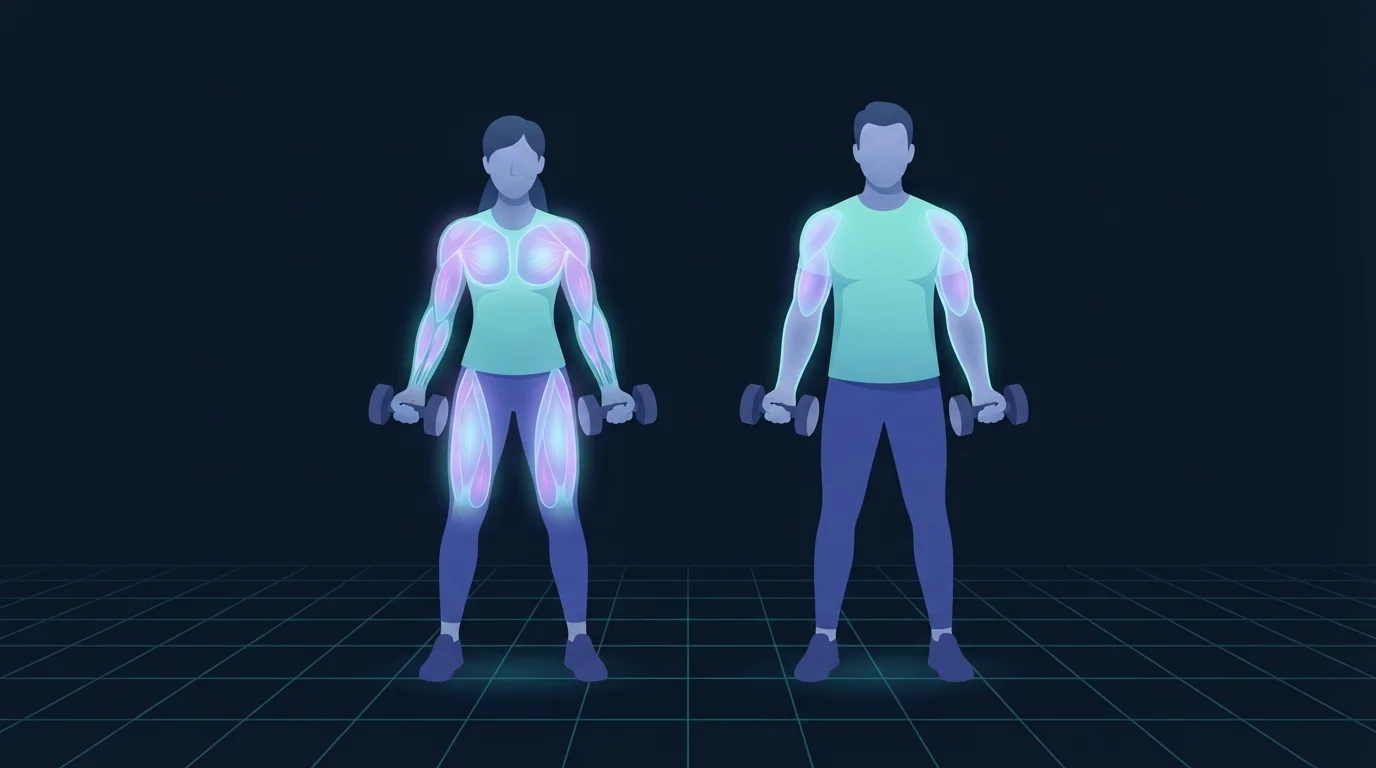
Ask this question in any gym and you'll get an answer delivered with total confidence, usually by someone who has only ever done one of the two. Full body is for beginners. Splits are for serious lifters. Neither claim survives contact with the research.
What the evidence actually supports is smaller and more useful: get enough hard sets per muscle each week, spread them over at least two sessions, and the arrangement beyond that is mostly logistics. Which is good news, because logistics is the part you control.
Here's what each layout means, what the frequency and volume trials found, sample weeks for two through five training days, and how the answer shifts when you're training at home with a pair of dumbbells.
What Each One Actually Means
The vocabulary gets muddled, so a quick reset.
- Full body. Every session touches every major movement pattern: a squat, a hinge, a push, a pull, and some trunk work. Each muscle gets 2 to 6 sets per session and 2 to 4 sessions a week.
- Upper lower. Two session types. Upper days cover chest, back, shoulders and arms; lower days cover quads, hamstrings, glutes and calves. Four days gives every muscle two weekly exposures.
- Push pull legs. Three session types, usually run five or six days a week. Pushing muscles together, pulling muscles together, legs on their own.
- Body-part split. The classic bodybuilding layout: one muscle group per day, each trained once a week. This is the version the frequency literature is least kind to.
Everything except full body is a workout split. When people argue about full body vs split workout programming they're usually comparing full body against upper lower or against push pull legs, so those are the comparisons this page runs.
Quick Comparison
| Full body | Split (upper lower or push pull legs) | |
|---|---|---|
| Days per week it suits | 2 to 4 | 4 to 6 |
| Exposures per muscle per week | Equal to the number of sessions | 2 on a 4-day upper lower, 2 on a 6-day push pull legs, 1 on a body-part split |
| Typical session length | 45 to 70 minutes | 40 to 60 minutes |
| Sets per muscle per session | 2 to 6 | 6 to 12 |
| Cost of missing one session | Low: the next session covers the same muscles | High: a missed leg day means legs get nothing that week |
| Weak point | Session length balloons once weekly volume gets high | Needs a reliable schedule to work at all |
| Home and dumbbell friendliness | High: no equipment queue, short sessions cost nothing | Moderate: fine on 4 days, awkward below that |
| Best for | Beginners, unpredictable weeks, 2 or 3 training days, home training | Intermediates chasing higher volume, 4 or more reliable days |
What the Frequency Research Actually Found
The argument usually gets framed as frequency, so start there. Schoenfeld, Ogborn and Krieger (2016), in Sports Medicine, pooled 10 studies comparing training a muscle once a week against twice or more. Higher frequency came out slightly ahead for hypertrophy, and the authors recommended training each muscle at least twice a week. That recommendation has held up. The explanation people attached to it did not.
Three years later the same group re-ran the analysis with stricter criteria. Schoenfeld, Grgic and Krieger (2019), in the Journal of Sports Sciences, restricted inclusion to 25 volume-equated studies and found no significant difference in hypertrophy between low and high frequencies. In other words, most of the 2016 advantage came from higher-frequency groups doing more total work, not from the frequency itself.
The most recent modelling says the same thing with more precision. Pelland and colleagues (2026), in Sports Medicine, ran meta-regressions across 67 studies and 2,058 participants. Weekly set volume raised both muscle size and strength with a posterior probability of 100 percent, with diminishing returns that were far steeper for strength than for growth. Frequency was a different story: compatible with negligible effects for hypertrophy, and a consistent but flattening benefit for strength.
Strength is where frequency earns a little on its own. Grgic and colleagues (2018) pooled 22 studies in Sports Medicine and found training a muscle two or three times a week produced greater strength gains than once a week, with a small-to-moderate effect. Skill practice is part of that. A squat is a motor pattern, and patterns respond to repetition.
There is also one trial that ran the comparison directly in trained lifters. Schoenfeld and colleagues (2015), in the Journal of Strength and Conditioning Research, put well-trained men through eight weeks of either a total-body routine three days a week or a body-part split training each muscle once, with weekly volume matched. The total-body group showed significantly greater increases in forearm flexor thickness. It's a single small study, but it points the same direction as the meta-analyses and it's the closest thing to a head-to-head we have. Our full review of the training frequency research goes through the rest of the literature.
Volume Is the Thing You Are Actually Choosing
If frequency is close to neutral for growth, weekly sets are what you're really deciding. Schoenfeld, Ogborn and Krieger (2017), in the Journal of Sports Sciences, pooled 34 treatment groups from 15 studies and found a graded dose-response between weekly set count and muscle growth. More sets, more growth, up to a point. The 2026 ACSM Position Stand puts the practical floor at 10 hard sets per muscle group per week for hypertrophy and at least two sessions a week for every major muscle group.
Now do the arithmetic, because this is where the split question answers itself.
| Weekly sets per muscle | Goal it serves | Layout that carries it comfortably |
|---|---|---|
| 6 to 10 | General health and baseline strength | Full body, 2 days |
| 10 to 14 | Beginner and early intermediate growth | Full body, 3 days |
| 14 to 18 | Intermediate growth | Upper lower, 4 days |
| 18 to 22 | Advanced growth or a focused block | Push pull legs, 5 or 6 days |
Fitting 18 sets for chest into one weekly session produces a long, ugly workout whose last six sets are visibly worse than its first six. Splitting it across three sessions of six is the same total at higher quality. That, and nothing more mystical, is what a split is for. If you want the per-session version of this arithmetic, our guide on how many exercises per workout works it from the other end.
Find out what's really holding you back
FitCraft, our mobile fitness app, pairs you with an AI coach who builds you a personalized plan around your goals, schedule, and fitness level. Every FitCraft program is designed by Domenic Angelino, MPH (Brown University) and NSCA-CSCS, with research published in the Journal of Strength and Conditioning Research and Medicine & Science in Sports & Exercise.
Take the Free Assessment Free • 2 minutes • No credit cardSample Weeks for 2, 3, 4 and 5 Days
Every template below runs on dumbbells and bodyweight. Swap in a barbell or machines if you have them; the structure doesn't change. If you're not sure which number of days is yours, our post on how many days a week you should work out works through that first.
Two days: full body, no debate
Two sessions, both full body, 48 hours apart. Six compound movements each, 3 sets apiece, landing near 6 to 8 weekly sets per muscle group. That clears the ACSM twice-a-week floor and it's the layout with the best result-per-hour ratio in the whole article.
| Day | Session |
|---|---|
| Monday | Goblet squat, floor press, one-arm row, Romanian deadlift, overhead press, plank |
| Thursday | Rear-foot-elevated split squat, incline press, chin-up or inverted row, hip thrust, lateral raise, dead bug |
A two-day split is the one common arrangement worth arguing against. It gives every muscle a single weekly exposure and no way to recover the missing sets, which is the exact condition the frequency meta-analyses rate worst.
Three days: still full body, now with room
Three full-body sessions on non-consecutive days, each rotating its emphasis. Squat-led on Monday, hinge-led on Wednesday, single-leg and carry-led on Friday. Four sets of the day's main lift and two or three for the rest lands at 12 to 15 weekly sets per muscle group, which is comfortably inside the productive range for a beginner or early intermediate.
This is also the layout with the most forgiving failure mode. Miss Wednesday and every muscle still gets trained twice that week.
Four days: the split starts to earn its keep
Upper, lower, rest, upper, lower. Each muscle gets two exposures, sessions stay around 45 minutes, and weekly sets per muscle land in the 14 to 18 range without any session dragging. This is the point where splitting starts to buy something real rather than just feeling more serious. Our guide to the upper lower split has the full four-day template with sets and reps already counted.
A four-day full-body week also works, and it's underrated. It just needs the per-session volume kept low, 2 or 3 sets per muscle, or the sessions run long and the fatigue stacks up.
Five days: push pull legs, or four plus one
Two clean options. Run push, pull, legs, upper, lower and accept that the fifth day gives some muscles a third weekly exposure. Or run a four-day upper lower and add a fifth day for weak points, conditioning, or the lifts you care about most. Beyond five days, the extra sessions are buying volume, not frequency, and volume has a ceiling where recovery starts losing.
The Home and Dumbbell Angle
Training at home changes the calculus, and it mostly pushes toward full body.
The historical case for splits is partly a gym-logistics artifact. In a busy gym you wait for equipment, you travel to get there, and a 40-minute session costs nearly as much of your day as a 70-minute one. None of that applies in a living room. A 35-minute full-body session at home costs 35 minutes, so the argument for batching muscle groups into longer blocks mostly evaporates.
The second factor is load. With a fixed pair of dumbbells you'll often cap out on your stronger movements long before your muscles are the limiting factor, and the fix is more frequent exposures with higher rep ranges and slower tempos rather than more sets crammed into one day. Full body suits that: you're back to the same movement pattern in 48 hours, refining reps instead of waiting a week. A personalized training program that adapts as you progress handles this ramp for you, but the principle works whether or not you use one.
The third is that home weeks are less predictable than gym weeks. A missed session hurts a split badly and a full-body week barely at all. On a 3-day full body plan, two sessions is still a decent week. On a 4-day upper lower plan, missing both lower days means your legs did nothing.

Who Should Choose Which
| If this is you | Run this | Why |
|---|---|---|
| 2 or 3 training days | Full body | Only layout that reaches every muscle twice |
| Brand new to lifting | Full body | More practice reps per pattern, and Grgic found frequency helps strength |
| Unpredictable schedule | Full body | A missed session costs far less |
| Training at home with dumbbells | Full body at 2 to 3 days, upper lower at 4 | No equipment queue, so short sessions are cheap |
| 4 reliable days, chasing size | Upper lower | 14 to 18 weekly sets per muscle in 45-minute sessions |
| 5 or 6 days, intermediate or beyond | Push pull legs | Room for 18 to 22 weekly sets without marathon sessions |
| Coming back after a layoff | Full body, 2 days | Rebuilds every pattern at once with low weekly fatigue |
Mistakes That Make This Choice Worse Than It Is
Running a split on too few days. A two or three day upper lower leaves most muscles with a single weekly exposure. If your schedule is that tight, full body is the correct choice, and that has nothing to do with experience level.
Switching every few weeks. Both layouts work. Neither works if you never stay on one long enough to add weight or reps to the same movements. Pick one and run it for at least eight weeks.
Counting sessions instead of sets. Six days a week of low-volume sessions can total fewer weekly sets than three good full-body days. Track the number that matters.
Treating a split as a sign of seriousness. The one trial that compared a total-body routine against a once-weekly body-part split in trained men favoured the total-body group. Advanced lifters split for volume management, not because full body stops working.
Ignoring rest days entirely. Five or six training days is a real recovery cost, and it's the number most people overreach on first. Our post on how many rest days a week covers where the floor sits.
The Bottom Line
Full body vs split workout is decided by your calendar, not your physiology. When weekly sets match, the volume-equated evidence finds no meaningful hypertrophy difference between frequencies, and frequency buys only a small, diminishing bonus for strength. So pick by days: full body at 2 to 3, upper lower at 4, push pull legs at 5 or 6.
Practical rule: choose your weekly sets per muscle first (10 or more if you want growth), then pick whichever layout divides that number into sessions you'll finish on the days you'll actually show up.
The people who make the most progress are rarely the ones who picked the optimal split. They're the ones who picked a workable one and then added a rep or a little weight to the same movements, week after week, for a year.
Frequently Asked Questions
Is a full body workout better than a split?
Neither is better in itself. Schoenfeld, Grgic and Krieger pooled 25 volume-equated studies and found no significant hypertrophy difference between low and high training frequencies, which means the split is a delivery mechanism for weekly sets rather than a driver of growth on its own. Full body wins on 2 and 3 days a week because it's the only layout that reaches every muscle twice. Splits win at 4 days and above because they let you add sets without the session running past an hour.
How many days a week do you need for a split workout?
Four is the honest floor for an upper lower split and five or six for push pull legs, because both need enough sessions to hit each muscle twice a week. A two-day split leaves every muscle with a single weekly exposure, which is the one arrangement the frequency literature consistently rates below the alternatives. If you only have two or three days, run full body instead of a shortened split.
Can you build muscle on full body workouts three times a week?
Yes, and there is a trial pointing that way in trained lifters. Schoenfeld and colleagues in 2015 put well-trained men through eight weeks of either a total-body routine three days a week or a body-part split hitting each muscle once, with weekly volume matched, and the total-body group gained significantly more forearm flexor thickness. Three full-body days can carry 12 to 18 weekly sets per muscle group, which is squarely in the productive range.
Does training a muscle more often build more muscle?
Not by itself. Pelland and colleagues modelled 67 studies and 2,058 participants and found weekly set volume raised both size and strength with high certainty, while frequency was compatible with negligible effects for hypertrophy and showed a consistent but diminishing benefit for strength. Frequency helps mainly because spreading sets over more sessions lets you do more of them well.
What is the best split for home dumbbell workouts?
Full body for two or three days a week and an upper lower split for four. Home training has no queue for equipment and no commute, so short sessions cost almost nothing, which removes the main practical argument for splitting. The constraint at home is load, not time, so pick a layout that lets you repeat each movement pattern often enough to keep progressing reps before you add weight.
How many sets per muscle per week should you do?
At least 10 for growth, and 6 to 10 is enough for general strength and health. The 2026 ACSM Position Stand landed on at least 10 hard sets per muscle group per week for hypertrophy, and Schoenfeld's dose-response meta-analysis found a graded relationship between weekly sets and muscle size. Pick your weekly number first, then choose whichever split divides it into sessions you will actually finish.