You set up for a squat, you stand up out of the hole, and everything you feel is quads. Or you finish a run and your lower back is the thing that aches, not your backside. Somewhere along the line you read that your glutes have gone to sleep, that a desk job switched them off, and that the fix is a few minutes of clamshells before you train.
Half of that's fair. The other half is a story the internet told itself, and knowing which half is which changes how you use these drills. They are worth five minutes. They aren't worth the twenty that some warm-up routines demand, and they're not a substitute for actually loading the muscle.
This page covers the mechanism, what the electromyography and MRI data actually found, a self-test you can run in three minutes, seven drills with dosing, and how to slot them in before squats, lunges or a run. For the strength exercises that build the muscle, our roundup of the best glute exercises at home is the page you want next, and this one deliberately stops short of repeating it.
What "Gluteal Amnesia" Actually Means
Start with the honest version. Search the biomedical literature for "gluteal amnesia" or "dead butt syndrome" and you get a handful of passing mentions, none of them defining it as a condition. No diagnostic criteria, no prevalence, no trials. It's a coaching metaphor that escaped into the wild.
What does exist, under a duller name, is arthrogenic muscle inhibition: a reflexive damping of muscle drive caused by something irritating the joint the muscle crosses. It has been documented in the knee for decades. Freeman, Mascia and McGill (2013) tested whether the same thing happens at the hip, using twelve patients who needed an MRI arthrogram, which distends the hip capsule with injected fluid. They measured peak gluteus maximus activity during a bridge and an active hip extension before and after the injection, against nine uninjected controls. Activity on the affected side dropped. Their opening line is worth quoting for context: clinical talk about gluteal inhibition was growing while supportive research was, in their word, non-existent.
A second line of evidence comes from people in pain rather than people with injected joints. Glaviano and Norte (2022) used burst superimposition, which electrically stimulates a muscle during a maximal voluntary effort to reveal how much of it the nervous system is leaving on the table, in women with patellofemoral pain. The gluteus maximus central activation ratio came out at 84 percent and the gluteus medius at 90.5 percent. A healthy muscle sits closer to complete. That's a genuine, measurable activation deficit, and it sits alongside knee pain rather than alongside a desk chair.
The third strand is timing rather than amplitude. Nelson-Wong and colleagues (2008) had pain-free adults stand in one place for two hours. Sixty-five percent of them developed low back pain during the protocol, and the people who did were distinguished by co-activation of the gluteus medius on both sides, an agonist and antagonist pattern that classified 76 percent of participants correctly. The interesting part is the direction: this pattern was present before the pain, not after it.
Put together, the fair claim is that hip pain, knee pain and back pain can each change how your glutes behave, and that the change is small, measurable and reversible. The unfair claim is that sitting down for a living deletes a muscle's nerve supply. Nothing supports that.
A Three-Minute Self-Test
Three checks, no equipment. None of them diagnose anything. They tell you which drills to prioritise.
- The standing squeeze. Stand up, squeeze both glutes as hard as you can for five seconds, and put a hand on each one. Can you feel a hard contraction on both sides, and are they equal? If one side is noticeably softer or slower to switch on, start with single-side work.
- The single-leg bridge hold. Lie on your back, feet flat, lift your hips, then straighten one leg and hold for 30 seconds. Cramping hamstrings, a lower back that takes over, or hips that sag on one side all point at the gluteus maximus not carrying its share.
- The single-leg stand. Stand on one leg with a mirror in front of you, or your phone camera recording. Watch the standing hip. If the opposite hip drops, or the standing knee falls inward, the gluteus medius isn't holding the pelvis level. This is the check that predicts what happens during running and lunges.
Fail the first, prioritise glute squeezes and bridges. Fail the second, prioritise bridges and hip extension work. Fail the third, prioritise side-lying abduction, clamshells and band walks. Fail all three, do the whole warm-up below and be patient.
What the EMG and MRI Evidence Actually Shows
The exercise-ranking literature is older and better than most people realise, and it's more specific than "bridges are good."
Distefano and colleagues (2009) put surface electrodes on 21 healthy, physically active people and compared 12 exercises. Their conclusion was clean: side-lying hip abduction was the best exercise for the gluteus medius, while the single-limb squat and single-limb deadlift produced the greatest gluteus maximus activation.
Boren and colleagues (2011) extended that to 18 exercises in 24 subjects and published a rank order that contains one genuinely surprising entry. The front plank with hip extension topped the gluteus maximus list at 106 percent of maximum voluntary contraction. Second was the plain gluteal squeeze at 81 percent, an isometric with no movement at all, no equipment, and no setup. For the gluteus medius, side plank abduction hit 103 percent, the single-limb squat 82 percent, and the fourth progression of the clamshell 77 percent.
The newest data uses imaging rather than surface electrodes, which matters because the deep hip rotators sit too far under the glute max for electrodes to read them. Kim and colleagues (2026) in Sports Health used muscle functional MRI before and after one set of 40 reps of four drills. Side-lying abduction with external rotation raised gluteus minimus activation 18.1 percent and tensor fasciae latae 17.8 percent. The single-leg bridge raised gluteus medius 11.6 percent against 4.5 percent for the clamshell. The clamshell, meanwhile, did its work deeper: 24.2 percent in the obturator internus and 14.5 percent in the piriformis, against 5.3 percent for the bridge in the obturator internus.
The practical reading of all three is that these drills aren't interchangeable. Bridges and squeezes hit the big hip extensor, side-lying abduction hits the pelvic stabiliser, and clamshells mostly reach the small deep rotators underneath. If one drill were enough, the papers would say so.
Seven Glute Activation Exercises, With Dosing
Low load, slow tempo, pause at the top, stop well short of burning. These numbers are deliberately small.
1. Standing glute squeeze
Stand tall, feet hip width, squeeze both glutes hard without tucking your pelvis or holding your breath. The cheapest entry on the list and, per Boren's rank order, one of the highest gluteus maximus readings of any drill tested.
Dosing: 5 holds of 5 seconds. Thirty seconds total.
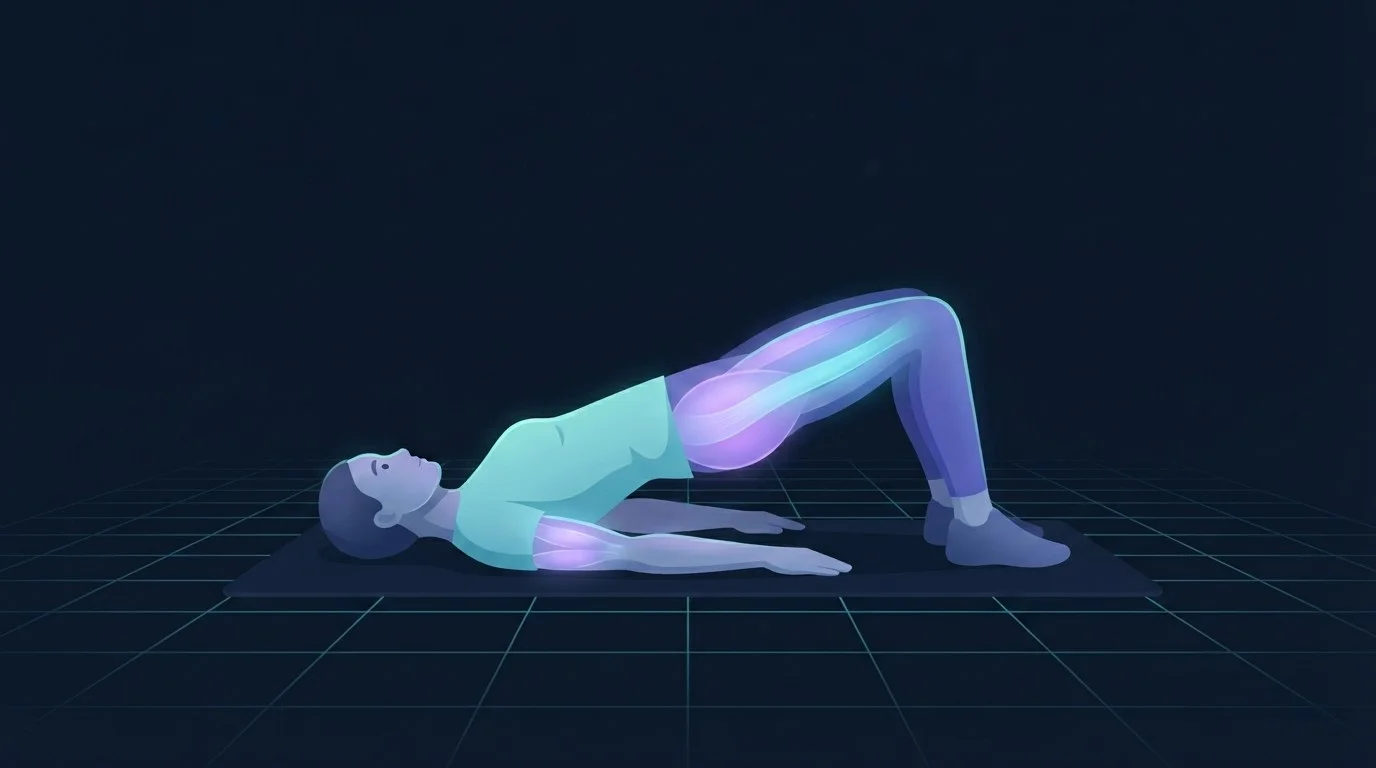
2. Glute bridges
Feet flat, heels close, tilt the pelvis slightly toward your ribs before you lift so the glutes fire ahead of the lower back, then drive up until knees, hips and shoulders form a line. Pause for two seconds at the top of every rep. Our glute bridges page has the full setup.
Dosing: 1 to 2 sets of 12 to 15, two-second pause at the top.
3. Single-leg glute bridges
Same setup, one leg extended. This is where the imaging data puts the best gluteus medius return of the floor drills, because your pelvis now has to resist dropping on the unsupported side.
Dosing: 1 to 2 sets of 8 to 10 per side. Stop the set when the hip starts sagging.
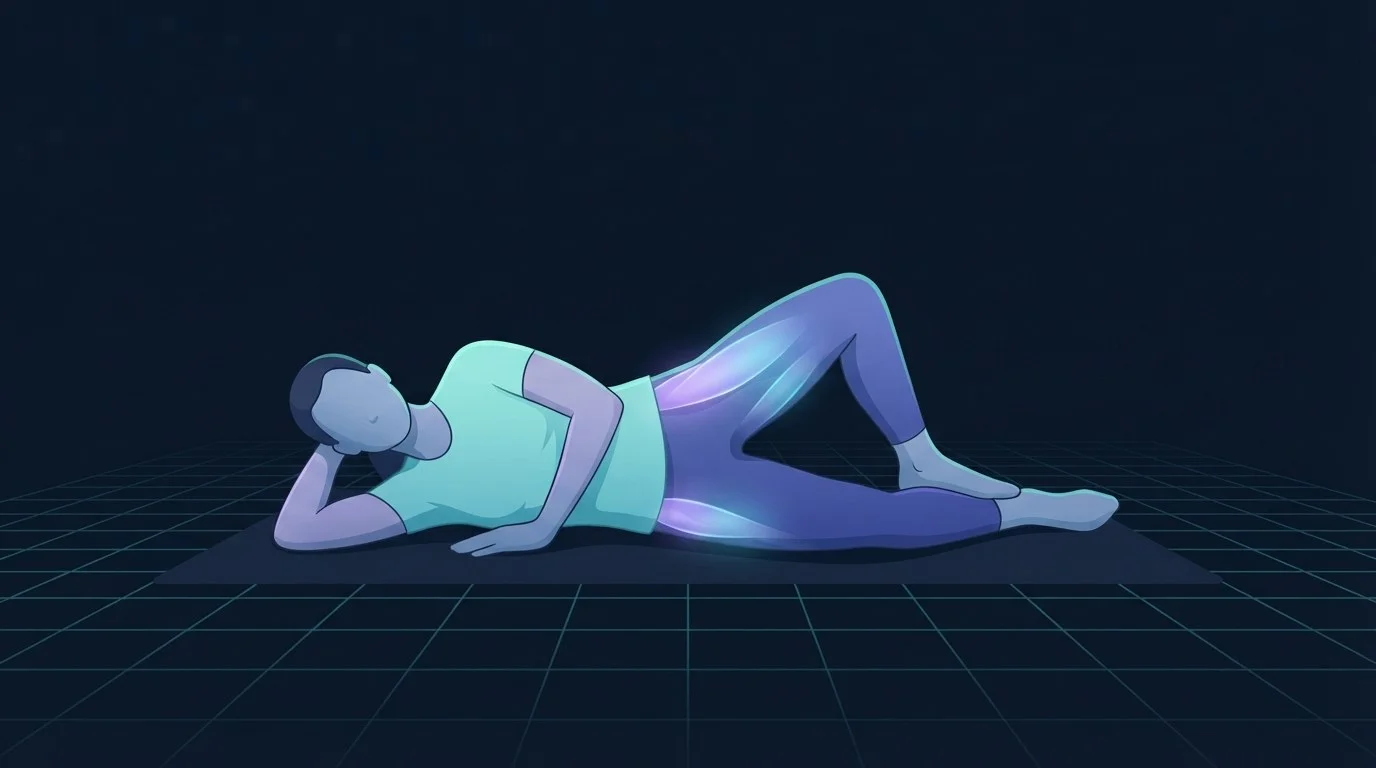
4. Side-lying hip abduction
On your side, bottom knee bent, top leg straight and a few degrees behind the line of your body, lift to about 40 degrees without rolling the pelvis backward. Distefano's pick for the gluteus medius, and adding a little external rotation at the top is what recruited the deeper muscles in the 2026 imaging study.
Dosing: 1 to 2 sets of 12 to 15 per side, three seconds up and three seconds down.
5. Clamshells
Side-lying, hips and knees bent, heels together, open the top knee while the pelvis stays stacked. If your lower back arches or your torso rolls, you've gone past your available range. See our clamshells page for the pelvis cue that makes the difference.
Dosing: 1 to 2 sets of 15 per side, controlled.
6. Lateral band walks
The one optional piece of equipment. A 2025 narrative review by González-de-la-Flor pulled together the band-walk literature and reported moderate to high gluteus medius and maximus activation, with two conditions attached: the band sits at the ankles or the forefeet rather than above the knees, and you stay in a semi-squat rather than standing tall. Both details reduce how much the tensor fasciae latae takes over. No band? Side-lying abduction covers the same muscle from the floor.
Dosing: 2 sets of 10 steps each direction, in a quarter-squat.
7. Bird dogs
On all fours, extend the opposite arm and leg while keeping the pelvis level and the lower back still. This one is on the list for a different reason from the rest: it trains hip extension without letting the lumbar spine supply the range, which is exactly the compensation people bring to bridges and lunges. Our bird dogs page covers the balance setup.
Dosing: 1 set of 8 per side, holding two seconds at full extension.
Find out what's really holding you back
FitCraft, our mobile fitness app, pairs you with an AI coach who builds you a personalized plan around your goals, schedule, and fitness level. Every FitCraft program is designed by Domenic Angelino, MPH (Brown University) and NSCA-CSCS, with research published in the Journal of Strength and Conditioning Research and Medicine & Science in Sports & Exercise.
Take the Free Assessment Free • 2 minutes • No credit cardThe Five-Minute Warm-Up, by Session Type
Pick two or three drills, not seven. The selection changes with what you're about to do, because the demand changes.
| Before | Drills | Why these |
|---|---|---|
| Squats and deadlifts | Glute squeeze, glute bridges, lateral band walks | Loads hip extension first so the quads and lower back don't lead the first working set |
| Lunges and split squats | Single-leg bridges, side-lying abduction, bird dogs | A split stance is a frontal-plane problem, so the stabiliser needs waking before the pattern starts |
| Running | Glute squeeze, side-lying abduction, lateral band walks | Running is thousands of single-leg landings, and the medius is the muscle keeping the pelvis level on each one |
| Desk-bound day, no training | Glute squeeze, bird dogs, clamshells | Two minutes of hip extension breaks up the shape a chair holds you in |
Two rules. Keep it under five minutes, and finish feeling warm rather than worked. If your glutes are burning before your first set, the warm-up has eaten part of the workout, and the set you cared about will be worse for it.
Slowing down helps more than adding reps here. A pause at the top of each rep, a hand on the muscle, and your attention on the contraction rather than the count is most of what makes these drills do anything, which is the mind-muscle connection in its most literal form.
Does an Activation Warm-Up Actually Improve Performance?
Here is where the honest answer is more interesting than the marketing one, because the two best studies point in different directions and both are probably right.
On the yes side: Crow and colleagues (2012) had 22 elite Australian Rules footballers perform three warm-up conditions in randomised order, then measured countermovement jump peak power within five minutes. The low-load gluteal protocol produced significantly greater peak power than both the no-warm-up condition and a whole-body vibration protocol. The authors were careful to note the mechanism was unclear.
On the complicated side: Parr, Price and Cleather (2017) in BMJ Open Sport and Exercise Medicine ran 17 professional rugby union players through high hang pulls at 80 percent of their one-rep max after a control warm-up and after a gluteal activation warm-up, with electromyography plus force plate and motion capture. Peak gluteus maximus electrical activity was significantly lower after the activation warm-up. Their interpretation is that the same or greater force was being produced with less neural drive, which is efficiency rather than failure. It's also a direct contradiction of how these drills are usually sold: they don't make the muscle fire harder.
And on the sobering side: Willy and Davis (2011) randomised 20 female runners with excessive hip adduction to six weeks of hip abductor and external rotator strengthening plus movement retraining, or to no intervention. Hip abductor and external rotation strength rose significantly, and single-leg squat mechanics improved. Running mechanics didn't change. Six weeks of real strengthening, in the population most likely to benefit, moved the strength number and left the gait alone.
So: worth five minutes, plausibly useful for power output and for how connected you feel, and not a mechanism for rewriting movement patterns. That's a genuinely useful thing to be. It just isn't everything the term implies.
Activation Is Not Strength Training
This is the part that decides whether these drills help you or waste your training time. Activation work is deliberately sub-maximal. Low load, low fatigue, high quality. Muscle grows in response to hard sets taken near the limit, and a set of 15 easy clamshells isn't that, by design.
Which means the warm-up buys you nothing unless something loaded follows it. Bridges progress to single-leg bridges and then to hip thrusts. Bodyweight squats progress to goblet squats and split squats. Side-lying abduction is the appetiser for single-leg work, and our review of the research on single-leg training covers why unilateral loading earns its place.
For the loaded half of the plan, our roundup of the best glute exercises at home lays out twelve bodyweight moves as a progression from activation through bridges and lunge patterns to single-leg work, along with the honest limits of bodyweight training and when adding load becomes the more efficient path. This page is the five minutes before that one. When bodyweight stops producing change, a couple of adjustable dumbbells and a plan that tracks the load is the next step, which is most of what a dumbbell workout app is for.
What to Expect in the First Month
Week one is mostly sensation. You will notice the bridge in your glutes rather than your hamstrings, and the single-leg version will be harder than you expected. That's not a fitness change yet, it's a feedback change.
Weeks two and three are where the single-leg stand starts looking steadier and the first working set of squats stops feeling like an all-quad affair. The self-test is worth re-running here, particularly the single-leg stand, because it's the most visible of the three.
Weeks four onward, the drills stop being the interesting part. If they still feel hard by week six, the loaded work isn't progressing and that's the thing to fix. Activation drills are supposed to become easy. That's the signal they have done their job.
If deep buttock pain rather than weakness is what brought you here, and it worsens the longer you sit, that's a different presentation with a different plan. Our guide to the piriformis stretch covers the deep rotators, the self-check and the red flags.
The Bottom Line
Two or three drills, five minutes, slow reps, before you squat, lunge or run. Glute squeeze and bridges for the hip extensor, side-lying abduction or band walks for the stabiliser, bird dogs to stop the lower back stealing the range. Expect a better connection to the muscle and possibly a little more power. Don't expect your gait to change or your glutes to grow from this alone.
And drop the amnesia framing. Your glutes aren't asleep, they're under-used, which is a much more fixable problem and a much less mysterious one.
Frequently Asked Questions
Is gluteal amnesia real?
The nickname isn't a clinical diagnosis and barely appears in the biomedical literature. The underlying phenomenon is real but narrower than the slogan. Freeman, Mascia and McGill showed in 2013 that injecting fluid into the hip joint reduced gluteus maximus activity during bridging and hip extension, which is arthrogenic inhibition, and Glaviano and Norte measured a gluteus maximus central activation ratio of 84 percent in women with patellofemoral pain in 2022. So a painful or irritated hip can genuinely damp gluteal drive. Sitting at a desk all week isn't the same thing as that, and no study shows it switches your glutes off.
Do glute activation exercises actually work?
They work for one measurable thing and are unproven for another. Crow and colleagues found in 2012 that a set of low-load gluteal drills raised countermovement jump peak power in 22 elite footballers more than a whole-body vibration warm-up or no warm-up at all. But Parr, Price and Cleather found in 2017 that after a gluteal activation warm-up, peak gluteus maximus electrical activity during a heavy high hang pull was significantly lower, not higher. Activation drills appear to change how efficiently the muscle is recruited, which isn't the same as making it fire harder.
How long should a glute activation warm-up be?
Five minutes, and it should leave you feeling warm rather than fatigued. Two or three drills, 10 to 15 slow reps per side, one or two rounds. Load stays low on purpose, because the point is quality of contraction rather than accumulated work. If your glutes are burning before the first working set, you've turned the warm-up into the workout and you'll squat worse for it.
What is the best glute activation exercise?
For the gluteus medius, side-lying hip abduction. Distefano and colleagues tested 12 exercises in 2009 and concluded it was the single best drill for that muscle. For the gluteus maximus at low load, the plain standing glute squeeze is surprisingly strong: Boren and colleagues recorded it at 81 percent of maximum voluntary contraction in 2011, which is remarkable for a movement with no movement. Neither one builds much muscle on its own. That isn't their job.
Can you really not feel your glutes working?
Yes, and it's usually a sensation problem rather than a muscle problem. The glutes sit behind you, they're covered by a thick fat pad, and you get very little visual feedback from them. Most people who say they can't feel their glutes can produce a strong contraction the moment someone taps the muscle and tells them to squeeze. Activation drills mostly fix the feedback loop, which is why they work fastest when you slow down, pause at the top of each rep, and put a hand on the muscle.
Should you do glute activation before running?
It is a reasonable five minutes and an honest expectation matters. Willy and Davis randomised female runners with excessive hip adduction to six weeks of hip abductor and external rotator strengthening plus movement retraining in 2011. Hip strength rose significantly and single-leg squat mechanics improved, but running mechanics didn't change. Warming up the hips before a run is cheap and probably helps you feel more stable. Expecting it to rewrite your gait is asking more than the evidence supports.