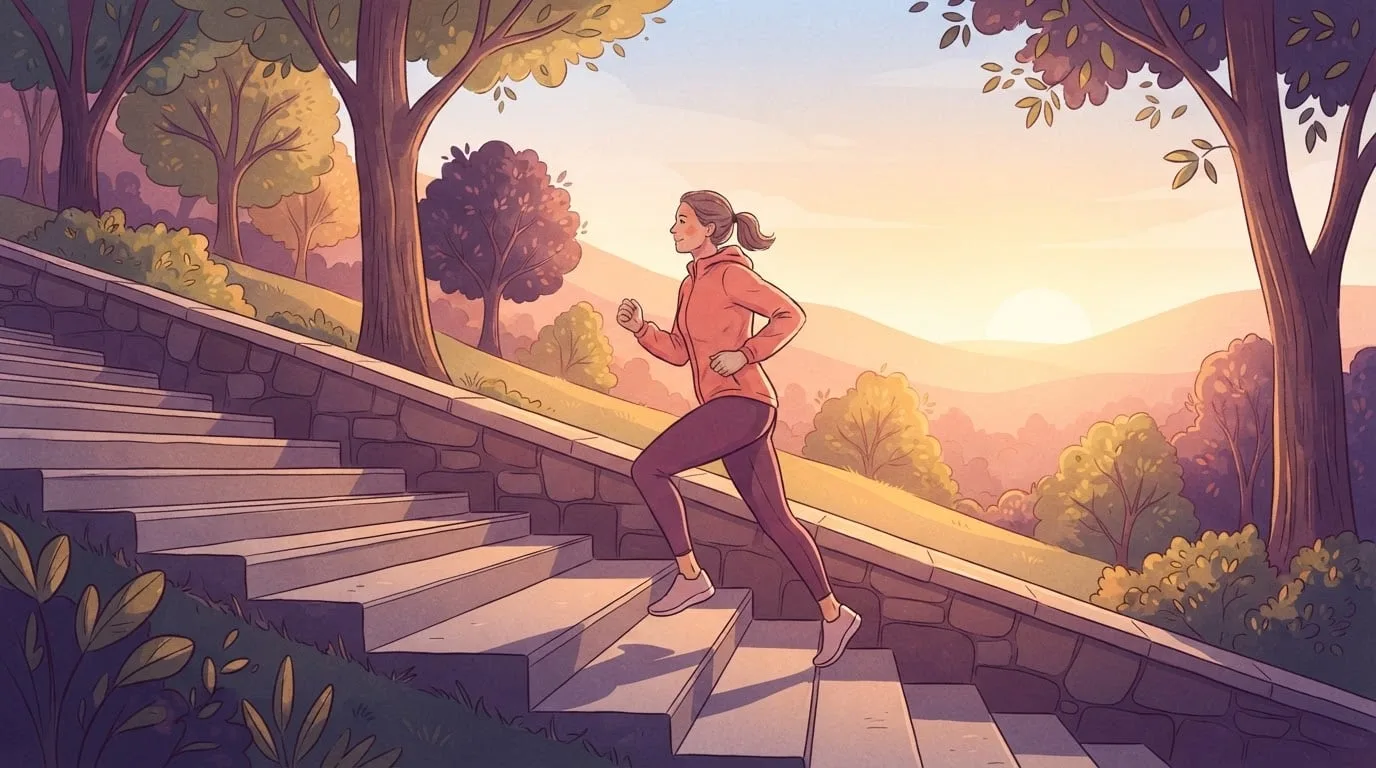
What is the biggest muscle in the body? Most answers stop at the gluteus maximus, and they're right. The numbers behind that answer are more useful than the name, though, and second place goes to a muscle most people have never heard of.
If your workouts have felt like a long list of small exercises with little to show for them, this is worth knowing. A large share of your muscle sits around your hips and thighs, so a few big lower-body moves can do more for you than an hour of small ones.
Our main page on how many muscles are in the human body covers the total count and how much of your weight is muscle, and our page on the strongest muscle in the human body covers force. This page sticks to size: volume, mass, length and width, from the largest muscle down to the smallest, and how to train the biggest ones with body weight and dumbbells.
What Is the Largest Muscle in the Body?
The largest muscle in the body is the gluteus maximus, the outer muscle of each buttock. The largest single measurement comes from Whitcher and colleagues (2026), who ran automated muscle measurement on 10,840 UK Biobank MRI scans of adults with a mean age of 65. Here are the ten largest hip and thigh muscles, ranked by the men's volumes, with left and right added together:
| Rank | Muscle | Men (ml) | Women (ml) |
|---|---|---|---|
| 1 | Gluteus maximus | 1,914 | 1,427 |
| 2 | Adductor magnus | 1,346 | 903 |
| 3 | Vastus lateralis (quadriceps) | 1,095 | 745 |
| 4 | Vastus intermedius (quadriceps) | 966 | 653 |
| 5 | Vastus medialis (quadriceps) | 798 | 566 |
| 6 | Gluteus medius | 750 | 573 |
| 7 | Biceps femoris (hamstring) | 655 | 462 |
| 8 | Semimembranosus (hamstring) | 503 | 359 |
| 9 | Rectus femoris (quadriceps) | 469 | 331 |
| 10 | Semitendinosus (hamstring) | 338 | 239 |
At the usual muscle density of about 1.06 g per ml, that puts a gluteus maximus pair at about 2.0 kg (4.5 lb) in men and 1.5 kg (3.3 lb) in women. It makes up about 18 percent of all the muscle volume the study measured around the hips and thighs.
The surprise is number two. The adductor magnus runs down the inside of your thigh, and it's bigger than any single part of your quadriceps. The order was nearly the same in both sexes. In women, the gluteus medius edged past the vastus medialis.
Gluteus Maximus or Quadriceps? It Depends How You Group Muscles
The answer changes as soon as you count groups. Anatomists usually treat the quadriceps as four muscles, which keeps the gluteus maximus on top. The name means four-headed, though, and some references describe one muscle with four heads. Count it that way and the quadriceps win easily:
| Muscle group (both sides) | Muscles added | Men (ml) | Women (ml) |
|---|---|---|---|
| Quadriceps | 4 | 3,328 | 2,295 |
| Gluteals | 3 | 2,863 | 2,152 |
| Adductors | 5 | 2,144 | 1,506 |
| Hamstrings | 3 | 1,496 | 1,060 |
Those are our sums from the study's table. The quadriceps come out about 1.6 to 1.7 times the size of the gluteus maximus. In women, the three gluteal muscles together come within about 6 percent of the quadriceps.
What cadaver and other MRI data show
Other methods land in the same place. Ward and colleagues (2009) weighed muscles from 21 cadaver legs: the gluteus maximus came to 547 g per leg, the vastus lateralis 376 g and all four quadriceps together 898 g. Son and colleagues (2024) found the same order at the top in 34 legs, with the gluteus maximus first at 576 g, then the vastus lateralis, adductor magnus and soleus.
Age and method move the numbers a lot. Handsfield and colleagues (2014) scanned 24 young adults, and the eight women averaged 747 ml per side for the gluteus maximus, according to the comparison table in Montefiori and colleagues (2020). The 11 older women in that second study averaged 576 ml. The vastus lateralis ran close behind in the young women, at 699 ml per side.
Does the biggest muscle mean the strongest?
No. A muscle's size tells you how much tissue it has, while its force depends on how many fibers pull side by side. The gluteus maximus has long fibers, about 15.7 cm in Ward's data, so the much smaller soleus in your calf out-pulls it. Our page on the strongest muscle has that ranking.
Why Is the Gluteus Maximus So Big?
Everyday walking doesn't explain it. Lieberman and colleagues (2006) recorded the muscle's activity and found it largely inactive during level and uphill walking, then much more active in running, where it helps keep the trunk from pitching forward and slows the swinging leg. They proposed that its growth mattered for the evolution of human running.
Bartlett and colleagues (2014) added sprinting and climbing to the comparison and read the result more broadly: its large size reflects many rapid, powerful movements rather than one adaptation for distance running. For you, that means your biggest muscle does its real work when you stand up from low, climb, jump or accelerate. Ordinary strolling leaves most of it unused, which our review of dead butt syndrome looks at more closely.
Knowing what to do is the easy part.
FitCraft, our mobile fitness app, pairs you with an AI coach who builds you a personalized plan around your goals, schedule, and fitness level. Every FitCraft program is designed by Domenic Angelino, MPH (Brown University) and NSCA-CSCS, with research published in the Journal of Strength and Conditioning Research and Medicine & Science in Sports & Exercise.
Take the Free Assessment Free • 2 minutes • No credit cardThe Longest and Widest Muscles, and the Biggest in the Upper Body
Volume isn't the only way to size a muscle. These are the other records:
| Record | Muscle | Where it is | The measurement |
|---|---|---|---|
| Longest | Sartorius | Across the front of the thigh, hip to inner knee | Fibers about 40.3 cm long, but only 79 g |
| Widest | Latissimus dorsi | Lower spine and pelvis to the upper arm | Among the largest by surface area, fascicles about 26.6 cm long, about 170 g |
| Biggest in the upper body | Deltoid | Cap of the shoulder | 15.2 percent of arm and shoulder muscle volume |
The sartorius figures come from Ward's dissections. Its fibers run nearly its whole length, so it's built for range of motion, with a cross-section of just 1.9 cm². The latissimus dorsi is the classic example of a big-looking muscle that's fairly light. Gerling and Brown (2013) describe it as thin and fan-shaped, and their 12 cadaver muscles weighed less than a third of a gluteus maximus.
For the upper limb, Holzbaur and colleagues (2007) measured 32 muscles by MRI in 10 young adults. Total volume per limb ran from 1,427 to 4,426 ml, so the deltoid works out at about 220 to 670 ml on one side. A gluteus maximus in the UK scans averaged about 710 to 960 ml on one side, even with an average age of 65. We couldn't find a single study that ranks every muscle in the body in the same people, so the top spot rests on these comparisons.
What Is the Smallest Muscle in the Human Body?
The smallest muscle in the human body is the stapedius, which sits in the middle ear and attaches to the stapes, the tiny bone that passes sound to the inner ear. In a microCT study of 16 temporal bones, Wojciechowski and colleagues (2020) measured its belly at 2.98 mm on average, with a range of 2.19 to 4.01 mm. Beger and colleagues (2020) dissected 10 cadavers and put the entire muscle at 4.80 mm.
It has a real job. When a sound is loud, a reflex tightens the stapedius and limits how far the stapes can move, which helps protect the inner ear. Rönnblom and colleagues (2023) analyzed eight of these muscles and found 79 percent of the fibers were the fast type, which suits a muscle that has to react quickly. For scale, a single gluteus maximus fiber is about 50 times longer than the belly of the stapedius.

How to Train the Biggest Muscles With Bodyweight and Dumbbells
Depth matters most for the two biggest muscles. Kubo and colleagues (2019) had 17 men train with either full squats or half squats twice a week for 10 weeks, and measured the results with MRI. That study used a heavier loaded squat than most home setups allow, but the depth lesson carries over to a goblet squat:
- Gluteus maximus: up 6.7 percent with full squats and 2.2 percent with half squats.
- Adductors: up 6.2 percent with full squats and 2.7 percent with half squats.
- Knee extensors: up 4.9 and 4.6 percent, about the same either way.
So a deep squat trains the top two muscles on the list, and half squats short-change them. Stepping up works too. In a systematic review by Krause Neto and colleagues (2020), step-ups and their variations produced the highest gluteus maximus activation of the loaded exercises compared, though the spread between studies was wide and activation doesn't guarantee growth.
Here's a routine for two days a week:
| Exercise | Sets and reps | Biggest muscles trained | No-equipment version |
|---|---|---|---|
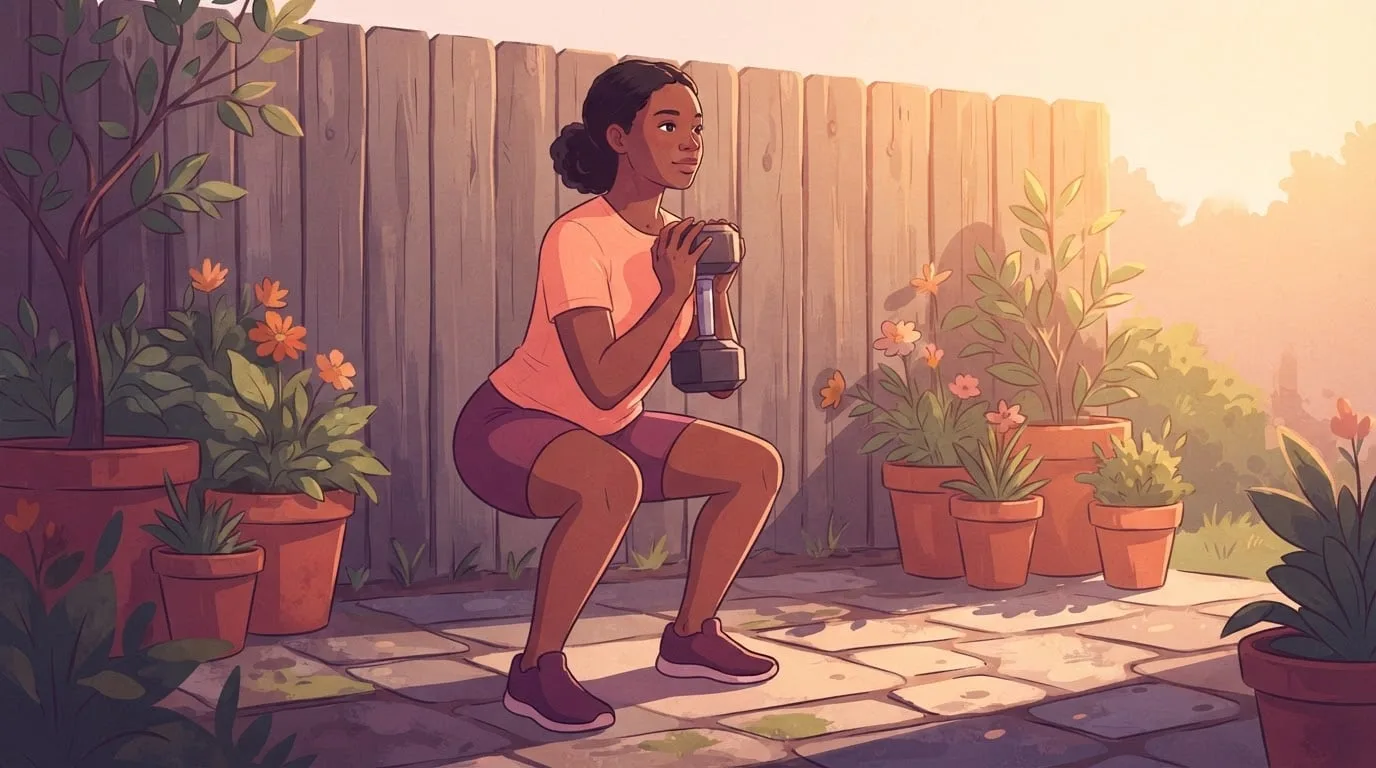
| Goblet squat, as deep as you control | 3 x 8 to 12 | Gluteus maximus, adductor magnus, quadriceps | Bodyweight squat, 3 seconds down |
| Dumbbell step-up | 3 x 8 to 10 per leg | Gluteus maximus, quadriceps | Step-up on a sturdy stair, slow on the way down |
| Dumbbell Romanian deadlift | 3 x 8 to 12 | Gluteus maximus, adductor magnus, hamstrings | One-leg hinge, reaching toward the floor |
| Side lunge | 2 x 8 to 10 per side | Adductors, gluteus medius | Same move with no weight |
Legs outgrow body weight fast, so make each set harder as you adapt: lower more slowly, pause at the bottom or move to one leg. Our guide to growing your glutes has a full plan for the three gluteal muscles, and our leg day workout builds this into a complete session.
What the Size Ranking Means for You
You don't need much to train your biggest muscles. Two short sessions a week of deep squats, step-ups and hinges cover most of the muscle in your lower body, and a staircase or a single dumbbell is enough to start. Those same muscles carry you up stairs and out of chairs for the rest of your life, so they're worth keeping.
What usually stops people is the middle stretch, when the first excitement has worn off and the results haven't shown up yet. A home workout app that needs no equipment can make those weeks easier. In FitCraft, a 3D AI coach demonstrates each exercise on an interactive model you can zoom in on and says your name during the workout, while streaks and collectible cards reward you for showing up. As one FitCraft user, Katie, put it: "I've tried everything. This is the first time I've stuck with something past two weeks."
Frequently Asked Questions
What are the top 3 largest muscles in the body?
The top 3 largest single muscles measured by MRI are the gluteus maximus, the adductor magnus and the vastus lateralis, all around the hip and thigh. People who ask about the big 3 muscles usually mean the groups those belong to: the glutes, the inner thigh and the quadriceps.
What is the biggest muscle in the body for women?
The gluteus maximus is the biggest muscle in women too. In MRI scans of UK adults, it averaged 1,427 ml for the pair in women and 1,914 ml in men, and nearly every muscle kept the same rank.
Does walking strengthen your glutes?
Only a little. The gluteus maximus stayed largely inactive during level and uphill walking in a study of its role in gait, and it works much harder when you run, sprint or climb. For real strength gains, add stairs, step-ups or loaded squats.
Does muscle weigh more than fat?
A pound of each weighs the same, but muscle is denser, at about 1.06 g per ml against about 0.9 g per ml for fat. The same weight of muscle takes up less space, so your shape can change while the scale holds still. Our review of the density data has the details.
Which muscle never gets tired?
That title goes to your heart, not your biggest muscle. The gluteus maximus tires like any other skeletal muscle. Our page on the strongest muscle in the human body explains why the heart keeps going.