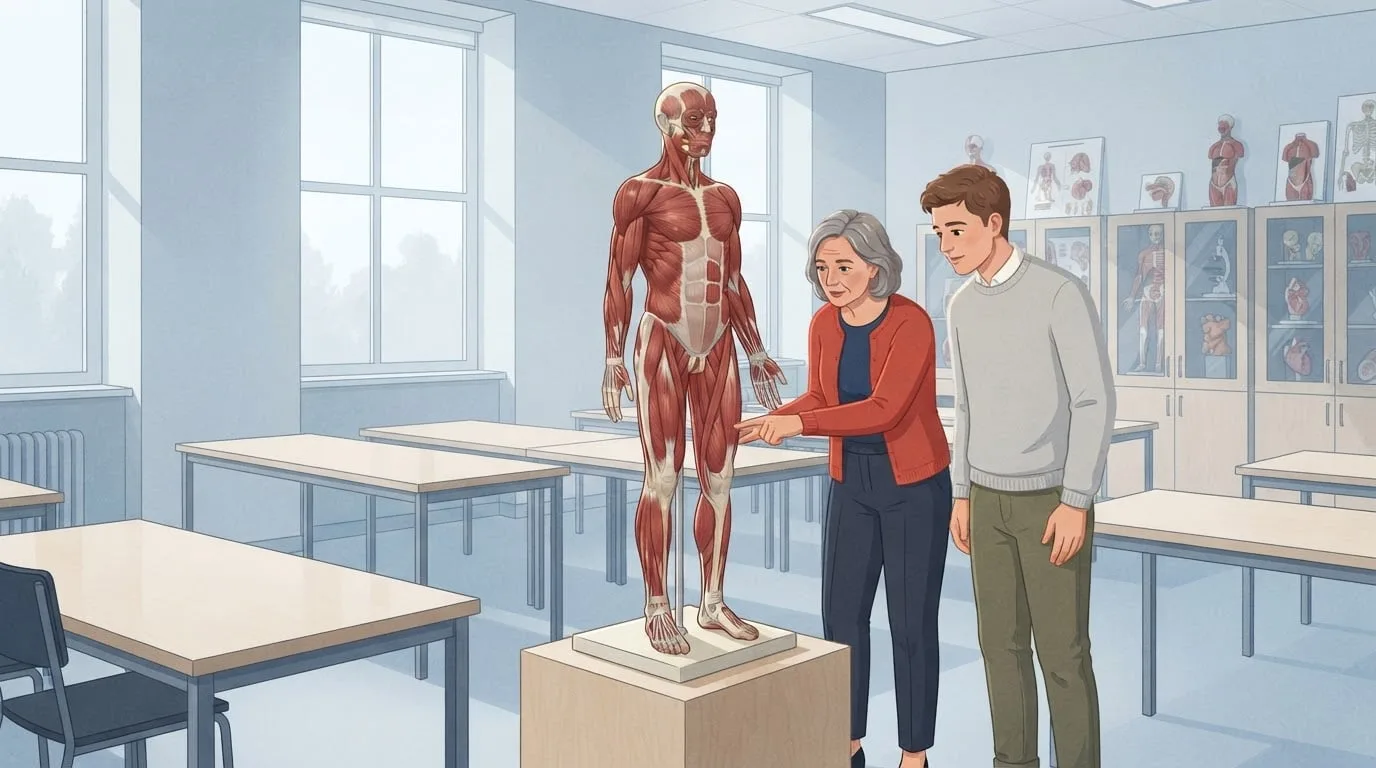
Ask how many muscles are in the human body and you'll get a different answer from almost every source: 600, 650, 700 or even 750. The disagreement is real. Deciding where one skeletal muscle ends and the next begins is partly a judgment call, and there's no definitive list.
That's a fun fact until you're looking at a chart of hundreds of Latin names and wondering how anyone could train all of it. If anatomy has ever made working out feel like a subject you'd have to study first, you're in good company. Muscles work in teams, so a handful of exercises can reach nearly all of them, and you never need to learn a single name.
This page covers why the count changes, the three types of muscle tissue, how much of your body weight is muscle by sex and age, what the major muscle groups do, and how little it takes to train them.
How Many Skeletal Muscles Are in the Human Body?
The human body has more than 600 skeletal muscles, which is the figure the National Cancer Institute's anatomy training modules use. No single list is official. The editors of Wikipedia's table of skeletal muscles, who tallied every row, say there doesn't appear to be a definitive source. Higher totals come from counting more generously:
| Total | What's being counted | Source |
|---|---|---|
| More than 600 | The standard reference figure | National Cancer Institute |
| About 700 | Named skeletal muscles in an anatomy textbook | Tortora and Grabowski (1996), cited by PainScience |
| About 753 | Every copy of 249 named muscles, in one public table | Wikipedia's tally |
The gap comes down to whether anatomists treat a structure as one muscle with several parts or as several muscles. So a count near 600 and a count above 750 can describe the same body.
Why the count changes: pairs, heads and tendons
Three counting choices explain most of the spread:
- Pairs. Most skeletal muscles come as a left and a right copy, and some repeat along the spine or ribs. That's how Wikipedia's 249 names become about 753 muscles.
- Heads. A muscle can start from two or more points, called heads. The biceps has two and the triceps three, and each still counts as one muscle. The four parts of the quadriceps count as four muscles, even though they share a tendon at the knee.
- Tendons and parts. The deep finger flexor in your forearm sends a tendon to each of four fingers and counts once. Anatomy's official vocabulary, Terminologia Anatomica, goes the other way and gives some muscles several entries, so Wikipedia's 289 rows match 337 official entries.
The boundaries are still being argued. In 2022, Mezey and colleagues dissected 12 cadaver heads and proposed a new name for a deep third layer of the masseter, your main chewing muscle. A reply in the same journal pointed out that 18th-century anatomists had already described it.
Not everyone has the same set of muscles
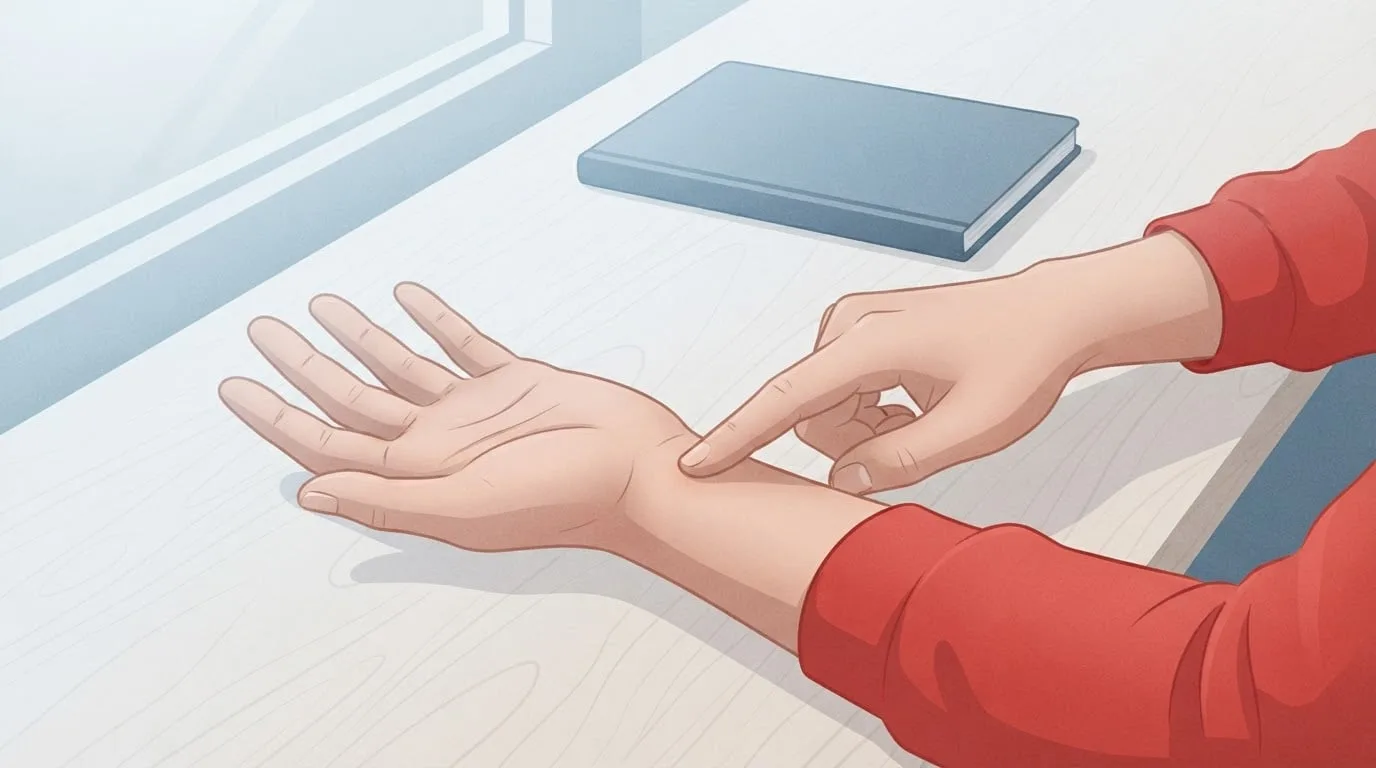
Even a perfect count would only describe an average body. The palmaris longus, a thin forearm muscle, is missing in about 20 percent of people in a meta-analysis by Yammine (2013), ranging from 4.5 percent in East Asian groups to 41.7 percent in Arab Middle Eastern groups. The psoas minor, a small muscle that runs down the front of the lower spine, appears in only about 33 to 52 percent of people, according to a 2017 review of its variants.
You can check for your own palmaris longus. Press your thumb and little finger together and bend your wrist slightly. If no thin cord stands out in the middle of your wrist, you may not have one. Most people never notice.
What Are the Different Types of Muscle Tissue?
There are three types of muscle tissue: skeletal, cardiac and smooth. Only skeletal muscle appears in those 600-plus counts, and it's the only type you can contract on purpose.
| Type | Where it is | Control | How many | Can you train it? |
|---|---|---|---|---|
| Skeletal | Mostly attached to bones by tendons | Voluntary | More than 600 | Yes, directly |
| Cardiac | The wall of the heart | Automatic | One organ | Yes, through aerobic exercise |
| Smooth | Walls of blood vessels, gut, airways, bladder and uterus | Automatic | Too many to count | No exercise targets it |
Skeletal muscle is what most people mean by muscle. It moves your bones, its fibers look striped under a microscope, and you can flex it at will. A few skeletal muscles also run on autopilot. Your diaphragm keeps you breathing while you sleep, and it still responds to training, as our review of inspiratory muscle training shows.
Cardiac muscle is the striped, involuntary muscle of the heart wall. You can't flex it, but you can change it. In a randomized trial by Spence and colleagues (2011), 24 weeks of endurance training raised left ventricle mass in young untrained men from 112.5 to 121.8 g, while the change after resistance training wasn't significant. That's one reason aerobic fitness sits alongside strength among the 5 components of fitness.
Smooth muscle moves blood, food and air through your body with no input from you. It forms sheets and rings around hollow organs, so it has no list of named muscles to count.
Knowing what to do is the easy part.
FitCraft, our mobile fitness app, pairs you with an AI coach who builds you a personalized plan around your goals, schedule, and fitness level. Every FitCraft program is designed by Domenic Angelino, MPH (Brown University) and NSCA-CSCS, with research published in the Journal of Strength and Conditioning Research and Medicine & Science in Sports & Exercise.
Take the Free Assessment Free • 2 minutes • No credit cardHow Much of Your Body Weight Is Muscle?
Skeletal muscle makes up about 38 percent of body weight in men and about 31 percent in women, on average. Those figures come from one of the largest direct measurements available: Janssen and colleagues (2000) scanned 468 adults aged 18 to 88 with whole-body MRI. The familiar line that muscle is about 40 percent of your weight, which is also the National Cancer Institute's figure, sits close to the male average and well above the female one.
| Measured by whole-body MRI | Men | Women |
|---|---|---|
| Skeletal muscle mass | 33.0 kg (73 lb) | 21.0 kg (46 lb) |
| Share of body weight | 38.4 percent | 30.6 percent |
The gap between the sexes was wider in the upper body, at about 40 percent, than in the lower body, at about 33 percent.
How muscle changes with age
In Janssen's data, muscle began falling as a share of body weight in people's 20s, but absolute muscle mass didn't drop noticeably until around age 50, and most of that loss came from the lower body.
Large DXA studies show a similar plateau. DXA can't isolate muscle, so researchers use lean tissue in the arms and legs as a stand-in. Kim and colleagues (2002) showed in 321 adults that this measure predicts MRI-measured whole-body muscle closely (R² of 0.96). Wang and colleagues (2024) then charted it by age in 17,203 people in China and 12,663 people in the US. In the Chinese group, median arm and leg muscle barely moved between 20 and 60: from 23.8 to 23.0 kg in men and from 15.5 to 15.4 kg in women. Leg muscle started falling at 49, while arm muscle held up past 50. The US participants peaked later and at higher values.
The real slide comes later. A quantitative review by Mitchell and colleagues (2012) found median losses of about 0.47 percent a year in men and 0.37 percent in women across cross-sectional studies, and estimated that most people over 70 have about 80 percent of the muscle they had at 20 to 30.
One caution if you've had a body composition scan: DXA "lean mass" also includes organs, skin and water. Wang's whole-body figure for young Chinese men was 54.3 kg, far above the 33.0 kg of skeletal muscle that MRI found in Janssen's men.
The Major Muscle Groups and What Each One Does
The CDC's guidelines for adults name seven major muscle groups: legs, hips, back, abdomen, chest, shoulders and arms. If you're asking how many main muscles are in the human body, that's the most useful answer.
| Group | Main muscles | What they do | One home exercise |
|---|---|---|---|
| Legs | Quadriceps, hamstrings, calves | Straighten and bend the knee, push you off the ground | Goblet squat |
| Hips | Gluteus maximus and medius, adductors, hip flexors | Stand you up from a chair, steady the pelvis on one leg | Dumbbell Romanian deadlift |
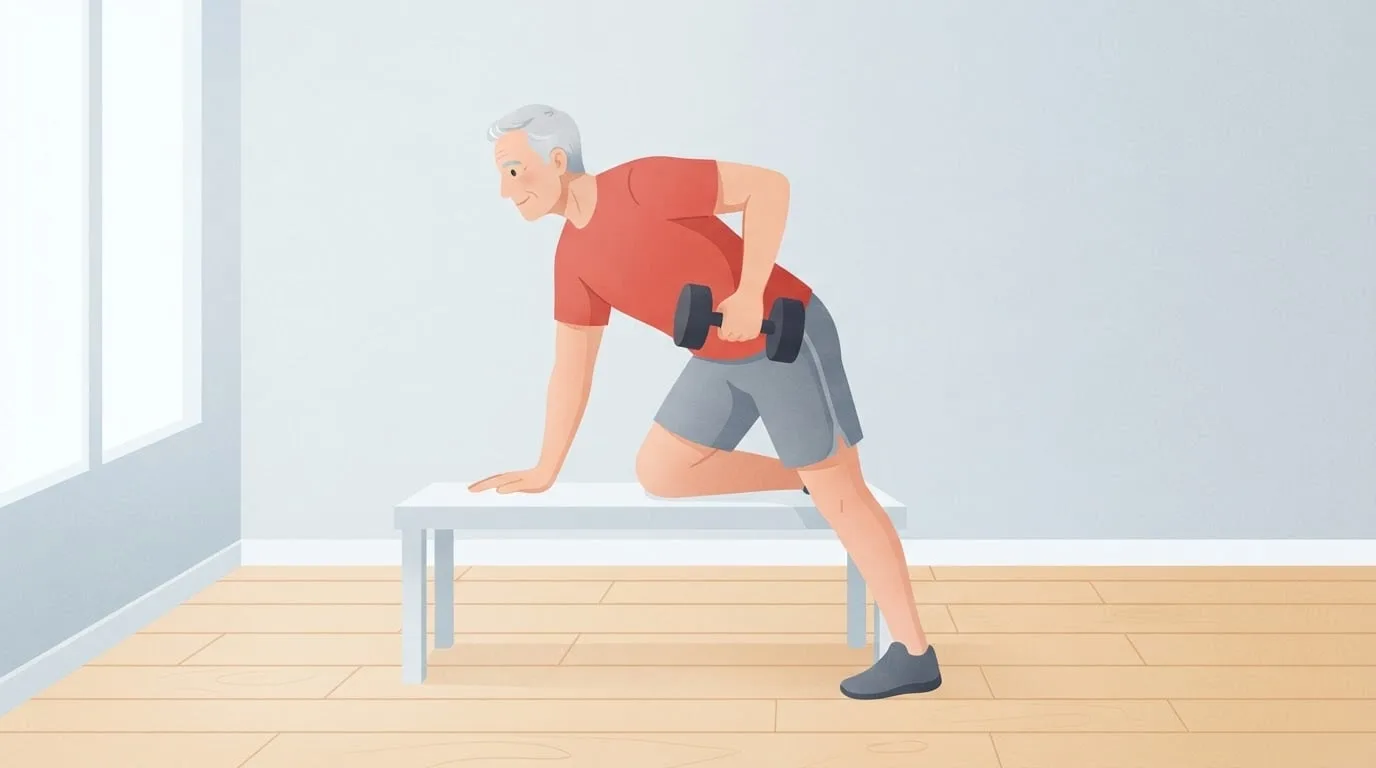
| Back | Latissimus dorsi, trapezius, rhomboids, erector spinae | Pull your arms down and back, hold your spine upright | One-arm dumbbell row |
| Abdomen | Rectus abdominis, obliques, transverse abdominis | Brace, bend and rotate your trunk | Plank |
| Chest | Pectoralis major and minor | Push your arms forward and across your body | Push-up |
| Shoulders | Deltoids, rotator cuff | Lift your arms, keep the shoulder joint steady | Dumbbell shoulder press |
| Arms | Biceps, triceps, forearm muscles | Bend and straighten your elbow, grip | Trained by the row and the push-up |
Two follow-up questions come up all the time. Our pages on the biggest muscle in the body and the strongest muscle in the human body rank these muscles by size and by force, and the winners are different.
How Many Muscles Do You Need to Train?
You can train almost all of your 600-plus skeletal muscles, and you'll reach most of them without aiming at any one in particular. Compound exercises move more than one joint, so every rep loads several groups at once, and the small muscles around each joint work to hold things steady.
The trials back this up. Gentil and colleagues (2015) split 29 untrained young men into two groups for 10 weeks. Both did the same leg and chest work, and then one group added lat pulldowns while the other added biceps curls. Elbow flexor thickness rose 6.10 percent with pulldowns and 5.83 percent with curls, and strength rose 10.40 and 11.87 percent. The difference wasn't significant, so a pulling exercise for the back trained the arms just as well.
Paoli and colleagues (2017) went further and matched total work across a compound program and an isolation program in 36 young men. After 8 weeks, squat strength was up 13.8 percent with compound lifts and 8.3 percent with isolation work, and aerobic fitness was up 12.5 and 5.1 percent, though the groups used different rep ranges, so exercise choice may not explain the whole gap. Body composition changed about the same in both.
That's why the six exercises in the table can cover all seven groups. Two or three full-body sessions a week is a solid start: 2 to 3 sets of 8 to 12 reps of each exercise, stopping a rep or two short of failure, plus planks of 20 to 40 seconds. Our full-body dumbbell workout lays out a session you can follow, and how muscles grow explains why the sets need to be hard. Isolation work earns its place when you want one muscle bigger than the rest, and our guide to isolation vs compound exercises shows how to add it.
What This Means for You
You don't need to memorize 600 names. The exact count is a question for anatomists, and the answer changes with who's counting. Your results depend on something simpler: train the seven major groups at least two days a week, and keep doing it long enough for the changes to add up.
That last part is where most plans fall apart. You start strong, miss a week, and the gap keeps growing. Picture six months from now instead: the six moves feel familiar, the dumbbells you started with feel light, and two or three sessions are just part of your week. You've also built a reserve for the slow muscle loss that starts around 50.
A personalized training program takes the planning off your hands. In FitCraft, a 3D AI coach demonstrates each exercise on an interactive model you can zoom in on, says your name during the workout and adapts your workouts as you progress, while streaks and calendar rewards give you a reason to come back. As one FitCraft user, Mike, put it: "The streak system got me hooked. I didn't want to break my chain."
Frequently Asked Questions
What's the biggest muscle in the body?
The gluteus maximus is the biggest single muscle in the body. In MRI scans of 10,840 UK adults, the pair averaged about 1.9 liters in men and 1.4 liters in women, and the four quadriceps muscles are larger still if you add them together. Our page on the biggest muscle in the body compares them.
Which muscle never gets tired?
The heart comes closest. It beats about 100,000 times a day for your whole life, and mitochondria fill at least 30 percent of each heart muscle cell. Our page on the strongest muscle in the human body shows how much work that adds up to.
What is a sarcomere?
A sarcomere is the smallest working unit of skeletal and cardiac muscle. Inside it, thick myosin filaments pull thin actin filaments inward and the unit shortens. Thousands of sarcomeres sit end to end along each muscle fiber, so when they shorten together the whole muscle contracts.
What is muscle atrophy?
Muscle atrophy is the shrinking of muscle tissue, usually from disuse, ageing, illness or too little food. A limb in a cast loses muscle within days, while a short break from training costs far less, as our page on how long it takes to lose muscle explains.
How many muscles are in the human body male and female?
Men and women have the same set of muscles apart from a handful in the pelvis. The real difference is size: men averaged 33.0 kg of skeletal muscle and women 21.0 kg in whole-body MRI scans of 468 adults.