You bought a pair of dumbbells with good intentions. Then you went looking for a workout and found forty exercises, five-day splits and programs written for people with a full gym, so the dumbbells ended up in a corner.
That stalls a lot of people, and effort has little to do with it. When every session starts with deciding what to do, the session is easy to skip, and each skipped week makes the next start feel heavier.
A whole body workout with dumbbells needs fewer decisions than you'd think: a squat, a hinge, a push, a pull, something for your shoulders and something for your core. Below are two full body dumbbell sessions built that way, one for beginners and one for intermediates, then how to do each exercise, how often to train, how heavy to go and how to keep progressing. If you'd rather have a different session for each day of a two- or three-day week, our full body workout routine has three complete plans.
Beginner Full Body Dumbbell Workout
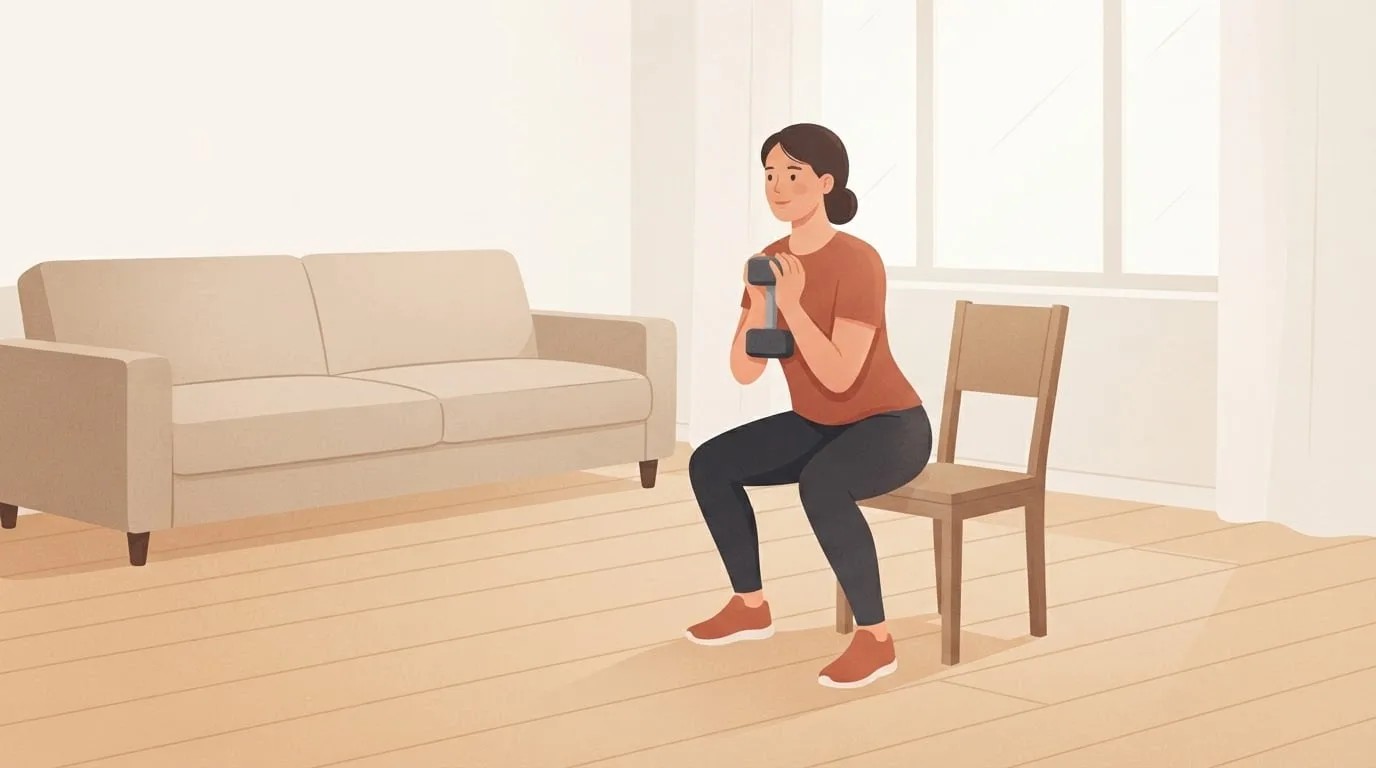
This beginner weights workout is built for one or two pairs of light to moderate dumbbells, a sturdy chair and some floor space. Do the same session two or three times a week, on days that aren't back to back, for your first 8 to 12 weeks. Repeating one session is the point. You learn six movements well, and every workout shows you whether you got stronger since the last one.
| Order | Exercise | Sets x reps | Rest |
|---|---|---|---|
| 1 | Goblet squat to a chair | 3 x 12-15 | 90 sec |
| 2 | Dumbbell floor press | 3 x 10-12 | 90 sec |
| 3 | Dumbbell Romanian deadlift | 3 x 10-12 | 90 sec |
| 4 | One-arm dumbbell row, hand on a chair | 3 x 10-12 per arm | 60 sec |
| 5 | Seated dumbbell shoulder press | 2 x 10-12 | 60 sec |
| 6 | Dead bug | 2 x 6-8 per side | 45 sec |
Stop every set with 2 or 3 good reps still in you. That margin is called reps in reserve, and it keeps your form clean while you learn. In your first week, do 2 sets of everything, then move to the full prescription in week two. Warm up for five minutes before you start: a couple of minutes of marching or stepping, then one light set of goblet squats and one of rows.
The rests are long on purpose. A 2024 meta-analysis by Singer and colleagues pooled 9 studies and found a small muscle-building advantage for resting longer than 60 seconds between sets, with no clear extra benefit past about 90 seconds. The session takes about 35 minutes plus the warm-up.
Intermediate Full Body Dumbbell Workout
Move to this session when the beginner one stops feeling like work, usually after 8 to 12 weeks (the progression section below lists the signs). It needs heavier dumbbells or an adjustable pair, plus a flat bench or a sturdy step. It swaps the goblet squat for a single-leg squat, stands you up for the press, adds lateral raises and a loaded carry, and uses heavier sets of 6 to 12 reps.
| Pair | Exercise | Sets x reps | Rest |
|---|---|---|---|
| A1 | Dumbbell bench press (or floor press) | 3 x 6-10 | 60 sec, then A2 |
| A2 | One-arm dumbbell row | 3 x 8-12 per arm | 60 sec, then A1 |
| B1 | Bulgarian split squat | 3 x 8-12 per leg | 60 sec, then B2 |
| B2 | Standing dumbbell overhead press | 3 x 6-10 | 60 sec, then B1 |
| C1 | Dumbbell Romanian deadlift | 3 x 8-12 | 60 sec, then C2 |
| C2 | Dumbbell lateral raise | 3 x 12-20 | 45 sec, then C1 |
| D | Suitcase carry | 2 x 30-40 m per side | 60 sec |
The letters mark pairs. Do a set of A1, rest 60 seconds, do a set of A2, rest 60 seconds, and repeat until you've done three rounds, then move on to B. Pairing a press with a row, or a leg exercise with a shoulder exercise, lets one muscle group rest while the other one works. Each muscle still gets about two and a half to three and a half minutes between its own sets, which is as long as the rests in most straight-set programs, and the whole session fits into about 45 minutes. Our guide to supersets explains which pairings work and why.
Take the first exercise of each pair to within 1 or 2 reps of failure on the last set, and leave 2 reps in reserve on everything else. Lateral raises can go a little closer to failure, because a missed rep there is harmless.
How to Do the 9 Full Body Dumbbell Exercises
These are the full body dumbbell exercises from both sessions, in the order they move through the body: legs and hips first, then the upper body, then the core. Each one comes with the cue that matters most and the mistake that costs the most.
1. Goblet squat
Hold one dumbbell upright against your chest, both hands cupping the top end and your elbows pointing down. Stand with your feet a little wider than your hips, toes turned slightly out. Sit down between your heels until your hips are at least level with your knees, then stand by pushing the floor away. The weight at your chest keeps your torso upright, which makes this the easiest loaded squat to learn. In the beginner session you squat to a chair: touch it lightly without sitting down. Our goblet squat page covers the setup in more detail.
2. Bulgarian split squat
Stand about two feet in front of a bench, rest the top of your back foot on it and hold a dumbbell in each hand. Lower straight down until your back knee nearly touches the floor, keeping most of your weight on the front foot, then drive up through your front heel. One leg does the work, so dumbbells that feel light for a two-leg squat feel heavy here. That's why this exercise replaces the goblet squat in the intermediate session.
3. Dumbbell Romanian deadlift
Stand tall with a dumbbell in each hand in front of your thighs and your knees slightly bent. Push your hips back and slide the dumbbells down your thighs until you feel a strong stretch in your hamstrings, usually around mid-shin. Keep your back flat and the dumbbells close to your legs, then squeeze your glutes to stand. If your lower back starts to round before your hamstrings stretch, stop the rep higher.
4. Dumbbell floor press or bench press
Lie on the floor, or on a flat bench, with a dumbbell in each hand above your chest. Lower the dumbbells until your upper arms touch the floor at about 45 degrees from your sides, pause for a moment, and press back up. The floor stops your elbows at a safe depth, so the floor press is the easiest dumbbell chest press to learn without a spotter. A bench lets the dumbbells travel lower for a deeper stretch, so switch to it once you have one.
5. One-arm dumbbell row
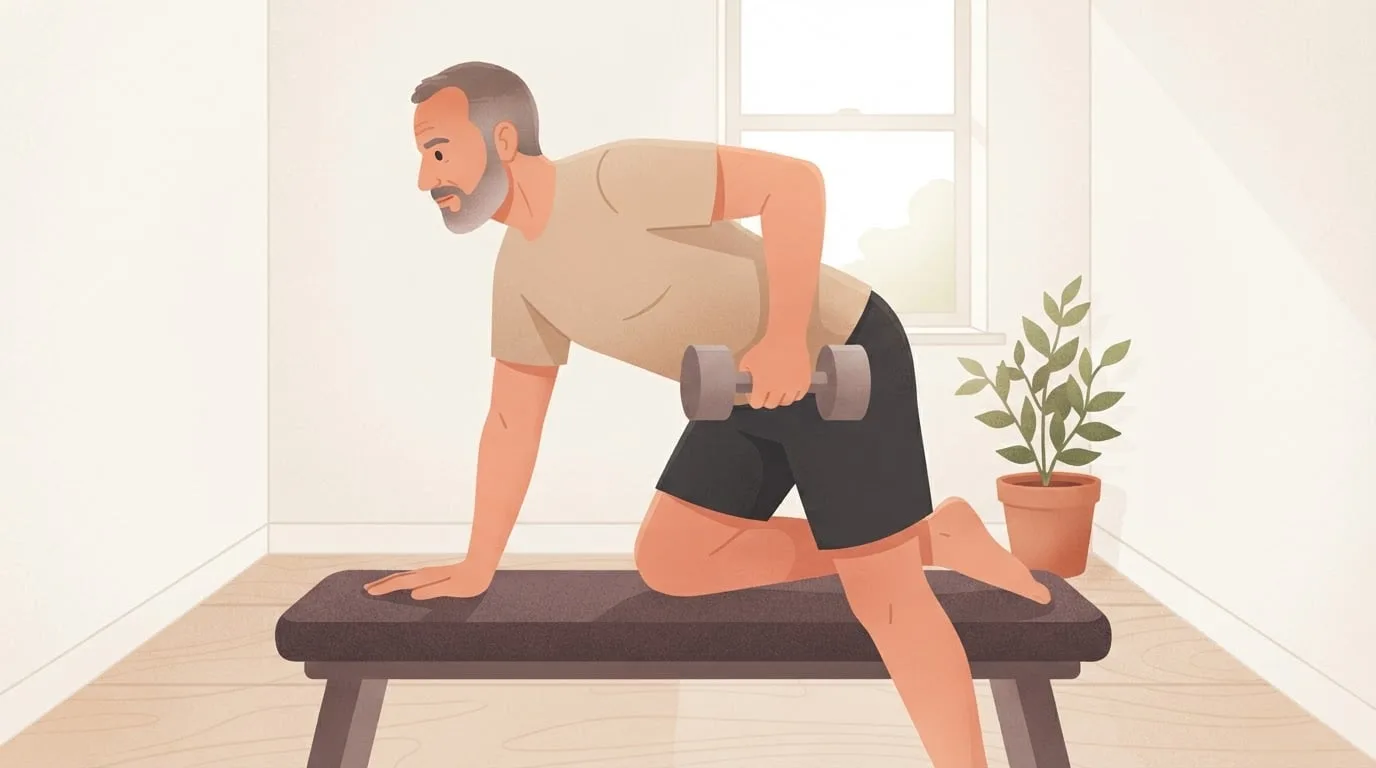
Put one hand and the same-side knee on a bench or the seat of a chair, back flat, with a dumbbell hanging from your other hand. Pull the dumbbell toward your hip rather than your chest, elbow close to your side, then lower it until your arm is straight and your shoulder blade slides forward. Bracing on the bench takes your lower back out of the lift, so your lats and upper back do the work. Start each set with your weaker side and match its reps on the other.
6. Dumbbell overhead press
Sit on a chair with a backrest for the beginner session, or stand with your feet hip-width apart for the intermediate one. Start with the dumbbells at your shoulders, palms facing forward or toward each other, and press up until your arms are straight beside your ears. Lower them back to your shoulders under control. Standing makes your trunk and hips brace against the load, so keep your ribs down and your glutes tight instead of leaning back.
7. Dumbbell lateral raise
Stand with light dumbbells at your sides. Raise them out to the sides with your elbows slightly bent until your arms are about level with the floor, then lower them over two or three seconds. This is the one exercise in the plan where lighter is right, because the side of your shoulder is a small muscle working on a long lever. If you have to swing your body to finish a rep, the dumbbells are too heavy.
8. Dead bug
Lie on your back with your arms pointing at the ceiling and your knees bent at 90 degrees above your hips. Press your lower back gently into the floor, then slowly lower one arm behind your head and the opposite leg toward the floor, return, and switch sides. Your lower back stays on the floor the whole time, and if it lifts, shorten the reach. Holding one light dumbbell in both hands above your chest makes it harder once the bodyweight version is easy.
9. Suitcase carry
Pick up one heavy dumbbell in one hand and walk 30 to 40 meters, about 100 to 130 feet, standing tall without leaning toward the weight. Then switch hands and walk back. The carry trains your grip, your upper back and the muscles along the side of your trunk that keep you from tipping over. In a small room, walk laps or march in place for 30 to 40 seconds per side.
Find out what's really holding you back
FitCraft, our mobile fitness app, pairs you with an AI coach who builds you a personalized plan around your goals, schedule, and fitness level. Every FitCraft program is designed by Domenic Angelino, MPH (Brown University) and NSCA-CSCS, with research published in the Journal of Strength and Conditioning Research and Medicine & Science in Sports & Exercise.
Take the Free Assessment Free • 2 minutes • No credit cardHow Often Should You Do a Full Body Dumbbell Workout?
Do a full body dumbbell workout two or three times a week, with at least one rest day between sessions. Two sessions already meet the muscle-strengthening part of the CDC's physical activity guidelines for adults, which ask for activities on 2 or more days a week that work all the major muscle groups: legs, hips, back, abdomen, chest, shoulders and arms. Each session on this page covers that whole list.
Three sessions a week suits most people who want to see more muscle. The 2026 ACSM position stand by Currier and colleagues concluded that strength improved with 2 or more sessions a week and muscle size with 10 or more sets per muscle each week. Three beginner sessions give your thighs, chest and back 9 working sets each. Three intermediate sessions do the same for your chest, back and thighs, and give your glutes, shoulders and triceps more, because the presses and split squats work them too. If you want one muscle past the 10-set mark, add a fourth set to its exercise.
Four or more full body sessions a week rarely make sense. At that point a split that trains different muscles on different days usually fits better, and our full body workout routine page explains when to make that switch.
How Heavy Should Your Dumbbells Be for a Full Body Workout?
Your dumbbells should be heavy enough that the last 2 or 3 reps of each set are slow but still clean. In a full body session that means different weights for different exercises, because your legs and hips are far stronger than the side of your shoulders. A goblet squat or Romanian deadlift usually takes a much heavier dumbbell than a lateral raise, so one pair can't be right for every exercise in the session.
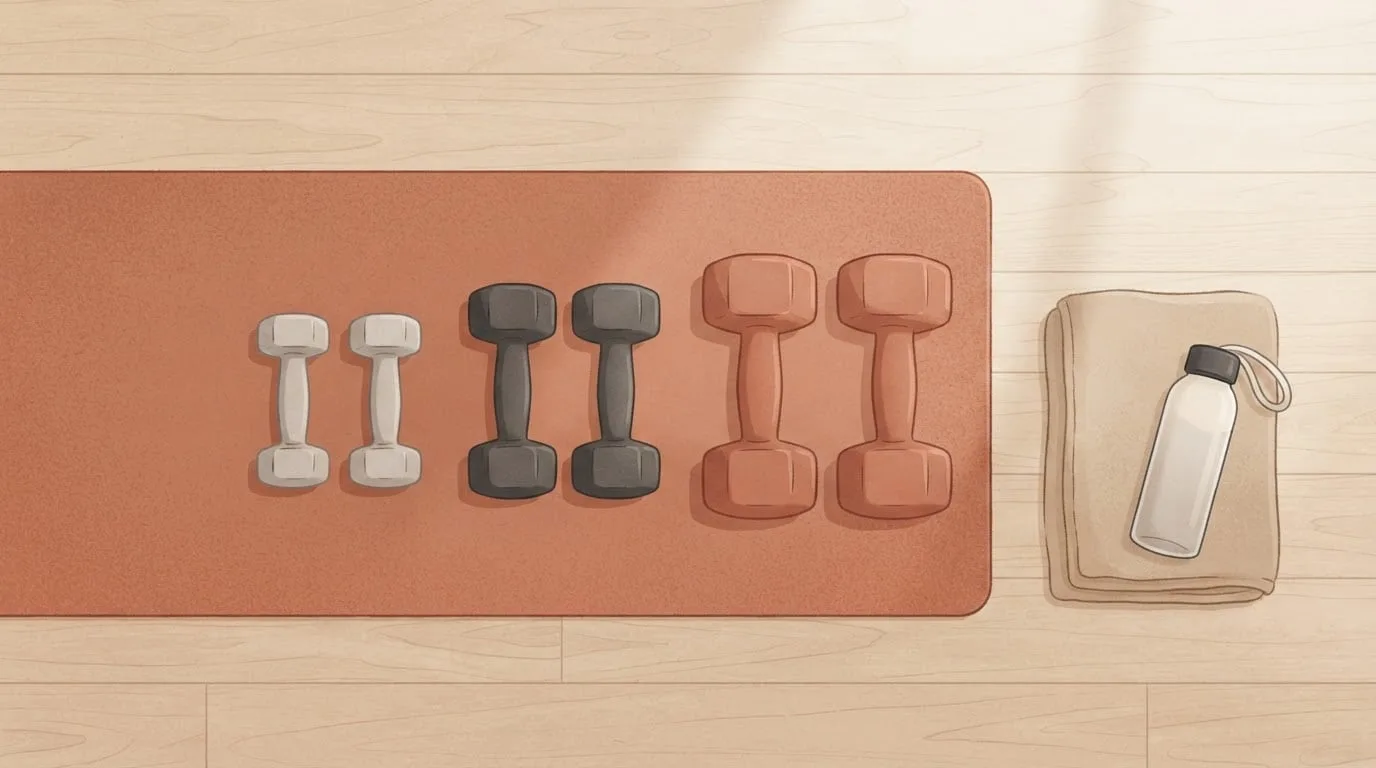
Most people end up with either an adjustable pair or three fixed pairs: a light pair for lateral raises and early presses, a medium pair for rows and presses, and a heavy pair, or a single heavy dumbbell, for squats, deadlifts and carries. Our list of the best dumbbell exercises for beginners suggests starting weights for each kind of move.
Light dumbbells still build muscle, up to a point. In a 12-week trial, Lasevicius and colleagues (2018) had 30 men train one arm and one leg at 20 percent of their one-rep max and the opposite limbs at 40, 60 or 80 percent, with the total amount of work matched. The heavier limbs grew about 20 percent in the thigh and 25 percent in the upper arm. The 20 percent limbs grew only 8.9 and 11.4 percent. So when a dumbbell becomes very light for an exercise, make the exercise itself harder: use one leg instead of two, slow the lowering, or pause at the bottom.
How to Progress Your Dumbbell Strength Training
Use double progression. Work up to the top of the rep range on every set, then pick up the next dumbbell and start again at the bottom of the range. In the beginner session, once you get 3 sets of 15 goblet squats with 2 reps to spare, move to the next weight and aim for 12.
The catch with dumbbells is the size of the jumps. Most fixed dumbbells sold in pounds go up in 5-pound steps. Going from 40 to 45 pounds on a goblet squat is a 12.5 percent increase, but going from 10 to 15 pounds on a lateral raise is a 50 percent increase, and nobody gets 50 percent stronger in a week.
That's where reps carry the load. In a randomized trial by Plotkin and colleagues (2022), 43 lifters with at least a year of training spent 8 weeks either adding weight or adding reps at the same weight, twice a week. Muscle growth was similar in both groups, and the strength gain favored the weight group by about 2 kilograms, which the authors judged of questionable practical importance. The trial used squats and leg machines rather than dumbbells, but the principle carries over. When the next dumbbell is too big a jump, add reps, slow the lowering to three seconds, add a pause or add a set before you add weight. Our guide to progressive overload for beginners covers those options in more depth.
When to move from the beginner to the intermediate session
Switch when at least two of these are true: you've done the beginner session for 8 to 12 weeks, you're at the top of the rep range on the goblet squat with the heaviest single dumbbell you can hold at your chest, or the sessions feel easy even when you stop each set with only 2 reps to spare. The goblet squat usually runs out first, because your legs outgrow what your arms can hold at your chest. The intermediate session solves that with the Bulgarian split squat, where one leg handles the whole load.
20-Minute and 30-Minute Full Body Dumbbell Workouts
On a short day, pair the four big movements and skip the extras. This 20-minute full body dumbbell workout keeps a squat, a hinge, a push and a pull, which still trains every major muscle group.
| Pair | Exercise | Sets x reps | Rest |
|---|---|---|---|
| A1 | Goblet squat | 3 x 10-15 | 30 sec, then A2 |
| A2 | One-arm dumbbell row | 3 x 10-12 per arm | 45 sec, then A1 |
| B1 | Dumbbell floor press | 3 x 8-12 | 30 sec, then B2 |
| B2 | Dumbbell Romanian deadlift | 3 x 10-12 | 45 sec, then B1 |
For a 30-minute full body dumbbell workout, run the same two pairs and finish with 2 sets of seated or standing overhead presses and 2 sets of dead bugs. Short sessions still count. Momma and colleagues (2022) pooled 16 cohort studies and found that muscle-strengthening activities were linked to a 10 to 17 percent lower risk of early death, heart disease, cancer and diabetes, with the largest drop in risk of death, heart disease and cancer at about 30 to 60 minutes a week. Two or three of these 20-minute sessions land inside that range.
Full Body Dumbbell Workout for Women and Men
The same sessions work for women and men. In a meta-analysis of studies that trained both sexes on matching programs, Roberts, Nuckols and Krieger (2020) found no significant sex difference in muscle growth across 10 studies or in lower-body strength gains across 23. The one difference ran in women's favor: across 17 studies, women made larger gains in upper-body strength relative to their starting point, and the authors suggest untrained women may have more room to grow there.
So choose your dumbbells by reps in reserve rather than by what a plan for men or for women says you should lift. There's no separate rep range for toning either. A more toned look comes from building some muscle and, if you want more definition, carrying a little less body fat.
What You Need for a Full Body Dumbbell Workout at Home
A dumbbell program at home needs less than most people expect: an adjustable pair or two to three fixed pairs of dumbbells, a sturdy chair or flat bench, a mat for the floor press and dead bugs, and a clear patch of floor about 2 meters (6 to 7 feet) square. A bench matters from the intermediate session on, because the bench press and the Bulgarian split squat both use one. A sturdy step or the edge of a couch can hold your back foot for the split squat.
If one area lags behind, our dumbbell chest workout, dumbbell shoulder workout and dumbbell arm workout each add a focused 30-minute session you can run on a separate day.
If you'd rather have the sessions planned and the weights progressed for you, a dumbbell workout app can take that part off your plate. FitCraft's strength workouts use dumbbells and bodyweight, your AI coach demonstrates each exercise on an interactive 3D model, your workouts adjust as you progress, and streaks and calendar tracking help the sessions keep happening.
The Bottom Line
A full body dumbbell workout is the simplest way to train with dumbbells: a squat, a hinge, a push, a pull, shoulders and core, two or three times a week. Start with the beginner session, stop each set with 2 or 3 reps to spare, add reps before you add weight, and move to the paired intermediate session when the goblet squat runs out of dumbbell.
Sticking with it matters more than finding the perfect exercise list. As Mike, 23, put it after four months of getting visibly stronger: "The streak system got me hooked. I didn't want to break my chain." Pick the session that fits where you are, put it on your calendar for this week, and do it again next week.
Frequently Asked Questions
Is a full body dumbbell workout enough to build muscle?
Yes. A full body dumbbell workout builds muscle as long as your sets are hard and you add reps or weight over time. The 2026 ACSM position stand found that the type of equipment didn't consistently change results, while 10 or more sets per muscle each week did increase muscle size. Three intermediate sessions a week give your chest, back and thighs 9 hard sets each, and you can add a fourth set to any exercise to pass 10.
How many days a week should I do a full body dumbbell workout?
Do a full body dumbbell workout two or three days a week, with a rest day between sessions. Two days meets the CDC guideline of muscle-strengthening activity for all major muscle groups on 2 or more days a week, and three days gives each muscle more weekly sets. Beginners can start with two and add a third once the sessions feel routine.
How long should a full body dumbbell workout be?
A full body dumbbell workout takes about 35 minutes at beginner level and about 45 minutes at intermediate level, plus a 5-minute warm-up. A 20-minute version that pairs a goblet squat with a row and a floor press with a Romanian deadlift still trains every major muscle group. If a session runs past an hour, drop an exercise or pair your exercises rather than cutting your rests short.
What weight dumbbells should I use for a full body workout?
Use a weight that leaves 2 or 3 clean reps in reserve at the end of each set, which means different dumbbells for different exercises. Squats, Romanian deadlifts and carries take the heaviest dumbbells, rows and presses take medium ones, and lateral raises take the lightest. An adjustable pair or three fixed pairs covers a full body session.
Can I do a full body dumbbell workout every day?
Not hard ones. Hard sessions need recovery time, so most people do best with a rest day between full body dumbbell workouts and walking, mobility work or rest on the days in between. If you want to lift four or more days a week, a split that trains different muscles on different days fits better than daily full body sessions.
What is the best full body dumbbell workout for beginners?
A good beginner full body dumbbell workout has six exercises: a goblet squat to a chair, a dumbbell floor press, a Romanian deadlift, a one-arm row, a seated shoulder press and a dead bug. Do 2 or 3 sets of each, mostly 10 to 15 reps, with 45 to 90 seconds of rest, two or three times a week. Stop each set with 2 or 3 reps left, and add reps before you add weight.